
Play it Again (and Again), Sam: The Tape Recorder in Film (Part One on Noir)
 Being a teacher, I can’t resist giving out a summer reading list. Being a researcher, I can’t help but want to share the projects that I am working on–which right now includes excavating the cultural history of the magnetic tape recorder in the United States. So, in honor of the Summer Solstice tomorrow (marking the official start of the season) I compiled a three-part summer series for Sounding Out! that does both: “Play it Again (and Again) Sam: The Tape Recorder in Film.”
My summer sound studies A-V list encourages you to fill your idle hours watching the “top 6” featured appearances of the magnetic tape recorder in film, in chronological order (2 each month, with a bonus “supporting role” nod rounding out each post). Not only will “Play it Again (And Again) Sam” help you beef up your cinema buff credentials, but it will trace a little-known history, asking you to consider how the recorder tangled its thin brown plastic tape so effectively into the warp and weft of our twentieth-century lives. You’ll find that my “top 6” list reveals much more human desire than technological determinism; the representations I examine express a complex mixture of fear and fascination, optimism and regret, change and stasis. Often a tool of the powerful, sometimes a weapon of the weak, the tape recorder was a cold war domestic product that could never truly be domesticated. As you will see in this spoiler-free three part series, interactions with the tape recorder remixed America’s workplaces, schools, homes, public spaces and private moments, ultimately shifting how the world was heard (and heard again and again).
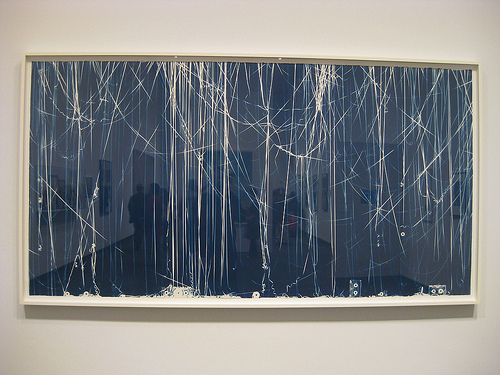
Memento (Soul II Soul) 2008 by Christian Marclay, Photo by Nathan Bowers
So, load up your Netflix queue, shake up your Jiffy Pop, and take a much-needed couch-break from the heat and humidity with these oh-so-cool black-and-whites from the 1940s and 1950s. Of course, we can’t start our films without some “Coming Attractions”: look for part two on July 18th (spotlight on Walter Murch) and part three (the 1980s) on August 15th.
1. Double Indemnity (Paramount, 1944, Directed by Billy Wilder)
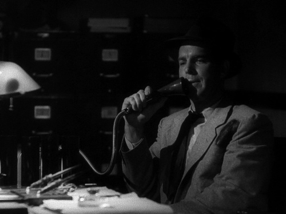
Walter Neff (Fred MacMurray) speaks his sordid tale into the dictaphone
Okay, so it is actually a dictaphone that appears in this film and the tormented insurance salesman Walter Neff (Fred MacMurry) is “putting it on wax” rather than magnetic tape, but this once ubiquitous, now long forgotten recording device has such a haunting presence and a structuring role in this grim noir confessional that, like Neff himself, I am suddenly willing to break my own rules. Outside of femme fatale Phyllis Dietrichson’s (Barbara Stanwyck) elaborately sculptured coiffure, the key image of Double Indemnity is Neff’s lips murmuring his murderous late night confessions into the dictaphone’s horn, a physical and metaphorical stand in for the ear of his hardnosed boss (and the true object of his desire) claims investigator Barton Keyes (Edward G. Robinson).
The dictaphone was Billy Wilder (director/screenwriter) and Raymond Chandler’s (screenwriter) deliberate addition to the filmscript; James M. Cain’s 1943 novella was essentially Neff’s scrawled confession to the reader of his almost-perfect plot to kill Phyllis’s husband and reap double insurance rewards. The introduction of the dictaphone transformed the standard noir flashback voiceover into an even-more intimate exchange of anxious aspiration, guilty pleasure, and homosocial desire channeled through Neff’s tense vocal grain and fierce grip on the machine’s cord. A familiar office machine made strange by Neff’s late-night admissions, the dictaphone mediates the entire film, transforming the audience into eavesdroppers, listening in to an act of recording made for Keyes’s ears only. After stumbling into his office and jamming a cylinder into the machine, Neff begins, sternly: “Office memorandum. ‘Walter Neff to Barton Keyes, Claims Manager, Los Angeles, July 16, 1938. Dear Keyes: I suppose you’ll call this a confession when you hear it. Well, I don’t like the word ‘confession.’ I just want to set you right about something you couldn’t see because it was smack up against your nose.” Sound, in the form of Neff’s heated breath pressed through the dictaphone’s curves and into our waiting ears, is the perfect device to exorcise the unseen desire in a film that tests the boundaries of darkness.
..
2. Blackboard Jungle (MGM, 1955, Directed by Richard Brooks)

Screen Capture by JSA
Most people remember Blackboard Jungle for its seductive visual representations of juvenile delinquency, stoked by the sound of Bill Haley and the Comet’s “Rock Around the Clock,” the song (written in 1952, recorded in 1954) that opened and closed the film (and became a smash hit as a result, as I discussed in a previous archival blog post here). I’d like to add an often-overlooked image to the film’s legacy, that of teacher Mr. Dadier (Glenn Ford) plunking a bulky case down on his desk and triumphantly announcing “This is a tape recorder!” A cutting edge device at the time—magnetic tape was only introduced in the states after World War II, largely through the efforts of Bing Crosby and Les Paul—Dadier’s recorder is part and parcel of the technological milieu of the 1950s, which evoked positivistic fascination with “progress” even as it was shaped by existent fears and inequalities.
At the point of almost giving up on his surly working class, ethnic, inner-city students to seek a cushy job in the segregated suburbs, Dadier brings in the reel-to-reel as a Hail Mary attempt to quell his students’ noise and remake them into good Cold War citizens once and for all. As he tells them, “We all talk, but nobody listens.” From the moment he enters the classroom, the students continue to defy the white male authority embodied in Dadier and housed in his machine—“Did you bring your cosmetics to school, Chief?” taunts one student (Gregory Miller, played by Sydney Poitier)—and they undermine his assignment by selecting the “noisiest” student in the class to make a recording: Puerto Rican Student Pete Morales. As I have discussed on this blog and in print, the concept of “noise” has a racialized edge, particularly in the 1950s, when Cold War cosmologies of colorblindness and “enemies within” ruled the day. Sound was an efficient way to separate “Us” from “them”—the noisy dissident from the quiet citizen—without making explicit reference to visual markers of race. And, let me tell you, Morales’s obscene, heavily-accented speech—peppered with “stinkin’”s, 14 of them in total—really makes Dadier’s spools spin. To hear more on the tape recorder in 1950’s American life and this film, see my essay “Reproducing U.S. Citizenship in a Blackboard Jungle: Race, Cold War Liberalism and the Tape Recorder” forthcoming in the American Quarterly special issue on sound (September 2011).
[youtube=http://www.youtube.com/watch?v=tr7n9Wxmcf4]..
And. . .in a supporting role:
Kiss Me Deadly (Parklane Pictures, 1955, Directed by Robert Aldrich)

Hammer Screens His Calls: Screen Capture by Michael Leddy
The byzantine stairwalks and gingerbread Victorians of Los Angeles’s defunct Bunker Hill neighborhood are not the only ghosts you will encounter in the noir classic Kiss Me Deadly. Our first glimpse of Mike Hammer’s (Ralph Meeker) space-age Wilshire Boulevard bachelor pad includes a shot of his wall mounted, reel-to-reel answering machine, quite a technological marvel in 1955; it would be over 15 years before Phone Mate introduced the first commercially viable home model in 1971. His recorder manages to look both ridiculously large yet streamlined–and to twenty-first century audiences, old yet futuristic. However, it also allows the hunted, haunted private detective to take just a little more control of his tailspin of a life. After the jarring ring of a telephone call, the spools spin, and a sultry female voice intones: “This is Crestview 5-4124. Mister Hammer, whom you are calling, is not available at present. If you wish to leave a record of your call, please state your message at the sound of the tone.” His back inevitably against the wall, Hammer brings a suave tension to an act that has now become mundane: call screening. Removing the small surprise of who’s on the line, Hammer uses his recorder to listen just a step ahead, pacing an increasingly mysterious world given over to the dangerous riddle of the “whatsit” that leaves so many in the morgue by the film’s end. For a more general take on sound in this film (with a brief mention of Mike Hammer’s tape recorder), see Noira-Blanchè-Rougi’s November 2009 blog post, “The Use of Sound in Kiss Me Deadly.”


Share this:

Into the Woods: A Brief History of Wood Paneling on Synthesizers*

Various Species for the Prophet 08, Analogics
*a companion piece of this research, on electronic sounds as lively individuals, is forthcoming in the American Quarterly special issue on sound, September 2011.
Not long ago, while researching the history of synthesized sound—or taking a break to troll for interesting synthesizers for sale online (activities that, for me, inevitably blend together)—I came across a thriving industry of small companies that offer custom-made wood panels to adorn the sides of old and new synths, like Synthwood, Custom Synths, Analogics, and MPCStuff.
As Trevor Pinch and Frank Trocco note in Analog Days, their history of Moog synthesizers, an “analog revival” is underway: “Today in the digital world, there is a longing to get back to what was lost” (9). The music technology magazine Sound on Sound concurs, documenting a renewed interest among electronic music-makers in modular synthesizers like those popularized by Moog and others in the late-1960s. Yet there seems to be more at play with this proliferation of wood customizations than merely nostalgia for analog synths, Hammond organs, and hi-fi cabinetry. How might we interpret this desire to adorn—lovingly, even obsessively—steel-encased machines that produce sound by electronic means, with various species of wood? What does this realm of audio esoterica reveal about material and social aspects of musical instruments, and the workings of contemporary media cultures more broadly?
On Contingency and Faith: Walnut, Purple Felt, and the True Cross
Pinch and Trocco describe the Minimoog as the first synthesizer to become a “classic,” due to its relative ease of use, widespread availability, portability and compact design (214). In the retrospective imaginations of historians and musicians, a significant feature that established its classic design was the walnut wood case on an early generation of Minimoog models.

The Moog Minimoog B (with walnut case), ca. 1970, Audities Foundation
However, Bill Hemsath, an engineer who assembled the first Minimoog prototypes in 1969-70, told Pinch and Trocco that these instruments were assembled from “junk I found in the attic” and an assortment of affordable materials cobbled together in the moment (214). Jim Scott, another engineer who worked on developing the Minimoogs, explained in a 1997 interview: “the reason we made it walnut [was] because Moog had gotten a deal someplace and had a whole barnful.” He noted that “the musicians certainly appreciated the fact that it was made out of walnut,” but eventually the designers “ran out of walnut and started buying something else and slapping paint on it to make it look like walnut.” The various kinds of wood used on models from different years, and the exact start and end dates of the coveted walnut models, remain contested matters among Moog enthusiasts.
Hemsath elaborated on this history in a 1998 interview by making an analogy to “classic” piano design: “There’s a similar story from Steinway. Back when they first got started in the U.S. they used to buy their felts from a feltmaker in Paris… And they got a lot of purple felt because [the supplier] used to be the felt maker for Napoleon’s army, and had a lot left over. So the colored cores in the hammers of those old Steinways were purple because of Napoleon’s army. Well, [the supplier] ran out, and [Steinway] said, red’s fine. They started making pianos with red felt, which is what they have today, and people started complaining, saying, it’s not a real Steinway, it’s not purple.” Like the proverbial purple felt on original Steinway pianos, walnut panels on synthesizers became “classic” because of their association with an originary moment, however happenstance, in the history of a particular instrument, and a limited supply and production run that rendered the material in question relatively rare.
So, a contemporary synthesizer enthusiast’s desire to acquire a “classic” walnut Minimoog, or to commemorate its aesthetic with customized wood panels, is in part an effort to establish a material connection to history. Synthesizer history unfolds in the deep time of technoscience which, as Donna Haraway has argued, often “barely secularize[s]” Judeo-Christian narratives of first and last things, of figural anticipation and fulfillment (9-10). The concern among some synthesizer enthusiasts to possess either the actual wood of an early-model Minimoog, or a faithful substitute for it, indeed resonates with Christian material cultures around relics of the True Cross and next-best artifacts with suitable provenance. A historical conjuncture that is contingent on otherwise unremarkable circumstances (e.g., Bob Moog’s good deal on a barnful of walnut in upstate New York) is marked as an originary or otherwise defining moment (the “invention” of a “classic” synthesizer) for a culture that defines itself as proceeding from it; the former is made to anticipate the latter, and the latter comes to fulfill the former.
Taking Stock: Materialities of Instruments, Sounds, Ecosystems
What kind of wood panels live in my studio? The manual to my Jomox XBase 09 drum machine, from 1999, details that its “steel sheet body” is bookended by “varnished side panels made of alder wood.” Wikipedia‘s pop-anthropological roundup of alder’s “use by humans” includes smoking various foods, treating skin inflammations and tumors, and building electric guitars. Fender Stratocasters have been built with alder since the 1950s. Guitar enthusiasts are notoriously fussy about which type of wood comprises the instrument’s body because of its effect on tone. Scientists, meanwhile, have taken to applying medical imaging techniques to Stradivarius violins, trying to “crack the mystery” of its prized tone. (Some say it’s due to the particular density of slow-growing trees in the Little Ice Age; others conclude it must be the varnish.)

The author
Given these interconnected concerns with instrument materials and the composition of tone, one might venture an etymological connection between timbre—which the Oxford English Dictionary describes as the character or quality of a musical sound depending upon the instrument producing it—and timber, which references “the matter or substance of which anything is built up or composed.” Music scholars often characterize timbre as the materiality of sound. Despite longstanding knowledge of the relationships of timber and timbre among instrument builders and musicians, and possible overlaps in historical applications of these words, placing wood panels on the sides of synthesizers surely has no effect on the resulting tone. Or does it? Audiophiles are prone toward occult-like habits, such as placing a single coin on top of a speaker to absorb vibration; and wood panels may well have subtle effects on the overall stability of an electronic instrument, resulting in barely perceptible sonic artifacts.
My Virus B synthesizer from the late-1990s has darker wood side panels than the Jomox, sort of a faux mahogany. Recently I wrote to Access Music, explaining my research on synthesizer history and inquiring what kind of wood they used. They replied that the B series featured stained beech wood (also commonly used and appreciated for producing smoked German beers and cheeses). Virus volunteered that they “in general do not use any kind of tropical wood for our devices.” Using sustainable wood has become a mandate and marketing concern at the Moog company as well; Moog’s wood “comes primarily from Tennessee. Hardwoods in Tennessee are growing faster than they are being harvested… US hardwoods are a world-wide model of sustained forest management.” Among contemporary synthesizer companies, there is often a selective eco-consciousness; as synthesizer designer Jessica Rylan suggested in our interview for Pink Noises: Women on Electronic Music and Sound (Duke: 2010), it is arguably impossible to build a synthesizer that does not incorporate at least some materials that are toxic in stages of manufacturing and/or disposal.

A Flashstick USB drive that incorporates wood from Berkshire, England
The paradox of dressing up an electronic machine made partly of toxic materials and processes with a sustainable-wood exterior is a fitting metaphor—like a contemporary fig leaf—for how we outwardly express environmentalist concern, despite plenty of contradictions in practice. Wood-adorned electronic devices, in all their glorious contradictions, are especially resonant in this cultural moment; see Asus’s EcoBook, Karvt’s lineup of custom wood skins for MacBooks, and, my favorite, Flashsticks: handmade wood USB “sticks” that combine “the high tech world of computing with the simplicity of the world of nature.” The story of Flashsticks’ handmade creation is a case study in eco-contradiction: the website implies that no trees were harmed in the making of their USB sticks—the company uses locally-sourced, “fallen wood from the previous winter’s storms”—yet we do not hear of the toxic materials that may comprise the drive itself.
Wood panels indeed work to conceal inconvenient truths. As Ruth Schwartz Cowan pointed out, the midcentury aesthetic of hiding household appliances behind wood paneling typified a culture that concealed gendered divisions of domestic labor (205). Lisa Parks has documented the similar recent phenomenon of dressing up cell towers as trees, which obscures the politics of media infrastructure behind a cloak of “nature.”
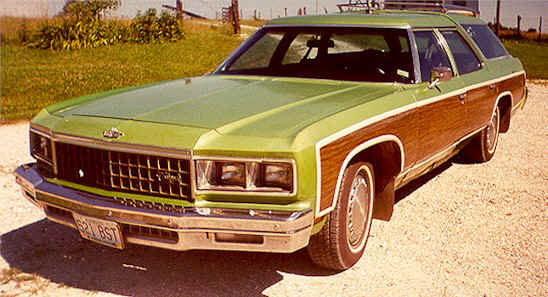
This is also a story about the mirage of a space between nature and artifice. Retro-culture enthusiasts celebrate that “real cars have fake wood paneling.” Meanwhile, a company called iBackwoods has engineered a “real wood” iPhone case that pays tribute to “timeless style of a wood panel station wagon.” Moog’s new Filtatron application for iPad, a software emulation of the company’s Moogerfooger filter pedal, is rendered authentic by its virtual wood panels. All of these examples reveal the “nature” of wood paneling to be cultural all the way down.

Washington DC - National Museum of American History: America on the Move - Park Forest, Illinois 1950s by Wallyg (via Flickr)
Ultimately, wood paneling might prompt us to recognize the interconnectedness among seemingly divergent materials, environments, and social practices. Consider, as a useful comparison to the climate-forged Stradivarius, the ash baseball bat: cherished by players for its “magical” effects on hitting, and now threatened by a warming climate and killer beetle in its source forests in Pennsylvania. Every synthesizer likewise holds and explodes into an ecosystem, and sometimes sounds like one too. The composer Mira Calix has suggested that analog synthesizers, with their individual quirks that increase with age, are much like wooden instruments; both seem to breathe like “little creatures” and take on a unique character, like a human voice. Our synthesizers, our kin.


Share this:


Current Top Posts





April 2021

January 2020

November 2019

October 2019

August 2019

April 2014

November 2017

March 2015

December 2017

October 2015
 Sounding Out!
Recent Comments