
Listen to the Word: Deafness and Participation in Spiritual Community
Managing Editor’s note: This post is the first in a three-part Sounding Out! series on deafness, Sound Studies, and Deaf Studies during February 2012.–LMS
DOI: https://doi.org/10.59350/rm14v-4j545

Growing up I attended many religious services. As an adult I attend church services less often, but it still stands out to me that sound is an essential part of the traditional Christian religious service. Participation depends upon listening, responding, and singing. If the service (or mass, as I knew it growing up in the Catholic faith) reminds us we are a community of people with common religious beliefs, our participation in the rituals is a manifestation—a ratification if you will—of our belonging to that community. (Last month David B. Greenberg talked in our podcast series about how sound—specifically listening to religious services while on the road—allows Christian truck drivers to feel like they are a part of a community of faith.) In addition to singing and responding, there are several sound metaphors that imbue the experience of being a churchgoer: the references to the Word of God, discussions of how God will listen to our prayers, the insistence that we need to listen to what God was trying to tell us, even a parent’s admonishment that one sit still and be quiet while the preacher talks…in sum, to be a practicing Christian requires a lot of listening.
However, in Deaf culture (defined by music researcher Alice Ann Darrow in her article “The Role of Music in Deaf Culture: Implications for Music Educators” as “composed primarily of congenitally deaf adults who communicate through sign language rather than speech” but is not limited to them) this takes another shape. When I visited the Deaf International Community Church, located in Olathe, Kansas, I realized that deafness complicates what it means to listen, especially in terms of religious services.
The Deaf International Community Church (DICC) has been holding services in Olathe since 2010, according to journalist Dawn Bormann from Olathe News. They emerged from a deaf ministry at a local Baptist church, but are nondenominational. At the moment the DICC holds services at the Center of Grace, a rented space. The services are open to the deaf, the hearing impaired, and those who hear; however, the services are geared toward the deaf community.

As I walked into the Center of Grace in late January, I was surprised to be welcomed by sound. I heard and saw people talking and signing—sometimes at once. Music played loudly from within the temple, and parishioners milled about. I was not sure if I should walk in and not talk to anyone or if I should just act casual. I suddenly felt very subconscious about my sense of hearing. I found an empty pew toward the back—after all, I would be taking notes and didn’t want to interrupt—and sat there, observing my surroundings. Shortly after, Pastor Debbie Buchholz, one of the spiritual leaders of the DICC, walked over to me and introduced herself, putting me at ease.
When the service started, the same woman who had just spoken to me stood in front of the congregation, signing her words. In front of the crowd a voice interpreter spoke for Pastor Debbie. The effect was unexpected: the hands gave life to words, to sounds, to language while the disembodied (from my angle) female voice translated into sound what Pastor Debbie signed to the crowd. It took me a while to get used to the new sound of the pastor. I had only spoken briefly to Pastor Debbie, yet it seemed surreal to hear another voice speaking for her.
I meditated upon the fact that language is conceived in terms of the arbitrary relationship between signs and sounds. A letter sounds a certain way. Put letters together and you put sounds together. Letters (and their sounds) make words (a compilation of sounds) that designate an object. In this sense, sound is closely connected to making sense of the world. Even though we can create sounds with objects, our bodies are constantly creating sounds as well. The sounds of words come from our lungs out through our mouths and to our ears as they designate people, places, things, and ideas.
At the DICC service, sound—something that we conceive of as naturally emanating from bodies—was disconnected from language. In the Deaf culture language is transformed into hand gestures. Swinging a finger, shaking a hand, pushing down a palm, these small gestures stand in for sound— or stand apart from sound. Even though for me, growing up Catholic, participation came in the guise of listening to the priest, singing along with the congregation, and repeating the prayers, here participation came through hands. They sang with their hands, they prayed through their hands. Being in the DICC service reminded me of how natural and normal we take sound to be. In that space, I was suddenly very conscious of the sound of my voice, and of sound’s relationship to language.
This brings me to PhD student and Sound Studies scholar Steph Ceraso’s HASTAC blog post on listening with your whole body. In her post she uses an interview with percussionist Evelyn Glennie as a way to reflect upon listening practices and the ability to listen with more than one’s ears. Evelyn Glennie, according to Ceraso, engages in a restrictive sound diet where she sometimes, voluntarily, eliminates sound from her environment in order to become more aware to sound. Ceraso’s words on multimodal listening resonate with me, and put my visit to the DICC in perspective. The DICC service showed how deafness can make sound studies scholars reflect upon the role of sound in our society—and more importantly, how we listen and communicate.
Also, Ceraso’s ideas about multimodal listening make me think about what other ways the deaf congregation at the church listens. If listening is a form of spiritual/religious participation, multimodal listening accounts for how the parishioners participate in the service. The body, including the eyes, become a gateway into absorbing the message (the Word of God) and in that way demonstrate alternate ways of listening.
For this spiritual community, the need to worship in their own language brings them together, but so does the Deaf culture. During the service they prayed together for an end to discrimination against deaf people and hoped that God would help those newly born in deafness. As I prayed with them, I realized that the congregation comes to DICC not just for religious guidance but also for affirmation of their humanity and their culture. The space of the church is a place to recharge spiritually but also become socially empowered.
—
Liana M. Silva is co-founder and Managing Editor of Sounding Out! She is also a PhD candidate at Binghamton University.
—
Share this:

Taking Me Out of the Ball Game: Advertising’s Acoustic Pitch
DOI: https://doi.org/10.59350/xza0t-tte72
This past week the Commercial Advertisement Loudness Mitigation Act (CALM) went into effect. The law requires broadcasters to use technology that regulates the difference in volume between normal programming and commercials. As Congressperson Anna G. Eshoo mentions in a letter to the FCC on the legislation she sponsored, “[I]n 21 of the 25 quarterly FCC reports on consumer complaints between 2002 and 2009, abrupt changes in volume during transition from regular programming to commercials was the top consumer grievance related to radio and television broadcasting.” The complaint and resultant law suggests that, despite television’s reputation as a primarily visual medium, advertisers understand that it is sound that captures the attention of viewers ready to move on to do other things during the commercial break.
This disparity in volume seems all the more egregious during sports broadcasts, where the need for live sound-mixing makes adjusting for difference all the more difficult. I should know, as I spend about half the year listening to the television—baseball season. From early April until sometime in October, baseball broadcasts are the “background noise” at my place. Five to seven nights a week, I watch—but really listen to—Mets games.
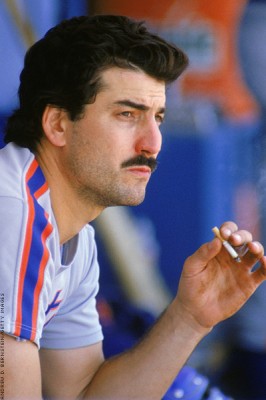
There is something about the rhythm of baseball—maybe it is really the rhythm of the broadcasts—that allows the viewer to do other things while following the game. Baseball does not demand every moment of your attention and yet, any moment—any pitch, any swing of the bat, any dash between bases—can be dramatic, stellar. While some friends have ribbed that my ability to split my attention really serves as an indication that the game must be boring, I prefer to think of baseball as moving at life’s rhythm. I love listening while I cook, running into the living room to catch a play (or replay) when I hear Gary Cohen’s voice get pitched in the way it does when something exciting is happening, like a bang-bang double play or when he calls a homerun. And even if I am in the room with the TV, I am reading a book or futzing on my laptop, looking up when the sound alerts me.
Commercials are an important part of this listening practice. Since commercials come fairly often in baseball (every half inning and during pitching changes), they are an important signal to me that I can stop my active listening and focus more intently on the book I am reading, the student papers I am grading, or the garlic I am chopping. No matter how shrill the voice of used car dealers or how annoying the jingle for a local aluminum siding installer, I can usually tune out the commercials and pick up the game again when the timbre of the general sounds change back to the flaring music and subdued baritones the announcers use when not shouting their excitement.
For the last few seasons, however, the NY State Smoker’s Quitline—a frequent sponsor on the SNY channel—arrested that ability to tune out the commercials, to ignore them by not seeing them, by introducing sound to their graphic images of tumor-ridden lungs and clogged aortas as a way to dissuade smokers.
An early example of these commercials was a series featuring Rinaldo Martinez, who narrates his tale of throat cancer through an electrolarynx.
This particular commercial’s use of the intersection of voice and baseball through Martinez’s now unattainable dream of being an umpire is crafty because the sounds of the game around Martinez could fool a listener into paying attention because the ad relates the public service announcement to the mode of entertainment with which the listener is primarily engaged. However, played as much as these commercials are (probably eight or nine times over the course of a game), I was able to ignore it as well, the electrolarynx voice becoming the cue to cease my active listening.
The emphysema cough commercial from this past season is not so easily ignored. The loud arresting sound is deeply troubling. The captions between shots of the man coughing may explain the daily misery of the disease, but they are superfluous compared to the sound itself, which tells the story the way no verbal retelling can accomplish. In fact, the commercial’s visual elements seem designed to foreground the sound, as the featured smoker sits with his back to the camera, and the eventual close-up focuses on his mouth. The man’s wheezing and the desperation that it evokes as he tries to get a decent breath is difficult to ignore. The pathos of the commercial is that much more visceral when divorced from the personalized suffering of the electrolarynx commercials. The coughing disrupts the rhythm of the baseball broadcast experience (including the ignorable commercials) to suggest that such an affliction does not obey the patterns of sounds and actions that might bring us comfort.
Truly, there was not a time that that pained coughing would echo through our apartment that my partner did not complain about how disturbing it was, or that my cooking, grading, reading, writing was not interrupted for a moment—even if I succeeded at not looking at the TV. And now, long after the season is over the commercial resonates with me. I cannot speak to its effectiveness in dissuading smokers (having quit smoking over 15 years ago), but in terms of making an impression on TV listeners, there is no doubting its effectiveness.
While equity of volume between shows and commercials can be legislated, ultimately, it is the context of sounds that make an advertisement stand out. Furthermore, the experience of repeatedly hearing this commercial has made the role of sound in how and what we view exceedingly evident—telling us when to look (or look away). The loudness of TV commercials may be mitigated, but the way in which their sounds can capture our attention, disrupt our activities or haunt our days without recourse to the visual calls on critical viewers to also be critical listeners to become aware of their enduring influence.
—
Osvaldo Oyola is a regular contributor to Sounding Out! He is also an English PhD student at Binghamton University.
—
Share this:




Current Top Posts





April 2021

January 2020

November 2019

October 2019

August 2019

April 2014

November 2017

March 2015

December 2017

October 2015


Recent Comments