
Quiet on the Set? : The Artist and the Sound of a Silent Resurgence
On a recent episode of Law and Order: SVU Mariska Hargitay’s Olivia Benson takes her new paramour, David Haden (played by Harry Connick Jr.) to see Michel Hazanavicius’s The Artist. When Benson asks him what he thought of the film, he replies with notable disdain: “I think maybe there’s a reason they don’t make silent films anymore.” When Benson responds nervously to his subsequent display of affection, presumably fearing that someone from work might see them, Haden pronounces, “Don’t worry. Nobody we work with could sit through two hours of black-and-white, no talking.”
Haden’s response might seem surprising given the box-office and critical success of the film, with The Artist grossing more than $120 million worldwide and receiving five of the Academy’s most coveted Oscars, including Best Picture, Best Direction, and Best Actor in a Leading Role. In fact, with both The Artist and Martin Scorsese’s Hugo walking away with a preponderance of Academy Awards, many critics, including the editors of Cineaste, began to wonder if we were finally seeing a long-overdue challenge to “long-entrenched cultural prejudices against silent cinema.” There seems to be a renewed optimism that, with The Artist’s critical and commercial success, the popular stereotypes about silent film—heavy-handed acting, artless cinematography, mundane plots—may finally begin to break down.
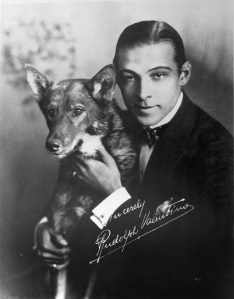
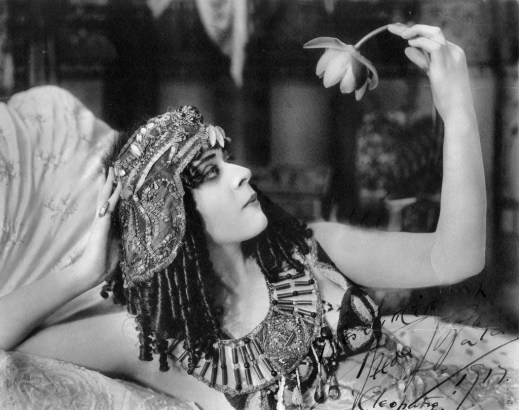
Rudolph Valentino and his Dog, this and featured photo of Theda Bara as Cleopatra (1917) courtesy of the Orange County Archives
As a film studies professor who specializes in the pre-sound era and frequently asks even my freshman students to engage with at least one silent film, I am both buoyed and dubious about this supposed sea change in public attitudes toward silent cinema. While some of my students sound a lot like David Haden after I ask them to watch even the most accessible silent slapstick comedies, many of my upper-level students now count works like F. W. Murnau’s Sunrise among their favorite films. And I’ve discussed the merits of The Artist with many of those same students, who easily recognized the film’s many references to other silent-era works, and appreciated its ability to mimic a very particular brand of silent film. I honestly believe there is some truth to the claim that films like The Artist and Hugo have encouraged spectators to engage with other silent films, including the recently restored color version of Trip to the Moon that is showcased in Scorsese’s film. In fact, in recent weeks there has been considerable buzz about skyrocketing demand for silent films via streaming services and even Cinemark’s XD-equipped theaters will be screening the 1927 film Wings as part of its “Reel Classics” series in late May. Rumor has it that Broadway will soon be hawking a production about Charlie Chaplin’s life and 2012 will see the life of silent film star Rudolph Valentino represented in Silent Life.
Michel Hazanavicius explains in the production notes to The Artist that his desire to make a silent film had been brewing for years: “From the beginning of my career, I fantasized about making a silent film.” But he also viewed the dream as far-fetched, one that would be unlikely to draw support in contemporary film production circles: “I call it a fantasy because whenever I mentioned it, I’d only get an amused reaction—no one took this seriously.” Despite this resistance, Hazanavicius refused to let go of the idea and continued to imagine how he might capitalize on the unique artistic potential of the silent medium: “As a director, a silent film makes you face your responsibilities. . . .Everything is in the image, in the organization of the signals you’re sending to the audience. And it’s an emotional cinema, it’s sensorial; the fact that there is no text brings you back to a basic way of telling a story that only works on the feelings you have created. I thought it would be a magnificent challenge and that if I could manage it, it would be very rewarding.”
Despite the initial skepticism Hazanavicius faced, The Artist’s unexpected international success has revealed consumers’ (perhaps temporary) appetite for silent film. Parody trailers of upcoming Hollywood blockbusters like The Avengers have aped silent film form and The Artistifier allows users to transform any Youtube video into a silent film.
.
Even hipster clothiers, Shabby Apple, have taped into silent film’s newfound cultural cache by launching a “Silent Era” collection of swimsuits with names like the “Bara swim mini” and the “Karloff swim top.” Despite this recent upsurge in references to and imitations of the silent film medium, advertisers, filmmakers, artists, and musicians have expressed a nostalgic reverence for silent film for decades. Between 2007 and 2010, Janelle Monáe released her Metropolis and ArchAndroid Suites, which refashioned Fritz Lang’s iconic 1927 film, Metropolis.
.
Mimicking both the film’s visual style and political message, Monáe also refashioned herself as Metropolis’s iconic android and adopted her trademark tuxedo attire after seeing photos of Marlene Dietrich, the silent and sound film star who helped mainstreamed this androgynous look in the 1920s (and also as a tribute to the working class uniforms of her parents). From AFLAC’s 2006 satirizing of the medium’s stereotyped damsel in distress, to IBM’s 1986 series of ads featuring Charlie Chaplin, marketers have frequently banked on silent films’ ability to attract the public eye.
.
What do we make of this renewed interest in silence? We must first remember that, as I tell my students, silent films were never designed for silent viewing at all given that most were screened with musical accompaniment that ranged from a single organist to a 40-piece orchestra. Even the composition of The Artist reveals the lie behind silent film “silence,” with composer Ludivic Bource employing 80 musicians from the Flanders Philharmonic Orchestra in developing the score for the film. Despite the fact that live orchestral accompaniments of silent film have become staples of film festivals around the world, most of today’s viewers’ experiences with silent film are limited to watching DVD transfers of varying quality, with canned music that is sometimes recycled from one DVD release to another, regardless of film title or subject matter. Few viewers, including those who have attended screenings of The Artist, have truly experienced the “silent” medium as it was intended, with sound and image working in tandem via a combination of “live” music and projected celluloid. Two years ago, I saw the transformative effect of recreating a more authentic silent film viewing experience when I arranged a screening of Sunrise at the University of Northern Colorado with the Mont Alto Chamber Orchestra providing live musical accompaniment. Many of my students still speak of that experience with tremendous reverence, explaining that they finally understood what it meant to truly experience a “silent film.”
While popular audiences tend to neglect how integral sound was to silent film, Rick Altman has argued in Silent Film Sound that sound has thus far failed to establish its own “autonomous measure of worth,” with scholars arguing that because film’s historical roots are bound up in silence “cinema is thus essentially a visual art” (6). Yet, this bias seems to be belied by the reaction to The Artist, with even the Oscars ceremony choosing to use the film’s only synchronized sound scene when introducing it as a the Best Picture nomination. It seems that even an acclaimed twenty-first century silent film must flaunt its, albeit brief, reliance on synchronized sound. Certainly, the many viewers who demanded refunds from their local cineplexes reflect the prevailing opinion that film must include sound if it hopes to maintain their interest and earn their cinema-going dollars.

Silent Film Festival Winter event at the Castro by Flickr User Steve Rhodes
So, what is the appeal then of these “silent” films in which, though accompanied by music and sound effects, dialogue is not spoken but read via soundless lips or intertitles? For me, the attraction comes from both understanding the aesthetic and technological roots of an art form that I admire and the fact that they require the development of character and narrative in purely visual terms. I am also attracted to its higher degree of abstraction, its ability to create a kind of poetry while also defying the very essence of language itself. And I see in the absence of sound a refreshing denunciation of contemporary demands for ever-increasing realism. Silent film is the antithesis of today’s fetishizing of 3-D.

Projector, Chaplin by Flickr User Stephen Coates
While I acknowledge this statement may seem naïve given that Scorsese’s aforementioned film manages to combine that “new” technology with a tremendous reverence for silent film’s seemingly “primitive” techniques, I firmly believe that the aesthetics of “silence” have an important resonance for contemporary viewers raised on Dolby. After hearing my frequent complaints about the current impetus toward 3-D, one of my students has taken to calling me Charlie Chaplin, seeing in my resistance a mirroring of the great comedian and director’s opposition to sound technology. Like Chaplin’s Tramp in Modern Times who cannot keep up with the machine-age and its insistence on productivity, I often find myself longing for something simpler from film, something more retrained and abstracted, less motivated by the demand for “progress” and, at least on the surface, The Artist’s return to silence seems to fulfill that admittedly nostalgic desire. While it is an imperfect, and perhaps misleading, example of the silent medium, even the modernized form of silent cinema that we see in The Artist demands that viewers consider the relationship between history and memory, between film’s relatively youthful heritage and its contingent representations of the past, between sound and silence.
—
April Miller is an Assistant Professor and Director of Film Studies at the University of Northern Colorado. Her research focuses primarily on the intersections between literature, film and socio-scientific concerns such as criminality and mental illness. She is currently completing a book manuscript, Offending Women: Modernism, Crime, and Creative Production, which investigates the female criminal and her often-overlapping sites of representation in literature, journalism, and silent film.
Share this:

DIANE… The Personal Voice Recorder in Twin Peaks

READERS. 9:00 a.m. April 2nd. Entering the next installment of SO!’s spring series, Live from the SHC, where we bring you the latest from the 2011-2012 Fellows of Cornell’s Society for the Humanities, who are ensconced in the Twin Peaks-esque A.D. White House to study “Sound: Culture, Theory, Practice, Politics.” Enjoy today’s offering from Tom McEnaney, and look for more from the Fellows throughout the spring. For the full series, click here. For cherry pie and coffee, you’re unfortunately on your own. –JSA, Editor in Chief
“I hear things. People call me a director, but I really think of myself as a sound-man.”
—David Lynch
From March 6-April 14 of this year, David Lynch is presenting a series of recent paintings, photographs, sculpture, and film at the Tilton Gallery in New York City. The event marks an epochal moment: the last time Lynch exhibited work in the city was in 1989, just before the first season of his collaboration with Mark Frost on the ABC television series Twin Peaks. At least one painting from the exhibit, Bob’s Second Dream, harkens back to that program’s infamous evil spirit, BOB, and continues Lynch’s ongoing re-imagination of the Twin Peaks world, a project whose most well known product has been the still controversial and polarizing prequel film Twin Peaks: Fire Walk With Me.
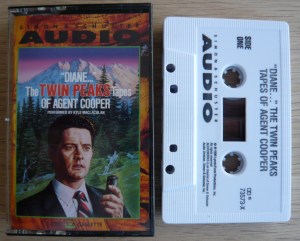
photo by Flickr user svennevenn
These forays into the extra-televisual possibilities of Twin Peaks began with the audiobook Diane…The Twin Peaks Tapes of Agent Cooper (1990). An example of what the new media scholar Henry Jenkins and others have labeled “transmedia storytelling,” the Diane tape provided marketers with another way to cash in on the Twin Peaks craze, and fans of the show a means to feed their appetite for FBI Special Agent Dale Cooper, aka Kyle Maclachlan’s Grammy nominated voice praising the virtues of the Double R Diner’s cherry pie.
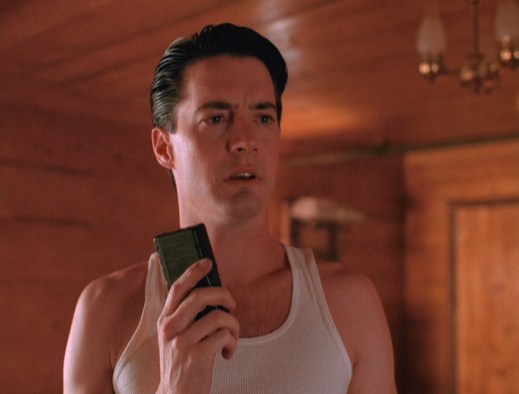
Based on the reminders Cooper recorded into his “Micro-Mac pocket tape recorder” on the show, the cassette tape featured 38 reports of various lengths that warned listeners about the fishy taste of coffee and wondered “what really went on between Marilyn Monroe and the Kennedys.” As on the program, each audio note was addressed to Diane, whose off-screen and silent identity remained ambiguous. For the film and audio critic Michel Chion, Diane is an abstraction, or the Roman goddess of the moon. Others claim “Diane” is Cooper’s pet name for his recorder. The producers delivered their official line in the 1991 book The Autobiography of Special Agent Dale Cooper: My Life, My Tapes, “as heard by Scott Frost,” (the brother of Lynch’s co-creator), where Cooper says, “I have been assigned a secretary. Her name is Diane. I believe her experience will be of great help.”
Whatever her identity, on the show Diane became the motive for Cooper’s voice recordings, and these scenes laid the groundwork for the audiobook. However, unlike the traditional audiobook, which reads a written text in its entirety, Cooper’s audio diary cuts away parts of the story, and includes additional notes and sounds not heard on the show.
The result is something like a voiceover version of Twin Peaks. And without the camera following the lives of the other characters, listeners can only experience the world of Twin Peaks as Diane would: through the recordings alone. Strangely, the inability to hear anything more than Cooper’s recordings opens up a new dimension: even as eavesdroppers we come closer to understanding Diane’s point of audition, the point towards which Cooper speaks in the first place.
Back on the show, Cooper’s notes to Diane track his movements as he tries to solve the mystery of who killed the Twin Peak’s prom queen Laura Palmer. Strangely—and not much isn’t strange in Lynch’s work— in some sense this mystery has already been solved by the show’s second episode, where Laura whispers the name of her killer to Cooper in a dream.
.
.
However, Laura’s whisper remains inaudible to the audience, and Cooper forgets what she said when he wakes up in the next episode. Much of the remainder of the program, full of Cooper’s reports to Diane, was spent trying to hear Laura’s voice. Thus, Diane, the off-screen and silent listener, became the narrative opposite to Laura, whose prom queen photograph closed each episode, and whose voice became the show’s central fetish object. Moreover, this silent relationship changes how the audience hears Cooper’s voice. Rather than a chance to relish in its sound, Cooper makes his recordings because of Laura’s voice from the grave, and directs them to Diane’s ears alone. In other words, Cooper and his recordings become a conduit to Laura/Diane rather than a solipsistic memoir about his time in Twin Peaks.

This triangulation becomes more obvious, if no less complicated in a typically labyrinthine Lynchian plot twist. As I mentioned, the Diane tape makes Cooper’s reports into a kind of voiceover. Critics have interpreted them as a parody of film noir, a genre whose history Ted Martin argues in his dissertation is defined by the relationship between voiceover and death: “Noir’s speaking voice moves from being on the verge of death to being in denial of death to emanating immediately, as it were, from the world of the dead itself.” Fascinated by this history, Lynch tweaks it through the introduction of a mina bird, famed for its capacity to mimic human voices. Discovered in a cabin at the end of episode 7, season 1, the police find the bird’s name—Waldo—in the records of the Twin Peaks veterinarian, Lydecker. The combined names—Waldo Lydecker—happen to identify the attempted murderer of Laura Hunter responsible for the voiceover in Otto Preminger’s classic noir film Laura (1944). On Twin Peaks, Cooper’s voice-activated dictaphone records Waldo the bird’s imitation of Laura Palmer’s last known words, which also happen to be Waldo’s last words, as he is shot by one of the suspects in Laura’s death.
If we follow this convoluted path of listening, we can trace a mediated circuit—from Laura to Waldo to Cooper’s voice recorder—which locates the voice of the (doubled) dead in the Dictaphone, thereby returning that voice to its noir origins in another classic of the genre: Double Indemnity (1944) (see SO! Editor’s J. Stoever-Ackerman’s take on the Dictaphone in this film here). More than a mere game of allusions, this scene substitutes Cooper’s voice with the imitation of Laura’s voice, inverting the noir tradition by putting the victim’s testimony on tape. And yet, while Waldo tantalizes the audience with an imitation of the sound of Laura’s voice, it ultimately only reminds the listener of the silent voice: Laura’s voice in Cooper’s dream.
The longer this voice remained out of range of the audience’s ears, the more it produced other voices—from Cooper’s recordings to Waldo to the dwarf in the Red Room.
Eventually, however, the trail of tape and sound it left behind ended with the amplification of Laura’s whisper, which became as much the “voice of the people” as Laura’s voice. After all, ABC instructed Lynch and Frost to answer the show’s instrumental mystery (“Who killed Laura Palmer?”) because of worries about the program’s declining ratings 14 episodes after Laura’s first inaudible whisper. The audience’s entrance into the show through the mediation of marketers mimicked the idea behind the Dianetape, but with a crucial difference: now the audience tuned in to hear their own collective voice, rather than to hear what and how Diane heard. Laura’s audible voice was audience feedback. It was the voice they called for through the Nielsen ratings. The image of her voice, on the other hand, was an invitation to listen. And Cooper’s voice-activated recorder, left on his bedside, placed in front of Waldo, or spoken into throughout the show remained an open ear, a gateway to an inaudible world called Diane. Although critics and Lynch himself have compared the elusive director to Cooper, perhaps its Diane who comes closest to representing Lynch as a “sound-man.”

David Lynch, August 10, 2008 by Flickr User titi
—
Tom McEnaney is an Assistant Professor of Comparative Literature at Cornell University. His work focuses on the connections between the novel and various sound recording and transmission technologies in Argentina, Cuba, and the United States. He is currently at work on a manuscript tentatively titled “Acoustic Properties: Radio, Narrative, and the New Neighborhood of the Americas.”
Share this:


Current Top Posts





April 2021

January 2020

November 2019

October 2019

August 2019

April 2014

November 2017

March 2015

December 2017

October 2015
 Sounding Out!
Recent Comments