
Gendered Ears
While there is a rich discussion in cultural studies about gendered representation in popular music, there remains very little about gendered listening experiences—or, more accurately—gendered perceptions of other’s listening experiences. Big Ears: Listening for Gender in Jazz Studies, one of the newest offerings from Duke’s Refiguring American Music series, makes promising headway in this direction, initiating a conversation about the way in which various types of listening practices—that of fans, musicians, and critics—are coded in the largely male dominated world of jazz. In popular music, however, this conversation has remained more nascent. As a female practitioner in the field with multiple identities—fan, vinyl collector, academic critic, consumer, blogger—it is uncomfortable how frequently I find people making very circumspect and circumscribed assumptions about the way in which I listen to music.
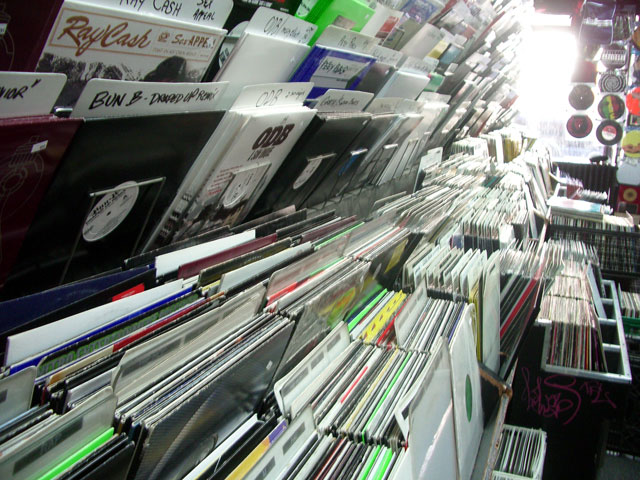 I have been collecting vinyl since the days when it was just called “buying records.” My first purchase at age 5, made via my Dad, was The GoGos’ Beauty and the Beat, which I still own, now carefully tucked into a plastic sleeve. And, thanks to my Dad’s gentle lesson in how to handle vinyl, it isn’t in very bad shape, either. Record collecting was a thrill my father shared with me, creating a connection between us that sometimes held when other bonds were endangered. No matter what, I always wanted to call him and tell him when I finally found a mint copy of Michael Jackson’s Off the Wall at a thrift store or Prince’s Purple Rain with the poster still inside.
A number of weeks ago, I was on a routine summer Saturday morning mission: trolling the yard sales in my neighborhood for kid’s stuff, used books, and vinyl. While I never expect to find the holy grail of record albums at a yard sale, I am always willing to flip through piles of Barbara Streisand, Eddie Rabbit, Billy Joel, and Herb Alpert in the hopes I might uncover it. Usually, I just end up taking in the ripe dusty smell and silently cursing the sad condition of the vinyl I find there, hating to leave even the most scratched-up Mantovani warping in the full summer sun. But you never know.
On this particular Saturday, I was vinyl hunting with my infant son strapped to my chest and had my dog, He Who Cannot Be Named, pulling at the leash. In effect, I had suburban motherhood written all over my body as I strained on my tip-toes to reach records at the back of the pile and whispered to my sleeping son about why I was so excited to find a Les Paul and Mary Ford record. In the midst of my record reveries, I overheard a man next to me begin telling the proprietor of the yard sale about his record collecting habit. He went on and on about how long he has been collecting, how many records he has, how he “just got back from buying a thousand records off a guy in Appalachin.”
My hackles were instantly raised by this conversation about record-size. I already felt a bit left out, as this man obviously chose to ignore the woman actually looking at the records in favor of the only other man around. Vinyl collecting remains an overtly male phenomenon, as Bitch Magazine discussed in their 2003 Obsession issue. Although I am embodied evidence that women do collect vinyl, I am used to being in the complete minority at record shows, music conferences, and dusty basement retail outlets and overhearing countless conversations just like this one. In spite of myself, I decided to jump in to the conversation. . I thought I would cast out a lifeline to my fellow vinyl junkie, as the yard sale guy was obviously not interested and just humoring the record geek in front of him in the hopes that he would cart away the entire stack. Plus, I miss geeking out with someone else who loves records. After a lifetime in urban California, I now live in a small town in Upstate New York. While the record bins are not so tapped out here, it is lonely going for a record head. So I said to him, “I collect records too. I can’t believe you found so many records in Appalachin.” My invitation down the path of geekdom, however, was rebuffed. “Oh,” he said, barely looking up, “yeah. It happens all the time.” And then back to yard sale guy.
I tried not to take it personally, but it became impossible after this same scene was re-enacted at four or five different houses down the block. This guy was like a cover version of the Ancient Mariner, compelled to tell man after man all about the size of his enlarging record collection, the beloved albatross around his neck: “Man, have you ever tried to move a thousand records all at one time? They are so heavy and they take up so much space!”
And, I was the invisible witness to his tale of obsession, love, and woe, silently flipping through records just a few steps ahead of him. That is ultimately how I knew he did not see me as an equal rival in the world of vinyl hunting—he let me get ahead and stay ahead in the bins, neither sneaking peeks at what I pulled or, fingers flying, moving faster and faster in the hopes of overtaking me. He just assumed that I, dog in hand and baby on chest, would pull complete crap.
My listening ears then, bear the weight of my gender and the limited ways in which women are expected to engage with music. Women remain perpetually pegged as teeny-bopper fan club leaders and screaming Beatle fans, perpetually deafening themselves to the “real music.” Despite the deft critiques of Norma Coates, Susan Douglas, and Angela McRobbie, in which the early Beatles audience is re-imagined as proto-feminist and teenaged girls’ bedrooms are viewed as sites of cultural competency rather than deaf consumerism, my female ears remain cast as those of a groupie but never an aficionado, as if the two are somehow mutually exclusive. Imagine the Ancient Mariner’s surprise when this vinyl mama plucked pristine copies of The Cure’s Faith, The Fania All Stars Live at Yankee Stadium, and Aretha Franklin’s Live at the Fillmore West right out from under his own blind ears.
–JSA


Share this:

Can You Hear What I Hear?
Recently I read Meta Wagner’s article on listening to music in public, “A Lament on the Deafening Silence of iPods.”Wagner reminds readers that there was a time where people actually listened to their music in public—and I don’t mean in designated venues like concerts, but rather boomboxes, car radios, and block parties—vis a vis nowadays when people prefer to listen to their music on their mp3 players left and right. She briefly draws attention to the political/subversive undertones of the act of listening to music in public; however, she shies away from that political tone and points the reader toward music’s ability to connect people who otherwise wouldn’t interact with each other. I want to call attention to the subversive act of listening to music in public; when I play my music in public, I am making a statement about who I am and what I stand for, even if subtly. But if everyone around me is tuning out, what happens to that assertion of presence? There will always be people who complain about the loudness of the music of others (think back to the obnoxious lady on the bus staring down the youngsters and their music blasting through headphones), but they weren’t listening in the first place. They want to silence the music. Who will listen to the music?
This article particularly struck me because my iPod has become an intrinsic part of who I am: it never leaves my side. Oftentimes I tune in precisely because I want to tune the world out—like when I am writing. One time, a friend told me he refused to listen to music on the NYC subway because he would miss out on all the interesting conversations that take place in subway cars. He made me feel a little self-conscious, frankly; my white headphones were a sign of distinction and, dare I say, musical snobbery. But his comment made me realize that when we put our headphones on, we are doing more than setting up our soundtrack: we are tuning out the world around us, and in that act we are exercising the power to not listen to others. When we or the people around us blast their music, maybe that is what they want: to be heard. In the loudness of their music there is a subversive element, subversive because it demands to be heard. If music oftentimes reflects who we are, in playing music in public we are sharing it with others, and expressing it in a loud manner. It may seem rude, but it becomes an expression of self from which you can’t run away. When we listen to someone’s music across the subway car, we’re listening to them.
After that conversation with my friend, I try to avoid tuning out when I ride the subway—or in other public places. I want to listen to my surroundings, listen to the music play, because they’re looking for an audience.
LMS


Share this:


Current Top Posts





April 2021

January 2020

November 2019

October 2019

August 2019

April 2014

November 2017

March 2015

December 2017

October 2015
 Sounding Out!
Recent Comments