
Oh Say Can You Hear?: Singing the National Anthem

DOI: https://doi.org/10.59350/gsqjx-37f74
In my decade as a play-by-play broadcaster and sports reporter, I’ve covered more than 1,300 games in sports ranging from high school football to Major League Baseball. Every one of those games has been preceded by “The Star-Spangled Banner,” the national anthem of the United States of America. One season, I was responsible for selecting the national anthem singers for all the home games of a minor-league basketball team I worked for. I’m about as familiar with “The Star-Spangled Banner” as someone who’s never performed the song can be. Yet, I wonder why anyone would want to sing “The Star-Spangled Banner” before a sporting event.
For starters, it’s a very difficult song to sing, which isn’t surprising when you consider that “The Star-Spangled Banner” wasn’t originally designed to be sung. What we now know as our national anthem started off as part of a poem written by lawyer and author Francis Scott Key. The poem, titled “Defence of Fort McHenry,” was Key’s thoughts on a battle he witnessed during the War of 1812. [See guest blogger Jeb Middlebrook’s post “Prison Music: Containment, Escape, and the Sound of America” for more on the Star Spangled-Banner as a prison song.–Editor] Key’s brother-in-law noticed that the poem’s words could be set to the music of “The Anacreontic Song“, a popular English drinking song. Within weeks, Key’s words were printed in newspapers throughout the country, the name changed to “The Star-Spangled Banner.” Although all four verses of Key’s poem were converted to song, only the first verse was designated as the official national anthem of the United States of America in 1931.
No one has pinpointed the first sporting event that had “The Star-Spangled Banner” sung before it. However, there’s evidence the song was sung both before and during Major League Baseball games while World War I was going on. During the first game of the 1918 World Series between the visiting Boston Red Sox and the Chicago Cubs at Weeghman Park (known today as Wrigley Field), a band performed “The Star-Spangled Banner” during the seventh-inning stretch (“Take Me Out to the Ball Game” was ten years old in 1918, but the Tin Pan Alley song had yet to become a seventh-inning stretch standard). It wasn’t until World War II when the national anthem was performed before every baseball game, an affirmation of the American spirit during such a difficult time.
It’s fitting that baseball was the first sport whose games were preceded by the national anthem; baseball’s status as America’s national pastime and as one of its defining cultural institutions was undisputed for most of the 20th century. Also, in the 1940s, professional basketball was just getting off the ground, professional football was barely 20 years old, and professional hockey was dominated by Canadians and only played in a handful of American markets. If the tradition of pre-game anthem singing had begun in one of those sports, it would’ve taken much longer to catch on, if it caught on at all. Eventually, all the other professional leagues followed baseball’s example.
When I was an account executive for the Yakima (Washington) Sun Kings of the Continental Basketball Association during their 2002-2003 season, my boss assigned me the responsibility of choosing our pre-game national anthem singers. Fortunately, it proved to be an easy task, since folks who were interested in singing regularly called the team’s offices, and as long as they could hold a tune I booked them. All I could give the singers were tickets to the game at which they were performing, but no one ever bemoaned the lack of compensation.
When I think about all of the games I’ve covered, I honestly can’t remember any vocal renditions of “The Star-Spangled Banner” that stand out because of their greatness. However, I remember all of the terrible singers I’ve heard. There was the raven-haired woman in Keizer, Oregon who got halfway through the song, screwed up the lyrics and started over. There was a middle-aged man in Binghamton, New York who messed up the song’s pitch and pacing so badly, there was a good three seconds of stunned silence when he finished, followed by polite applause. There was the teenager in Kalamazoo, Michigan whose voice cracked every time she hit a high note. And, that’s just the tip of the iceberg. So, you work your butt off to sing an extremely difficult song, you manage not to mess it up, you get some nice applause once you’re done and then you’re forgotten right after the first pitch. Singing the national anthem is a thankless job, yet there’s no shortage of people willing to do it.
When I think about the people who volunteered to sing at Yakima Sun Kings games, I don’t recall anyone who who looked at singing the anthem as a way to honor their country. There was one woman who lived an hour and a half away who volunteered her anthem-singing services to every professional and college team within three or four hours of her home. I asked her why she put in all this effort and she said “I just like to sing.” The one singer I rejected was an eight-year-old girl whose mother bragged over the phone about her daughter being such an outstanding singer that “she brings people to tears.” Her mother seemed to think singing the national anthem before about 3,000 people in the middle of nowhere would lead her daughter to stardom. I was out of the office when a CD arrived with 10 tracks and the young lady’s picture on the cover (her mother called the office twice to make sure her husband had dropped off the CD and that I had received it). I listened to the one track that featured her singing “The Star-Spangled Banner” and I didn’t think it was very good; she had a nice voice but she was trying way too hard. Thankfully, I never heard from her mother again.
Other than that young lady (or, more accurately, her mother), none of the aspiring anthem singers I encountered seemed to be seeking stardom. Perhaps these singers were more patriotic than they – or I – realized. Perhaps they just wanted to cross an item off their bucket list. Or, they were big sports fans and relished an opportunity to go to a game free of charge. Maybe they just thought it would be a cool thing to do and a great way to gain the admiration of their family and friends; many people are petrified of doing anything in front of an audience and those who aren’t are often seen as heroic, even if their anthem singing is immediately forgotten.

However, the best way to get your rendition of “The Star-Spangled Banner” to be noticed and remembered is not to sing it but to play it on a musical instrument. Live instrumental performances of the national anthem are rare, so even an average instrumental rendition is more memorable than a great sung rendition. In my stint as national anthem booker for the Yakima Sun Kings, I encountered just one non-singer: a 13-year-old boy who taught himself how to play “The Star-Spangled Banner” on his saxophone. The amount of positive feedback I received from the fans on his rendition was easily double or triple the feedback on all the anthem singers combined; he was one of only two performers I booked for multiple games. When I lived in Binghamton, New York, my favorite national anthem performers were a pair of trumpeters; they played “The Star-Spangled Banner” before a variety of sporting events in the area. I still get chills when I think about the exceptional national anthem rendition performed by trumpeter Jesse McGuire – the former lead trumpeter for the Lincoln Center Jazz Orchestra in New York City – prior to the seventh game of the 2001 World Series in Phoenix, Arizona, the only World Series I’ve covered.
Nowadays, “The Star-Spangled Banner” is far from the only song sung at many American sporting events. In games featuring teams from Canada (the NBA, MLB and NHL all have Canadian franchises), “O Canada”, the Canadian national anthem, is sung pre-game along with “The Star-Spangled Banner.” “O Canada” is a much easier – and shorter – song to sing. Many baseball teams also recruit singers for “Take Me Out to the Ball Game” during the seventh-inning stretch. You don’t even have to sing as much as you have to lead the crowd in singing “Take Me Out to the Ball Game” and being an expert singer isn’t required. However, my guess is more people would rather sing “The Star-Spangled Banner” over anything else at a sporting event. Singers aren’t looking for easy or simple. They’re looking to showcase their talents singing a song we all learned growing up, a song we’ve heard countless others sing on big and small stages and a song that demands the utmost respect and importance requiring both fans and participants alike to stop what they’re doing and to salute the American flag.
—
Robert Ford is currently a reporter and radio pre- and post-game show host covering Major League Baseball’s Kansas City Royals. He has also been a radio play-by-play broadcaster for several minor league baseball, college and high school teams, allowing him to call places like Yakima, WA, Kalamazoo, MI and Binghamton, NY home at various points in his life. Follow him on Twitter: twitter.com/raford3 and read his blog: http://radioguydiaries.wordpress.com/
—
Share this:

“I didn’t say look; I said listen”: The People’s Microphone, #OWS, and Beyond
DOI: https://doi.org/10.59350/ks1pf-z7v73
On a Tuesday right after Valentine’s Day in 2011 thousands of people marched on the Wisconsin capitol and good-naturedly, but firmly, took over the building. They came for a hearing scheduled by the state government’s Joint Finance Committee, and as crowds swelled out on the snow-covered lawn a long line of citizens formed indoors, waiting their turn to address the Committee and give brief remarks about proposed changes to the state budget.
Up for discussion was the Governor’s proposal to cut public employees’ benefits and eliminate their collective bargaining rights, and having gotten word of widespread outcry, the co-chairs of the Committee had released this statement:
We welcome public participation in our representative democracy. Unlike two years ago when Democrats did not hold a public hearing for the last budget repair bill, we want to listen to individuals’ concerns. Due to the large number of participants, each person will be given up to 2 minutes to address the committee. This will ensure that everyone has their voice heard.
Late that night, the Committee cut off public testimonies in spite of a line still stretched down the hall. One group refused to leave and staged an occupation of the capitol building in protest of both the bill and the foreclosure of public input.
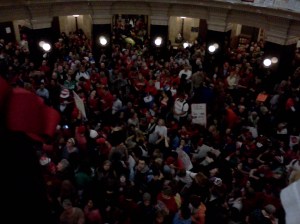
Over the next few weeks, people slept overnight on the marble floor while bigger groups assembled there each day, reportedly in numbers reaching between 70,000 and 100,000. Many carried signs backing public sector workers, but the overall majority showed their solidarity with the protest simply by wearing bright “Badger red” hats, coats, sweaters, and shirts, University of Wisconsin memorabilia now transformed into signs of political support for all of the state’s public institutions. The view from upper levels of the capitol rotunda struck a dramatic portrait as people ringed the center of the room facing inward. One person who spent a lot of time there told me he liked to call it the “eye of the storm.”
Domed spaces tend to be noisy. Sound bounces off of the curvature of the ceiling at so many different angles that what’s audible on the floor quickly takes on so many threads of reverberation that a single voice gets easily obscured. In the Wisconsin capitol, handheld electric bullhorns became instrumental for leading chants and making announcements, but people found they didn’t always do the trick. In one reported instance, a megaphone still wasn’t enough for one woman’s voice to be heard across the rotunda, and so she broke her announcement into fragments and waited in between them as people standing near her repeated each one in loud unison. “State Senator Dale Schultz [repeated]…has withdrawn his vote for the bill [repeated].”
Today that variation of call and response is widely regarded as an iconic feature of the Occupy Wall Street campaign, where it has been likened to liturgy, to brainwashing, to a game of “telephone,” to Garrett Morris’s “News for the Hard of Hearing” bit from Saturday Night Live, and to Monty Python’s Life of Brian.
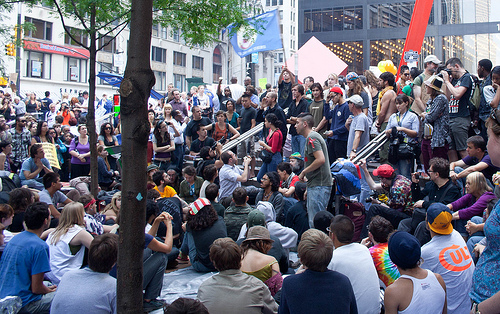
.Yet also, as the practice was manifest at lower Manhattan’s Zuccotti Park, it has attracted great interest and variety of comment regarding how it might reflect the values and objectives of those gathering in downtown New York City. It was purported to unite a crowd; it helps ensure that “no one is left to feel isolated and alone;” it accelerates the exchange of information because it “forces everyone to edit group public speech down to the essentials;” it slows the campaign and gives it valuable time to develop; it is “a lesson in the obstinacy required for intentional, durable citizenship.”
Although one need only consider the depth of history stretching out prior to the invention of electric amplification to be certain that the method of communication isn’t new to this year nor even to this century, the question of its recent emergence remains important for identifying possible affinities across boundaries that might otherwise divide protest actions. Last winter in Wisconsin, after transmitting the message about Senator Schultz, the demonstrators apparently didn’t carry on with it the way people did in lower Manhattan, but one need not stop at noting that this proves the technique wasn’t invented this fall in New York. In the capitol building, members of the Wisconsin public instituted a different audio innovation that reflects a shared sense of purpose between the two protest actions. And if one follows a similar connection recently posited in Rolling Stone Magazine between Occupy Wall Street and factory takeovers in Argentina, one might bring into focus a call and response operating across even broader stretches of time and space.
In Wisconsin, the civil disobedience broke out immediately after lawmakers ended the budget hearing with citizens still waiting to speak, and in the following days an alternative system of public testimony took shape on the floor of the capitol rotunda. According to one member of the collective who facilitated its operation, the forum emerged in conjunction with a circle of drummers, who, during pauses in their playing, invited individuals to sequentially address all those gathered using megaphones carried in by the public. Soon after moving up to a single-speaker amplifier that had been provided on friendly loan, some of the drummers pooled their money and purchased a 70-watt (RMS) portable public address system, an additional extension speaker, and a Shure SM58 for, according to one, “whomever wanted to speak, ensuring their voices were heard, never cutting anyone off or denying anyone the right to speak.” With what I submit as telling coincidence, they called the apparatus “The People’s Mic.”
Here is a clip that came up when I used Google to search with the terms “people’s microphone Wisconsin video.”
.
.
There are important contrasts between this platform for testament and the call and response technique that has garnered recent notoriety under the same name. In its Zuccotti Park incarnation, the people’s microphone is often celebrated as a clever workaround designed in response to the prohibition against using electric sound amplifiers in public without a permit. However, its key feature is the reciprocity it demands between the person speaking “into” the microphone and others gathered in the space. In this way it not only attenuates the hierarchy usually exerted by one amplified person over the soundscape, but it also fosters the pursuit of accord within the group overall, because the method’s very functioning relies so heavily on the crowd’s ongoing willingness to participate:
.
.
In Wisconsin, the People’s Mic did provide citizens a platform otherwise reserved for government and union officials (and the celebrities of their choosing), but individual testimonies were still unidirectional and the system proceeded without the same means of direct and immediate exchange, at least in the realm of sound. As we see in these clips, in Wisconsin, the People’s Mic required the largest number of people to keep quiet for the longest amount of time. Sometimes people had to keep especially quiet because the sound of chanting from outside was bleeding into the space.
.
.
However, while much of the discussion of the people’s microphone constructed in Zuccotti Park centers on its horizontal, consensus-oriented nature, why reduce the method’s oppositional potential to a matter of challenging government’s increasing control over the audible city? Fortunately, as though taking a more direct cue from the People’s Mic as it was instigated in Wisconsin, people have recently begun pushing the call and response version adopted in New York past the confines of community building, realizing its practical potential to channel a message and grab the attention of leaders far too often unavailable, unwilling, or uninterested in taking time to—as the Wisconsin Joint Finance Committee had grandly promised—“welcome public participation in our representative democracy.”
The following clips show how the people’s microphone in its new iteration has been used to satisfy the goal more explicitly associated with its Wisconsin variation—that of getting heard. The first comes from an October 25,2011 meeting of the New York City Panel for Education Policy, where a crowd packing a public forum forced board members to relinquish control of the proceedings and allow a statement conveyed on behalf of parents and teachers.
.
.
And here in a clip from a November 3, 2011 breakfast meeting at the upscale Union League Club in Chicago, people used the technique as it is now most widely associated with the New York City campaign and directly reconnected it to the efforts in Wisconsin, not only in the sense that they focused their amplifying echo at a particular intended audience, but also by virtue of whom they chose to address:
.While some might take exception to these two examples as uses of the people’s microphone without enough reciprocity in mind, I have some confidence that viewers will look upon the second clip, especially, as an overdue carriage bearing a bit of just that. But more importantly to the issue of how the different iterations fit together—Madison, New York City, and beyond—both of these scenes are peaceful, attention-grabbing, and they appear to stem from no more seditious an effort than to urge democratically elected leaders to entertain the voices of their constituents even, and especially, if they aren’t using a “corporate microphone” to speak. Now, with New York police having cleared Zuccotti Park and thrown the Wall Street campaign into yet another bout with uncertainty, it will be especially interesting to find out where, how, and by whom, the people’s microphone is picked up and repurposed again. In Wisconsin, a drive to recall Governor Scott Walker just got underway, and if demonstrations break out again at the capitol, I expect the portable PA will be back up and running. How will people use the people’s mic this time? How will they speak to those recently evicted from Zuccotti Park?
—
Ted Sammons is completing a doctorate in anthropology at the Graduate Center, CUNY.
—
Share this:




Current Top Posts





April 2021

January 2020

November 2019

October 2019

August 2019

April 2014

November 2017

March 2015

December 2017

October 2015


Recent Comments