
“People’s lives are at stake”: A conversation about Law, Listening, and Sound between James Parker and Lawrence English

DOI: https://doi.org/10.59350/psewd-cn976
Lawrence English is composer, media artist and curator based in Australia. Working across an eclectic array of aesthetic investigations, English’s work prompts questions of field, perception and memory. He investigates the politics of perception, through live performance and installation, to create works that ponder subtle transformations of space and ask audiences to become aware of that which exists at the edge of perception.
James Parker is a senior lecturer at Melbourne Law School, where he is also Director of the research program ‘Law, Sound and the International’ at the Institute for International Law and the Humanities. James’ research addresses the many relations between law, sound and listening, with a particular focus at the moment on sound’s weaponisation. His monograph Acoustic Jurisprudence: Listening to the Trial of Simon Bikindi (OUP 2015) explores the trial of Simon Bikindi, who was accused by the International Criminal Tribunal for Rwanda of inciting genocide with his songs (30% discount available with the code ALAUTHC4). James is also a music critic and radio broadcaster. He will be co-curating an exhibition and parallel public program on Eavesdropping at the Ian Potter Museum of Art in Melbourne between July and October 2018.
Lawrence English: James, thanks for taking the time to correspond with me. I was interested in having this conversation with you as we’re both interested in sound, but perhaps approaching its potential applications and implications in somewhat different ways. And yet we have a good deal of potential cross over in our sonic interests too. Particularly in the way that meaning is sought and extracted from our engagements with sound. How that meaning is constructed and what is extracted and amplified from those possible, meaningful readings of sound in time and place. I read with great interest your work on acoustic jurisprudence, specifically how you almost build a case for an ontological position that’s relational between sound and the law. I wondered if you could perhaps start with a summary of this framework you’re pushing towards? I am interested to know how it is you have approached this potentiality in the meaning of sound and the challenges that lie in working around an area that is still so diffuse, at least in a legal setting.
James Parker: Let me begin by saying a sincere thank you for the invitation. As a long-time fan of your work, it’s a pleasure. It’s also symptomatic in a way, because – so far at least – the art world has been much more interested in my research than the legal academy. When I’m in a law faculty and I say that my work is about law’s relationship(s) with sound, people are mostly surprised, sometimes they’re interested, but they rarely care very much. I don’t mean this as a slight. It’s just that their first instinct is always that I’m doing something esoteric: that my work doesn’t really ‘apply’ to them as someone interested in refugee law, contract, torts, evidence, genocide, or whatever the case may be. As you point out though, that’s not the way I see it at all. One of the things I’ve tried to show in my work is just how deeply law, sound and listening are bound up with each other. This is true in all sorts of different ways, whether or not the relationship is properly ‘ontological’.
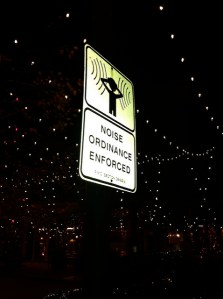
At the most obvious level, the soundscape (both our sonic environment and how we relate to it) is always also a lawscape. Our smartphones, loudspeakers, radios and headsets are all proprietary, as is the music we listen to on them and the audio-formats on which that music is encoded. Law regulates and fails to regulate the volume and acoustic character of our streets, skies, workplaces, bedrooms and battlefields. Courts and legislatures claim to govern the kinds of vocalizations we make – what we can say or sing, where and when – and who gets to listen. As yet another music venue, airport, housing development or logging venture receives approval, new sounds enter the world, others leave it and things are subtly reconstituted as a result.
What’s striking when you look at the legal scholarship, however, is that how sound is conceived for such purposes gets very little attention. There are exceptions: in the fields of copyright and anti-noise regulation particularly. But for the most part, legal thought and practice is content to work with ‘common sense’ assumptions which would be immediately discredited by anyone who spends their time thinking hard about what sound is and does. So as legal academics, legislators, judges, and so on, we need to be much better at attending to law’s ‘sonic imagination’. When an asylum seeker is denied entry to the UK because of the way he pronounces the Arabic word for ‘tomato’ (which actually happened…the artist Lawrence Abu Hamdan has done some fantastic work on this), what set of relations between voice, accent and citizenship is at stake? When a person is accused of inciting genocide with their songs (in this instance a Rwandan musician called Simon Bikindi), what theory or theories of music manifest themselves in the decision-making body’s discourse and in the application of its doctrine? These are really important questions, it seems to me. To put it bluntly: people’s lives are at stake.
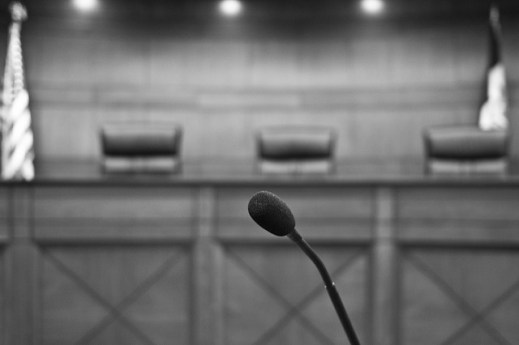
Another way of thinking about the law-sound relation would be to think about the role played by sound in legal practice: in courtrooms, legislatures etc. For a singer to be tried for genocide, for instance, his songs must be heard. Audio and audio- video recordings must be entered as evidence and played aloud to the court; a witness or two may sing. How? When? Why? The judicial soundscape is surprisingly diverse, it turns out. Gavels knock (at least in some jurisdictions), oaths are sworn, judgment is pronounced; and all of this increasingly into microphones, through headsets, and transmitted via audio-video link to prisons and elsewhere. This stuff matters. It warrants thinking about.
Outside the courtroom, sound is often the medium of law’s articulation: what materialises it, gives it reality, shape, force and effect. Think of the police car’s siren, for instance, or a device like the LRAD, which I know you’re also interested in. Or in non-secular jurisdictions, we could think equally of the church bells in Christianity, the call to prayer in Islam or the songlines of Aboriginal Australia. The idea that law today is an overwhelmingly textual and visual enterprise is pretty commonplace. But it’s an overstatement. Sound remains a key feature of law’s conduct, transmission and embodiment.
And to bring me back to where I started, I feel like artists and musicians are generally better tuned in to this than us lawyers.
English: Given the fact that the voice, and I suppose I mean both literally and metaphorically, reigns so heavily in the development and execution of the law it’s surprising that the discourses around sound aren’t a little more engaged. That being said, it’s not that surprising really, as I’d argue that until recently the broader conversations around sound and listening have been rather sparse. It’s only really in the past three decades have we started to see a swell of critical writings around these topics. The past decade particularly has produced a wealth of thought that addresses sound.
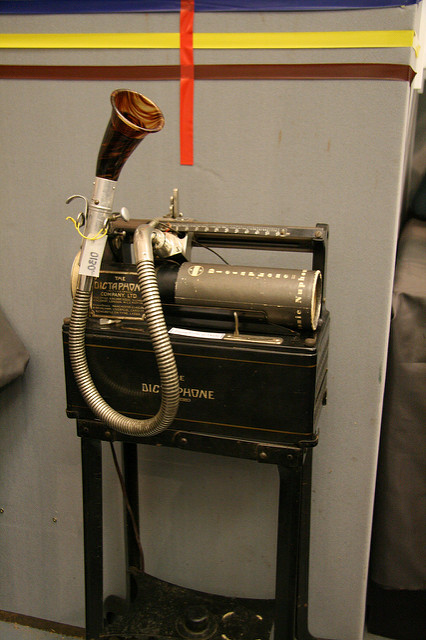
I suppose though that really this situation you describe in the law is tied back into the questions that surround the recognition of sound and the complexities of audition more generally. I can’t help but feel that sound has suffered historically from a lack of theoretical investigation. Partly this is due to the late development of tools that provided the opportunity for sound to linger beyond its moment of utterance. That recognition of the subjectivity of audition, revealed in those first recordings of the phonograph must have been a powerful moment. In that second, suddenly, it was apparent that how we listen, and what it is we extract from a moment to moment encounter with sound is entirely rooted in our agency and intent as a listener. The phonograph’s capturing of audio, by contrast, is without this socio-cultural agency. It’s a receptacle that’s technologically bound in the absolute.
I wonder if part of the anxiety, if that’s the word that could be used, around the way that sound is framed in a legal sense is down to its impermanence. That until quite recently we had to accept the experience of sound, as entirely tethered to that momentary encounter. I sense that the law is slow to adapt to new forms and structures. Where do you perceive the emergence of sound as a concern for law? At what point did the law, start to listen?
Parker: Wow, there’s so much in this question. In relation to your point about voice, of course lawyers do ‘get it’ on some level. If you speak to a practitioner, they’re sure to have an anecdote or two about the sonorous courtroom and the (dark) arts of legal eloquence. You may even get an academic to recognise that a theory of voice is somehow implicit in contemporary languages of democracy, citizenship and participatory politics: this familiar idea that (each of us a little sovereign) together we manifest the collective ‘voice’ of the people. But you’ll be hard pushed to find anyone in the legal academy actually studying any of this (outside the legal academy, I can thoroughly recommend Mladen Dolar’s incredible A Voice and Nothing More, which is excellent – if brief – on the voice’s legal and political dimensions). One explanation, as you say, might be that it’s only relatively recently that a discourse has begun to emerge around sound across the academy: in which case law’s deafness would be symptomatic of a more general inattention to sound and listening. That’s part of the story, I think. But it’s also true that the contemporary legal academy has developed such an obsession with doctrine and the promise of law reform that really any inquiry into law’s material or metaphysical aspects is considered out of the ordinary. In this sense, voice is just one area of neglect amongst many.
As for your points about audio-recording, it’s certainly true that access to recordings makes research on sound easier in some respects. There’s no way I could have written my book on the trial of Simon Bikindi, for instance, without access to the audio-archive of all the hearings. Having said that, I’m pretty suspicious of this idea that the phonograph, or for that matter any recording/reproductive technology could be ‘without agency’ as you put it. It strikes me that the agency of the machine/medium is precisely one of the things we should be attending to.
English: I may have been a little flippant. I agree there’s nothing pure about any technology and we should be suspicious of any claims towards that. It seems daily we’re reminded that our technologies and their relationships with each other pose a certain threat, whether that be privacy through covert recording or potential profiling as suggested by the development of behavioral recognition software with CCTV cameras.
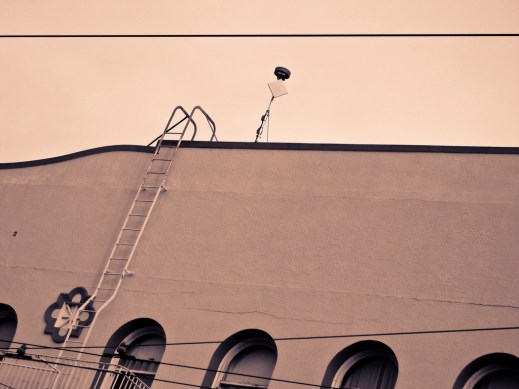
Parker: Not just that. CCTV cameras are being kitted out with listening devices now too. There was a minor controversy about their legality and politics earlier this year in Brisbane in fact.
English: Thinking about sound technologies, at the most basic level, the pattern of the microphone, cardioid, omni and the like, determines a kind of possibility for the articulation of voice, and its surrounds. I think the microphone conveys a very strong political position in that its design lends itself so strongly to the power of singular voice. That has manifest itself in everything from media conferences and our political institutions, through to the inane power plays of ‘lead singers’ in 1980s hard rock. The microphone encourages, both in its physical and acoustic design, a certain singular focus. It’s this singularity that some artists, say those working with field recording, are working against. This has been the case in some of the field recordings I have undertaken over the years. It has been a struggle to address my audition and contrast it with that of the microphone. How is it these two rather distinct fields of audition might be brought into relief? I imagine these implications extend into the courtroom.
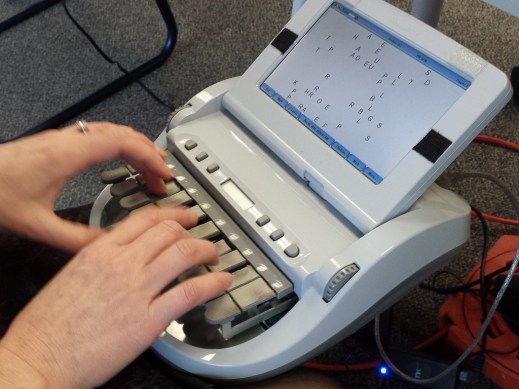
Parker: Absolutely. Microphones have been installed in courtrooms for quite a while now, though not necessarily (or at least not exclusively) for the purposes of amplification. Most courts are relatively small, so when mics do appear it’s typically for archival purposes, and especially to assist in the production of trial transcripts. This job used to be done by stenographers, of course, but increasingly it’s automated.
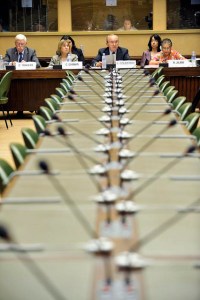
So no, in court, microphones don’t tend to be so solipsistic. In fact, in some instances they can help facilitate really interesting collective speaking and listening practices. At institutions like the International Criminal Tribunal for Rwanda, or for the Former Yugoslavia, for instance, trials are conducted in multiple languages at once, thanks to what’s called ‘simultaneous interpretation’. Perhaps you’re familiar with how this works from the occasional snippets you see of big multi-national conferences on the news, but the technique was first developed at the Nuremberg Trials at the end of WWII.
What happens is that when someone speaks into a microphone – whether it’s a witness, a lawyer or a judge – what they’re saying gets relayed to an interpreter watching and listening on from a soundproof booth. After a second or two’s delay, the interpreter starts translating what they’re saying into the target language. And then everyone else in the courtroom just chooses what language they want to listen to on the receiver connected to their headset. Nuremberg operated in four languages, the ICTR in three. And of course, this system massively affects the nature of courtroom eloquence. Because of the lag between the original and interpreted speech, proceedings move painfully slowly.
Courtroom speech develops this odd rhythm whereby everyone is constantly pausing mid-sentence and waiting for the interpretation to come through. And the intonation of interpreted speech is obviously totally different from the original too. Not only is a certain amount of expression or emotion necessarily lost along the way, the interpreter will have an accent, they’ll have to interpret speech from both genders, and then – because the interpreter is performing their translation on the fly (this is extraordinarily difficult to do by the way… it takes years of training) – inevitably they end up placing emphasis on odd words, which can make what they say really difficult to follow. As a listener, you have to concentrate extremely hard: learn to listen past the pauses, force yourself to make sense of the stumbling cadence, strange emphasis and lack of emotion.
On one level, this is a shame of course: there’s clearly a ‘loss’ here compared with a trial operating in a single language. But if it weren’t for simultaneous interpretation, these Tribunals couldn’t function at all. You could say the same about the UN as a whole actually.
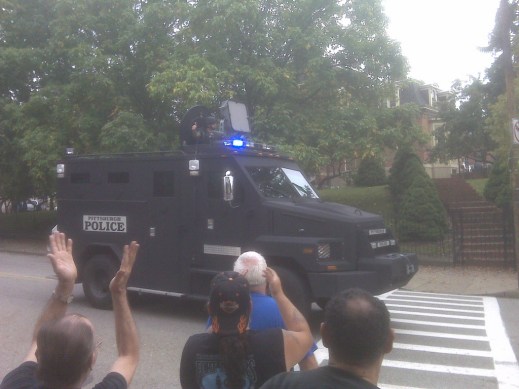
English: I agree. Though for what it’s worth it does seem as though we’re on a pathway to taking the political and legal dimensions of sound more seriously. Your research is early proof of that, as are cases such as Karen Piper’s suit against the city of Pittsburgh in relation to police use of an LRAD. As far as the LRAD is concerned, along with other emerging technologies like the Hypershield and the Mosquito, it’s as though sound’s capacity for physical violence, and the way this is being harnessed by police and military around the world somehow brings these questions more readily into focus.
Parker: I think that’s right. There’s definitely been a surge of interest in sound’s ‘weaponisation’ recently. In terms of law suits, in addition to the case brought by Karen Piper against the City of Pittsburgh, LRAD use has been litigated in both New York and Toronto, and there was a successful action a couple of years back in relation to a Mosquito installed in a mall in Brisbane.
On the more scholarly end of things, Steve Goodman’s work on ‘sonic warfare’ has quickly become canonical, of course. But I’d also really recommend J. Martin Daughtry’s new book on the role of sound and listening in the most recent Iraq war. Whereas Goodman focuses on the more physiological end of things – sound’s capacity both to cause physical harm (deafness, hearing loss, miscarriages etc) and to produce more subtle autonomic or affective responses (fear, desire and so on) – Daughtry is also concerned with questions of psychology and the ways in which our experience even of weaponised sound is necessarily mediated by our histories as listeners. For Daughtry, the problem of acoustic violence always entails a spectrum between listening and raw exposure.
These scholarly interventions are really important, I think (even though neither Goodman nor Daughtry are interested in drawing out the legal dimensions of their work). Because although it’s true that sound’s capacity to wound provides a certain urgency to the debate around the political and legal dimensions of the contemporary soundscape, it’s important not to allow this to become the only framework for the discussion. And that certainly seems to have happened with the LRAD.
Of course, the LRAD’s capacity to do irreparable physiological harm matters. Karen Piper now has permanent hearing loss, and I’m sure she’s not the only one. But that shouldn’t be where the conversation around this and other similar devices begins and ends. The police and the military have always been able to hurt people. It’s the LRAD’s capacity to coerce and manage the location and movements of bodies by means of sheer acoustic force – and specifically, by exploiting the peculiar sensitivity of the human ear to mid-to-high pitch frequencies at loud volumes – that’s new. To me, the LRAD is at its most politically troubling precisely to the extent that it falls just short of causing injury. Whether or not lasting injury results, those in its way will have been subjected to the ‘sonic dominance’ of the state.
So we should be extremely wary of the discourse of ‘non-lethality’ that is being mobilised by to justify these kinds of technologies: to convince us that they are somehow more humane than the alternatives: the lesser of two evils, more palatable than bullets and batons. The LRAD renders everyone before it mute biology. It erases subjectivity to work directly on the vulnerable ear. And that strikes me as something worthy of our political and legal attention.
English: I couldn’t agree more. These conversations need to push further outward into the blurry unknown edges if we’re to realise any significant development in how the nature of sound is theorised and analysed moving forward into the 21st century. Recently I have been researching the shifting role of the siren, from civil defence to civil assault. I’ve been documenting the civil defence sirens in Los Angeles county and using them as a starting point from which to trace this shift towards a weaponisation of sound. The jolt out of the cold war into the more spectre-like conflicts of this century has been like a rupture and the siren is one of a number of sonic devices that I feel speak to this redirection of how sound’s potential is considered and applied in the everyday.
—
Featured Image: San Francisco 9th Circuit Court of Appeals Jury Box, Image by Flickr User Thomas Hawk, (CC BY-NC-ND 2.0)
—

REWIND! . . .If you liked this post, you may also dig:
Sounding Out! Podcast #60: Standing Rock, Protest, Sound and Power (Part 1)–Marcella Ernest
The Noises of Finance–N. Adriana Knouf
Learning to Listen Beyond Our Ears: Reflecting Upon World Listening Day–Owen Marshall
Beyond the Grandiose and the Seductive: Marie Thompson on Noise
—
Share this:

Beyond the Grandiose and the Seductive: Marie Thompson on Noise

DOI: https://doi.org/10.59350/z2hsp-mha62
Dr. Marie Thompson is currently a Lecturer at the Lincoln School of Film and Media, University of Lincoln. Her new book Beyond Unwanted Sound: Noise, Affect and Aesthetic Moralism has just been published by Bloomsbury. We’ve been following each other on Twitter for a while(@DrMarieThompson and @AbstractTruth) and I have become very interested in her ideas on noise. I’m David Menestres, double bassist, writer, radio host, and leader of the Polyorchard ensemble (“a vital and wonderfully vexing force of the area’s sonic fringes”) currently living in the Piedmont region of North Carolina.
—
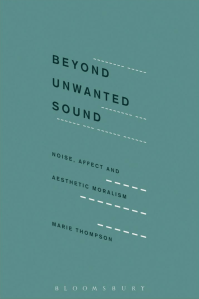
In her new book, Dr. Thompson covers a wide variety of ideas from Spinoza to Michel Serres’s cybernetic theory, acoustic ecology and the politics of silence to the transgressiveness of noise music, and many other concepts to show how we are affected by noise. Thompson is also the co-editor of Sound, Music, Affect: Theorizing Sonic Experience (Bloomsbury, 2013). Here is a conversation we had over email in February 2017 about Beyond Unwanted Sound.
David Menestres (DM): Why now? Why did you feel compelled to write this book? What do you hope this book will accomplish?
Marie Thompson (MT): I think my ‘academic’ interest in noise began as an undergraduate music student – I was interested in thinking ‘beyond’ distinctions of avant-gardism and popular culture and noise, as something that traverses such separations became an evermore appealing concept. So I’ve been circling some of these ideas for quite a while.
I felt compelled to write the book partly due to what I perceived as a gap between some of my ‘everyday’ experiences of noise and how noise was represented in discourse – particularly noise’s representation as an essentially negative phenomenon; or as a shocking, sublime, radical, overwhelming, transgressive force. Noise seems to be one of those topics that makes ordinarily quite progressive thinkers revert to quite uncritical and reactionary tropes – there’s something about it that ‘touches a nerve’. Consequently, much of the discourse around noise is underlined by an often-unacknowledged conservatism. I’ve always found the grandiose rhetoric of noise comparatively quite seductive but at the same time, more often than not, noise is quotidian and banal rather than overwhelming or sublime (which isn’t to say it can’t also be those things). Likewise, I felt like this grandiose rhetoric resulted in an amplification of certain sonic arts practices, while silencing others. I guess I was compelled by a desire to expand the (material and discursive) universe of noise while also trying to maintain some consistency in definition.
Quite simply, I hope the book will contribute something helpful to the recent discussions around noise in media theory, acoustic ecology and music.
DM: What is the difference between a subjective-oriented definition of noise vs. an object-oriented definition and how do both lead to the ethico-affective approach that you champion in the book?
MT: When I refer to subject- and object-oriented definitions I’m referring, quite simply, to noise being defined either in relation to the ear of the beholder, or in relation to the sound-itself. [MT also defines her “ethico-affective approach” as a perspective that “recognises the entanglement of the ethical and the affective: affective relations are also ethical relations.” –ed.]
What I think is useful about a subject-oriented definition is that it remains open to what noise might be, what form it might take – it might be your neighbour hoovering, it might be a fellow travelers mobile phone, or it might be a buzzing wasp. However, subject-oriented definitions of noise are typically wedded to liberal notions of subjectivity and the politics that carries. Noise becomes an issue of personal taste – one person’s music is another’s noise etc. Subject-oriented definitions also struggle to account for noise that isn’t ‘unwanted’, ‘bad’, ‘negative’, and so on; and for noise that might not be perceptible, or noticeable.
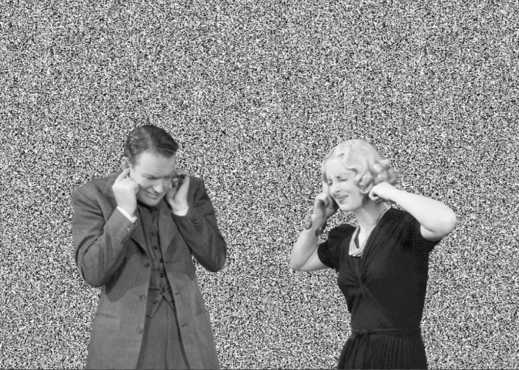
Object-oriented definitions which treat noise as a type of sound are helpful insofar as there is a consistency of definition and it does not assume noise to be a solely negative phenomenon; however, to my mind, they risk losing sight of context: a particular sound is noise irrespective of how it is heard, what it does.
The ethico-affective approach I develop can be understood to maintain aspects of both these definitional approaches. It maintains the separation created by an object-oriented definition of noise between noise and negativity, so that noise’s ‘unwantedness’ becomes secondary and contingent. It also maintains the contextual focus of a subject-oriented definition, so that noise is not tethered to particular types of sound or sound sources.
DM: I’ve been very interested in the idea of noise as a weapon: the use of sound cannons to silence and sicken protestors, the use of the “Mosquito” device (which produces high frequency pitches thought to be audible only to teenagers in order to keep them from loitering), or the use of classical music to annoy young people.
You talk in one section about the noise of neighbors and the “policed silence of the suburbs.” I am also interested in the use of noise as protest. At the Women’s March in Raleigh on January 21, there were so many fascinating sounds: the sounds of thousands of voices bouncing off tall buildings, drummers, people leading chants with the crowd shouting back, the singing of classic protest songs (“A Change is Gonna Come,” “This Land Is Your Land,” etc.).
What do you think the role of noise will be in our current political climate? I can definitely see noise being used as a weapon by both sides: the government trying to use it as a weapon against the people and the people using noise to amplify their voice against the government. But there is a stark difference between these two sides: the use of sound weapons is clearly for their intended negative affect on people (both the physical effects of sound weapons and the psychological effects of the endless noise that comes from Trump’s press conferences and general bullshit), but I see the protestors intending to use sound in a positive way, to amplify their message, to make sure those in charge hear their voices, to ensure the message arrives intact.
MT: As a concept, noise seems evocative of much about our current political climate: be it the ‘noise’ of ‘fake news’, and ‘alternative facts’ (how does one determine ‘signal’ from ‘noise’, and who gets to determine that distinction); be it the ‘white noise’ of the Trump campaign administration (I recently saw a performance lecture with Barby Asante which effectively performed the ‘tuning out’ the noise of recently-bolstered white supremacy); or be it the collective noise of protest against the brutality of borders, white supremacy and police-state violence.
That noise can be both a force of domination and resistance is revealing of its ambiguity more generally – what I refer to as the ‘both-and’ of noise. Of course, that is not to conflate these uses of sonic force. One of the ways in which I’ve thought about this ethico-political difference in sonic forces is through the Spinozist distinction of power-over/power-to. The ethico-political entangles ethical questions (good-bad) with political questions (power over/power to).
So, when sound is weaponized to exert authority, to bring people into line, by diminishing their capacity to act and do, then this can be thought of as an exertion of power-over. Likewise, when sound becomes a means of collective resistance, or of connectivity (I’m thinking partly here of various ‘noise-protests’ at prisons and detentions centres, where sound is used to traverse walls and borders) then it might be understood as an expression of ‘power-to’ – a (collectivized) body’s capacity to act, to be, to do.
DM: You talk in the book of the “conservative politics of silence.” How does this conservativism affect both how people perceive sound and how we relate to it? Is there something at the other end of the scale, a “liberal politics of silence” so to speak?
MT: To my mind, the conservative politics of silence informs a number of assumptions that are frequently made about what are ‘good’ and ‘bad’ sonic environments; it relates to a preference for the simple over the complex, sameness over difference, past over present, predictability over unpredictability, the ‘synthetic’ over the ‘natural’ (whatever that might mean) and, ultimately, quietude over noise. This ideological framework underlines much ‘common sense’ about auditory experience, however it frequently remains unacknowledged.
We might consider a liberal politics in opposition to this conservative politics of silence, which recognises responses to sonic environments as ‘personal’ and therefore refuses overarching moral judgements about ‘good’ and ‘bad’ sound. However, I’m also wary of endorsing a politics that treats the individual, autonomous subject as the primary site of the political. Indeed, the conservative politics of silence that we see in the work of figures such as R. Murray Schafer is often indebted to a liberalism that prioritises control and the freedoms and rights of the individual – I’m thinking here of Schafer’s complaint that you can rid your private property of a physical intruder but not an aural one: “A property-owner is permitted by law to restrict entry to his private garden or bedroom. What rights does he have against a sonic intruder?” (1993, 214)
DM: One of the sections I particularly liked was the “What does noise do?” section where you delved into information theory through the work of Claude Shannon to show how noise was an essential part of a communications system, how noise can be a necessary, amplifying presence, needed to successfully transmit a message (voice over phone lines, data packets over the internet, etc.), how noise can enrich a system. I found myself thinking about this section a lot, often in relation to R. Murray Schaffer’s Platonic ideal state of silence. (“a Platonic, transcendent realm of a pure and ideal sonority, which paradoxically exists as undisturbed and eternal silence”).

I was also thinking about Cosmic Microwave Background radiation, the residual signature of the Big Bang, the background noise that carried all the information that formed our universe. It seems like noise is an intrinsic part of our world, both human made and naturally occurring, and fighting against it seems like such a waste of energy.
MT: It strikes me that when Schafer and other acoustic ecologists talk about fighting noise, they’re fighting a symptom rather than a cause. In these discourses, there is much talk of noise and environmental destruction but very little on how these processes relate to capitalism and settler-colonialism. In that regard, while I don’t think fighting against noise in absolute terms is futile, I do maintain that there are still fights to be had against high levels of noise. While I am critical of liberal notions of privacy and control and the ‘right’ to silence, I do also recognise that noise can feel oppressive in some contexts. That said, more often than not high levels of noise is a symptom of bigger social and political problems – for example, of poor quality housing, and a lack of economic choice over where one lives.
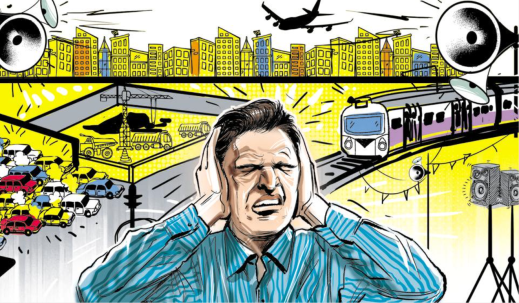
DM: One of the themes explore in the book is the idea of the parasite, based on the work of Michel Serres. How does the parasite relate to your idea of noise?
MT: I take from Serres’ figure of the parasite the idea of noise as a relational, transformative and ambiguous in its necessity. In Serres’ reading, the parasite changes things, for better or for worse. Either way, the parasite does something, it adds something to the mix. In other words, it is affective. And yet, there is no ‘mix’ without it. Parasitic noise is the ‘excluded middle’ that must be included: it is the necessary ‘third term’, which pertains to the necessity of the material medium/milieu. From this perspective, there is no original state of calm, which is then broken by noise. If there is mediation there is noise, if there is the relation there is the parasite.
DM: Could you talk some about “the poetics of transgression” as you call it? How does this “transgression” relate to your ethico-affective approach?
MT: The poetics of transgression refers to the centrality of ‘line-crossing’ narratives in accounts of noise’s use in the sonic arts and art more generally. It’s predicated on what Henry Cowell calls the ‘time-honoured axiom’ that noise and music are opposites. Bringing noise into music, or music into noise relies on the crossing of boundaries, of material and discursive borders. This ‘line-crossing’ is often accompanied by a rhetoric of extremity and radicalism, shock and awe.
While different notions of transgression have certainly been influential for various noise music practitioners, I seek to decentre it as a way rather than the way of understanding noise’s use as an artistic resource. I argue that the dominance of the poetics of transgression has risked reducing noise music to its most ‘extreme’ manifestations. In light of the ethico-affective approach to noise that I develop throughout the book, which understands noise as a transformative force and necessary component of mediation, I suggest that noise music can be understood as an act of exposure, which, rather than bringing noise into music (or vice versa) exposes, extends and foregrounds the noise that is within the techno-musical system so as to generate new sonic sensations. With this approach, I hope to make more space for noise music practices that do not fit comfortably with the poetics of transgression and its aesthetics and rhetoric of extremity.
—
Featured Image: Noise Music
—
REWIND! . . .If you liked this post, you may also dig:
Sounding Out! Podcast #60: Standing Rock, Protest, Sound and Power (Part 1)–Marcella Ernest
The Noises of Finance–N. Adriana Knouf
Learning to Listen Beyond Our Ears: Reflecting Upon World Listening Day–Owen Marshall
—
Share this:




Current Top Posts





April 2021

January 2020

November 2019

October 2019

August 2019

April 2014

November 2017

March 2015

December 2017

October 2015


Recent Comments