
“Sensing Voice”*
*a longer version of this piece is forthcoming in Senses & Society 6 (2), July 2011.

Bathroom Recital 2007
In 2007, I received an invitation to a recital that would take place in my bathroom; the artist offered to present an underwater concert in my tub. My reaction? “Crazy,” I thought. “Why go to the trouble of singing in an element so far from ideal?” After a year of mulling it over, though, I finally realized that what I had dismissed for its hopeless impracticality might—precisely because it was impractical—offer fresh perspectives on singing and listening by resituating these familiar activities in vastly unfamiliar territory.
The underwater singing practiced by contemporary American soprano and performance artist Juliana Snapper challenges audiences to confront their unexamined assumptions about the relationships between the voice and materiality, the sensed and the singular. How do the physical and sensory properties of singers’ and listeners’ bodies affect and participate in the music we create and the sounds we hear? How do the physical space within and the matter through which sound travels shape what we hear? And how do the relations between these aspects affect what it feels like to sing, and what it is possible to hear?

The rooftop bar at the Standard Hotel, downtown LA
During the spring of 2010, while I was working on an article about Snapper’s project and teaching a seminar on the multi-sensory aspects of music, Snapper offered to mount a participatory version of her project for my class. She took us through some exercises in a large swimming pool in downtown Los Angeles. The first exercise paired us up; one person gently held the other under water, while the person underwater made sounds. I was paired with Natalia, who shouted––but with my ears above the water I couldn’t hear her voice.

The author with Natalia Bieletto (under water). Aquaopera #4/Los Angeles, 28 April 2010.
So we tried another strategy: one person made sounds underwater while the rest of us put our heads and ears in – and then we could hear her. We found that the deeper into the water we descended, the more difficult it was to sing high notes. Fast tempi were also difficult to maintain; Natalia’s attempt resulted in muddled sounds.
We found that the deeper into the water we descended, the more difficult it was to sing high notes. Fast tempi were also difficult to maintain; Natalia’s attempt resulted in muddled sounds. Surprisingly, while sung sounds didn’t seem very loud, small internal throat sounds were incredibly powerful. These exercises demonstrate how much the medium through which sound waves flow affects their characteristics: their speed, direction and so on. It also shows that in order to register sound, the listening body (including the head) must be immersed in the material through which the sound flows.

The next exercise linked the six of us together
The next exercise linked the six of us together by the arms; three participants stood in a line, with their backs against three others. We sang in a drone-like manner, playing with our voices above the water, at its surface, and then slowly sinking into it. We felt the sonic vibrations largely through direct contact with each other’s bodies. Of course sound also passed through the air and water, but because the most immediate path was from one body to another, this was the sensation that overpowered us.
At the end of the day, gathered around the poolside fireplace, we discussed how different singing felt in a liquid environment. We’d discovered that aural experience is predicated on physical contact with sound waves through shared media, in this case water and air, flesh and bone. We noted that the shared medium makes a great differenceto how we experience the voice, and that the sound we ultimately hear depends partly on what is sung, and partly on the medium through which it passes (and how our bodies interact with that medium). In other words, in Snapper’s workshop we discovered that sound is a multi-sensory experience, tactile as well as aural. It also became clear that sound and music involve much more than traditional theories and notation can capture. (For a more thorough discussion of the differences between singing and sound underwater and in air, please see my forthcoming article.)
-

- At the Standard poolside fireplace.
-

- Hyunjong Lee and Zachary Wallmark.
-

- Sam Baltimore and Alexandra Apolloni.
-

- Jill Rogers.
I would like to underscore here that the character of a given sound source is not stable. Instead it is dependent on specific material conditions, and on particular relationships between the elements involved. A sound signal will move with a given speed depending on the material––air, water, metal, glass, etc.––through which it is propelled. As humans register the sound it will move more or less directly through the ear drum or bones (and then transfer to the inner ear) depending on the relationship between the material through which it is propelled and the materiality of the ear. The part of the body that registers sound also plays a role in its apparent directionality.

Juliana Snapper.
For example, our ability to hear in “stereo”––two distinct signals, left and right––is the result of sound entering our bodies from two directions (two ears). Because we most frequently deal with sound as it is propelled through air, we take this as a given and adjust our musical and acoustic research (and thus our concert halls and (performance spaces accordingly).
By highlighting the material aspects of sound and their reception, Snapper reminds us that what we hear depends as much on our materiality, physicality, and cultural and social histories as it does on so-called objective measurements (decibel level, soundwave count, or score), which are themselves mere images. Our experience of sound is a triangulation of events in which physical impulses (sonic vibrations), our bodies’ encultured capacity to receive these vibrations, and how we have been taught to understand them are at constant play, and subject to negotiation. In the experience of sound, what becomes clear is not a stable explanation of what sound or music is. Instead we are led to understand that each such account is a composite manifestation of our perception of sound at a given moment in time and place.
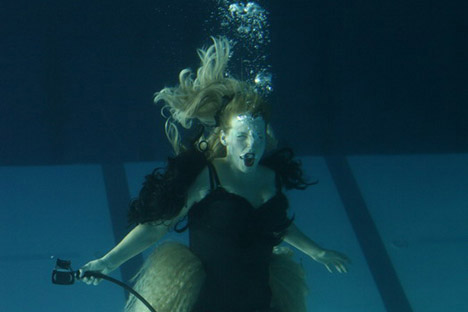
Juliana Snapper
Share this:

Listening to Modern Family’s Accent

**This piece is co-authored by Juan Sebastian Ferrada and Dolores Inés Casillas
DOI: https://doi.org/10.59350/kekr6-ptx85
Since debuting in 2009, American audiences have fallen in love with ABC’s Modern Family, a mockumentary comedy starring Ed O’Neill, Julie Bowen, and Colombian actress Sofía Vergara who plays the curvaceous, gorgeous, and ”accented” Gloria. Clearly a satirical comedy, the show presents three interrelated modern day versions of nuclear families. The patriarch Jay (O’Neill, formerly of Married With Children) marries Gloria, a much younger Latina who has an eleven-year-old son from her previous marriage (the wise-beyond-his-years Manny, played by Rico Rodriguez). The heterosexual suburban nuclear family is represented through Claire (Jay’s daughter, played by Bowen) and Phil (Ty Burrell) who have three children. The homosexual nuclear family is fashioned through the characters of Mitchell (Jay’s son, Jesse Tyler Ferguson), his partner Cameron (Eric Stonestreet) and their adoptive daughter, Lily, from Vietnam. The show follows the tried-and-true conventions of family sitcoms, complete with exaggerated portrayals of their characters and a feel good message delivered in 22 minutes. Our current fascination is Gloria—arguably the most popular character on the show (see her lucrative Pepsi deal here)—and the use of her “accent” to mark her Latina body. Visually audiences may be ogling over her curves, but it is her vocal body – her “accent,” tone, and staged grammatical blunders – that work to racialize her character as much as sexualize it.
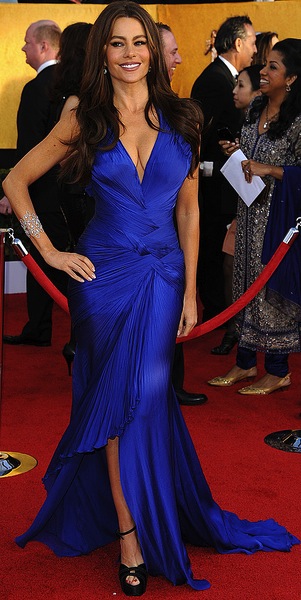
Vergara’s character Gloria hails from the same township of Barranquilla, Colombia as the actress herself. Despite her emerging star status in the U.S., Vergara is no stranger to Spanish-language television viewers. (Wilson Valentín-Escobar refers to such English-language media discoveries as “Columbus effects”). Vergara rose to fame through the immensely popular telenovela format and in recent years has gained popularity through various comedic roles type cast as the “sexy Latina.” Visually, the spitfire Latina is characterized by her red-painted lips, seductive clothing, curvaceous hips, long brunette hair, extravagant jewelry, and an inherent ability to dance. (See Priscilla Peña Ovalle’s fabulous SO! blog piece on Latinas, dance, and the “aural Otherness” of Rita Moreno). Vergara, in her personification of Gloria, embodies many of these attributes quite well. For instance, a natural blond, Vergara was forced to color her hair in order for American viewers to imagine her as an “appropriate” brown Latina.
In an equivalent vocal vein, Vergara showcases the required Spanish “accent.” Case in point, from the pilot episode:
Phil: Hi Gloria. How are you? Oh, what a beautiful dress.
Gloria: Ay, thank you Phil [Ph-eee-l].
Phil: Okay. [Proceeds to touch Gloria]
Claire: [Slaps Phil’s hand] No, honey. That’s how she says Phil. Not feel, Phil!
The communication mishap serves as the underlying funny because of Gloria’s accent and at the expense of Gloria’s body; her voice and her body are both subjected to gratuitous scrutiny. Phil, once again in episode 5 of season 1, does understand Gloria’s “accent” but seems to confuse the context. He greets Gloria upon arriving to his house to watch a football game:
Phil: Hey, for you! [Gives Gloria a bottle of wine] Nice to see you, Gloria. [Hugs Gloria]
Gloria: Two times today.
Phil: Okay. [Proceeds to hug her again]
Claire: Phil! She means we’ve seen them two times today.
In this case Phil is confused by Gloria’s inflection and repeatedly mistakes Gloria’s unintentional statements as personal invitations to her body. These acts sexualize and racialize Gloria as a desired “other” because of her apparent “accent.” Once again, repeated in this scene, Claire (Phil’s wife) is required to intervene or harness her husband’s sexual prowess by announcing what Gloria means, stripping Gloria of her voice to defend herself.

Perhaps most frustrating and audibly apparent feature of Gloria lies in her incessant grammatical errors scripted within her English-language lines. Yes, scripted. Vergara certainly has an audible “accent,” especially to Americans not accustomed to Latino-speak (although there are 35 million Latinos in the U.S.) or to those in denial that we all carry some sort of accent influenced by our social locations – class, race, and in this case, migration. But to Vergara’s own admission, she is bilingual and biliterate, which means the grammatical blunders that serve as punch lines or as a means of laughing at her, are largely owed to the script itself. Gloria’s grammar, like her “brown” hair, is an important false feature that helps make her a true Latina immigrant character.
Listeners have always struggled to make sense of one’s accent and speech style especially if the speaker’s body does not match stereotypical perceptions based on race and gender. A key study showed, for instance, that when participants were shown a recorded lecture by an Asian American woman voiced over with a white woman’s voice, they overwhelmingly insisted that the Asian American woman spoke with an Asian accent. A classic case of what sociolinguists refer to as “accent hallucination.” Listeners truly have a hard time believing what they hear or believe they hear.
In the case of comedian Margaret Cho, audiences laugh their heads off with her signature act – vocal reenactments of her immigrant Korean mother. Elaine Chun offers a brilliant analysis of Margaret Cho’s revoicings of her immigrant Korean mother (Chun refers to this as “Asian speech”). According to Chun, Cho’s comedic routines are not only incredibly funny but they offer a critique of racist mainstream ideologies precisely because Margaret Cho is read as an Asian American.
Which makes us wonder, how is Sofia Vergara read within a U.S. context and to non-Latino audiences? Ideally, folks would see her as a U.S. Latina role playing a recently arrived immigrant and offer viewers a critique of accented Latina spitfire. But alas, Vergara’s vocal performance of an immigrant Latina wrought with grammatical errors only helps her character Gloria become the quintessential racialized Other (or a true U.S. Latina).
—
D. Inés Casillas and Sebastian Ferrada
—
Share this:




Current Top Posts





April 2021

January 2020

November 2019

October 2019

August 2019

April 2014

November 2017

March 2015

December 2017

October 2015


Recent Comments