
The Musical Flow of Shane Carruth’s Upstream Color
DOI: https://doi.org/10.59350/fya2b-65669
Welcome back to Sculpting the Film Soundtrack, SO!‘s new series on changing notions about how sound works in recent film and in recent film theory, edited by Katherine Spring.
Two weeks ago, Benjamin Wright started things off with a fascinating study of Hans Zimmer, a highly influential composer whose film scoring borders on engineering — or whose engineering borders on music — in many major Hollywood releases. This week we turn to the opposite end of the spectrum to a seemingly smaller film, Shane Carruth’s Upstream Color (2013), which has made quite a few waves among sound studies scholars and fans of sound design, even earning a Special Jury Prize for sound at Sundance.
To unpack the many mysteries of the film and explore its place in the field of contemporary filmmaking, we are happy to welcome musicologist and film scholar Danijela Kulezic-Wilson of University College Cork. Listen to Upstream Color through her ears (it’s currently available to stream on Netflix) and perhaps you’ll get a sense of why you’ll have to listen to it two or three more times. At least.
–nv
—

When Shane Carruth’s film Upstream Color was released in 2013, critics described it in various ways—as a body horror film, a sci-fi thriller, a love story, and an art-house head-scratcher—but they all agreed that it was a film “not quite like any other”. And while the film’s cryptic imagery and non-linear editing account for most of the “what the hell?” reactions (see here for example), I argue that the reason for its distinctively hypnotic effect is Carruth’s musical approach to the film’s form: he organizes the images and sounds according to principles of music, including the use of repetition, rhythmic structuring, and antiphony.
The resulting musicality of Upstream Color may not be surprising given that Carruth composed most of the score, and also, as Jonathan Romney has noted in Sight & Sound, Carruth has said on many occasions that he was hoping “people would watch this film repeatedly, as they might listen to a favourite album” (52). In this sense, Carruth (whose DIY toolkit also includes writing, directing, acting, producing, cinematography, and editing) joins the ranks of filmmakers such as Darren Aronofsky and Joe Wright who recognize that, despite our culture’s obsession with the cinematic and narrative aspects of “visual” media, music governs film’s deepest foundations.
Upstream Color is a story about a woman, Kris, who is kidnapped by a drug manufacturer (referred to in the credits as Thief) and contaminated with a worm that keeps her in a trance-like state during which the Thief strips her of all her savings. Kris is subsequently dewormed by a character known as the Sampler, who transfers the parasite into a pig that maintains a physical and/or metaphorical connection to Kris. Kris later meets and falls in love with Jeff who, we eventually discover, has been a victim of the same ordeal. Although the bizarreness of the plot has encouraged numerous interpretations, the film’s unconventional audio-visual language suggests that its story of two people who share supressed memories of the same traumatic experience shouldn’t be taken at face value, but rather serves as a metaphor for existential anxiety resulting from being influenced by unknown forces.
Such an interpretation owes as much to the film’s disregard for the rules of classical storytelling as it does to a formally innovative soundtrack, one that uses musicality as an overarching organizing principle. The fact that Carruth wrote the score and script simultaneously (discussed in the video below) indicates the extent to which music was from the beginning considered an integral part of the film’s expressive language. More importantly, as the scenes discussed in this post suggest, the musical logic of the film is even more pervasive than the style, role, and placement of the actual score.
Whereas feature films traditionally assign a central role to speech, allowing music and sound effects supporting roles only, Upstream Color breaks down the conventional soundtrack hierarchy, often reversing the roles of each constitutive element. For example, hardly any information in the film that could be considered vital to understanding the story is communicated through speech. Instead, images, sound, music, and editing–for which Carruth shares the credit with fellow indie director David Lowery–are the principal elements that create the atmosphere, convey the sense of the protagonists’ brokenness, and reveal the connection between the characters. At the same time, characters’ conversations are either muted or their speech is blended with music in such a way that we’re encouraged to focus on body language or mise-en-scène rather than trying to discern every spoken word. For example, Jeff and Kris’s flirting with one another during their initial meetings (at roughly 0.44.20-0.47.00 of the film) is conveyed primarily through gestures, glances, and fragmentary editing rather than speech, which would be more typical for this sort of narrative situation.
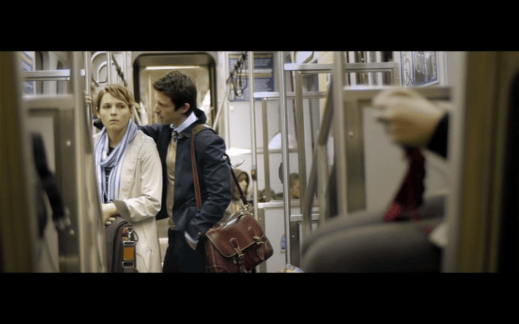
Further undercutting the significance of speech across the film is how the film has been edited to resemble the flow of music. For example, non-linear jumps in the narrative are often arranged in such a way as to create syncopated audio-visual rhymes. This technique is particularly obvious in the montage sequence in which Kris and Jeff argue over the ownership of their memories, whose similarities suggest that they were implanted during the characters’ kidnappings. In this sequence, both the passing of time and the recurrence of the characters’ argument is conveyed through the repetition of images that become visual refrains: Kris and Jeff lying on a bed, watching birds flying above trees, touching each other. Some of these can be seen in the film’s official trailer:
The scene’s images and sounds are fragmented into a non-linear assembly of pieces of the same conversation the characters had at different times and places, like the verses and the choruses of a song. Importantly, the assemblage is also patterned, with phrases like “we should go on a trip” and “where should we go?” heard in refrain. The first time we hear Jeff say “we should go on a trip” and suggesting that they go “somewhere bright”, his words are played in sync with the image of him and Kris lying on the bed. The following few shots, accompanied only by music, symbolize the “honeymoon” phase of their relationship: the couple kiss, hold hands, and walk with their hands around each other’s waists. A shift in mood is marked by the repetition of the dialogue, with Jeff again saying “we should go on a trip” – only this time, the phrase plays asynchronously over a shot of Jeff and Kris pushing a table into the house that they have moved into together. Finally, the frustration that starts infiltrating the characters’ increasingly heated arguments is alleviated by the repetition of the sentence “They could be starlings.” As it is spoken three times by both characters in an antiphonic exchange, the phrase emphasizes the underlying strength of their connection and gives the scene a rhythmic balance. Across this sequence, the musical organization of audio-visual refrains prompts us to recognize the psychic connection between Kris and Jeff, and even to begin to guess the sinister reason for it.
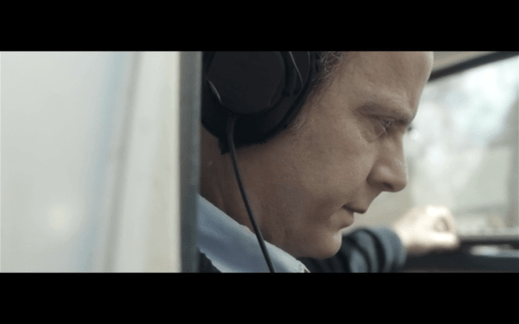
While speech in Upstream Color is often stripped of its traditional role as a principal source of information, sound and music are given important narrative functions, illuminating hidden connections between the characters. In one of the most memorable scenes, the Sampler is revealed to be not only a pig farmer but also a field recordist and sound artist who symbolizes the hidden source of everything that affects Kris and Jeff from afar. As we hear the sounds of the Sampler’s outdoor recordings merge with and emulate the sounds made and heard by Kris and Jeff at home and at work, the soundtrack eloquently establishes the connection between all three characters while also giving us a look “behind the scenes” of Kris’s and Jeff’s lives and suggesting how they are influenced from a distance.
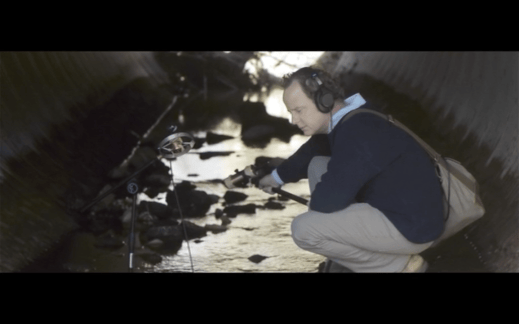
In one sense, by calling attention to the very act of recording sound, the scene exposes how films are constructed, offering a reflexive glimpse into usually hidden processes of production. The implied idea here–that the visible and audible are products of not-so-obvious processes of formation–refers not only to the medium of film but also to the complexity of the inner workings of someone’s mind. Thus the Sampler’s role, his actions, and his relationship to Kris, Jeff, and other infected victims can be interpreted as a metaphor for the subconscious programming – all the familial, social and cultural influences – that all of us are exposed to from an early age. The Sampler is portrayed symbolically as the Creator, a force whose actions affect the protagonists’ lives without them knowing it. The fact that he is simultaneously represented as a sound artist establishes sound-making and musicality as the film’s primary creative principles.
Considering Carruth’s very deliberate departure from the conventions of even what David Bordwell calls “intensified” storytelling, it is fair to say that Upstream Color is a film that weakens the strong narrative role traditionally given to oral language. What is intensified here are the musical and sensuous qualities of the audio-visual material and a mode of perception that encourages absorption of the subtext (in other words, the metaphorical meaning of the film) as well as the text.
The musical organization of film form and soundtrack is no longer limited to independent projects such as Carruth’s Upstream Color. As I have shown elsewhere, musicality has become an extremely influential principle in contemporary cinema, acting as an inspiration and model for editing, camera movement, movement within a scene and sound design. Some of the most interesting results of a musical approach to film include Aronofsky’s “hip hop montage” in Pi (1998) and Requiem for a Dream (2000), Jim Jarmusch’s rhythmically structured film poems (The Limits of Control, 2009; Only Lovers Left Alive, 2013), the interchangeable use of musique concrète and environmental sound in Gus Van Sant’s Death Trilogy and films by Peter Strickland (Katalin Varga, 2009; Berberian Sound Studio, 2012); the choreographed mise-en-scène in Joe Wright’s Anna Karenina (2012); the musicalization of language in Harmony Korine’s Spring Breakers (2012); and the foregrounding of musical material over intelligible speech in Drake Doremus’s Breathe In (2013). Given the breadth of these examples, it’s no exaggeration to say that filmmakers’ growing affinity for a musical approach to film is changing the landscape of contemporary cinema.
—
Danijela Kulezic-Wilson teaches film music, film sound, and comparative arts at University College Cork. Her research interests include approaches to film that emphasize its inherent musical properties, the use of musique concrète and silence in film, the musicality of sound design, and musical aspects of the plays of Samuel Beckett. Danijela’s publications include essays on film rhythm, musical and film time, the musical use of silence in film, Darren Aronofsky’s Pi, P.T. Anderson’s Magnolia, Peter Strickland’s Katalin Varga, Gus Van Sant’s Death Trilogy, Prokofiev’s music for Eisenstein’s films, and Jim Jarmusch’s Dead Man. She has also worked as a music editor on documentaries, short films, and television.
—
All images taken from the film.
—

REWIND! . . .If you liked this post, you may also dig:
Sound Designing Motherhood: Irene Lusztig & Maile Colbert Open The Motherhood Archives— Maile Colbert
Play it Again (and Again), Sam: The Tape Recorder in Film (Part One on Noir)— Jennifer Stoever
Animal Renderings: The Library of Natural Sounds— Jonathan Skinner
—
Share this:

Learning to Listen Beyond Our Ears: Reflecting Upon World Listening Day

DOI: https://doi.org/10.59350/n81ks-y7m77
World Listening Day took place last week, and as I understand it, it is all about not taking sound for granted – an admirable goal indeed! But it is worth taking a moment to consider what sorts of things we might be taking for granted about sound as a concept when we decide that listening should have its own holiday.
One gets the idea that soundscapes are like giant pandas on Endangered Species Day – precious and beautiful and in need of protection. Or perhaps they are more like office workers on Administrative Professionals’ Day – crucial and commonplace, but underappreciated. Does an annual day of listening imply an interruption of the regularly scheduled three hundred and sixty four days of “looking”? I don’t want to undermine the valuable work of the folks at the World Listening Project, but I’d argue it’s equally important to consider the hazards of taking sound and listening for granted as premises of sensory experience in the first place. As WLD has passed, let us reflect upon ways we can listen beyond our ears.
At least since R. Murray Schafer coined the term, people have been living in a world of soundscapes. Emily Thompson provides a good definition of the central concept of the soundscape as “an aural landscape… simultaneously a physical environment and a way of perceiving that environment; it is both a world and a culture constructed to make sense of that world.”(117) As an historian, Thompson was interested in using the concept of soundscape as a way of describing a particular epoch: the modern “machine age” of the turn of the 20th century.

Anthropologist Tim Ingold has argued that, though the concept that listening is primarily something that we do within, towards, or to “soundscapes” usefully counterbalanced the conceptual hegemony of sight, it problematically reified sound, focusing on “fixities of surface conformation rather than the flows of the medium” and simplifying our perceptual faculties as “playback devices” that are neatly divided between our eyes, ears, nose, skin, tongue, etc.
Stephan Helmreich took Ingold’s critique a step further, suggesting that soundscape-listening presumes a a particular kind of listener: “emplaced in space, [and] possessed of interior subjectivities that process outside objectivities.” Or, in less concise but hopefully clearer words: When you look at the huge range of ways we experience the world, perhaps we’re limiting ourselves if we confine the way we account for listening experiences with assumptions (however self-evident they might seem to some of us) that we are ‘things in space’ with ‘thinking insides’ that interact with ‘un-thinking outsides.’ Jonathan Sterne and Mitchell Akiyama, in their chapter for the Oxford Handbook of Sound Studies, put it the most bluntly, arguing that
Recent decades of sensory history, anthropology, and cultural studies have rendered banal the argument that the senses are constructed. However, as yet, sound scholars have only begun to reckon with the implications for the dissolution of our object of study as a given prior to our work of analysis.(546)
Here they are referring to the problem of the technological plasticity of the senses suggested by “audification” technologies that make visible things audible and vice-versa. SO!’s Jennifer Stoever-Ackerman has also weighed in on the social contingency of the “listening ear,” invoking Judith Butler to describe it as “a socially-constructed filter that produces but also regulates specific cultural ideas about sound.” In various ways, here, we get the sense that not only is listening a good way to gain new perspectives, but that there are many perspectives one can have concerning the question of what listening itself entails.
But interrogating the act of listening and the sounds towards which it is directed is not just about good scholarship and thinking about sound in a properly relational and antiessentialist way. It’s even less about tsk-tsking those who find “sound topics” intrinsically interesting (and thus spend inordinate amounts of time thinking about things like, say, Auto-Tune.) Rather, it’s about taking advantage of listening’s potential as a prying bar for opening up some of those black boxes to which we’ve grown accustomed to consigning our senses. Rather than just celebrating listening practices and acoustic ecologies year after year, we should take the opportunity to consider listening beyond our current conceptions of “listening” and its Western paradigms.
For example, when anthropologist Kathryn Lynn Guerts first tried to understand the sensory language of the West African Anlo-Ewe people, she found a rough but ready-enough translation for “hear” in the verb se or sese. The more she spoke with people about it, however, the more she felt the limitations of her own assumptions about hearing being, simply, the way we sense sounds through our ears. As one of her informants put it, “Sese is hearing – not hearing by the ear but a feeling type of hearing”(185). As it turns out, according to many Anlo-ewe speakers, our ability to hear the sounds of the world around us is by no means an obviously discrete element of some five-part sensorium, but rather a sub-category of a feeling-in-the-body, or seselelame. Geurts traces the ways in which the prefix se combines with other sensory modes, opening up the act of hearing as it goes along: sesetonume, for example, is a category that brings together sensations of “eating, drinking, breathing, regulation of saliva, sexual exchanges, and also speech.” Whereas English speakers are more inclined to contrast speech with listening as an act of expression rather than perception, for the Anlo-Ewe they can be joined together into a single sensory experience.
The ways of experiencing the world intimated by Geurts’ Anlo-Ewe interlocutors play havoc with conventionally “transitive,” western understandings of what it means to “sense” something (that is, to be a subject sensing an object) let alone what it means to listen. When you listen to something you like, Geurts might suggest to us that liking is part of the listening. Similarly, when you listen to yourself speak, who’s to say the feeling of your tongue against the inside of your mouth isn’t part of that listening? When a scream raises the hairs on the back of your neck, are you listening with your follicles? Are you listening to a song when it is stuck in your head? The force within us that makes us automatically answer “no” to questions of this sort is not a force of our bodies (they felt these things together after all), but a force of social convention. What if we tried to protest our centuries-old sensory sequestration? Give me synaesthesia or give me death!
Indeed, synaesthesia, or the bleeding-together of sensory modes in our everyday phenomenological experience, shows that we should loosen the ear’s hold on the listening act (both in a conceptual and a literal sense – see some of the great work at the intersections of disability studies and sound studies). In The Phenomenology of Perception, Maurice Merleau-Ponty put forth a bold thesis about the basic promiscuity of sensory experience:
Synaesthetic perception is the rule, and we are unaware of it only because scientific knowledge shifts the centre of gravity of experience, so that we have unlearned how to see, hear, and generally speaking, feel, in order to deduce, from our bodily organization and the world as the physicist conceives it, what we are to see, hear and feel. (266)
Merleau-Ponty, it should be said, is not anti-science so much as he’s interested in understanding the separation of the senses as an historical accomplishment. This allows us to think about and carry out the listening act in even more radical ways.
Of course all of this synaesthetic exuberance requires a note to slow down and check our privilege. As Stoever-Ackerman pointed out:
For women and people of color who are just beginning to decolonize the act of listening that casts their alternatives as wrong/aberrant/incorrect—and working on understanding their listening, owning their sensory orientations and communicating them to others, suddenly casting away sound/listening seems a little like moving the ball, no?
To this I would reply: yes, absolutely. It is good to remember that gleefully dismantling categories is by no means always the best way to achieve wider conceptual and social openness in sound studies. There is no reason to think that a synaesthetic agenda couldn’t, in principle, turn fascistic. The point, I think, is to question the tools we use just as rigorously as the work we do with them.
—
Owen Marshall is a PhD candidate in Science and Technology Studies at Cornell University. His dissertation research focuses on the articulation of embodied perceptual skills, technological systems, and economies of affect in the recording studio. He is particularly interested in the history and politics of pitch-time correction, cybernetics, and ideas and practices about sensory-technological attunement in general.
—
Featured image: “” by Flickr user woodleywonderworks, CC-BY-2.0
—

REWIND!…If you liked this post, you may also dig:
Snap, Crackle, Pop: The Sonic Pleasures of Food–Steph Ceraso
“HOW YOU SOUND??”: The Poet’s Voice, Aura, and the Challenge of Listening to Poetry–James Hyland
SO! Amplifies: Eric Leonardson and World Listening Day 18 July 2014–Eric Leonardson
—
Share this:




Current Top Posts





April 2021

January 2020

November 2019

October 2019

August 2019

April 2014

November 2017

March 2015

December 2017

October 2015


Recent Comments