
Press Play and Lean Back: Passive Listening and Platform Power on Nintendo’s Music Streaming Service

I remember long car rides as a kid in the early 2000s, headphones on, gazing out the window at the passing scenery while looping background music from The Legend of Zelda and Pokémon games on my Game Boy. After school, I’d occasionally throw the Super Smash Bros. Melee soundtrack on my Discman CD player, keeping me motivated while doing homework. Like many others, I found Nintendo’s music to be an effective accompaniment to everyday activities, a kind of functional listening long before streaming platforms like Spotify and YouTube made it trendy. Which raises the question: how has Nintendo adapted to the streaming age?
Unlike many other game publishers, Nintendo has conspicuously kept its music off streaming services—despite having some of the most recognizable soundtracks in video game history, such as Super Mario Bros., Donkey Kong, and Metroid. Instead, the company took a different direction by unveiling its own music streaming service in October 2024, aptly titled Nintendo Music. The platform, available to Nintendo Switch Online subscribers, showcases soundtracks spanning the company’s history, from 1980s NES titles to recent Nintendo Switch 2 releases.
In a listening landscape dominated by Spotify, Apple Music, and YouTube Music, Nintendo’s decision to launch its own proprietary streaming service makes it unique among video game companies. This move is idiosyncratic in a way that feels characteristically Nintendo, but it is also a bold bid to compete in the broader attention economy. By situating itself alongside, rather than within, the major music streaming services, Nintendo signals that its soundtracks are valuable cultural content worth curating and controlling directly.
Nintendo Music caters specifically to video game fans by including screenshots with each track, having a “Spoiler” filter that lets users block music from games they haven’t played, and making personalized recommendations based on each user’s play history. But perhaps most notable is its emphasis on background listening: through features like mood playlists and an “Extend” tool, video game music is explicitly framed as a companion for contexts like relaxing, working out, or doing household chores.
By repurposing game soundtracks as tools for everyday routines, Nintendo Music capitalizes on nostalgia and contemporary listening habits to deepen fan engagement and retain control over its brand—a strategic move from a company that is famously (over)protective of its intellectual property. More generally, it also reflects neoliberal logics in which music is woven into daily life to regulate mood and productivity, revealing the increasing reach of digital platforms over how we work, listen, and live.
Listening in Loops: Video Game Music in the Background
In advertisements for Nintendo Music, actors hum and sing along to famous video game tunes while carrying out their daily activities. “Whether you’re grocery shopping, straightening up at home, or getting some studying done, Nintendo Music can be the background sound to your everyday life,” the description to one video reads.
This marketing is strikingly similar to strategies by streaming services such as Spotify, which encourage listening to music in any and every context. Playlists based around specific moods or activities—like Spotify’s “Gym Hits,” “Intense Studying,” and “sad girl starter pack”—use music as a tool to manage listeners’ energy levels, focus, and emotions as they go about their lives. Anahid Kassabian’s concept of “ubiquitous listening” helps describe this phenomenon, showing how even passive, background engagement can shape listeners’ affects and experiences.
In many ways, video game music is ideal for the ubiquitous listening that streaming services promote. Game soundtracks are generally (though not always) designed for the background and are usually instrumental, setting the emotional tone of on-screen action, from serene soundscapes to intense boss battles. Unlike other multimedia soundtracks, such as film scores, much video game music is also composed to loop indefinitely, making it especially effective for sustained listening.
As Michiel Kamp demonstrates in Four Ways of Hearing Video Game Music, “background listening” is one of the main ways users experience video game soundtracks. He writes that “background music both in games and elsewhere requires us to be so attuned to it that it offers no experiential friction in need of interpreting, and through this it has the capacity to attune us to our environment, be it a mythical underworld full of dangers or a convenience store full of groceries” (2024, 175).
While Kamp primarily focuses on background listening while playing games, game music can attune listeners to moods, activities, or environments even when heard outside of gameplay. In fact, video games train us to listen in this way, using music to establish the appropriate affect for narrative events, settings, and characters. These immersive qualities have made video game music immensely popular on streaming services: soundtracks from games and franchises like Halo, Final Fantasy, The Elder Scrolls, Undertale, and Minecraft have collectively garnered over a billion streams on Spotify alone.
But Nintendo, by launching its own proprietary platform, trades streaming royalties and wider exposure for something arguably more valuable: the ability to control how and where fans experience its content.
Features in Focus: Nintendo Music’s Approach to Passive Listening
Nintendo Music’s features illustrate how the service adapts soundtracks for continuous, everyday listening. Perhaps most notable is the service’s unique Extend feature, which allows users to stretch the runtime of tracks up to 60 minutes. Described in the app as “the perfect accompaniment to studying or working,” this feature facilitates seamless background listening without the distraction of frequent track changes. So if you’ve ever wanted to loop the Wii Shop music for a full hour—and let’s be honest, who hasn’t—now you can.


Alongside complete soundtracks, Nintendo Music also foregrounds curated playlists, including those based around specific video game characters, themes, and moods. The “Powering Up” playlist features “up-tempo tracks to fill you with energy,” for example, while “Good Night” has “down-tempo tracks to help you drift into dreamland.” Screenshots for each track further immerse listeners, visually reinforcing the moods and environments the music is designed to evoke. On these playlists, Nintendo’s music is presented less as individual compositions and more as “vibes.”

Packaging music around moods or vibes is not a neutral act. In Mood Machine: The Rise of Spotify and the Costs of the Perfect Playlist, Liz Pelly asserts that “organizing music by mood is a way to transform it into a new type of media product. It is about selling users not just on moods, but on the promise of the very concept that mood stabilization is something within their control. It’s a tactic for luring users to double click and start streaming” (2025, 40). Pelly’s observation underscores that mood-based playlists do more than entertain: they are a way for platforms to influence how listeners organize their time and attention.
Furthermore, Nintendo Music’s approach positions music not only as a creative or cultural artifact, but also as a commodified resource for self-regulation. This aligns with Eric Drott’s claim that streaming services often employ music as a “technology of social reproduction,” used to structure and maintain day-to-day existence. For Drott, this is “part of a broader tendency under neoliberal capitalism that prizes music, the arts, and culture not on account of their aesthetic worth but on account of their ‘expediency’ for other social, political, and economic ends” (2024, 197).
Many users still actively listen to their favourite Nintendo soundtracks on the platform, and there’s also nothing inherently wrong with background listening—it’s how much of this music was originally designed to be heard. However, presenting music as an aid to concentration, productivity, or mood regulation also risks repurposing soundtracks as a form of “neo-Muzak,” a vehicle for continuous consumption designed to keep listeners plugged into Nintendo’s broader product ecosystem.
Background Benefits: Nintendo’s Platform Power
Beyond guiding listening habits, Nintendo Music reinforces the company’s brand image of nostalgia, innovation, and family-friendly fun while increasing engagement with its intellectual property on its own terms. As a Nintendo spokesperson said in an interview with Nippon TV News, “To increase the number of people who have access to Nintendo IP, we believe that game music is an important and valuable form of content. Nintendo Music is a service that allows us to deliver this game music in a way that is uniquely Nintendo. . . . We hope that Nintendo Music will help you recall some of your favorite gaming experiences and think that it will also encourage people to play the games again” (translation by Nicholas Anderson).
Nintendo’s efforts to centralize its music are also likely, at least in part, a response to fans unofficially circulating soundtracks online. As part of a broader trend of functional music compilations (think lofi beats to study/relax to), YouTube hosts countless user-generated Nintendo music playlists designed for activities such as studying and sleeping. Despite Nintendo’s notoriety for issuing takedown notices over copyright infringement—including shutting down the massively popular YouTube video game music channel GilvaSunner in 2022—many of these unofficial videos and reuploads continue to accrue millions of views.
By providing an official home for soundtracks and its own contextual playlists, Nintendo Music is a subtle exercise in platform power, gating access to subscribers. It redirects listeners from other platforms, letting Nintendo control its content without diluting its brand on third-party services. Although Nintendo Music’s catalogue is currently slim—as of writing it has roughly 100 soundtracks—the company continues to trickle out new music most weeks, incentivizing listeners to keep coming back.
Nintendo Music promotes ongoing background listening not only to attract users who are already accustomed to mood and activity playlists, then, but also to keep them on the platform and connected to the company’s games and services. After all, every minute a listener spends on Nintendo Music looping David Wise’s “Aquatic Ambiance” from Donkey Kong Country is a minute they aren’t spending on YouTube, Spotify, or any other entertainment platform.
* * *
Video game music is, in many respects, perfectly suited for the streaming age. From the popularity of playlists to the ascent in ambient music, streaming services’ focus on passive listening aligns with the background function of video game soundtracks. As we’ve seen, Nintendo Music takes full advantage of this, using its marketing and features to bolster branding, solidify control over IP, and encourage engagement.
For many, Nintendo Music offers an enjoyable experience and a convenient way to stream nostalgic soundtracks. But the service also exposes how proprietary platforms concentrate power and leverage passive listening for ongoing consumption, reinforcing broader patterns where work and leisure become intertwined with corporate interests. By prompting users to integrate Nintendo’s music into their activities, the platform extends the reach of its games beyond the screen and into daily life.
Whether you’re listening to famed composer Koji Kondo or everyone’s favourite troubadour dog K.K. Slider, Nintendo’s message is clear: press play and lean back.
—
Featured Image: “Mario Kart” by MIKI Yoshihito (#mikiyoshihito), CC BY 2.0
—
Ryan Blakeley is Visiting Assistant Professor at Northeastern University and holds a PhD in Musicology from the Eastman School of Music. His research investigates how digital platforms like music streaming services are shaping creative practices, listening habits, and music industry power dynamics.
—
REWIND!…If you liked this post, you may also dig:

Video Gaming and the Sonic Feedback of Surveillance: Bastion and the Stanley Parable–Aaron Trammell
Playing with the Past in the Imagined Middle Ages: Music and Soundscape in Video Games–James Cook
Beyond the Grave: The “Dies Irae” in Video Game Music–Karen Cook
Sounding Out! Podcast #29: Game Audio Notes I: Growing Sounds for Sim Cell–Leonard J. Paul
Papa Sangre and the Construction of Immersion in Audio Games— Enongo Lumumba-Kasongo
Share this:

Functional Sound (Studies): The First European Sound Studies Association Meeting

On October 4-6, 2013 ESSA – The European Sound Studies Association – will have its first conference in Berlin. This initiative is just the latest sign that an institutionalization is taking place within the inter-disciplinary field of sound studies. Erik Granly Jensen, who is one of the founding members and vice-chair of ESSA, tells the story here:
During the past decade, the field of sound studies – or auditory culture if you will –has been growing immensely. International conferences and seminars, numerous dissertations, monographs and research articles have shaped a vibrant, interdisciplinary area of study that of course has a much longer history within the more traditional disciplines of the humanities and social sciences, but which during the past 10-15 years has morphed into a discipline of its own. Just last year, two extensive collections of theoretical texts appeared with major publishing houses, The Oxford Handbook of Sound Studies (ed. Trevor Pinch & Karin Bijsterveld) on Oxford University Press and The Sound Studies Reader (ed. Jonathan Sterne) on Routledge. A second edition of the classic Auditory Culture Reader (ed. Michael Bull) is in the making and supposedly another Routledge anthology is being planned as well. Furthermore, in 2010 three European journals on sound cultures appeared within just a few months: the Holland-based Journal of Sonic Studies, the Ireland-based journal Interference and the Denmark-based SoundEffects; all three of them international online journals devoted to the analysis of sound cultures with an explicit ambition to integrate sound into academic analysis. To give an illustration of the interest that these journals are already enjoying is the fact that SoundEffects in 2012 alone had 15,000 individual article downloads.

With all these activities taking place, supplemented by the high number of research networks and transnational research projects throughout Europe, for instance “Sound in Media Culture” sponsored by the German Research Foundation or “The Nordic Research Network for Sound Studies” sponsored by the Nordic Research Foundation, Nordforsk, it seemed to be a question of time before the area of sound studies would take yet another disciplinary step and bring all the efforts together in an association. For even if the field of sound studies is alive and well, the advantage of creating a lasting academic platform where researchers, practitioners and artists can meet annually to exchange ideas and build new networks should not be underestimated. The existence of an association and an explicit reference to a global community for research and artistic practice into sound could be the decisive argument for both the introduction of university programs and job positions within sound studies. ESSA, The European Sound Studies Association that was founded last year could become such a forum.
As is so often the case, the idea for a sound studies association arose at an occasion that was scheduled for other purposes. In January of 2012, twelve members of the Nordic Research Network for Sound Studies were gathered in Copenhagen to plan the activities of the Nordic research network, www.sdu.dk/norsound. During discussions of a possible doctoral school that would include not just doctoral students from the Nordic countries, but be a traveling European doctoral school, the idea for both a European summer school and for a forum that could facilitate sound studies throughout the European continent was put on the table. Everybody present (including Anahid Kassabian, Michael Bull, Heikki Uimonen, and Marcel Cobussen to mention a few) agreed that this was both a great and a timely idea and the association ESSA, European Sound Studies Association, was born.
ESSA is a groundbreaking organization, bringing together the widest range of approaches to the study of sound. It’s exciting to be involved in its earliest stages and to participate in shaping this new community. I’m very much looking forward to its growth over the next few years and to ESSA becoming a productive environment for scholars working with many aspects of sound. –Anahid Kassabian, University of Liverpool
During the past year, an ESSA website was launched and discussions of a possible legal statute of the association have been circulating in the group parallel with the planning of the first ESSA conference. The reason for the working of the legal statute is, that ESSA in the future will be run by membership donations and through a democratically elected board of members.
In particular musicologist Morten Michelsen from the University of Copenhagen and Holger Schulze, professor of historical anthropology of Sound at the Academy of Arts in Berlin (two other members of the founding group) have been the driving forces of ESSA in this initial phase. At this point where everything is still waiting to happen, it is of course hard to predict what ESSA will be and what kind of an association it can be in the future. However, the ambition is to provide “a forum where those involved in the study of sound can meet and exchange ideas.” ESSA will also encourage “the development of research and systematic study in topics and in areas where such study in not well developed” as is stated on the website. In addition to these overall ambitions, the initial idea of a European doctoral summer school for sound studies still has a high priority as a future goal for ESSA.
With the founding of the European Sound Studies Association – the study of sound in all it’s inter-disciplinary richness and diversity now has an independent institutional voice for the first time. The range of sonic scholars that is converging on Berlin for ESSA’s first annual conference in October is evidence of both the need and the success of ESSA. The presence of ESSA will provide a platform, not just for European scholars, but for all those working on sound globally. –Michael Bull, University of Sussex
The theme for the upcoming conference in Berlin is “Functional Sound.” The conference will focus on existing as well as emergent and cutting-edge approaches to functional sound design, sonification, auditory culture, everyday soundscapes, artistic concepts and popular culture. In particular, the conference encourages presentations that include both theoretical and practical aspects and presentations that address everyday contexts within which sound—in its relation to media, technology, and the arts—is constitutive for new ways of thinking, listening, and becoming. The conference is a joint venture with the international research network “Sound in Media Culture” (led by Holger Schulze). During the three conference days, paper presentations in six parallel streams will cover topics such as “Soundscape of the Urban Future,” “Sound Design Practices,” “Sonic Artistic Practices and Research,” and “Cultural Politics & Sonic Experience.” [Editor: Click here for the full program, which includes several Sounding Out! editors and writers: Jennifer Stoever-Ackerman, Neil Verma, reina alejandra prado saldivar, Mack Hagood, and Regina Arnold. –JSA]
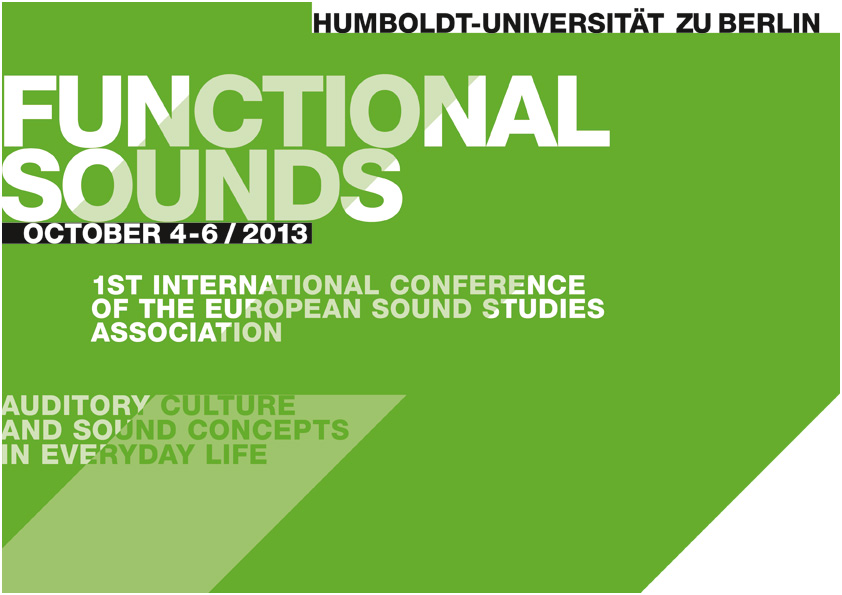
The confirmed keynote speakers are all leading scholars in the field and include Douglas Kahn, who is professor of Media and Innovation at the University of New South Wales in Sydney. Professor Kahn has been a driving force for the development of sound studies, primarily due to his influential 2001 book Noise, Water, Meat: A History of Sound in the Arts. Jason Stanyek, professor at the Faculty of Music at Oxford University, is also a keynote speaker. Professor Stanyek is a musicologist, who specializes in Brazilian hip-hop and Pan-African Jazz. Also he is the co-editor of The Oxford Handbook of Mobile Music Studies. The final keynote speaker is Thomas Macho, professor in cultural history at the Humboldt University in Berlin. Professor Macho has published on numerous subjects but of special interest for the sound studies field is his work concerned with the human voice and most recently his book on synchronization, Kulturtechniken der Synchronisation from 2011.
For those who cannot make it to Berlin this year, the place and dates for the 2014 ESSA conference have already been decided. It will take place in Denmark on June 27-29 2014 at the University of Southern Denmark in Odense. To be updated about ESSA and future events, please visit the website, http://www.soundstudies.eu, and sign up.
—
Featured Image Courtesy of Mediateletipos. In 2008, artist Akio Suzuki presented a sound installation around Berlin’s water tower focused on listening to everyday situations, directing listener’s attention through audial symbols painted on the ground.
—
Erik Granly Jensen is associate professor at the Department for the Study of Culture at the University of Southern Denmark. He is the research leader of The Nordic Research Network for Sound Studies, sponsored by Nordforsk 2011-2014. He is also the co-editor of the online journal SoundEffects and a founding member of ESSA, The European Sound Studies Association. His most recent research areas include historical sound archives and radio art. Contact: erikgranly@sdu.dk
—
 REWIND! . . .If you liked this post, you may also dig:
“Once the word ‘sound’ was in the title, it opened up a kind of door”: A Conversation with Eric Weisbard –-Liana Silva
Listening to the A. D. White House: Cornell’s Society for the Humanities’ Year in Review–Timothy Murray
Sound at ASA 2012–Jennifer Stoever-Ackerman
Share this:


Current Top Posts





April 2021

January 2020

November 2019

October 2019

August 2019

April 2014

November 2017

March 2015

December 2017

October 2015
 Sounding Out!
Recent Comments