
“A Long, Strange Trip”: An Engineer’s Journey Through FM College Radio


Today is World College Radio Day, and it’s more important than ever to honor and preserve free airwaves for our communities, now and for the generations to come. Sounding Out! is marking the day with a special post devoted to the intergenerational relationships that power college radio and keep it lit, whether over the terrestrial airwaves or via online streaming. College radio binds campus and community in tangible ways and builds deep and long lasting connections, as Sean Broder’s (WHRW 90.5 Class of 2025) conversation with Freddie Montalvo (WHRW 90.5 Class of 1987) certainly shows. Tune in to the people and keep it locked on college radio. –SO! Eds
—
In 2026, Binghamton University’s WHRW 90.5FM will celebrate its 60th birthday. Ferdinand “Freddie” Montalvo has been an prominent member of the station for 45 of those years, which means he has experienced many changes in radio’s culture and technology. Supplemented by his experience as a professional electrician, Freddie’s enthusiasm for a traditional approach to broadcasting has remained unchanged through the station’s many alterations, bringing undeniable authenticity to the forefront of the station, and showing newcomers how they can do the same.
An expressive medium, college radio has enabled students of all backgrounds to project their voice and music taste as far as the radio waves take them. Whereas some former college radio DJs apply their newfound power of expression to other professional fields, others like Freddie have only continued to develop their broadcasting style, which is why I wanted to get his perspective on college radio’s evolutions. Freddie has never lost sight of the art and the value of individualized broadcasting in the age of streaming music, and he generously shares it with incoming members who seek their own voices.

I met Freddie for this interview in the station’s current location in the basement of the university union. WHRW has three studios, one of the largest record libraries in the northeastern United States, and a common space that’s layered in stickers, posters, and graffiti spanning several generations of broadcasters. I found him in WHRW’s primary studio, CR-1, serving as the required broadcaster for a student talk show. As this was the end of the Spring ‘25 semester at BU, I was able to briefly catch the thank yous and goodbyes of the hosts at the conclusion of their final show. Freddie continues to host his own weekly radio show–Dimenciones on Saturdays from 7-10 PM on terrestrial radio 90.5 in the Greater Binghamton area and via WHRW’s livestream–but his additional involvement as an engineer for others at the station continues to enable newcomers to develop and project their own voices, even if they’re not certified broadcasters themselves. This post offers some excerpts of our in-depth conversation concerning Freddie’s life and rich history with WHRW, as well as his perspective on the continued importance of college radio, and of course some of the many valuable music recommendations he shared over our two hours together.
—
Freddie’s journey into the world of FM radio began in 1976, when the South Bronx native transferred from Bronx Community College to Binghamton University. It wasn’t until ‘79 that he would be introduced to the station by a friend of his who was hosting a Latin music show on the campus station WHRW 90.5, which had Freddie instantly hooked. Coming from a Puerto Rican family, it meant a lot to Freddie to join his friend in the station’s Latin Department; he became the first Latino program director in 1981 and the first Latino general manager in 1982. While serving leadership roles and maintaining his weekly programming, Freddie attended Binghamton through the work-study program BOCES (Boards of Cooperative Educational Services). It’s here that he trained to become an electrician, further intertwining his personal connection to WHRW:
BOCES… they taught you the fundamentals and at that time, I was getting involved at the station, and it was like a synergy of that, you know? Between electronics and radio broadcasting. So, at that time I was going to school in the evening, I went to the BOCES program 8-4/8-5, went to school at night, was doing radio, so everything was involved and influencing each other.
As a leading member of his department, Freddie embraced the alternative radio that WHRW was known for, broadcasting an assortment of music ranging from Latin Jazz to Cumbia, Disco, Salsa, and Santana… not to mention his confirmed favorite song: “Sofrito” by Mongo Santamaria.
In the decades following his transfer to BU, he has established a home and marriage in Binghamton, describing his life’s journey in the city as “a long, strange trip.”
—
WHRW has been a free format station since it began in 1966, giving each DJ and engineer freedom to play their favorite pieces of music within the FCC guidelines. WHRW has always been, according to Freddie, about “protecting that alternativeness on campus and off campus… we weren’t copying anybody.” He brings attention to what he calls the “great social redeeming value” of alternative broadcasting, which surpasses the confines of the station and not only enriches the surrounding community, but influences future forms of expression by DJs, or “broadcasters” as Freddie calls them.
When you record your shows and listen to yourself that’s how you develop your sense of style… The voice is an instrument, and you learn to modulate when you turn that mic on, always make sure you have on your headset, and that’s how you develop your style. ‘Cause at first you don’t realize these things, but as you evolve, you’ll notice these different nuances.

As his career progressed and Freddie became an installer technician, he increased accessibility to new musical programs for local residents, most notably, MTV. Combining this work with his many hours at the station, Freddie felt a great sense of pride and responsibility in bringing the forefront of new music to the lives of countless listeners. “I always called it therapeutic radio,” he explained to me, bringing attention to WHRW’s commercial-free programming, and the station’s ability to allow for its broadcasters to express their personalities. Freddie has never felt the need to possess an alter-ego while broadcasting as many do, explaining that members of the station are “audiophiles experiencing music, certain different genres, and that’s what we’re presenting. And when you do a show, you’re that show. That is your artwork in action.”
In addition to producing unique art on air, each WHRW broadcaster makes and plays hourly “carts,” public service announcements that are the closest thing to commercials on 90.5. There too, the station’s members have managed to transform the regulation-required station identifiers, PSAs, promos, and announcements into pre-recorded miniature productions; each about a minute long. During Freddie’s earlier years at the station, engineers made carts on Ampex audio track tape machines, quite different from the digital editing software utilized today. While traditional, bulky tape machines offered creative possibilities, they were be far less forgiving of errors than modern audio editing software. As Freddie told me,
there’s a certain thing that you can do with reel-to-reel recorders, where you could do sound-on-sound and sound-with-sound, and what that does is it creates an echo effect that is different from the electronic echos that you can do with the software… The mixing and the editing was hardcore, it was physical.
One of Freddie’s favorite promotional carts was “La Emisora Que Vuela,” made several years ago on the Ampex by a DJ apprentice of his, Francisco Reyes. Freddie remembered that it took eight full hours of recording, splicing, and layering for the minute-long audio production. Rightfully so, he refers to both the production process and final recording as true art, going on to describe the context of the dialogue:
So it’s like a gathering in a Latin household talking about different foods. And… It’s like a sitcom in a sense because he’s goofing with the different characters and he’s talking about, you know, the foods to be prepared. You say, well, who is this guy? That’s when he starts talking and saying: ‘you’ve got to be listening to WHRW in Binghamton.
“La Emisora Que Vuela” (“The Station That Flies”) -Francisco Reyes
The Ampex isn’t the only thing that has changed during Freddie’s 45+ years at WHRW. Other significant changes to the technologies utilized for broadcasting over the years. Because the station has always operated 24 hours a day, it required a certified broadcaster to remain on air at any given time for many decades. More recently, an automated system has allowed for some time slots to be occupied by a digital playlist, inevitably creating a distinct gap between WHRW’s night owls and early risers. Additionally, physical media such as vinyl records and CDs are no longer necessary for radio shows on WHRW. After the implementation of a Eurorack–which allows DJs to use an aux chord to play their shows–most current station members went digital. Despite this change and preference, Freddie remains loyal to the art of digging through physical media, for him primarily CDs, in order to find music that portrays his personality and taste.
Not too many people have FM radios at home, which was the norm. Everybody had records, they were listening to FM radio, and the only way you could listen to the station was tuning in with an FM radio. Today, everybody’s into Spotify… they’re not pulling records, they’re not pulling CDs, there’s no more really hands-on, it’s all plug in a laptop and sitting back… But that’s just me because I came from a different era, you know, where we had the hands-on with vinyl… once they put that Eurorack in there, it’s not the same. That’s why we have to have turntable classes to teach people how to work with the vinyl cause most of the younger crowd didn’t grow up playing 45s or lps, you know?… That’s when you’re definitely an audio aficionado.

Despite the sonic and technological changes that have permanently altered radio broadcasting, Freddie urges people of all backgrounds to get involved with radio given the opportunity; especially on the rare occasion that the station is free-format like WHRW has been since its inception. Technological changes aside, WHRW harbors the unique and deeply personal environment that deems college radio so valuable. Today, more than ever it is vital to understand the importance of large-scale audial expression in the face of vastly different musical soundscapes, as explained by Freddie:
This (the station) is the focal point for social interaction relating to music but, you know, today it’s more Spotify based, which is not the greatest because with a CD or an LP, you’re able to read the line-in notes, you get to read about the musicians, the group, the transition of between groups. Just think about Led Zeppelin. Zeppelin, let’s say Led Zeppelin 1, 2, and 3: different LPs, different flavors in their musical repertoire, you know? And you’re reading the LP, and you’re reading about the musicians and all the songs and the line and all… I’m not sure if Spotify has the same thing today… it’s not interactive. With LP’s, you’re fully engaged with that LP as you’re listening to it, whereas with that it’s just, you know, a certain song, or if you go looking for a little bit of tidbit, but it’s not the same experience. With the LP you get to see, you get to feel the artwork… it has to be different from the laptop experience… it’s more tactile.
Today, everything is digitized, it’s not like we have our live broadcaster or radio DJ… it’s not visceral in that sense… radio is different today. ‘Corporate radio’, as they refer to it… There’s no personality in it, and if there is a personality, it’s more blahblahblahblahblah and very little with the music and all… Even today, I listen to some DJs that I was listening to then and they’re still around today, and there’s a difference between that time and today. But, their influence must have influenced me unknowingly, and so as I experienced radio here, it’s vastly different from what I thought about radio at that time.
The thing is, when you do radio here [at WHRW], it is different than if you weren’t doing radio just listening to your laptop or Spotify. When you’re doing radio, you are engaging actively and producing your own show… It will influence you too, you know, we always used to say here: ‘expand your horizons’ and not just stay in a certain genre. As you experience WHRW, you will be listening to certain things, or you should be listening to certain things, and exposed to certain things, and that’s what opens your whole view, you know, musically, orally. And so, what you were listening to two years ago might be vastly different from what you are listening to today. And, when you go back home and you listen to radio you say ‘man, I could do better than that shit!
WHRW is vital for those who have ever been involved in its community, expressed to its truest extent by Ferdinand Montalvo. Members define the atmosphere within the station and the growth of the station outside of it. Despite the many technological changes to broadcasting, college radio has continued to build a symbiotic relationship with its members and the local community of listeners.
—
Featured Images: Courtesy of Ferdinand “Freddie” Montalvo
—
Sean Broder is a recent graduate of Binghamton University in Binghamton, NY, where he was a trained DJ at WHRW 90.5 FM as well as an English Literature major. He was a Sounding Out! intern in Spring and Summer 2025. He’s from New Rochelle, New York and has always had a great love for music.
—

REWIND! . . .If you liked this post, you may also dig:
“Vous Ecoutez La Voix du Peuple”: The Kreyol Language Pirate Radio Stations of Flatbush, Brooklyn–David Goren
Listening (Loudly) to Spanish-language Radio–Dolores Inés Casillas
“Chicana Radio Activists and the Sounds of Chicana Feminisms“–Monica De La Torre
Radio and the Voice of the Aymara People – Karl Swinehart
Share this:

Mukbang Cooks, Chews, and Heals
 Welcome to Next Gen sound studies! In the month of November, you will be treated to the future. . . today! In this series, we will share excellent work from undergraduates, along with the pedagogy that inspired them. You’ll read voice biographies, check out blog assignments, listen to podcasts, and read detailed histories that will inspire and invigorate. Bet. –JS
Today’s post comes from Binghamton University junior David Lee, former student in SO! Editor-in-Chief J. Stoever’s English 380W “How We Listen,” an introductory, upper-division sound studies course at Binghamton University, with a typical enrollment of 45 students. This assignment asked students to
write one researched, multimedia blog post on our class WordPress in the style of Sounding Out! on a sound studies topic of interest to you (approximately 1500 words). Your post should involve an issue involving power and social identity, use our in-class readings as a springboard and quotes and analyzes at least 2 in the post, relate our course topic at hand to a contemporary event, conversation, or issue and includes evidence of research of that topic (3-5 quotations/links to credible online sources), include audio, visual, and/or audio-visual elements as a key part of your analysis (this can include recordings, still photos, you tube clips, videos, etc.) and follow SO!’s submission guidelines on form, style, tone, and content: (https://soundstudiesblog.com/to-blog-2/).
For the full assignment sheet, click How We Listen_Final Blog Assignment For the grading rubric, click Blog Assignment Grading Rubric (1). For the full Fall 2018 syllabus, click english-380w_how-we-listen_fall-2018
—
Mukbang is the newest wave in trends for ASMR; it is an online audiovisual broadcast in which the host enjoys his/her food while interacting with the audience. Adopted from Korea, Mukbang’s literal translation is a portmanteau—it is a combination of two Korean words: “mukja” (let’s eat) and “bangsong” (broadcast). The first time I watched these eating broadcasts was in 2018, before major surgery. Prior to the surgery, I could not eat for twenty-four hours. It came to the point where I was so hungry that I would chew up the meat and spit it out and I would make a mental list of foods that I wanted to eat after the surgery. In an effort to satisfy my hunger, I watched a lot of videos on the Tasty network and stumbled upon Mukbangs. I had heard of the term prior to that day but had never watched the videos myself. The experience could be expressed as an oxymoron: sweet torture. I remember salivating uncontrollably but at the same time watching someone eat began to ease my own stomach.
In recent years Mukbang has blown up on streaming sites like Youtube, and has been met with a subsequent huge audience growth. Mukbang was most notably referenced in the company’s Youtube Rewind 2018 video:
Interestingly, Mukbangs have only been considered ASMR once they were adopted by American content creators. According to journalist Matthew Sedacca, viewers explain that they experience what they call a “braingasm”, described as a tingling sensation down one’s spine from the sounds of cooking and eating. The sizzling sounds of the broth or the slurping sounds of noodles are what is said to relax the listeners. In Touch the Sound, Evelyn Glennie communicates that to hear is to also touch. Likewise, the viewers experience a sensation of touch from the audio and visual elements that the video stimulates. The sounds of food that many associate with tingling, pleasant sensation can also provide viewers with a sense of comfort and reassurance.
In today’s busy society, it is hard to have a formal meal with our family and friends, so oftentimes we are found eating alone. Watching Mukbangs can mitigate the feeling of loneliness through the presence of what Steve Connor calls the vocalic body, so while we are eating alone, the presence of another is real and felt. According to Connor, “[t]he principle of the vocalic body is simple. Voices are produced by bodies: but can also themselves produce bodies. The vocalic body is the idea—which can take the form of dream, fantasy, ideal, theological doctrine, or hallucination—of a surrogate or secondary body, a projection of a new way of having or being a body, formed and sustained out of the autonomous operations of the voice” (35). The voice in these videos takes the form of a body sitting next to us, eating and talking to us.
Simply put, viewers are watching another individual enjoy his/her meal, but Mukbangs have a greater social implication. The rise in popularity of Mukbangs coincide with the rapid technological advancements occurring in society and the shift in entertainment focus on streamable content. Eating is a routine and everyday experience, so Mukbangs portray a vital aspect of life where viewers can passively watch while experiencing the sensory feeling that sound evokes. When the host visually and audibly enjoys his/her meal the viewers can feel the presence of a body ,which accounts for the chills down one’s spine characteristic of ASMR videos. As this phenomenon demonstrates, sound can lessen feelings of loneliness by bringing the audience a sense of human comfort.

“the cook has to eat alone” by Flickr user Joseph Choi, CC BY 2.0
Mukbangs are also helpful to those who have restrictions in their diet. For someone who may be deadly allergic to shellfish, he/she can imagine that experience by watching another person enjoy the dish. While it is not the same as twisting off the claws of a lobster and eating the meat, watching and listening to another person do just that allows the viewer to be a part of that experience. Moreover, a deadly food allergy may keep someone from sharing a communal meal with friends; the sounds of a Mukbang video could recreate that experience. Lastly, and no less important, Mukbangs act in opposition to the unrealistic beauty standards of society; while society’s expectations push us to always keep our figure, a Mukbanger’s response is to eat senselessly. Therefore, Mukbangs embody our fantasies; we live vicariously through the broadcaster.
Mukbangs have introduced a new format for cooking shows. Rather than emphasizing cheesy background music and eccentric hosts on cable tv, Mukbangs strip all these effects away, so that viewers can truly appreciate the essence of cooking in the kitchen: it’s not just about what the dish tastes like in the end, but also the auditory experience. On cooking shows, a lot of the focus ends up on what the plate looks like, or what steps go in what order—it is a visual experience, in general. When it comes to Mukbangs, people watching the videos get to enjoy the relaxing sounds of cooking, and the focus is not on copying the recipe: Sedacca states, “with ASMR it becomes more about the sound than the taste.” The alternate format promotes cooking to a larger audience instead of gearing towards stay-at-home moms. Mukbang cooking videos tend to be more of a minimalist everyday perspective rather than displaying cooking as a luxurious commodity. Mukbangs show us that it is no longer about becoming the cook, but appreciating the cooking being done, and the sound adds to the intimacy of the event. With Mukbangs it is as if your mom were cooking in the kitchen.
In doing so, Mukbangs can also advocate for cultural awareness, as viewers are exposed to different foods that the host enjoys. By seeing a host they trust enjoy foreign food, it encourages the viewer to possibly try that food or visit that country in the future. A popular example of this would be when kpop idol Hwasa from group Mamamoo went on a South Korean tv show called I Live Alone and ate gopchang (cattle intestines) at a nearby restaurant. After the video went viral, the Korean BBQ restaurant industry exploded within a day, so much so, that the dish was reportedly sold out in all of Seoul, Korea.
As for me, nowadays I watch Mukbangs when I miss home. Now that I am away at college, many of my meals consist of dining hall food. Where I go to school, Korean restaurants are scarce and do not taste the same as home. There is something about a well-cooked Korean meal that Korean restaurants at school cannot replicate. So, when I am away at college, I often watch Korean Mukbangs to tap into the comfort of home, through sound and images.
Mukbang watchers have an array of audience members; people watch it to lose weight, for ASMR, or simply when they are eating alone. Mukbangs challenge social norms; although it may be rude to slurp spaghetti noodles in public, Mukbang is evidence that some people enjoy those exact sounds. Likewise, as more people begin to live individualistic lives, the eating broadcasts make up for this difference in human interaction. For those trying to lose weight, Mukbangs offer the option of seeing someone “eat their feelings” without you yourself having to overindulge or feel guilt.
More importantly, Mukbang is a relevant example that listening can be a tactile experience: through vibrations and also from sensations through the body. It challenges the listening audience to be present and appreciate the essence of food, and cooking as a sustaining artform. The aforementioned is especially true for cooking shows where the audience listens for the calming sounds that come with cooking instead of listening to what seems like a sales pitch to best copy the recipe. Mukbang makes cooking and, consequently, eating into healing activities instead of something that is reserved solely for those who have the time. Mukbangs are making a social difference by promoting Korean culture, spreading cultural awareness through food, and helping to lessen the feeling of loneliness. While Mukbangs were previously seen as fetishized or weird they are now challenging our preconceived notions on how, what, and with who we should enjoy food.
—
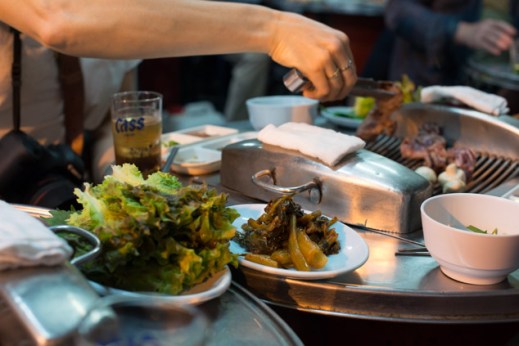
Featured image: “Korean Food – Korean Kimchi and BBQ Cooking Meat (Creative Commons)” by Flickr user Sous Chef, CC BY 2.0
—
David Lee is a Korean American Junior at Binghamton University studying Finance and Marketing. In his free time he likes to read, work out, or watch TV. He is an avid fan of Game of Thrones, Rick and Morty, and Got7.
—
 REWIND! . . .If you liked this post, you may also dig:
Sounding Out Podcast #14: Interview with Meme Librarian Amanda Brennan — Aaron Trammell
Listening to Whisperers: Performance, ASMR Community, and Fetish on Youtube — Joshua Hudelson
Toward A Civically Engaged Sound Studies, or ReSounding Binghamton–Jennifer Stoever
Share this:


Current Top Posts





April 2021

January 2020

November 2019

October 2019

August 2019

April 2014

November 2017

March 2015

December 2017

October 2015
 Sounding Out!
Recent Comments