
Reading the Politics Of Recorded Sound

Just released this past month, Social Text 102: The Politics of Recorded Sound is the latest special issue to take the temperature of the field of sound studies. Answering the provocative question posed by Michelle Hilmes in a 2005 review essay for American Quarterly (which will soon have its own special issue on sound), “Is There a Field Called Sound Culture Studies? And Does It Matter?” with a resounding “yes! and yes!”, the issue elegantly captures both the rigorous possibilities and the vexing challenges of this now-emerged interdisciplinary field. ST 102 is edited by Gustavus Stadler, Associate Professor of English at Haverford College, and the issue curates interdisciplinary essays by David Suisman, Mara Mills, Jennifer Stoever(yours truly), Stadler, Alexandra T. Vasquez, and Jayna Brown that challenge traditional technology-driven narratives of recording history by excavating the multiple, conflicted, and sometimes generative ways in which sound recording is tangled in networks of power like an old cassette tape gone wrong.

Given space limitations and my own vested excitement over the issue, my writing here will be more preview than review, slicing you off a tantalizing tidbit rather than chewing it all up for you. It really is something that critical sound studies heads will want to mull over on their own, and toward that end, I include links to each piece that take you to Social Text’s newly-revamped website where you can read the abstract, listen to hand-selected audio supplements, and download the article if you have an institutional subscription. My analog peeps can order hard copy of the issue here. Readers in the New York area can celebrate the issue’s release on Friday, April 30th @ NYU’s Tisch Center.
Gustavus Stadler’s “Introduction: Breaking Sound Barriers” takes the supposed transparency of recording technology to task and asks readers to consider not only what recording has enabled but what it has foreclosed. Eschewing technological determinism, Stadler writes, “what matters here is learning how to hear what power, history, culture, and difference sound like. Those categories are, ultimately, the ‘technology’ of sound recording” (10-11).
David Suisman’s “Sound, Knowledge, and the ‘Immanence of Human Failure’: Rethinking Musical Mechanization through the Phonograph, the Player-Piano and the Piano” recounts the forgotten history of the player piano, which once battled it out with the phonograph for the title of sound playback technology du jour. After reading Suisman, the ways in which scholars have tuned out the player piano will seem utterly surprising, given its importance as a forerunner of digital modes of reproduction.
Mara Mills’s “Deaf Jam: From Inscription to Reproduction to Information” tackles the complex history of the telephone, arguing for a more prominent place for telephony in media studies and exposing the submerged history of the use of disabilities within technoscience. Though deaf participants were invaluable in the quest to make speech more “streamlined,” scientists and marketers eventually redacted deaf populations themselves in the name of “efficiency.”
My “Splicing the Sonic Color-line: Tony Schwartz Remixes Postwar Nueva York” introduces readers to Tony Schwartz, sound artist and audio thinker, and reads his 1955 Folkways recording Nueva York as symptomatic of the ways in which listening experiences both reflect and generate ideas about racial difference and American citizenship. Using archival methods to reconstruct the soundscape of 1950s New York, I theorize the presence of what I call the “sonic color-line” in the U.S., linking sound and listening to bodily codes of race.
Gus Stadler’s “Never Heard Such a Thing: Lynching and Phonographic Modernity” explores the quiet-as-its-kept rumors of on-site lynching recordings made in the nineteenth century, using archival methods to expose their falsehood even as he notes how the presence and circulation of lynching (re)productions reveals another edge of the centuries-long white obsession with black voices and the marketability of black pain. Stadler very powerfully connects the “cheapness and tenuousness” of cylinder inscriptions with the “cheapness and tenuousness of black lives as shaped by the white supremacist turn-of-the-century United States” (103).
Alexandra T. Vasquez’s “Can You Feel the Beat”? Freestyle’s Systems of Living, Loving, and Recording” takes us into New York’s recording studios in the 1980s to amplify the suppressed experiences and unsung professionalism of Freestyle’s leading divas: Nayobe Gomez, Judy Torres, Cynthia. Vasquez’s critical labor enables us to hear these singers anew, exploring their work as theorists of the everyday, crafting pleasure, pain, and experience into a set of “bad ass armaments” for their listeners (122).
And finally, Jayna Brown’s “Buzz and Rumble: Global Pop Music and Utopian Impulse” reimagines both “world music” and “utopia” in her provocative essay on digital music’s newfound (and decentered) possibilities: to subvert national boundaries, evade corporate control, and heal bodies torn apart by capitalism and seemingly perpetual war. Tracing the complex links between Congotronics, Buraka Son Sistema, M.I.A. and kuduro music in Angola, Brown’s essay is not only a resonant reminder of the liberatory potential of music, but of scholarship as well.
JSA


Share this:

Gendered Ears
While there is a rich discussion in cultural studies about gendered representation in popular music, there remains very little about gendered listening experiences—or, more accurately—gendered perceptions of other’s listening experiences. Big Ears: Listening for Gender in Jazz Studies, one of the newest offerings from Duke’s Refiguring American Music series, makes promising headway in this direction, initiating a conversation about the way in which various types of listening practices—that of fans, musicians, and critics—are coded in the largely male dominated world of jazz. In popular music, however, this conversation has remained more nascent. As a female practitioner in the field with multiple identities—fan, vinyl collector, academic critic, consumer, blogger—it is uncomfortable how frequently I find people making very circumspect and circumscribed assumptions about the way in which I listen to music.
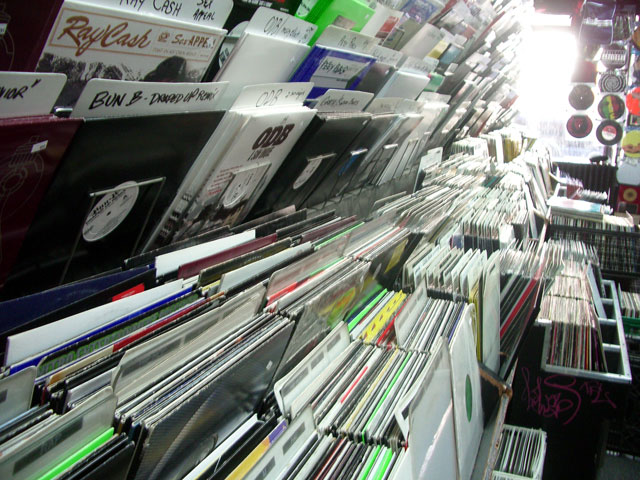 I have been collecting vinyl since the days when it was just called “buying records.” My first purchase at age 5, made via my Dad, was The GoGos’ Beauty and the Beat, which I still own, now carefully tucked into a plastic sleeve. And, thanks to my Dad’s gentle lesson in how to handle vinyl, it isn’t in very bad shape, either. Record collecting was a thrill my father shared with me, creating a connection between us that sometimes held when other bonds were endangered. No matter what, I always wanted to call him and tell him when I finally found a mint copy of Michael Jackson’s Off the Wall at a thrift store or Prince’s Purple Rain with the poster still inside.
A number of weeks ago, I was on a routine summer Saturday morning mission: trolling the yard sales in my neighborhood for kid’s stuff, used books, and vinyl. While I never expect to find the holy grail of record albums at a yard sale, I am always willing to flip through piles of Barbara Streisand, Eddie Rabbit, Billy Joel, and Herb Alpert in the hopes I might uncover it. Usually, I just end up taking in the ripe dusty smell and silently cursing the sad condition of the vinyl I find there, hating to leave even the most scratched-up Mantovani warping in the full summer sun. But you never know.
On this particular Saturday, I was vinyl hunting with my infant son strapped to my chest and had my dog, He Who Cannot Be Named, pulling at the leash. In effect, I had suburban motherhood written all over my body as I strained on my tip-toes to reach records at the back of the pile and whispered to my sleeping son about why I was so excited to find a Les Paul and Mary Ford record. In the midst of my record reveries, I overheard a man next to me begin telling the proprietor of the yard sale about his record collecting habit. He went on and on about how long he has been collecting, how many records he has, how he “just got back from buying a thousand records off a guy in Appalachin.”
My hackles were instantly raised by this conversation about record-size. I already felt a bit left out, as this man obviously chose to ignore the woman actually looking at the records in favor of the only other man around. Vinyl collecting remains an overtly male phenomenon, as Bitch Magazine discussed in their 2003 Obsession issue. Although I am embodied evidence that women do collect vinyl, I am used to being in the complete minority at record shows, music conferences, and dusty basement retail outlets and overhearing countless conversations just like this one. In spite of myself, I decided to jump in to the conversation. . I thought I would cast out a lifeline to my fellow vinyl junkie, as the yard sale guy was obviously not interested and just humoring the record geek in front of him in the hopes that he would cart away the entire stack. Plus, I miss geeking out with someone else who loves records. After a lifetime in urban California, I now live in a small town in Upstate New York. While the record bins are not so tapped out here, it is lonely going for a record head. So I said to him, “I collect records too. I can’t believe you found so many records in Appalachin.” My invitation down the path of geekdom, however, was rebuffed. “Oh,” he said, barely looking up, “yeah. It happens all the time.” And then back to yard sale guy.
I tried not to take it personally, but it became impossible after this same scene was re-enacted at four or five different houses down the block. This guy was like a cover version of the Ancient Mariner, compelled to tell man after man all about the size of his enlarging record collection, the beloved albatross around his neck: “Man, have you ever tried to move a thousand records all at one time? They are so heavy and they take up so much space!”
And, I was the invisible witness to his tale of obsession, love, and woe, silently flipping through records just a few steps ahead of him. That is ultimately how I knew he did not see me as an equal rival in the world of vinyl hunting—he let me get ahead and stay ahead in the bins, neither sneaking peeks at what I pulled or, fingers flying, moving faster and faster in the hopes of overtaking me. He just assumed that I, dog in hand and baby on chest, would pull complete crap.
My listening ears then, bear the weight of my gender and the limited ways in which women are expected to engage with music. Women remain perpetually pegged as teeny-bopper fan club leaders and screaming Beatle fans, perpetually deafening themselves to the “real music.” Despite the deft critiques of Norma Coates, Susan Douglas, and Angela McRobbie, in which the early Beatles audience is re-imagined as proto-feminist and teenaged girls’ bedrooms are viewed as sites of cultural competency rather than deaf consumerism, my female ears remain cast as those of a groupie but never an aficionado, as if the two are somehow mutually exclusive. Imagine the Ancient Mariner’s surprise when this vinyl mama plucked pristine copies of The Cure’s Faith, The Fania All Stars Live at Yankee Stadium, and Aretha Franklin’s Live at the Fillmore West right out from under his own blind ears.
–JSA


Share this:


Current Top Posts





April 2021

January 2020

November 2019

October 2019

August 2019

April 2014

November 2017

March 2015

December 2017

October 2015
 Sounding Out!
Recent Comments