
Musical Encounters and Acts of Audiencing: Listening Cultures in the American Antebellum

 Editor’s Note: Sound Studies is often accused of being a presentist enterprise, too fascinated with digital technologies and altogether too wed to the history of sound recording. Sounding Out!‘s last forum of 2013, “Sound in the Nineteenth Century,” addresses this critique by showcasing the cutting edge work of three scholars whose diverse, interdisciplinary research is located soundly in the era just before the advent of sound recording: Mary Caton Lingold (Duke), Caitlin Marshall (Berkeley), and Daniel Cavicchi (Rhode Island School of Design). In examining nineteenth century America’s musical practices, listening habits, and auditory desires through SO!‘s digital platform, Lingold, Marshall, and Cavicchi perform the rare task of showcasing how history’s sonics had a striking resonance long past their contemporary vibrations while performing the power of the digital medium as a tool through which to, as Early Modern scholar Bruce R. Smith dubs it, “unair” past auditory phenomena –all the while sharing unique methodologies that neither rely on recording nor bemoan their lack. The series began with Mary Caton Lingold‘s exploration of the materialities of Solomon Northup’s fiddling as self-represented in 12 Years a Slave. Last week, Caitlin Marshall treated us to a fascinating new take on Harriet Beecher Stowe’s listening practice and dubious rhetorical remixing of black sonic resistance with white conceptions of revolutionary independence. Daniel Cavicchi closes out “Sound in the Nineteenth Century” and 2013 with an excellent meditation on listening as vibrant and shifting historical entity. Enjoy! —Jennifer Stoever-Ackerman, Editor-in-Chief
—
“To listen” is straightforward enough verb, signifying a kind of hearing that is directed or attentive. Add an “er” suffix, however, and “listen” moves into a whole new realm: it is no longer something one does, an attentive response to stimuli, but rather something one is, a sustained role or occupation, even an identity. Everybody listens from time to time, but only some people adopt the distinct social category of “listener.”
And yet listeners have emerged in diverse historical and social contexts. Arnold Hunt, in his recent book The Art of Hearing, for example, points to the congregants of the Church of England in the late sixteenth and early seventeenth centuries, whose sermon-gadding and intense repetitive listening to preachers became a form of popular culture. Shane White and Graham White, in The Sounds of Slavery, argue that early nineteenth-century black slaves adopted listening, or “acting soundly,” as a way of being that gave everyday sounds—conversation, cries of exertion, hymns—multiple layers of meaning and a power unknown to white overseers. Jonathan Sterne, in The Audible Past, describes the post-Civil War culture of sound telegraphy, in which young working class men trained themselves to employ “audile technique” for bureaucratic purposes, rendering their hearing objective, standardized, and networked.

Physical manifestations of the growing standardization of listening, Dodge’s Institute of Telegraphy, circa 1910 – Valparaiso, Indiana, Image by Flickr User Mr. Shook
We might add our own contemporary iPod era to these examples. We live in a time, after all, when it entirely acceptable to appear alone in public, ears connected to an iPod, head bobbing to the grooves of a vast archive of recorded music. Sampling, playlists, streaming–thanks to playback technologies, the U.S. has become a nation of obsessive listeners, and the power to “capture” a sound and re-hear it, something that began with the phonograph, remains a time-bending drama that can awaken people to their own aurality. Technologized listening, in fact, has spawned many of the icons of music discourse in the past 100 years: Edison’s tone testers in 1910s, record-collecting jitterbugs in the 1930s, audiophiles of the Hi-Fidelity era in the 1950s, Beatles fans with their bedroom record players in the 1960s, the “chair guy” in Memorex’s famous ad campaign of 1980, dancing listeners silhouetted in iPod posters since 2003.
But I think also that phonograph-centric narratives have obscured earlier, equally powerful cultures of listeners. The focus of my recent research, for example, has been the world of antebellum concert audiences. Between 1830 and 1860, the United States developed concentrated population centers filled with boosters and recent migrants eager to embrace a life based on new kinds of economic opportunity. Shaping much of the urban experience was a growing commercialization of culture that generated new and multiple means of musical performance, including parades, museum exhibitions, pleasure gardens, band performances, and concerts. Together, these performances significantly enhanced the act of listening: for people used to having to make music for themselves in order to hear it, a condition common to most Americans before 1830, access to public performances by others provided an opportunity for working and middle-class whites (women, African Americans, and the poor were another matter) to stop worrying about making music and, with the purchase of a ticket, to solely, and at length, assume an audience role.
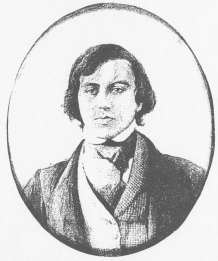
A young George Templeton Strong, Image from CUNY Baruch
The odd circumstance of purchasing the experience of listening provided class-striving urbanites with new possibilities for self-transformation. For many young, rural, white men, for example, arriving to the city for the first time to take clerking jobs in burgeoning merchant houses, being able to hear diverse performances of music was associated with a cosmopolitanism that brimmed with social possibility. Thus, for instance, Nathan Beekley, a young clerk, recently arrived in Philadelphia in 1849, found himself attending multiple performances of music several nights a week, including more and more appearances at the opera as a way to avoid “rowdies.” In New York City during the 1840s, George Templeton Strong, a young lawyer in Manhattan, derided his own musical abilities and instead attended every public musical event he could find, carefully chronicling his listening experiences and analyzing his reactions in a multi-volume journal. Walt Whitman, a young man on the make in Brooklyn and New York between 1838 and 1853, regularly attended every sound amusement he could, including the Bowery Theatre, dime museums, temperance lectures, political rallies, and opera, writing in Leaves of Grass, “I think I will do nothing for a long time but listen/And accrue what I hear into myself.”
This culture of listening was, in many ways, very much unlike ours. Despite an expanded access to performance, for instance, professional concerts before the mid-1850s were often understood as part of a wider ecology of sound. Very few listened to music in ways that we might expect today–focused on a “work,” in a concert hall, without distraction. Listening, in fact, was as much a matter of local happenstance as personal selection—a passing marching band, echoes of evening choir practice at a nearby church, an impromptu singing performance at a party. Such experiences were marked by the momentary thrill of spontaneity and discovery rather than the studied appreciation of familiarity; in any moment of hearing, it was difficult to know how long the encounter might be, or even what sounds, exactly, were being heard. Cities like Boston and New York were especially rich with such surprise encounters.
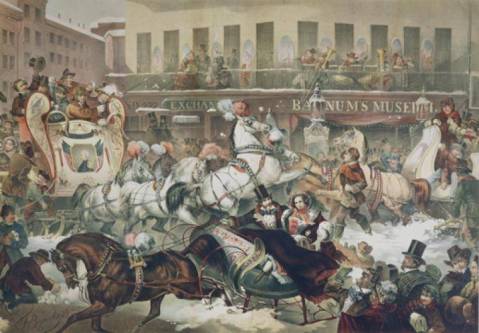
Thomas Benecke’s lithograph “Sleighing in New York” from 1855, which, among many other sounds, depicts musicians performing on the balcony of Barnum’s Museum on the corner of Broadway and Ann Street.
Francis Bennett, a young arrival to Boston in 1854, for example, encountered, in his first night in the city, a band concert and the “cries” from a “Negro meeting house,” and within weeks became enamored of fife and drum bands, often leaving work to follow one and then another as far as he dared. Young writer J. T. Trowbridge was more stationary but equally enthusiastic about what he heard from his New York rooming house in 1847: “The throngs of pedestrians mingled below, moving (marvelous to conceive) each to his or her ‘separate business and desire;’ the omnibuses and carriages rumbled and rattled past; while, over all, those strains of sonorous brass built their bridge of music, from the high café balcony to my still higher window ledge, spanning joy and woe, sin and sorrow, past and future….”
Music listeners were also often listeners of other forms of commercial sound, especially theater, oratory, and church services, which, together, comprised a complex sonic culture. This was especially reinforced by the physical spaces in which they shared such diverse aural experiences. In a rapidly-growing society, there often was not time or immediate resources to construct buildings dedicated to specific uses; instead, existing structures–typically a “hall” or “opera house”–served mixed uses.

Metropolitan Hall in New York City, where concert singer Elizabeth Taylor Greenfield debuted in 1853. It also hosted abolitionist meetings, talks on women’s rights, and various other activities.
As historian Jean Kilde noted in When Church Became Theater, evangelists in the Second Great Awakening often rented urban theaters for services; and congregations, in turn, rented churches to drama troupes, ventriloquists, and musicians to raise money. This “mixed-use” of buildings was reinforced by hearers, who often engaged in their own “mixed-use” understandings of what they heard. They evaluated sermons as they would a theatrical performance or found church choirs thrillingly entertaining rather than piously inspirational. Conversely, they listened to symphonic concerts with a religious solemnity.
This culture of antebellum, middle-class urban listeners didn’t last long, succumbing to the class sorting by post-Civil War social reformers, who mocked the indiscriminate over-exuberance of antebellum listeners as a kind of “mania” and a form of social disorder. As Lawrence Levine explains in Highbrow Lowbrow, over the course of the nineteenth century, developing a “musical ear” became increasingly paramount, reverence for great works of art shaped audience response, and listening became a specific skill to be learned. Music became something to appreciate not simply hear. By the 1890s, a true listener was someone who, in the words of critic Henry Edward Krehbiel (in his enormously popular How to Listen to Music, from 1897), “will bring his fancy into union with that of the composer” (51).

“Man With the Musical Ear.” Arthur’s Home Magazine (September 1853): 167.
In many ways, the controlled silent listening favored by reformers directly paved the way for music technologies, like the phonograph, that similarly sought to control and manipulate listening. But it was the urban music listeners of the 1840s and 1850s who were responsible, in the first place, for identifying and accentuating the joys and possibilities of “just listening.”
—
Featured Image: Etching of Jenny Lind Singing at Castle Garden in New York City, 1851
—
Daniel Cavicchi is Dean of Liberal Arts and Professor of History, Philosophy, and the Social Sciences at Rhode Island School of Design. He is author of Listening and Longing: Music Lovers in the Age of Barnum and Tramps Like Us: Music and Meaning Among Springsteen Fans, and co-editor of My Music: Explorations of Music in Daily Life. His public work has included Songs of Conscience, Sounds of Freedom, an inaugural exhibit for the Grammy Museum in Los Angeles; the curriculum accompanying Martin Scorcese’s The Blues film series; and other projects with the Public Broadcasting System and the National Park Service. He is currently the editor of the Music/Interview series from Wesleyan University Press and serves on the editorial boards of American Music and Participations: the Journal of Audience Research.
—
 REWIND! . . .If you liked this post, you may also dig:
“Como Now?: Marketing ‘Authentic’ Black Music,” –J. Stoever-Ackerman
Hearing the Tenor of the Vendler/Dove Conversation: Race, Listening, and the “Noise” of Texts –Christina Sharpe
How Svengali Lost His Jewish Accent––Gayle Wald
Share this:

Functional Sound (Studies): The First European Sound Studies Association Meeting

On October 4-6, 2013 ESSA – The European Sound Studies Association – will have its first conference in Berlin. This initiative is just the latest sign that an institutionalization is taking place within the inter-disciplinary field of sound studies. Erik Granly Jensen, who is one of the founding members and vice-chair of ESSA, tells the story here:
During the past decade, the field of sound studies – or auditory culture if you will –has been growing immensely. International conferences and seminars, numerous dissertations, monographs and research articles have shaped a vibrant, interdisciplinary area of study that of course has a much longer history within the more traditional disciplines of the humanities and social sciences, but which during the past 10-15 years has morphed into a discipline of its own. Just last year, two extensive collections of theoretical texts appeared with major publishing houses, The Oxford Handbook of Sound Studies (ed. Trevor Pinch & Karin Bijsterveld) on Oxford University Press and The Sound Studies Reader (ed. Jonathan Sterne) on Routledge. A second edition of the classic Auditory Culture Reader (ed. Michael Bull) is in the making and supposedly another Routledge anthology is being planned as well. Furthermore, in 2010 three European journals on sound cultures appeared within just a few months: the Holland-based Journal of Sonic Studies, the Ireland-based journal Interference and the Denmark-based SoundEffects; all three of them international online journals devoted to the analysis of sound cultures with an explicit ambition to integrate sound into academic analysis. To give an illustration of the interest that these journals are already enjoying is the fact that SoundEffects in 2012 alone had 15,000 individual article downloads.

With all these activities taking place, supplemented by the high number of research networks and transnational research projects throughout Europe, for instance “Sound in Media Culture” sponsored by the German Research Foundation or “The Nordic Research Network for Sound Studies” sponsored by the Nordic Research Foundation, Nordforsk, it seemed to be a question of time before the area of sound studies would take yet another disciplinary step and bring all the efforts together in an association. For even if the field of sound studies is alive and well, the advantage of creating a lasting academic platform where researchers, practitioners and artists can meet annually to exchange ideas and build new networks should not be underestimated. The existence of an association and an explicit reference to a global community for research and artistic practice into sound could be the decisive argument for both the introduction of university programs and job positions within sound studies. ESSA, The European Sound Studies Association that was founded last year could become such a forum.

As is so often the case, the idea for a sound studies association arose at an occasion that was scheduled for other purposes. In January of 2012, twelve members of the Nordic Research Network for Sound Studies were gathered in Copenhagen to plan the activities of the Nordic research network, www.sdu.dk/norsound. During discussions of a possible doctoral school that would include not just doctoral students from the Nordic countries, but be a traveling European doctoral school, the idea for both a European summer school and for a forum that could facilitate sound studies throughout the European continent was put on the table. Everybody present (including Anahid Kassabian, Michael Bull, Heikki Uimonen, and Marcel Cobussen to mention a few) agreed that this was both a great and a timely idea and the association ESSA, European Sound Studies Association, was born.
ESSA is a groundbreaking organization, bringing together the widest range of approaches to the study of sound. It’s exciting to be involved in its earliest stages and to participate in shaping this new community. I’m very much looking forward to its growth over the next few years and to ESSA becoming a productive environment for scholars working with many aspects of sound. –Anahid Kassabian, University of Liverpool
During the past year, an ESSA website was launched and discussions of a possible legal statute of the association have been circulating in the group parallel with the planning of the first ESSA conference. The reason for the working of the legal statute is, that ESSA in the future will be run by membership donations and through a democratically elected board of members.
In particular musicologist Morten Michelsen from the University of Copenhagen and Holger Schulze, professor of historical anthropology of Sound at the Academy of Arts in Berlin (two other members of the founding group) have been the driving forces of ESSA in this initial phase. At this point where everything is still waiting to happen, it is of course hard to predict what ESSA will be and what kind of an association it can be in the future. However, the ambition is to provide “a forum where those involved in the study of sound can meet and exchange ideas.” ESSA will also encourage “the development of research and systematic study in topics and in areas where such study in not well developed” as is stated on the website. In addition to these overall ambitions, the initial idea of a European doctoral summer school for sound studies still has a high priority as a future goal for ESSA.
With the founding of the European Sound Studies Association – the study of sound in all it’s inter-disciplinary richness and diversity now has an independent institutional voice for the first time. The range of sonic scholars that is converging on Berlin for ESSA’s first annual conference in October is evidence of both the need and the success of ESSA. The presence of ESSA will provide a platform, not just for European scholars, but for all those working on sound globally. –Michael Bull, University of Sussex
The theme for the upcoming conference in Berlin is “Functional Sound.” The conference will focus on existing as well as emergent and cutting-edge approaches to functional sound design, sonification, auditory culture, everyday soundscapes, artistic concepts and popular culture. In particular, the conference encourages presentations that include both theoretical and practical aspects and presentations that address everyday contexts within which sound—in its relation to media, technology, and the arts—is constitutive for new ways of thinking, listening, and becoming. The conference is a joint venture with the international research network “Sound in Media Culture” (led by Holger Schulze). During the three conference days, paper presentations in six parallel streams will cover topics such as “Soundscape of the Urban Future,” “Sound Design Practices,” “Sonic Artistic Practices and Research,” and “Cultural Politics & Sonic Experience.” [Editor: Click here for the full program, which includes several Sounding Out! editors and writers: Jennifer Stoever-Ackerman, Neil Verma, reina alejandra prado saldivar, Mack Hagood, and Regina Arnold. –JSA]

The confirmed keynote speakers are all leading scholars in the field and include Douglas Kahn, who is professor of Media and Innovation at the University of New South Wales in Sydney. Professor Kahn has been a driving force for the development of sound studies, primarily due to his influential 2001 book Noise, Water, Meat: A History of Sound in the Arts. Jason Stanyek, professor at the Faculty of Music at Oxford University, is also a keynote speaker. Professor Stanyek is a musicologist, who specializes in Brazilian hip-hop and Pan-African Jazz. Also he is the co-editor of The Oxford Handbook of Mobile Music Studies. The final keynote speaker is Thomas Macho, professor in cultural history at the Humboldt University in Berlin. Professor Macho has published on numerous subjects but of special interest for the sound studies field is his work concerned with the human voice and most recently his book on synchronization, Kulturtechniken der Synchronisation from 2011.
For those who cannot make it to Berlin this year, the place and dates for the 2014 ESSA conference have already been decided. It will take place in Denmark on June 27-29 2014 at the University of Southern Denmark in Odense. To be updated about ESSA and future events, please visit the website, http://www.soundstudies.eu, and sign up.
—
Featured Image Courtesy of Mediateletipos. In 2008, artist Akio Suzuki presented a sound installation around Berlin’s water tower focused on listening to everyday situations, directing listener’s attention through audial symbols painted on the ground.
—
Erik Granly Jensen is associate professor at the Department for the Study of Culture at the University of Southern Denmark. He is the research leader of The Nordic Research Network for Sound Studies, sponsored by Nordforsk 2011-2014. He is also the co-editor of the online journal SoundEffects and a founding member of ESSA, The European Sound Studies Association. His most recent research areas include historical sound archives and radio art. Contact: erikgranly@sdu.dk
—
 REWIND! . . .If you liked this post, you may also dig:
“Once the word ‘sound’ was in the title, it opened up a kind of door”: A Conversation with Eric Weisbard –-Liana Silva
Listening to the A. D. White House: Cornell’s Society for the Humanities’ Year in Review–Timothy Murray
Sound at ASA 2012–Jennifer Stoever-Ackerman
Share this:


Current Top Posts





April 2021

January 2020

November 2019

October 2019

August 2019

April 2014

November 2017

March 2015

December 2017

October 2015
 Sounding Out!
Recent Comments