
Re-orienting Sound Studies’ Aural Fixation: Christine Sun Kim’s “Subjective Loudness”
 Editors’ note: As an interdisciplinary field, sound studies is unique in its scope—under its purview we find the science of acoustics, cultural representation through the auditory, and, to perhaps mis-paraphrase Donna Haraway, emergent ontologies. Not only are we able to see how sound impacts the physical world, but how that impact plays out in bodies and cultural tropes. Most importantly, we are able to imagine new ways of describing, adapting, and revising the aural into aspirant, liberatory ontologies. The essays in this series all aim to push what we know a bit, to question our own knowledges and see where we might be headed. In this series, co-edited by Airek Beauchamp and Jennifer Stoever you will find new takes on sound and embodiment, cultural expression, and what it means to hear. –AB
—
A stage full of opera performers stands, silent, looking eager and exhilarated, matching their expressions to the word that appears on the iPad in front of them. As the word “excited” dissolves from the iPad screen, the next emotion, “sad” appears and the performers’ expressions shift from enthusiastic to solemn and downcast to visually represent the word on the screen. The “singers” are performing in Christine Sun Kim’s conceptual sound artistic performance entitled, Face Opera.
The singers do not use audible voices for their dramatic interpretation, as they would in a conventional opera, but rather use their faces to convey meaning and emotion keyed to the text that appears on the iPad in front of them. Challenging the traditional notions of dramatic interpretation, as well as the concepts of who is considered a singer and what it means to sing, this art performance is just one way Kim calls into question the nature of sound and our relationship to it.
Audible sound is, of course, essential to sound studies though sound itself is not audist, as it can be experienced in a multitude of ways. The contemporary multi-modal turn in sound studies enables ways to theorize how more bodies can experience sound, including audible sound, motion, vibration, and visuals. All humans are somewhere on a spectrum between enabled and disabled and between hearing and deaf. As we grow older most people move farther toward the disabled and deaf ends of the spectrum. In order to experience sound for a lifetime, it is imperative to explore multi-modal ways of experiencing sound. For instance, the Deaf community rejects the term disabled, yet realizes it is actually normative constructs of hearing, sound, and music that disable Deaf people. But, as Kim demonstrates, Deaf people engage with sound all of the time. In this case, Deaf individuals are not disabled but rather, what I identify as difabled (differently-abled) in their relationship with sound. While this term is not yet used in disability scholarship, it is not completely unique, as there is a Difabled Twitter page dedicated to, “Ameliorating inclusion in technology, business and society.” Rejection of the word disabled inspires me to adopt difabled to challenge the cultural binary of ability and embrace a more multi-modal approach.
Kim’s art explores sound in a variety of modalities to decenter hearing as the only, or even primary, way to experience sound. A conceptual sound artist who was born profoundly deaf, Kim describes her move into the sound artistic landscape: “In the back of my mind, I’ve always felt that sound was your thing, a hearing person’s thing. And sound is so powerful that it could either disempower me and my artwork or it could empower me. I chose to be empowered.”
For sound to empower, however, cultural perception has to move beyond the ear – a move that sound studies is uniquely poised to enable. Using Kim’s art as a guide, I investigate potential places for Deaf within sound studies. I ask if there are alternative ways to listen in a field devoted to sound. Bridging sound studies and Deaf studies it is possible to see that sound is not ableist and audist, but sound studies traditionally has suffered from an aural fixation, a fetishization of hearing as the best or only way to experience sound.
Pushing beyond the understanding of hearing as the primary (or only) sound precept, some scholars have begun to recognize the centrality of the body’s senses in sound experience. For instance, in his research on reggae, Julian Henriques coined the term sonic dominance to refer to sound that is not just heard but that “pervades, or even invades the body” (9). This experience renders the sound experience as tactile, felt within the body. Anne Cranny-Francis, who writes on multi-modal literacies, describes the intimate relationship between hearing and sound, believing that “sound literally touches us,” This process of listening is described as an embodied experience that is “intimate” and “visceral.” Steph Ceraso calls this multi-modal listening. By opening up the body to listen in multi-modal ways, full-bodied, multi-sense experiences of sound are possible. Anthropologist Roshanak Kheshti believes that the differentiation of our senses created a division of labor for our senses – a colonizing process that maximizes the use-value and profit of each individual sense. She reminds her audience that “sound is experienced (felt) by the whole body intertwining what is heard by the ears with what is felt on the flesh, tasted on the tongue, and imagined in the psyche” (714), a process she calls touch listening.
Other scholars continue to advocate for a place for the body in sound studies. For instance, according to Nina Sun Eidsheim, in Sensing Sound, sound allows us to posit questions about objectivity and reality (1), as posed in the age-old question, “If a tree falls in the forest and no one is there to hear it, does it make a sound?” Eidsheim challenges the notion of a sound, particularly music, as fixed by exploring multiple ways sound may be sensed within the body. Airek Beauchamp, through his notion of sonic tremblings, detaches sound from the realm of the static by returning to the materiality of the body as a site of dynamic processes and experiences that “engages with the world via a series of shimmers and impulses.” Understanding the body as a place of engagement rather than censorship, Cara Lynne Cardinale calls for a critical practice of look-listening that reconceptualizes the modalities of the tongue and hands.

Vibrant Vibrations by Flickr User The Manic Macrographer (CC BY 2.0)
As these scholars have identified, privileging audible sound over other senses reinforces normative ideas of communication and presumes that individuals hear, speak, and experience sound in normative ways. These ableist and audist rhetorics are particularly harmful for individuals who are Deaf. Deaf community members actively resist these ableist and audist assumptions to show that sound is not just for hearing. Kim identifies as part of the Deaf community and uses her art to challenge the ableist and audist ideologies of the sound experience. Through exploring one of Christine Sun Kim’s performance pieces, Subjective Loudness, I argue that we can conceptualize sound studies in the absence of auditory sound through the two concepts Kim’s piece were named for, subjectivity and loudness.
In creating Subjective Loudness, Kim asked 200 Tokyo residents to help her create a musical score. Hearing participants were asked to use their bodies to replicate sounds of common 85 dB noises into microphones. The sounds Kim selected included: the swishing of a washing machine, the repetitive rotation of printing press, the chaos of a loud urban street, and the harsh static of a food blender. After the list was complete, Kim has the sounds translated into a musical score, sung by four of Kim’s closest friends. The noises then become music, which Kim lowers below normal human hearing range for a vibratory experience accessible to hearing and non-hearing individuals alike; The result is music that is not heard but rather felt. As vibrations shake the walls, windows, and furniture audience members feel the music.
Kim’s performance expands upon current understandings of the body in sound by incorporating multiple materialities of sound into one experience. Rather than simply looking at an existing sound in a new way, she develops and executes the sound experience for her participants. Kim types the names of common 85 dB sounds, what most hearing people may call “noise” on an iPad – a visual representation of the sound.
By asking participants to use their bodies to replicate these sounds – to change words into noise – Kim moves visual representation moves into the audible domain. This phase is contingent on each participant’s subjective experience with the particular sound, yet it also relies on the materiality of the human body to be able to replicate complex sounds. The audible sounds were then returned to a visual state as they were translated into a musical score. In this phase, noise is silenced as it is placed as musical notes on a page. The score is then sung, audibly, once again shifting visual into audible. Noise becomes music.
Yet even in the absence of hearing the performers sing, observers can see and perhaps feel the performance. Similar to Kim’s Face Opera, this performance is not just for the ear. The music is then silenced by reducing its volume beyond that of normal hearing range. Vibrations surround the participants for a tactile experience of sound. But participants aren’t just feeling the vibrations, they are instruments of vibration as well, exerting energy back into the space that then alters the sound experience for other bodies. The materiality of the body allows for a subjective experience of sound that Kim would not be able to as easily manipulate if she simply asked audience members to feel vibrations from a washing machine or printing press. But Kim doesn’t just tinker with the subjectivity of modality, she also plays with loudness.

Christine Sun Kim at Work, Image by Flickr User Joi Ito, (CC BY 2.0)
In this performance Kim creates a think interweaving of modalities. Part of this interplay involves challenging our understanding of loudness. For instance, participants recreate loud noises, but then the loud noise is reduced to silence as it is translated into a musical score. The volume has been dialed down, as has the intensity as the musical score isolates participates. The sound experience, as the score, is then sung, reconnecting the audience to a shared experience. Floating with the ebb and flow of the sound, participants are surrounded by sound, then removed from it, only to then be surrounded again. Finally, as the sound is reduced beyond hearing range, the vibrations are loud, not in volume but in intensity. The participants are enveloped in a sonorous envelope of sonic experience, one that is felt through and within the body. This performance combats a long-standing belief Kim had about her relationship with sound.
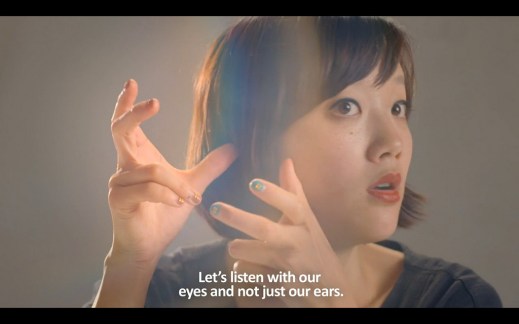
As a child, Kim was taught, “sound wasn’t a part of my life.” She recounted in a TED talk that her experience was like living in a foreign country, “blindly following its rules, behaviors, and norms.” But Kim recognized the similarities between sound and ASL. “In Deaf culture, movement is equivalent to sound,” Kim stated in the same talk. Equating music with ASL, Kim notes that neither a musical note nor an ASL sign represented on paper can fully capture what a music note or sign are. Kim uses a piano metaphor to make her point better understood to a hearing audience. “English is a linear language, as if one key is being pressed at a time. However, ASL is more like a chord, all ten fingers need to come down simultaneously to express a clear concept in ASL.” If one key were to change, the entire meaning would change. Subjective Loudness attempts to demonstrate this, as Kim moves visual to sound and back again before moving sound to vibration. Each one, individually, cannot capture the fullness of the word or musical note. Taken as a performative whole, however, it becomes easier to conceptualize vibration and movement as sound.

Christine Sun Kim speaking ASL, Image by Flickr User Joi Ito, (CC BY 2.0)
In Subjective Loudness, Kim’s performance has sonic dominance in the absence of hearing. “Sonic dominance,” Henriques writes, “is stuff and guts…[I]t’s felt over the entire surface of the skin. The bass line beats on your chest, vibrating the flesh, playing on the bone, and resonating in the genitals” (58). As Kim’s audience placed hands on walls, reaching out to to feel the music, it is possible to see that Kim’s performance allowed for full-bodied experiences of sound – a process of touch listening. And finally, incorporating Deaf and hearing individuals in her performance, Kim shows that all bodies can utilize multi-modal listening as a way to experience sound. Kim’s performances re-centers alternative ways of listening. Sound can be felt through vibration. Sound can be seen in visual representations such as ASL or visual art.
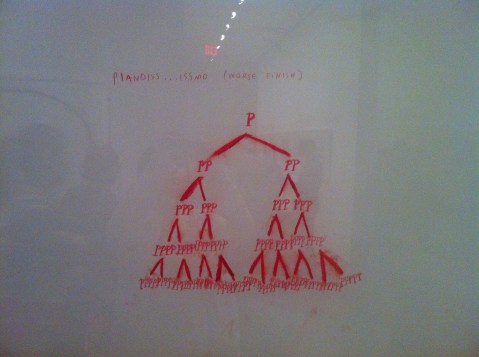
Image of Christine Sun Kim’s painting “Pianoiss….issmo” by Flickr User watashiwani (CC BY 2.0)
Through Subjective Loudness, it is possible to investigate subjectivity and loudness of sound experiences. Kim does not only explore sound represented in multi-modal ways, but weaves sound through the modalities, moving the audible to the visual to the tactile and often back again. This sound-play allows audiences to question current conceptions of sound, to explore sounds in multi-modalities, and to use our subjectivities in sharing our experiences of sound with others. Kim’s art performances are interactive by design because the materiality and subjectivity of bodies is what makes her art so powerful and recognizable. Toying with loudness as intensity, Kim challenges her audience to feel intensity in the absence of volume and spark the recognition that not all bodies experience sound in normative ways. Deaf bodies are vitally part of the soundscape, experiencing and producing sound. Kim’s work shows Deaf bodies as listening bodies, and amplifies the fact that Deaf bodies have something to say.
—
Featured image: Screen capture by Flickr User evan p. cordes, (CC BY 2.0)
—
Sarah Mayberry Scott is an Instructor of Communication Studies at Arkansas State University. Sarah is also a doctoral student in Communication and Rhetoric at the University of Memphis. Her current research focuses on disability and ableist rhetorics, specifically in d/Deafness. Her dissertation uses the work of Christine Sun Kim and other Deaf artists to explore the rhetoricity of d/Deaf sound performances and examine how those performances may continue to expand and diversify the sound studies and disability studies landscapes.
—
 REWIND! . . .If you liked this post, you may also dig:
Introduction to Sound, Ability, and Emergence Forum –Airek Beauchamp
The Listening Body in Death— Denise Gill
Unlearning Black Sound in Black Artistry: Examining the Quiet in Solange’s A Seat At the Table — Kimberly Williams
Technological Interventions, or Between AUMI and Afrocuban Timba –Caleb Lázaro Moreno
“Sensing Voice”*–-Nina Sun Eidsheim
Share this:

Gendered Sonic Violence, from the Waiting Room to the Locker Room

This past August 2016, professional “pick-up artist” Dan Bacon caused a stir with his article “How to Talk to a Woman Who is Wearing Headphones.” The article was published on TheModernMan, a site pledging to “make [a woman] want to have sex with you ASAP.” Bacon offers step-by-step “instructions” for pick-up artists to overcome the obstacle of being rendered inaudible by the music a woman might be listening to:
She will most likely take off her headphones to talk to you when you say, ‘Hey, how’s it going?’, but if she doesn’t, just smile, point to her headphones and confidently ask, ‘Can you take off your headphones for a minute?’ as you pretend to be taking headphones off your head, so she fully understands what you mean.
His article was criticized in articles that appeared in The Guardian, Washington Post, Slate, and other news sites, which pointed out that Bacon and his followers advocated ignoring a clear visual signifier of privacy in pursuit of sex. Not only did Bacon feel entitled to a woman’s time, they suggested, but also to an audience. What Bacon insists is “two, [sic] normal human beings having a conversation” is in fact a belief in his unilateral right to be heard.
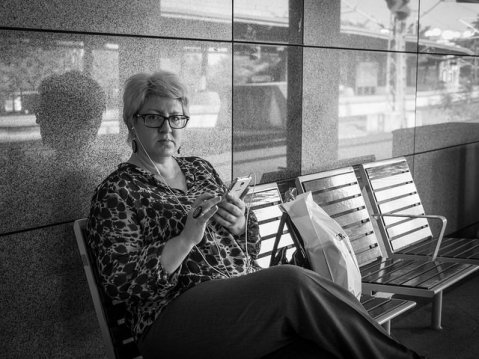
Image by Flickr User Chris Wolcott, Attribution 2.0 Generic (CC BY 2.0)
I witness a similar gendered dynamic of forced listening each week outside of a women’s health clinic in New York, where I volunteer as a clinic escort. Evangelical protesters from a handful of churches line the sidewalks outside the clinic every Saturday morning during the hours that they know abortions have been scheduled (in addition to pap smears, screenings for sexually transmitted infection, prenatal care, transgender services, etc.). Escorts walk with patients down the block to the front door. The sidewalk becomes a space of physical and emotional risk as protesters block the pathway with large, gruesome signs and their flailing limbs (at times physically assaulting volunteers and patients), as well as filming and photographing patients in the hopes of inducing shame.
Among their most intrusive weapons is the scream, which male protestors direct at patients, nurses, doctors, volunteers, security guards, and passersby. While women are abortion protestors, too, they generally get relegated to note-taking, sign holding, and pamphlet distribution, almost never given the authority to “sidewalk preach” or scream. In my experience of listening to this masculine screaming, words lose all sense and become pure sensation. Some patients wince, most speed up their pace, a few burst into nervous laughter, and almost all are stunned into speechlessness as they experience what one volunteer calls “the ripping apart of silence.”
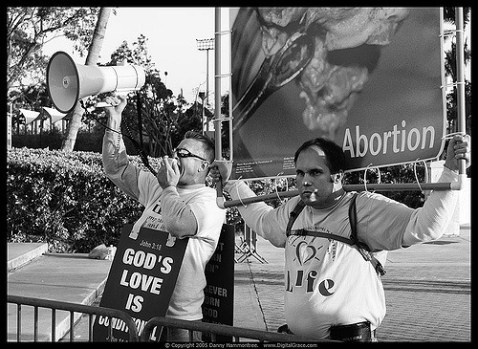
Anti-Abortion protest in Miami, 2006, Image by Flickr User Danny Hammontree, Attribution-NonCommercial-NoDerivs 2.0 Generic (CC BY-NC-ND 2.0)
During otherwise quiet moments, when nobody is walking down the sidewalk, a handful of men including a pastor and a high school science teacher pace the strip of sidewalk directly in front of the clinic entrance, preaching about sexual immorality and the “black genocide” taking place behind its soundproof walls. When a woman turns the corner down the sidewalk, they immediately begin to raise their voices. The men shout loudly as they attempt to chase women away from the door: “You don’t have to do this”; “Don’t be a murderer”; “You should have kept your legs closed.” The women and children accompanying these men plead in tones of pure desperation: “Your baby has a heartbeat at three weeks”; “You will regret it”; “Let us help you.” Volunteers chatter to the patients, trying to babble over the cacophony; the clinic has been forbidden from broadcasting amplified sound, though Janis Joplin and other artists used to play from speakers at the entrance.
A sample of anti-abortion protestors’ sonic technique, by Youtube user ehipassiko
At other clinics in the United States, protesters use amplified sound in violation of city sound permit requirements. In Tulsa, Oklahoma, the Catholic Church purchased the land across the street from the reproductive services clinic. Every weekday morning protesters gather there to sing, pray, and yell at cars and the patients getting out of them. Sitting in the midst of signs declaring “ALL LIVES MATTER” and “TULSA’S AUSCHWITZ,” a boombox faces the front door of the clinic and blasts Christian rock music. A clinic escort in Tulsa, who is also a Unitarian priest, described her experience with amplified sound in a sermon titled “A Womb of One’s Own”:
I stood near the driveway entrance where the protestors had placed a CD player blaring Christian music (which I happened to know) and so I stood near it and sang softly while they continued to shout. After about 20 minutes of shouting from afar, while I stood singing to the music, one of the protesters came near the CD player and began to pray for me—loudly. I stood quietly as he yelled a prayer for my misdirection, for my false prophethood, for my broken soul.
In Charlotte, North Carolina, volunteers track decibel levels on their phones in the hopes of getting the local police to issue a citation.
Cities4Life breaking the sound permit laws. CMPD won’t write a ticket. pic.twitter.com/40wLCnkx6V
— QC Clinic Escorts (@QCClinicEscorts) October 22, 2016
.
If, as Jonathan Sterne states in The Audible Past, “listening is a directed, learned activity” (19), then women and gender-nonconforming people must learn the art of hearing but actively not listening, of learning to direct one’s attention elsewhere to ignore catcalls and shouts of abuse. Christine Ehrick points out that vocal sound is not only a signifier of gender, it’s also a signifier of power. To ignore a male voice yelling over one’s own, or over one’s headphones, requires a stamina that contradicts the expectation of female receptivity and submission; Bacon asserts that “most women are polite” and will take off their headphones when asked. Even as patients overcome their shock and put up a wall against the shouting, protesters and volunteers must perfect the act of directed listening, focusing on the commentary to take note of periodic death threats, bomb threats, and any other unusual comments in spite of the repetition of the preaching and aural abuse. They must also speak and listen guardedly to each other, as protesters eavesdrop on conversations between volunteers, hoping to discover their identities so as to shame and harass them in the public and professional sphere.
Anti-abortion protesters push their agenda through their conflation of the public and private, the internal and external, the oral and aural. They continue to yell even once the patients have made their way into the clinic, despite the fact that the waiting room is soundproof—silent except for the occasional murmured conversation, soft piano music, or cartoons. In his essay “Broadcasting the body: the ‘private’ made ‘public’ in hospital soundscapes” in Georgina Born’s 2013 collection Music, Sound and Space, Tom Rice discusses the blurring of the internal and external in hospital environments, where patients must put on “mental headphones” as a form of “studied unawareness” (174). Despite the private, internal nature of illness, in hospitals there exist “threats to bodily boundaries and bodily control” (184). The right-to-life movement has capitalized on this blurring of boundaries since its 1984 film The Silent Scream. If their posters of mangled fetuses bring the unseen into the realm of the visible, their shouting brings the unheard into the realm of the audible as they give voice to these silent fetuses: “Mommy, mommy, don’t kill me!”

41st MARCH FOR LIFE RALLY in front of the US Supreme Court on 1st Street between Maryland Avenue and East Capitol Street, NE, Washington DC on Thursday afternoon, 22 January 2015 by Elvert Barnes Protest Photography, Attribution-ShareAlike 2.0 Generic (CC BY-SA 2.0)
When anti-abortion protesters gather in public spaces such as sidewalks, they affirm Judith Butler’s claim in Notes Toward a Performative Theory of Assembly that “if there is a body in the public sphere, it is presumptively masculine and unsupported, presumptively free to create, but not itself created. And the body in the private sphere is female, ageing, foreign, or childish, and always prepolitical” (75). The loudest protesters use their male bodies and male voices to assert their right to create sound and to be listened to by female ears. The masculine voices emanating from these presumptively male bodies stridently invade, interrupt, and attempt to shape private and prepolitical spaces, extending even to the uterus—what one would think would be the most private and prepolitical of spaces. At its most troubling, the loud, relentless insistence by the right to an audience translates to the desired ownership of non-male bodies. This desire for control–and its performative rhetoric enacted in the public sphere–originates in the absence of female bodies and voices, in the exclusively male private sphere of “locker room talk.”
***
This was locker room talk. This was locker room talk. I’m not proud of it . . . This was locker roomtalk. Yes, I’m very embarrassed by it, and I hate it, but it’s locker room talk. –Donald Trump in the third presidential debate, 19 October 2016
The stridency of the 2016 election cycle has revealed the gendered nature of public space and sonically blurred the boundaries between the theoretically public space of streets and the metaphoric masculine privacy of the metaphorical “locker room.”
“Locker room talk” has been the term used by right-wing pundits–and the candidate himself– to excuse the recently re-played 2005 recording of US presidential candidate Donald Trump bragging to radio and TV host Billy Bush about various sexual conquests: “I moved on her like a bitch”; “Grab them by the pussy”; “You can do anything.” Trump’s statement following the release of the tape in October 2016 emphasized a patriarchal delineation of space, in which male bodies are always safe and non-male bodies almost never are: “This was locker-room banter, a private conversation that took place many years ago.”
Trump’s insistence on a private space, in which men can talk amongst themselves with no consequences, reverses the dynamic outside of the hospital, in which the private is made public. It also further demonstrates the blurrability—and even portability—of private space, which white males arm themselves with and freely replicate in public spaces. Not only does such private “banter” affirm the assumption of the superiority of the male voice and the stigmatization of the female voice, it silences the voices of the women affected by Trump’s actions, while objectifying women-writ-large into currency exchanged between men. And indeed, women’s prior allegations were all but ignored by the press and the public until the release of Bush tapes.
We had to hear it from Trump’s own mouth to believe it.
***
In Modernity’s Ear, Roshanak Kheshti discusses the “feminization of listening” via sound reproduction and particularly the world music industry, which mythologizes the sound of the “other” in service of white female ears (27). Constructed in terms of a male heteronormative fantasy, the ear has come to resemble a vagina, “an organ to be penetrated by an active sonic force” (67). In this construction not even headphones–which ideally afford a visual signal calling for privacy and the gendered privilege of uninterrupted listening–are enough to shield non-male ears from the average scheming pick-up artist.
Kheshti’s arguments can be fittingly applied to gender-specific spaces of both the locker room and the abortion clinic. Male-asserted power dynamics of speaking and listening work to create spaces spaces that silence female needs, voices, and agency. In the public space outside the clinic, such practices deem women an ear for hearing patriarchal arguments against abortion, and in the private space of the locker room, objectify them as a vagina for “grabbing.”
The spatializing of power dynamics via sound has forced women to become versed in aural refusal, to keep our ears closed the same way we are encouraged to “keep our legs closed.” This aural refusal, however, all too often renders women silent in public, patriarchal spaces. Feminist initiatives like “Shout Your Abortion” and “Hollaback,” a movement to end street harassment, have given women voice within these structures of gendered sonic violence. The initial criticism faced by Hollaback, regarding racism in their viral video, alongside the targeting of non-white women and couples outside the clinic, suggests that the intersectional dimension of listening in public needs further examination in hopes of reaching an understanding of what equitable public space would sound like. Ultimately, however, with these and other movements, women are asserting not only our right to harassment-free public and private space, but our right to create sound, to speak, and to be heard.
—
Featured Image: “Yell!” by Flickr User Vetustense Photorogue, Attribution-NonCommercial 2.0 Generic (CC BY-NC 2.0)
—
Rebecca Lentjes is an NYC-based writer and gender equality activist with plans to pursue graduate studies in ethnomusicology at Stony Brook University. Her work has appeared in VAN Magazine, Music & Literature, TEMPO Quarterly Review of New Music, Bachtrack, and I Care If You Listen. By day she works as an editor and translator at RILM Abstracts of Music Literature; by night she hatches schemes to dismantle the patriarchy.
—
REWIND!…If you liked this post, check out:
I Can’t Hear You Now, I’m Too Busy Listening: Social Conventions and Isolated Listening–Osvaldo Oyola
Gendered Voices and Social Harmony–Robin James
Vocal Gender and the Gendered Soundscape: At the Intersection of Gender Studies and Sound Studies—Christine Ehrick
Share this:


Current Top Posts





April 2021

January 2020

November 2019

October 2019

August 2019

April 2014

November 2017

March 2015

December 2017

October 2015
 Sounding Out!
Recent Comments