
Afecto Caribeño / Caribbean Affect in Desi Arnaz’s “Babalú Aye”

Recently, the new biopic and telenovela Celia, La Serie on the life of Celia Cruz reminded me of how her iconic call “Azucar!”(translated as sugar) engaged audiences to feel the sabrosura of her music. The soap-opera included documentary footage of the larger iconic events in Celia’s career that could not be recreated, scenes that captured how Cruz and the audience connected. The scenes that best captured this are when Celia performs with Fania at Yankee Stadium in 1973 and in Zaire in 1974. When she felt the audiences’ joy in her performance she’d share that expressive sentiment of the sweetness in the moment, taking audiences to a deeper ecstatic place.
I also felt and witnessed this myself when I saw Cruz perform at the Hollywood Bowl decades ago. It’s akin to what I sensed when also hearing Damaso Pérez Prado’s guttural “Maaam-bO” in his “Mambo No 5.” While watching Celia, La Serie, I asked my mom if she had ever watched Desi Arnaz on I Love Lucy. Her response included a dislike for Arnaz, while I remembered enjoying his performance of “Babalú Aye.” Our exchange raised the question: can Arnaz’s performance, like Cruz’s expressive phrasing or Pérez Prado’s musical cue, unify a Latinx and African diaspora through sound and affect?
 I posit that Arnaz’s televised performances of “Babalú Aye” like Celia’s “Azucar” or Prado’s “Mambo” exemplify what Alejandra T. Vazquez calls in Listening in Detail “vocal armament and ornament” (132), a sound that cultivates an afecto caribeño among Spanish-speaking diasporic migrants and their descents. My use of afecto here is a key sonic detail, playing upon the Spanish meaning to show tenderness and emotion. I also appreciate affect theory as it provides a framework by which to explore the emotionality and connection to experiences that have not been named. For example, in “Feeling, Emotion, Affect,” Eric Shouse writes about affect as “the body’s way of preparing itself for action in a given circumstance by adding a quantitative dimension of intensity to the quality of an experience. The body has a grammar of its own that cannot be fully captured in language.” I attempt here to cultivate a language that address how Arnaz’s physical and sonic articulation sets an entry to examine contributions by members of the Latinx Caribbean diaspora and its reach to those of us hearing and seeing them in a US context.
Growing up bilingual and bicultural in Los Angeles, I saw how my mom retained a bit of her homeland by watching a variety show called Siempre en Domingo. Many of the artists who performed were also heard on the local Spanish language station K-Love. The ritual gathering on Sunday nights as we watched the show metaphorically united my mom with her family.I believe that viewing and hearing her Mexico made the distance away from her family soften. For me, listening to the songs I heard on Siempre en Domingo then replayed on the radio helped codify something more than Mexican; it was pan-Latino. These moments of engaging with television shows mediate my experience of sound and affect, which I’ve named afecto caribeño (translated to “caribbean affect”).
 My fondness of Desi Arnaz stems from a familiarity of Spanglish when I saw my first episodes of I Love Lucy (1951-1957) on Saturdays on KTLA. Its stars, Lucille Ball and Desi Arnaz, played a married couple, and the comedy of errors would inevitably involve “Lucy Ricardo” trying to scheme something. In real life, Ball and Arnaz were a Hollywood power couple who produced their show, establishing a practice of syndication rights paid to the actors. Arnaz played “Ricky Ricardo,” the owner of the Tropicana nightclub where he was also the bandleader. When scenes featured him at the club he would always play the congas, thus creating a continuum of his earlier career as a musician to now television star.
Hearing Desi Arnaz speaking inglés with a Cuban accent was familiar to my ears. I knew that sound of English blended with español because it was what I heard from my parents and their acquaintances. In the show, misunderstandings happened because one could not decipher what “Ricky” meant or said. The mistranslations led to some comedic moments and the establishment of a long-running comedic television trope at the expense of Latino characters and actors, as explored by Dolores Inés Casillas and Sebastien Ferrada in “Listening to Modern Family’s Accent.” However, in Life on the Hyphen, Gustavo Pérez-Firmat describes Arnaz’s nilingüe–someone who speak neither Spanish nor English—and argues his nilingüe-ism was personified through “Ricky Ricardo” as “Spanish utterances shot through anglicisms so that the monolingual viewer can understand what he was saying” (43). But, Arnaz did not reach only “English-only’ ears. To my pocha ears Arnaz spoke a familiar—and not incorrect—spoken Spanish. As a young viewer, I had no reference for his mistakes. Sonically “Ricky’s” familiarity came through when he complained about “Lucy” in Spanish. Hearing the español I spoke at home on “I Love Lucy” is how I connected to the hyphened Americano via tv. Nowhere was this more pronounced than with Ricardo’s frequent performances of “Babalú”.
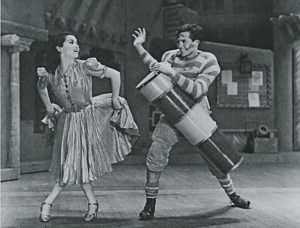
Diosa Costello and Desi Arnaz in Too Many Girls (1939)
Before his film career, Arnaz was known as the mambo king. Due to his lackluster rise as a “Latin Lover” in Hollywood, Arnaz returned to work as a musician and began singing his signature “Babalú” around 1943. The song is attributed to Margarita Lecuona and published in 1939. “Babalú” conflates the popular 1940s-50s big band sound with a Cuban folksong (or son) sung to the Orishas (deities or gods). Babalú is an Orisha deity who oversees health and is revered because of his power over life and death, and is also known as San Lázaro within the pantheon of Catholic saints. By the time Arnaz made the song popular in the United States, the song had also been associated with Miguelito Valdés, who was known as “Mr. Babalú.” Other musical contemporaries like Damaso Pérez Prado were also making a name for themselves by developing a new sound that Latinized dance music in the U.S. According to Ed Morales in Living in Spanglish, it is in the 1950s that Prado creates his signature sound in Mexico City by “mixing North American swing and bebop” known as mambo (152). However, it is Arnaz’s performance that I reference because of its reach to a multi-generational audience through syndication of the “I Love Lucy” show.
 Each time Arnaz performs “Babalú” it serves as an offering to the Orisha to heal the longing for a homeland he left long ago, as experienced by many musicians like Cruz who live in exile. With each performance on the “I Love Lucy Show,” Arnaz reconnects to his cultura. Performing this on national television it’s not about the Anglo viewer who only sees Arnaz as the “Rhumba Rhythm King” (sic) (Pérez-Firmat, 52) made famous in movies; rather it is about Arnaz creating a space of agency through a prayer and healing ritual in song, thus an expression of Afecto Caribeño connecting the Latinx diaspora to something beyond national borders and generations.
For example, in Season 2 episode 21 “Lucy Takes a Job at the Bank,” Arnaz (as Ricky Ricardo) brings out his son Ricky Jr. to play the congas alongside him. Ricky as proud father shares his joy in this moment. The camera pans out to Lucille Ball and her co-star Vivian Vance sitting at the table. Arnaz instructs his son to “say thanks” and he replies in Spanish “gracias.” This exchange is profound because it accentuates the bilingualism and bicultural exchanges that happen in the home space now introduced to many via television. Arnaz continues, “Even though Little Ricky was born in America, there’s lots of Cuban in his heart.” The Cuban in his heart plays out in sonic beats through a father-and-son performance on the congas and the calling upon “Babalú Aye.” Both Lucille Ball and Desi Arnaz are happy parents, not just stage parents, who revel in this moment. As Ricky Jr. plays, his mother bangs on the table too and Arnaz looks up to the sky as if in gratitude for this moment to the Orisha Babalú.
Upon reflection, I am aware of how television informed my childhood search for something that reflected how I spoke and heard the world. In these linguistic-sonic moments I reconnected to my mother’s homeland and sought to make sense of my pocha identity when I heard English spoken with a Spanish accent. In Relocations, Karen Tongson names these moments of connection that occur through a technological network as “remote intimacies” that can “account both technically and affectively, for the symbiosis that can happen between disparate subjects. . .I like to think that these imaginary correspondences sometimes have to happen across greater distances, both conceptually and topographically with other ethnicities, accents, nations (130)” The conceptual and topographical correspondence informs afecto caribeño as a means to enable critical connections to a Latinx diaspora centered en el Caribe highlighting the mestizaje of African and Spanish heritage, thus expanding upon Paul Gilroy’s notion of the “black Atlantic” on how the Atlantic slave trade also impacted culturally el Caribe. Upon singing “Babalú Aye” Arnaz’s performance not only is a disruption to Anglo American viewers, but also “disrupts the myth of Cuban whiteness” (Vasquez, Listening in Detail, 150).
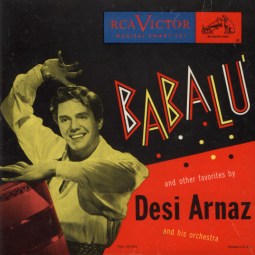 I am drawn to sonic experiences that can help unpack Latinidad and the multicultural roots that are informed by other migrations of Africans, Asians, and Spaniards to the Américas. I am a descendant of these mestizajes, as Gloria Anzaldúa writes in her canonical text Borderlands / La Frontera. A concept like afecto caribeño addresses the social and emotional exchanges that emanate from the complexity of these migrations and how they reveal themselves in momentary connections. When Arnaz performs as “Ricky,” he breaks that character upon playing the congas. Here he does not act as the nightclub owner; the reverberation of the conga mediates an embodiment of his true self exemplifying un afecto caribeño.
—
reina alejandra prado saldivar is an art historian, curator, and adjunct lecturer in the Women, Gender and Sexuality Studies Program and Liberal Studies Department at CSULA and in the Critical Studies Program at CALArts. As a cultural activist, she focused her earlier research on Chicano cultural production and the visual arts. Prado is also a poet and performance artist known for her interactive durational work Take a Piece of my Heart as the character Santa Perversa (www.santaperversa.com) and is currently working on her first solo performance entitled Whipped!
—
Featured Image: Desi Arnaz performing with Diosa Costello, 1948.
—

REWIND!…If you liked this post, you may also dig:
The Sweet Sounds of Havana: Space, Listening, and the Making of Sonic Citizenship – Vincent Andrisani
SO! Amplifies: Shizu Saldamando’s OUROBOROS–J.L. Stoever
SO! Reads: Dolores Inés Casillas’s ¡Sounds of Belonging! – Monica de la Torre
Share this:

A Manifesto, or Sounding Out!’s 51st Podcast!!!

This week, Sounding Out! dropped its 51st podcast episode. As the curator and producer, I thought it necessary to commemorate the occasion with some fanfare. I want to shout from the hilltops about how proud I am that our little podcast has turned 51!
Erm…at least I’m posting about it.
Also, I want to clear the air a little about what it is that we do. I’ve received feedback here and there over the years about the sound of our podcasts, that we sound “different” and/or “inconsistent,” that we need to normalize the sound a bit: hello out there, audiophiles! Today, I want to say, once and for all, that our sound is intentional and that we are proud of it, hiss, distortion, and all! We think what some hear as “imperfections” are all part of what sets us apart from the ever-growing pack of podcasters. SO!’s podcast has sounded different since we MacGyvered our first episode from an epic talk, a few great ideas, and a rogue tape recorder at River Read Books in Binghamton, NY in April, 2011.
The Sounding Out! Podcast began as a series of conversations within the editorial team back in 2011. We knew that the blog was “talking the talk” in new, excellent, and often provocative ways, but that something was missing to keep pushing the form into the red, not just the content. We knew we needed something more—a little snap, crackle, and pop, if you will—a way to show how Sounding Out! was always listening, and a way for thinkers, artists, provocateurs, and more to engage with sound more directly. In 2011, podcasts were accumulating in the shadows waiting to lunge forth to center stage. They seemed really cool, but there were relatively few, and fewer still (if any at all) on the topic of sound studies. Even though we knew that podcasts were going to be a big thing eventually, we had no idea that they would blow up so quickly.
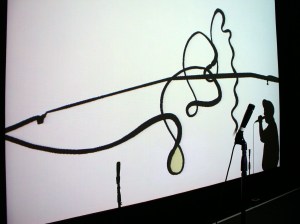
Image by Sandor Weisz @Flickr CC BY-NC.
While we flipped around many ideas, we decided to put our energies behind what was then an occasional series of podcasts that allowed us to capture important yet fleeting moments—too quick and dirty to really transcribe. While our our initial vision for the podcast was to capture these rare and powerful moments, over the past 5 years we have kept this mission consistent while evolving to better accommodate artists and theorists alike. During that time we have hosted mystics and librarians, shared fieldwork from São Paolo, Brazil to Lodi, Ohio, interviewed theremin players and visionaries. See the full list of episodes here. Even though our content has been wide ranging and eclectic, we’ve made it a point to privilege access and immediacy in all of our episodes.
As I listen back to the past five years, I realize that our contribution to the fields of sound studies and podcasting has not just been in terms of who we broadcast and what we amplify, but through the sound of our podcasts themselves. Our podcasts don’t sound perfect. They’re spiritually aligned by the raw production ethic of bands like The Minutemen, who always privileged the emotive qualities of immediacy, access, and intimacy over the brooding qualities of studio production. Particularly because we founded the podcast upon these same principles, I have strived to prioritize radical visions and ideas and to amplify new voices above all else. I want each podcast to arrive in your queue like a wrapped gift—topic, content, production, and sound all equally mysterious. Some of our podcasts were recorded on cellphones and others were recorded in high-end studios and recording booths. Our 51st anniversary isn’t the perfect occasion, either. But, hey, we’re proud of these audible distortions.
“The Minutemen: #1 Hit Song”
So what do I mean that our podcast sounds different? Well, I mean two things: First, we sound different than what episodic radio sounds like. Our DIY—or, more accurately, we will help you “Do It Yourself”—ethics deliberately dial back radio’s genre conventions: smooth identifiable hosts, heavy compression, sound-proof rooms with the latest in equipment. We encourage and construct our podcast with a deliberate sonic diversity, providing little sonic consistency from episode to episode in order to challenge regimes of production that threaten to make all recordings sound the same. We have many many different announcers and hosts; for this podcast to be the space of radical discourse that we intend, it’s important to cast our net wide. This isn’t to say that we don’t care about “quality,” but rather that we define quality differently. Rather than an audiophilic emphasis on the sorts of tone found most frequently in microphone technique, sound booths, and—when all else fails—postproduction, we believe that a “quality” podcast—particularly one about sound—should explore sounds that we rarely hear and allow its artists freedom over how they present their work.
I curate our podcast as a sonic refuge from the invisible regime of auditory production that has slowly constricted and strangled radio this past century. And I’m proud to share podcasts that have been recorded on in impromptu circumstances, Episode XXXIX: Soundwalking Davis, CA and New Brunswick, NJ, for example. We want artists to show more than they tell; Episode XII: Animal Transcriptions, Listening to the Lab of Ornathology is a perfect example of this. Here Jonathan Skinner’s brilliant exploration of animal sounds perfectly balances sound and interview and invites listeners to compare sounds to speech, and vice versa. Another example of this ethic is film professor Monteith Mccollum’s remix of the original War of the Worlds broadcast. Although Mccollum offers some commentary at the start of the recording, what follows is a unique and dazzling sonic experience. Giving radical ideas both the space and platform to be heard is this podcast’s mission. So far, so good!
The second way our podcast sounds different has to do with our deliberate curatorial resistance to consistency between our episodes. When programs bend to the whims of genre conventions, creativity is all but snuffed out. For our podcast to excel as a form for sharing visions, ideas, and experiments, we must allow our composers, authors, and auditors the freedom to explore sonic space. We celebrate Sounding Out!’s anniversary annually with a series of mixes hand-picked by our stable of authors (Listen to years 1, 2, 3, 4, 5, and 6 here!), we’ve entertained interviews, panels, and sound art alike. You may have missed it, but we even have an episode diving into the work of ambient sound in a Dungeons and Dragons game.
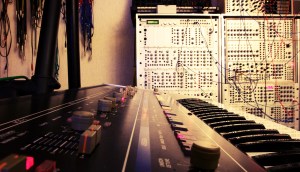
Behind the scenes, we look NOTHING like this. Image borrowed from fr4dd @Flickr CC BY.
While I do think about the sound of our podcast aesthetically—I used to run a music production studio out from the trunk of my car—we do not cultivate a DIY anything-goes ethic strictly for a “cool factor” or just for its own sake. Rather, we have calibrated our different sonic approach in deliberate defiance of styles of production which are all too frequently celebrated within the cultures of straight white men. (Check out SO! Editor-in-Chief Jennifer Lynn Stoever’s epic three-part treatise on the tape recorder in popular film to glean some sense of the tape-recorder’s role as an instrument of masculine control. Part 1, Part 2, Part 3). The standards of taste which have long governed the domain of radio production (and audio production, as a whole) are historically connected to the communities of practice which have occupied invisible yet powerful roles as audio producers, engineers, critics, and marketers.
As Jonathan Sterne explains in MP3, the science of audio fidelity has historical roots within a corporate logic that privileges sounds that are easily shared through telephone cables. “AT&T encountered hearing as an economic problem once its options for extracting additional profit through price were limited,” Sterne says, “Among other strategies, it sought to learn which frequencies could be excluded from the market for telephone signals” (14). In other words, the entire craft of audio engineering has historical roots in privileging sounds that make money above all else. Not only this, but the standards of fidelity cultivated by engineers allow them to gatekeep and demand money at the outset, blocking access to the means of production. These standards are more often than not embedded within the cultures of listening and sales fostered by the radio industry. Fortunately, podcasts have been able to challenge many of these genre tropes, We’re proud to contribute to this momentum and to propel it forward as we continue our series. And we’re not stopping! Up on deck in 2016 we have some amazing compositional sound art, more from Marcella Ernest’s trek to uncover lost sounds, and some notes on a forthcoming project in archiving one city’s local music scene.

BOOM!!!!! Image by Jamie McCaffrey CC @Flickr BY-NC.
So, in the spirit of Sounding Out!’s annual blog-o-versary we’re popping the cork for our podcast’s 50th episode with a few of the milestones we hit this past five years.
We found a theme song. This was a small but important step in our development. What would a podcast about sound be without some kind of awesome anthem representing it? (Nothing, that’s what!) We need to officially thank the members of Hunchback (Miranda, Mike, Jay, and Craig) for donating their song “Feeling Blind” to our podcast. Hunchback was a legendary horror-surf band from the NJ basement scene who endeavored to produce highly visceral sonic experiences of the highest caliber in their songwriting. You can still find a ton of their recordings on the internet. Thanks, crew!
 We got listed on iTunes and Stitcher. It bears mentioning that quite a bit of technical muscle is involved in establishing a podcast. We would have gotten nowhere without Andreas Duus Pape’s help and guidance during our earliest moments. Andreas was instrumental in opening up the hood of the podcast and making it purr. Not only did he donate his time to plug us into iTunes’ network of podcasts, but he also shared some excellent philosophical thoughts on the topic. You can listen here and read them here.
We went monthly. Originally we had conceived the podcast as more a haphazard, occasional treat for our readers. Slowly but surely as demand and interest grew, we began to carve out a more regular calendar space for our podcast. First we switched to a bi-monthly format, and then we started with monthly broadcasts. Can’t slow this beat down.
We are the sonic archive of a sound art conference. That’s right, we featured sonic mixdowns of the entire Tuned City of Brussels sound art festival. Over the course of the festivals three days, we featured daily mixdowns of the prior day’s key sounds and moments. Each mixdown is brilliant and a testiment to the raw passion of our podcast contributors. They worked round the clock to produce such an amazing series. Check out the night before, and days 1, 2, and 3.
 We produced a LOT of soundwalks. If you’re a listener you know that we love our soundwalks. We’re proud to be host to play host to a variety of soundwalks from cities around the world. Last month’s Yoshiwara soundwalk by Gretchen Ju challenged listeners to critically engage with the city’s fraught history of sex work. Other contributors in our soundwalk series like James Hodges have considered how the ambient music of big box stores and shopping malls are part of the architecture of commerce. Finally others like Frank Bridges have taken us to the edge of history and soundwalked the grounds of Thomas Edison’s workshop in Edison, NJ. No matter what the locale, our soundwalks are part of our podcast’s signature.
We found a regular contributor. Regular contributors are the heart and soul of Sounding Out! They lead the conversation on sound and work to bring you the best, most interesting content. For these reasons we’re proud to announce that Marcella Ernest will be joining our podcast as a regular contributor with her series “Searching for Lost Sounds.” Marcella will be interviewing a variety of sonic practitioners in an effort to give voice to the voiceless. Her most recent entry in the series was posted last Thursday. You can listen here.
We’re going to keep it coming. That’s our promise to you! We’ll be producing great content as long as you’re listening. Take a moment to subscribe to our iTunes or Stitcher accounts and also explore our Episode Guide to see if you missed anything this past 5 years. It’s been a rewarding adventure so far and we guarantee that we’ve already got some great content lined up in the coming months.
Image by Sandor Weisz @Flickr CC BY-NC.
–
Aaron Trammell is a Provost’s Postdoctoral Scholar for Faculty Diversity in Informatics and Digital Knowledge at the Annenberg School for Communication and Journalism at the University of Southern California. He earned his doctorate from the Rutgers University School of Communication and Information in 2015. Aaron’s research is focused on revealing historical connections between games, play, and the United States military-industrial complex. He is interested in how military ideologies become integrated into game design and how these perspectives are negotiated within the imaginations of players. He is the Co-Editor-in-Chief of the journal Analog Game Studies and the Multimedia Editor of Sounding Out!
–
Featured image is “Roscoe Considers Recording a Podcast” by zoomar @Flickr CC BY-NC.
—
 REWIND! . . .If you liked this post, you may also dig:
Sounding Out! Podcast #1: Peter DiCola at River Read Books – Peter DiCola
It’s Our Blog-O-Versary — Jennifer Lynn Stoever
Sounding Out! Podcast #51: Creating New Words from Old Sounds – Marcella Ernest
Share this:


Current Top Posts





April 2021

January 2020

November 2019

October 2019

August 2019

April 2014

November 2017

March 2015

December 2017

October 2015
 Sounding Out!
Recent Comments