
Malcolm Gladwell’s Bad Aesthetics

Malcolm Gladwell, who recently wrapped the first season of his podcast Revisionist History, has been on a roll lately. Not a particularly endearing one, though. I’ve been trying to locate his nadir, but it’s not easy with so many options to choose from. Is it in the New Yorker, when he condescendingly exclaims “Of course not!” in response to whether Caster Semenya should be allowed to compete in the 800-meter at the Olympics? He follows up with the assertion that no track-and-field fan disagrees with him, as if the complexity of gender identification is somehow best left to a majority appeal. Or is it in Revisionist History’s Episode 9, “Generous Orthodoxy,” when he chides Princeton students protesting the use of Woodrow Wilson’s name around campus? Calling one student “angry”—a loaded word to lob at a black woman—and surmising she would later “regret her choice of words,” Gladwell advises the students to instead threaten to leave the university if their requests aren’t honored. Why? Because otherwise “every crotchety old Princeton alum” wouldn’t believe they actually care about the university.

For those keeping score, that’s Gladwell, who spent an entire other episode of his podcast lamenting that we don’t “capitalize” people’s educational potential well enough, counseling black students to separate themselves from an Ivy League education as a way to make a point about a pro-segregationist president. Gladwell’s seventh episode, “Hallelujah,” where he discusses musical genius, is not obviously about the kind of systemic inequalities he bumbles in the Semenya and Princeton examples. But the conclusions he draws about genius and the anti-pop aesthetic judgments he claims are informed by the same bad gender and race politics that would put a person’s gender identification in other people’s hands and place the burden of sacrifice on the aggrieved in matters of racial injustice.
The episode “Hallelujah” revolves around two songs that Gladwell argues reached their peak of genius years after they were initially recorded: “Deportees Club” (1984) by Elvis Costello and “Hallelujah” (1984) by Leonard Cohen. In each case, Gladwell asserts that the first recordings were flawed but that they attained a certain beauty in later versions that reveals something about how genius works, though each attained that genius status by different routes. While Costello is responsible for the version of “Deportees Club” that Gladwell loves—he re-recorded it as “Deportee” in 1985 (it wouldn’t be released until 1995 on a re-issue of Goodbye, Cruel World)—“Hallelujah” would peak for Gladwell in a series of covers, most famously by Jeff Buckley (1994), performed by artists other than Cohen. Gladwell’s focus on the process by which a song reaches genius status is a riff on David Galenson’s Old Masters and Young Geniuses theory. Here, Costello and the litany of “Hallelujah” coverers display a process of genius called “experimental innovation,” where the first draft is never the final draft, and genius is only unlocked after years of work. I’ll return to Gladwell’s notion of musical beauty and how it relates to his bad politics momentarily, but I first want to unpack the theory of genius that enthralls him in this episode.
 Galenson’s notion of genius is a binary, where some geniuses (“conceptual innovators”) are very young, decisive artists and others, like the “experimental innovators” responsible for “Deportee” and “Hallelujah,” are endless tinkerers who tend to reach their creative potential later in life. Gladwell uses the same paradigmatic examples that Galenson does to categorize geniuses; conceptual innovators are Pablo Picasso, while experimental innovators are Paul Cézanne. Curiously, Gladwell notes that this theory of genius may be best exemplified in music, but he doesn’t seem aware that music scholars have already laid out this same broad theory of genius with easy comps: Mozart the young genius and Beethoven the old master. Moreover, Gladwell doesn’t seem aware that this is a lousy theory of genius.
I’ve written elsewhere about genius myths, and there’s a rabbit hole of problematic ideas out there about classical music genius that run from benignly self-serving to violently racist. One critique is particularly useful for pushing back against Gladwell, as it highlights the gender and race problems with Gladwell’s approach to genius. Tia DeNora’s Beethoven and the Construction of Genius (1994) is a painstaking deconstruction of Beethoven’s genius. While DeNora’s argument includes a number of moving parts, it can be summarized as a demonstration of the way “genius” isn’t so much innate talent as it is a combination of several social and political ideals intersecting with a person’s talents or insights.
It was the 90s, when postmodernity crested in musicology, and the aim of DeNora’s analysis is quintessentially postmodern: undo the Great White Man myth to make room for other kinds of histories and notions of genius to be accommodated. If we understand Beethoven’s genius to be firmly rooted in a number of social and political attitudes—including the reflexive belief that only a white man could be a genius—that tipped in his favor, then we can understand that history isn’t telling us that only men or only white people can be geniuses; rather, history is showing its biases. This sort of deconstruction doesn’t really move the academic needle now—most college freshmen can articulate the Great White Man critique—largely due to the work of DeNora and other deconstructionists who effectively cleared the space for us to build other kinds of scholarship on top of their work.

“Pop!Tech 2008 – Malcolm Gladwell” by Flickr user Pop!Tech, CC BY 2.0
Alas, though, the 90s truly must be all the rage right now, because Gladwell is wading right back into Great White Man territory. To be clear, he isn’t doing it on purpose, for whatever that’s worth. In Episode 9, the one where he counsels the black Princeton students to threaten to leave the school, he performs a whole Great White Man rant to establish his credibility as A Guy Who Gets It. But beyond understanding that there are too many things named after white men, Gladwell doesn’t indicate that he knows what the rub really is, that the name on a building or School is a tiny piece of a much bigger, systemic problem of race and gender. Perhaps unsurprisingly, then, his ideas about musical genius betray his own tendency to set up hierarchies where Great White Men are always on top. So excuse me while I pump some air in my Reeboks, hitch up my Guess jeans, and douse myself in CK1; we have some 90s theory to attend to.
Gladwell doesn’t—and perhaps can’t—articulate what’s genius about the versions of “Deportee” and “Hallelujah” he reveres, and his assessment of the originals is similarly vague. About 1984’s “Deportees Club,” he exclaims, “Oh, god, It’s awful!” For Cohen’s 1984 “Hallelujah,” Gladwell borrows a line from Michael Barthel, who could’ve just as well been describing Gladwell’s podcast: “The entire performance is so hyperserious that it’s almost satire.” [Historiographic aside: Barthel, who is now a researcher for the Pew Research Center, seems to be the under-cited source for the “Hallelujah” history in both Gladwell’s podcast and Alan Light’s book on the song]. Gladwell may suffer a poverty of aesthetic language to describe what is or isn’t good about these songs, but by considering what he does and doesn’t like—what counts as genius or not for him—we can understand where his aesthetic allegiances lie.

Screenshot of Leonard Cohen’s “Hallelujah” video on YouTube
Gladwell finds beauty in music whose emotional content is as stripped down as the acoustic guitar textures on the later recordings of “Deportee” and “Hallelujah.” The line he quotes from Barthel misses the point: Barthel likes the satirical nature of the original “Hallelujah” and finds the famous Buckley version—which becomes something of an ürtext for all the covers that came after it—an unfortunate telescoping of emotional range, a “Hallelujah” that only knows lament instead of the many “holy, broken, profane, transcendent” hallelujahs Cohen first explored. But all those hallelujahs, along with the “angry, loud, and upsetting” original “Deportees Club,” don’t seem to suit Gladwell, who prefers versions of the songs where both the emotional and musical content are as straightforward as possible.

Screenshot from Jeff Buckley’s video for “Hallelujah”
That Gladwell is drawn to the versions of Buckley’s “Hallelujah” and Costello’s later “Deportee” that feature an acoustic singer-songwriter coffeehouse vibe isn’t a coincidence. The villain in his account of genius is pop. Noting that both songs were initially recorded in 1984, he reminds us that year’s “biggest album” was Michael Jackson’s “Thriller,” “pop music glossed to perfection…not a single stray note or emotion on that record.” “Thriller” was the final single from an album two years old, and it peaked at #4 on the Billboard Hot 100, so Gladwell’s definition of “biggest album” is suspect, but he’s looking for “the antithesis of ‘Deportee’ and ‘Hallelujah,’” so I’ll engage on his terms and zero in on his aesthetics by figuring out what he thinks is wrong with pop music like “Thriller.”
Gladwell offers a couple other assessments of pop aesthetics in his description of producers. Clive Langer and Alan Winstanley, who co-produced the Goodbye, Cruel World album “Deporteees Club” appeared on, are the ill-fitting pop perfectionists who try to harness Costello’s sound but only manage to screw it up. Trevor Horn is the guy spending four weeks—“a month,” Gladwell bemoans—shaping a snare sound for Frankie Goes to Hollywood’s “Two Tribes” (1983). Whether it’s Langer and Winstanley, Horn, or Quincy Jones (who Gladwell doesn’t name but who produced “Thriller”), Gladwell has no space for the behind-the-glass work of sound design and sonic processing in his aesthetics of genius. He argues, citing Costello’s own assessment, that glossy pop perfection couldn’t capture the “dark, emotional, bitter songs, gritty and spare,” pouring out of Costello. For Gladwell, pop music production is the villain because it short circuits the true, raw emotion that he finds beautiful.
The problem with Gladwell’s aesthetics is that he’s mistaking his taste for genius, then reverse-manufacturing an explanation of genius that privileges a specifically white masculine mode of expression. “Glossy pop perfection,” in his estimation, covers up something beautiful, obscuring real emotion. But directly sharing one’s emotions—whether musically or politically—is more acceptable for some than for others. We need look no further than Gladwell for proof. If you’re Elvis Costello or Jeff Buckley singing laments? You’re a genius. If you’re a black woman protesting Woodrow Wilson at Princeton? You’re “angry.”
![Joe Mabel [GFDL (http://www.gnu.org/copyleft/fdl.html) or CC BY-SA 3.0 (http://creativecommons.org/licenses/by-sa/3.0)], via Wikimedia Commons](https://commons.wikimedia.org/wiki/File:Janelle_Mon%C3%A1e_12.jpg)
Joe Mabel [GFDL (http://www.gnu.org/copyleft/fdl.html) or CC BY-SA 3.0 (http://creativecommons.org/licenses/by-sa/3.0)%5D, via Wikimedia Commons
Gladwell’s bad aesthetics, his refusal to recognize beauty in pop music, is also bad politics. By holding up an aesthetic that prizes stripped-down, straightforward emotionality, a form of expression available to some but not others, Gladwell ends up in the same Great White Man genius bind DeNora and others unraveled in the postmodern 90s. So I’ll sum it up with a 90s phrase: genius is always already political. Denora argues—and Gladwell inadvertently demonstrates—that labeling artists as genius relies on politically volatile aesthetic judgments that reinforce existing power hierarchies, in this case along the lines of race and gender. Like his response to Princeton students and his armchair adjudication of Semenya’s gender identity, Gladwell’s theory of musical genius proves to be less a revision of history and more a revival of history’s worst politics.
—
Featured image: “Malcolm Gladwell” by Flickr user Ed Schipul, CC BY-SA 2.0
—
Justin D Burton is Assistant Professor of Music at Rider University, and a regular writer at Sounding Out!. His research revolves around critical race and gender theory in hip hop and pop, and his current book project is called Posthuman Pop. He is co-editor with Ali Colleen Neff of the Journal of Popular Music Studies 27:4, “Sounding Global Southernness,” and with Jason Lee Oakes of the Oxford Handbook of Hip Hop Music Studies (2017). You can catch him atjustindburton.com and on Twitter @justindburton. His favorite rapper is Right Said Fred.
—
 REWIND! . . .If you liked this post, you may also dig:
Pop’s Chill Thrills Aren’t So Cheap-Robin James
Trap Irony: Where Aesthetics Become Politics-Justin D. Burton
This is What It Sounds Like . . . . . . . . On Prince (1958-2016) and Interpretive Freedom-Ben Tausig
Share this:

Trap Irony: Where Aesthetics Become Politics

This beat ‘bout to get murdered
Thought this was Future when I heard it
Desiigner sounds kinda like Future. Probably you’ve noticed? Everyone else has. While some reactions are a register of genuine surprise that “Panda” isn’t a Future song (cf Uncle Murda epigraph), many are a combination of reflexive skepticism about Desiigner’s authenticity (He’s never even been to Atlanta!!)–or even the authenticity of New York as a hip hop city–alongside a sort of schadenfreude over his ability to notch a higher rated song than Future has ever managed (“Panda” hit #1 for two weeks in May 2016). This latter observation is certainly true: Southern trap god Future has cracked the Billboard Hot 100 top 10 just once, as a featured artist on Lil Wayne’s “Love Me,” and his other appearances in the top 30 are similarly collaboration. (My discussion of trap focuses here on the hip hop wing of trap. The related but not identical EDM genre also called “trap” lies outside the scope of this particular analysis.) But pointing to the chart “failure” of Future’s singles is also entirely disingenuous, as all four of his official album releases have landed in the Billboard 200 top 10, including a #1 for 2015’s DS2 and 2016’s EVOL. In other words, Future isn’t exactly struggling to be relevant, which is why the nearly reflexive journalistic pairing of “Desiigner sounds like Future” and “Desiigner’s song is more successful than any Future song” gets my critical side-eye popping. The reception of Desiigner as a fake-but-more-successful Future strikes me as a dig at trap music as an easily replicable and therefore unserious genre. Here, I’m listening closely to the ways Desiigner’s vocals sound like Future as an entry point to trap’s political work: a sonic aesthetics of dis-organized polity, of sonic blackness in a post-racial society that I call trap irony.
Sounds Like Future
Though I’ve found several instances of writers comparing Desiigner to Future, that comparison usually includes little detailed support about the Future-istic elements of Desiigner’s sound. There are a number of sonic cues in “Panda” that could lead listeners to mistake the singer for Future, but I’m going to focus on the most obvious similarity: Desiigner’s recorded vocals share timbral and affective similarities to some of Future’s recorded vocals. When critics say Desiigner sounds like Future, the vocals are likely their main point of reference, so I’ve identified five points of sonic similarity between Desiigner and Future.
- Desiigner’s voice on “Panda” is detuned, resonating slightly off pitch with the instrumental, a technique so common in Future songs that I could link to any number of examples. Here are four, all released in the last two years, as a representative sample: “Stick Talk,” “Where Ya At (feat. Drake),” “March Madness,” and “Codeine Crazy.”
- Second, Desiigner delivers his vocals with a flat affect, conveying little emotion through inflection. Listen to the sections in the video above where he repeats the word “panda” [0:33-39, 1:38-46, 2:44-52, 3:51-58]. These repetitions precede each verse and then punctuate the end of the song. Rhythmically they signal what should be a turn-up— a run of at least a measure’s worth of eighth notes just before the full beat drops. But Desiigner’s recitation is emotionless, each instance of the word sounding just like the last. Throughout the rest of the song, if a listener didn’t understand the words, it would be hard to guess what Desiigner is rapping about based on any emotive signals. Love? Aggression? Loss? The vocal performance is reportorial, dispassionate. Future adopts a similar technique in up-tempo songs. His repetition of the words “jumpman” (1:08-10) and “noble” (1:28-30) in “Jumpman” and the word “wicked” (0:13-24) in “Wicked” provide parallels to Desiigner’s recitation of “panda.” And in “Ain’t No Time,” Future delivers lines about his clothes and money as casually as he predicts his enemies ending up outlined in chalk (0:13-26); just as in “Panda,” a listener who didn’t catch the lyrics to “Ain’t No Time” wouldn’t be able to attach any particular emotional content to the song.
- Speaking of not catching lyrics, Desiigner and Future are both notoriously mushmouths: enunciation is optional. A number of online videos and fluff posts revolve around the fact that it’s hard to make out what Desiigner or Future is saying.
- Both Desiigner’s and Future’s performed voices seem to sit low in their registers, produced by opening the backs of their throats and elongating their vocal chords. For context, both artists seem to speak in the same register their recorded vocals fall in, and each is also likely to perform their vocals a little higher in a live setting.
- The bulk of “Panda”’s verses are in “Migos flow.” Named for the ATL trap trio who popularized it in their song, “Versace,” Migos flow is a triplet figure that rises from low to high, 3-1-2 (where 1 is the downbeat). The first twenty seconds of the “Versace” link above is a constant string of Migos flow. It’s pervasive throughout “Panda,” but 0:49-52 stacks two Migos flow lines back-to-back. Future’s verse on Drake’s “Digital Dash” (0:18-2:00) is a good example of an extended Migos flow.
In other words, Desiigner does sound like Future in some significant ways. But that’s not all he sounds like. Detuned vocals isn’t just a Future thing. Adam Krims theorizes this as part of the “hip hop sublime,” and it’s especially common among Southern rappers (for example, Young Jeezy sounded like Future before Future even did) (73-74). Many trap artists rap in a way that confounds efforts to understand what they’re saying; Young Thug, for instance, employs a vocal style distinct from Future and Desiigner but is equally difficult to understand. And the Migos flow, as partially demonstrated in this video, is not Future’s (or Migos’s) proprietary style. It’s been adopted by several (especially Southern) rappers, most recently in conjunction with trap. The elements I describe in the previous paragraph point to some specific ways Desiigner sounds like Future, which in turn points to ways that Desiigner sounds, more broadly, like trap.
The “Panda” beat, which comes from UK producer Menace, bears this out. Southern trap, as can be heard by surveying the songs linked above, features instrumentals with deep, tuned kick drums, usually dry 808 snares, high and bright synth lines, and punctuation from low brass and strings (0:40-1:33 in “Panda,” for the latter). This low/high frequency spread, with the mid-range mostly open, characterizes a good deal of trap music; the freed mid-range leaves more room for the bass to be amplified to soul-rattling levels without crowding out the rest of the instrumental. Also, one of the most iconic sonic elements of trap is the rattling hihat, cruising through subdivisions of the beat at inhuman rates (for instance, Metro Boomin’s hats at 0:16 in the aforementioned “Digital Dash” rattle but good when the full beat drops). Here’s the thing about “Panda,” though: those hats don’t rattle. Instead, they enter oh-so-quietly at 1:06 and bang out a steady eighth note pattern punctuated with a crash cymbal on every fourth beat until the end of the verse.

Sounds Like Trap
The missing hihats are an important piece of “Panda”’s sonic puzzle, and point to some broader observations about trap aesthetics as politics, what I’m calling trap irony. Trap music moves through society in ways it shouldn’t. The image of the trap is a house with only one way in and out, yet trap aesthetics produce a music that seems to constantly find a secret exit, a path not offered, a way around established norms. Materially, the bulk of trap music circulates through and out of Atlanta on mixtapes, beyond the purview of major record labels and, in part because it isn’t controlled by labels, at an astonishing rate—for instance, from January 2015-February 2016, Future released four mixtapes and two official albums. Moreover, trap reverberates as sonic blackness in a society whose mainstream has been explicitly peddling a post-racial ideology for nearly a decade. Trap aesthetics become trap politics.
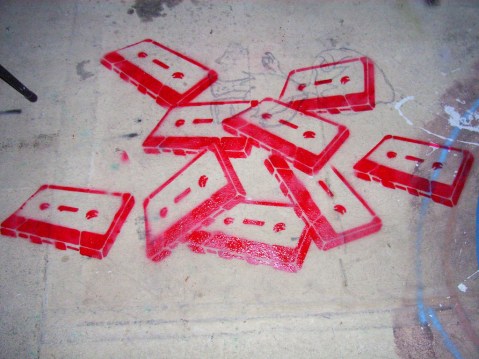
“I made you a mixtape” by Flickr user badjonni, CC BY-SA 2.0
Sonic blackness, as Nina Sun Eidsheim defines it and as Regina Bradley has expanded it, is the interplay of vocal timbre and current norms about what constitutes blackness; it’s a moving target that nonetheless shapes and is shaped by a society’s notions of race and racialization (Eidsheim, 663-64). In the case of trap, I argue that its sonic blackness is apparent in the context of post-racial ideology. Post-race politics depends on the notion that racism has ended and that race doesn’t matter anymore. In this framework, as Jared Sexton argues in Amalgamation Schemes, multiracialism, the blending of many races together until distinct racial backgrounds are purportedly indecipherable, becomes the ideal. The problem Sexton finds with multiracialism as a discourse is that it doesn’t account for the historical racial hierarchies that institutionalize whiteness as ideal; rather, multiracialism “is a tendency to neutralize the political antagonism set loose by the critical affirmation of blackness” (65).
Trap irony describes the way trap picks up recognizable markers of hip hop blackness (urban spaces, violence, drugs, sexual voracity, conspicuous consumption) so that its existence becomes an affirmation of blackness in a post-racial milieu. In fact, ironies abound in trap. Kemi Adeyemi has written about the use of lean, the codeine-based concoction of choice for many Dirty Southern rappers, as “generat[ing] productively intoxicated states that counter the violent realities of a particularly black everyday life” (first emphasis mine). LH Stallings has argued for the hip hop strip club — trap’s home away from home — to be understood as an always already queer space despite its surface heteronormativity. I’ve elsewhere used Stallings’s “black ratchet imagination” to think about party politics in the south, the way a group like Rae Sremmurd use party music as a refusal to produce and re-produce for the benefit of whiteness. The flat affect of rappers like Desiigner and Future is a similar shirking of emotional labor; where an artist like Kendrick Lamar brings fire and brimstone, Future shows up with dispassionate Autotune warble. Intoxicated but productive, heteronormative but queer, partying but political, affected but flat: in each case, we can hear trap irony navigating the complex assemblages of blackness in a purportedly post-racial society.
The last piece of the “Panda” puzzle is another trap irony, the sonification of a dis-organized polity, a bloc that doesn’t voice its interests as one. Listening to “Panda,” it’s hard to notice that the rattling hihat, integral to so much ATL trap, is missing. That’s because Desiigner vocalizes it himself. Throughout the track, he adds a handful of background vocals that trigger at seemingly random points. Unlike the flat affect of his flow, Desiigner’s vocal ad-libs are full of energy, as if he’s egging himself on. One of these vocals is “brrrrrrrrrrrrrrrah,” a tongue roll of varying lengths that replaces the missing hihat rattle. Listen back to the other trap songs I’ve linked in this essay, or check out nearly any track from trap artists like Young Thug, Rae Sremmurd, or Kevin Gates, and you’ll hear the pervasiveness of the hyped trap background vocals.

Screenshot of Desiigner’s performance at the 2016 BET Awards, June 26, 2016
Trap background vocals, like the aesthetics, politics, and economy of trap itself, is a messy business. Desiigner’s background vocals on “Panda” move in meter and sometimes lock into a sequence, but he triggers enough different ones at unexpected moments that a listener can’t know exactly what sound to expect next nor when it will occur. Desiigner sounds like Future, which is to say he sounds like trap, which is to say he sounds like blackness, and his background vocals, which he turns up loud, are emblematic of the aesthetics and politics of trap. Trap irony means that a genre that renders blackness audible in 2016 does so not through a multiracial neutralization of the critical affirmation of blackness, but by setting loose a disparate set of recognizably black voices sounding from all directions, rattling across the soundscape, routing themselves through any path that doesn’t lead to the designated entry/exit point of the trap.
—
Justin D Burton is Assistant Professor of Music at Rider University, and a regular writer at Sounding Out!. His research revolves around critical race and gender theory in hip hop and pop, and his current book project is called Posthuman Pop. He is co-editor with Ali Colleen Neff of the Journal of Popular Music Studies 27:4, “Sounding Global Southernness,” and with Jason Lee Oakes of the Oxford Handbook of Hip Hop Music Studies (2017). You can catch him at justindburton.com and on Twitter @justindburton. His favorite rapper is Right Said Fred.
—
 REWIND!…If you liked this post, you may also dig:
Slow, Loud, and Bangin’: Paul Wall talks “slab god” sonics–Doug Doneson
“The (Magic) Upper Room: Sonic Pleasure Politics in Southern Hip Hop“–Regina Bradley
“Tomahawk Chopped and Screwed: The Indeterminacy of Listening“–Justin Burton
Share this:


Current Top Posts





April 2021

January 2020

November 2019

October 2019

August 2019

April 2014

November 2017

March 2015

December 2017

October 2015
 Sounding Out!
Recent Comments