
Listening to Sounds in Post-Feminist Pop Music
Some of the most popular early 21st century feminist approaches to pop culture are rooted in a collapse of visual and aural representations. For example, though Disney princesses have become visibly more diverse and realistic, linguists Carmen Fought and Karen Eisenhauer have compiled data showing that women characters in Disney princess films speak less in films released between 1989-1999 than they did in films released in the 1930s-1950s. Writing in Noisey in 2015, Emma Garland wonders whether we “have created an environment in which female artists are being judged only on their feminism.” Both in her own analysis and in the thinkpieces she references, that judgment addresses the verbal content of song lyrics or artists’ public statements and the visual content of music videos. Noting that “a lengthy Google search will drag up hundreds of editorial pieces about the [Rihanna’s] ‘BBHMM’ video” (The Guardian alone hosts six), but barely any reviews of the actual song, Garland illustrates just how much feminist analysis of pop music skews to the visual and away from sound and music. Popular post-feminist analysis focuses on the visual and verbal because of the influence of law and legal theory on 20th century American feminism. However, in post-feminist pop, the sound lets in the very same problems the lyrics and visuals claim to have solved.

“filming of the HTML music video” by Flickr user MadLab Manchester Digital Laboratory, CC BY-SA 2.0
In her article “Liberal Feminism From Law To Art,” L. Ryan Musgrave argues, “many early feminist accounts of how art is political depend largely on a distinctly liberal version of politics” (214). This is a classical contractarian liberalism where “equality meant equality before the law…[and] democratic representation in a state” (214). Legally, these principles inform foundational liberal values like freedom of speech (e.g., the First Amendment to the US Constitution) and equality of opportunity (e.g., the Fourteenth Amendment to the US Constitution). 20th century feminist artists and art scholars translated these legal principles into ideas about how art should be made and interpreted. According to Musgrave, the political principle of free speech is translated into an aesthetic principle of “free expression…we should celebrate in order to be inclusive, straightforward expressions of either one’s individual experience or one’s identity as a member of an historically disenfranchised group” (223). This type of feminist aesthetics sought to counter the tendency to silence, ignore, trivialize, and censor women’s art.
In pop music, liberal feminism informs discussions of the marginalization of women artists in a particular genre, or celebrations of women’s self-expression, like ‘90s “girl power” and “revolution girl style now” aesthetics. As an aesthetic principle, equality of opportunity manifests as a two-pronged commitment to non-exploitative modes of production and to representational accuracy: women should not be objectified by or excluded from artistic practice, and they should be truthfully, realistically depicted in art (Musgrave 220). Pop and hip hop feminisms often appeal to this type of feminism, generally in discussions of women’s bodies: were women objectified in the video-making process? Do they appear on screen only as objects? Do the images of women accurately depict “real” women, or are they unrealistic images of too-thin, too-blonde ideals?
With its commitments to free speech and equality of opportunity, mainstream Anglo-American feminist aesthetics translates liberalism’s concept of political representation into a concept of aesthetic representation. The outcome of this translation is a “realism focused on the content of artworks” (Musgrave 223; emphasis mine) and “the conviction that it is the job of art or creative work to get it right, to show how it ‘really’ is, to come clean of previously incorrect and ideologically weighted images” (226). A feminist aesthetics focused primarily on the representational content of artworks and the subjectivity (or objectification) of artists translates classical liberalism’s ideas of what politics, injustice, and equality are into artistic terms.
Meghan Trainor’s infamous “All About That Bass” and “Dear Future Husband,” Lilly Allen’s “Hard Out Here,” and even Usher’s “I Don’t Mind” are recent examples of songs that trade in equality of opportunity-style liberal feminism. For example, “All About That Bass” and “Hard Out Here” address a disjoint between how women are portrayed in the media and how they “really” look. “Dear Future Husband” and “I Don’t Mind” are about (partnered, heterosexual) women’s entitlement to work, even sex work. Both of these approaches share the underlying assumption, drawn from liberalism, that art re-presents reality in the same way a vote re-presents a citizen’s will or an elected representative re-presents the will of their constituents: accurately and truthfully, in the sense of truth as correspondence between statement and fact, signifier and signified.

“In Her World” by Flickr user Nana B Agyei, CC BY 2.0
Within a liberal feminist framework, sound can only be political if it has a representational content that depicts or expresses a subject’s voice or identity. This is why post-feminist approaches to pop music overlook sound and music: requiring attention to things like formal relationships, pattern repetition and development, the interaction among voices and timbres, and, well, structure, they don’t fit into liberalism’s understanding of what politics is and how it works. But because the music part of Anglo-American pop music always does more than this, it has political effects that this liberal feminist framework can’t perceive as political, or as having to do with gender (or race).
This can be both a good thing and a bad thing. On the one hand, this emphasis on the visual to the exclusion of sound opens a space for radical and subcultural politics within the mainstream. For example, as Regina Bradley has argued here at Sounding Out!, Beyoncé uses sound to move outside the politics of respectability that her visual image often reinforces. On the other hand, it creates a back door through which white supremacist patriarchy can sneak in. This is the same back door that all liberalisms have, the back door that lets substantive inequality pass as equality before the law and/or the market (Falguni Sheth, Charles Mills, and Carole Pateman talk extensively about this).
Popular post-feminist pop refers back to liberal aesthetics in order to establish its “post-”ness, that is, to show that the problems liberal feminism identified are things in its and our past. For example, inaccurate representation and objectification or silencing are precisely the things that the contemporary pop examples I cited claim to have fixed: Trainor and Allen accurately represent “real” women, and Usher’s song talks about a stripper as an empowered (near) equal rather than an object. However, the sounds in these songs tell different stories; they make white supremacist patriarchy entirely present.
Usher’s “I Don’t Mind” uses sound to straighten out some of the ratchetness in hip hop sexuaility. L.H. Stallings’s “Hip Hop & the Black Ratchet Imagination” argues that
the strip club genre and the hip hop strip club also develop as a result of the unacknowledged presence of black women with various gender performances and sexual identities within the club, on stage and off, whose bodies and actions elicit new performances of black masculinity. Moreover, when woman is undone in this way, we note the potential for such undoing to temporarily queer men.” (138)
Though it’s conventional to see women strippers and their male rapper audience in terms of heterosexual desire and normativity, the dancers’ use of black dance performance traditions and aesthetics displace scripts of femininity and put their bodily gender performance in transition. And because “this is what rappers get caught up in–the fantasy of woman whose origin is in the female dancers’ undoing of woman,” (138), this fantasy also undoes them as “men.” The dancers’ performances are a type of “corporeal orature” (138) that puts outwardly heteropatriarchal gender and sexuality in transition, bending it away from respectability (the reproduction and transmission of wealth, property, and non-deviance qua whiteness) and toward ratchet.
The booty clap synth patch is one way this corporeal orature gets translated into sounds. It’s a particular variation on the hand-clap drum machine sound, and it translates the “booty clap” dance move and the rhythm of twerking into music. Following the dancers’ rhythm, the patch is usually used in a four-on-the-floor pattern, as for example in Juicy J’s “Bandz A Make Her Dance.” Featuring Juicy J as the misogynist foil to Usher’s progressive nice guy, “I Don’t Mind” is easy to hear as a direct response to “Bandz.” Like “Bandz,” “I Don’t Mind” is a song about men’s desire for strippers. However, “I Don’t Mind” straightens that desire out and classes it up by rewriting–indeed, erasing–the corporeal orature translated into the 4/4 booty-clap synth rhythm. Throughout “I Don’t Mind” that same synth patch is used on beats 2 and 4; it takes a “ratchet” sound and translates it into very respectable, traditional R&B rhythmic terms. Sound is the back door that lets very traditional gender and sexual politics sneak in to undermine some nominally progressive, feminist lyrics.
Sound plays a similar role in much of Meghan Trainor’s work. In “Dear Future Husband,” she sings apparently feminist lyrics about economic and sexual empowerment over do-wop, a backing track that sounds straight out of an episode of Happy Days (a 1970s TV program about 1950s nostalgia). Similarly, “All About That Bass” puts lyrics about positive body image over a very retro bassline that has more in common with the bassline in the theme song to David Simon’s New Orleans series Treme than it does with the bass in either Iggy Azalea’s “Black Widow” or Jessie J’s “Bang Bang”—two of the other singles consistently in the top five slots during “All About That Bass’s” weeks-long dominance of the Billboard Hot 100 in fall 2014.
Especially after the success of 2014’s “Uptown Funk” by Mark Ronson and Bruno Mars, this retromania isn’t unusual. But few pop songs look back as far as these post-feminist songs do, to the 1950s and even earlier. Appealing to pre-Civil Rights era sounds, these songs double down on the racialized sexual normalcy of white women’s performances of post-feminist empowerment. “Dear Future Husband,” “All About That Bass,” and “Marvin Gaye” (Trainor’s collaboration with Charlie Puth) all take rhythms, timbres, and genre conventions appropriated from black pop music, but which have, over half a century, been assimilated to bourgeois respectability. They recall Grease more so than Little Richard.

“Vintage Sindy Record Player” by Flickr user
Tai O’Leary, CC BY 2.0
For example, James Shotwell describes “Marvin Gaye” as taking “an innocent approach to talking about sex, with accompaniment that is straight out of your grandma’s favorite sock hop memories…Just like how Mark Ronson and Bruno Mars have made a mint in recent years with a revitalization of funk ethos, Meghan Trainor and Charlie Puth are now doing the same for pop, only with less risk.” “Marvin Gaye” sounds less sexually risky because it recalls what, for whites, was a more racially “innocent” time, a pre-Civil Rights era when white ears could more easily avoid the sounds of black radical politics in either James Brown’s funk or Gaye’s soul. In “Marvin Gaye,” old-school sounds evoke a time when society was organized by the same sort of comparatively simple racial politics that organize the song itself. For example, its bridge follows the trap convention of using a male-chorus “Hey!” on the 2 and 4 of every measure. Its verses, however, put that same “Hey!” patch only on 4. Sounds evoke racial non-whiteness to generate tension, but then resolve that tension sonically. Definitive sonic resolution shuts down the transitional effect ratchet sounds, like those heard in the bridge, can have on sexuality and gender.
In “Marvin Gaye” and the other retromanical post-feminist pop songs, sounds do the white supremacist patriarchal work the lyrics and videos claim to have progressed past. Even though these women’s speech and appearance are outside the bounds of traditional femininity, the sounds reassure us that this newfangled gender performance isn’t racially and sexually deviant, that it isn’t “ratchet” in Stallings’ sense. Using liberalism to define the paramaters of political (in)justice, contemporary post-feminist aesthetics focus our attention and effort on verbal content and visual mimesis; this creates an opening for sound and music to either destabilize or double down on normative gender, sexual, and racial performance. As the “Marvin Gaye” example shows, this opening is an essential component of neoliberal post-feminism: sound recodes white women’s transgressions of traditional femininity as racially and sexually normal.
—
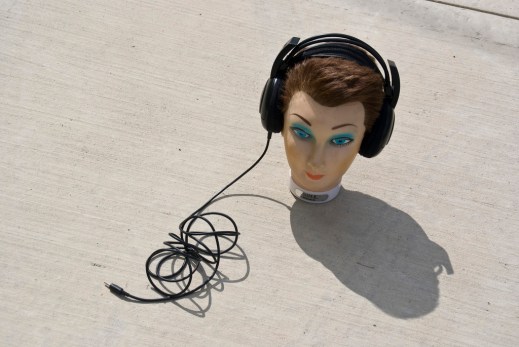
Featured image: “mannequin head on concrete with headphones” from Flickr user J E Theriot, (CC BY 2.0)
—
Robin James is Associate Professor of Philosophy at UNC Charlotte. She is author of two books: Resilience & Melancholy: pop music, feminism, and neoliberalism, published by Zer0 books last year, and The Conjectural Body: gender, race and the philosophy of music was published by Lexington Books in 2010. Her work on feminism, race, contemporary continental philosophy, pop music, and sound studies has appeared in The New Inquiry, Hypatia, differences, Contemporary Aesthetics, and the Journal of Popular Music Studies. She is also a digital sound artist and musician. She blogs at its-her-factory.com and is a regular contributor to Cyborgology.
—
 REWIND! . . .If you liked this post, you may also dig:
Love and Hip Hop: (Re)Gendering The Debate Over Hip Hop Studies–Travis Gosa
SO! Amplifies: Mega Ran and Sammus, The Rappers With Arm Cannons Tour–
Share this:

Gendered Voices and Social Harmony

 Editor’s Note: Our forum on gender and voice comes to a close today—and what a forum it has been! Last week AO Roberts talked about speech synthesis and why the robotic voices are so often female. That post followed Art Blake’s, where he talked about how his experience shifting his voice from feminine to masculine as a transgender man intersects with his work on John Cage. Before that, Regina Bradley put the soundtrack of Scandal in conversation with race and gender. The week before I talked about what it meant to have people call me, a woman of color, “loud.” The post that started it all? Christine Ehrick‘s selections from her forthcoming book, on the gendered soundscape.
This week Robin James returns to SO! to round out our forum with an analysis of how ideas of what women should sound like have roots in Greek philosophy. So, lean in, close your eyes, and let the voices take you back in time. –Liana M. Silva, Managing Editor
—
Dove and Twitter’s #SpeakBeautiful tries to market its brand by getting Twitter users to rally behind the hashtag. The idea is to encourage women to talk about their bodies and other women’s bodies only in positive terms–and to encourage interaction on Twitter. But why is tweeting, which is entirely text-based, called “speaking”? And what does it mean to speak beautifully, since beauty is usually an issue of body image? In other words, why give this campaign that specific name?
Their promotional video has a clue. As on Twitter, there is no voice, only text; however, there is an instrumental soundtrack throughout. It begins in a minor mode, traditionally associated with negative emotions. Then, around the 0:19 mark, once the blue Dove domino has started knocking down all the white dominoes with negative comments printed on them, the soundtrack shifts to major mode, which is traditionally associated with positive emotions. The video equates social media performance with musical harmony: negative comments are dissonant, positive ones are consonant.
“Speaking beautifully” means adopting the tone or attunement expected of the social media performance. But this still doesn’t tell us why it makes sense for Dove to describe women’s ability to follow social (media) norms as speaking, as making a particular kind of sound. #SpeakBeautiful is just the latest example of a convention that dates back thousands of years: patriarchy moderates women’s literal and metaphoric voices to control their participation in and affect on society, ensuring that these voices don’t disrupt a so-called harmoniously-ordered society. In what follows, I look to the origin of that convention in so we can better understand how it works today.
***
Anne Carson’s essay “The Gender of Sound” focuses mainly on ancient Greek literature and philosophy. “In general,” she argues, “the women of classical literature are a species given to disorderly and uncontrolled outflow of sound” (126). Unless carefully managed by husbands and the law, women’s loose lips (in both senses of the term) will upset overall “harmonious” order of the city. That’s why the ancient Greeks thought women’s disharmonious sounds acted “as political disease” (127).

“Eglise de Commana2012 469” by Lamiot – Own work. Licensed under CC BY-SA 3.0 via Wikimedia Commons
Emphasizing the relationship the Greeks drew between sonic harmony and social harmony, Carson’s analysis hinges on the concept of sophrosyne; often translated as “moderation,” the ancient Greeks understood sophrosyne as a type of harmony, and often explicitly connected it to musical harmony. Understanding the connection between sophrosyne and ancient Greek theories of musical harmony (which are very different than contemporary European ones) makes it easy to update Carson’s analysis to account for contemporary appraisals of women’s voices, such as the view that some feminist voices on social media are “toxic.”
According to Carson, the ancient Greeks thought women’s voices were immoderate when they exhibited excessive frequency: they could talk either at too high a pitch, or just talk too much. As Carson explains,
verbal continence is an essential feature of the masculine virtue of sophrosyne…[A]ncient discussions of the virtue of sophrosyne demonstrate clearly that, where it is applied to women, this word has a different definition than for men. Female sophrosyne is coextensive with female obedience to male direction and rarely means more than chastity. When it does mean more, the allusion is often to sound. A husband exhorting his wife or concubine to sophrosyne is likely to mean ‘Be quiet!’ (126).
So, (certain kinds of) men were thought to be capable of embodying (masculine) sophrosyne, that is, of comporting their bodies in accord with the order of the city, so that when they did speak, their speech contributed to social harmony and orderliness. The practice of sophrosyne aligns one’s body with the logos of a properly-ordered society, and, indeed, a properly-ordered cosmos. As Judith Periano puts it, moderation “tunes the soul to the cosmic scale (rather than the physical body)” (33). Women (and slaves, and some other kinds of men) were thought to be incapable of embodying this logos, of transforming their bodies into microcosms of the well-ordered city and harmonious cosmos. Their speech would disrupt social and cosmic harmony with dissonant, disorganized material. Silence, then, is how women contributed to social and cosmic harmony: their verbal and sexual chastity preserved the optimal, most well-balanced political and metaphysical order.

“Sanzio 01 Plato Aristotle” by Raphael – Web Gallery of Art: Image Info about artwork. Licensed under Public Domain via Wikimedia Commons
Women couldn’t embody the logos because they had “the wrong kind of flesh and the wrong alignment of pores for the production of low vocal pitches, no matter how hard they exercised” (Carson 120). Women’s disproportional “alignment of pores” matters, and Ancient Greek music theory is key to understanding why. Though there was widespread disagreement as to the specific ratios that were the most consonant and harmonious, there was a general consensus among music theorists and philosophers that musical harmony was a matter of geometric proportion. For example, Plato says in Timaeus 32c that the cosmos “was harmonized by proportion.” Proportion, for the ancient Greeks is both a ratio and a hierarchical ordering, a relational distribution that is also a series. Plato’s myth of the metals, for example, is both proportional (the “gold” get the most responsibility) and hierarchical (the gold are on the top). There is a right place for everything, and harmony is the effect of everything being in its right, appropriately proportionate place.
Harmonious sounds are side-effects of harmoniously proportioned material bodies–or rather, sonic harmony occurs when the relationship between an instrument’s internal structure and external emission (e.g., between body and speech) is itself proportionate. For example, on a pipe organ, a pipe’s size is directly and consistently proportional to the pitch it emits, such that the geometric relationships among pipes are directly and consistently proportional to the relationships among pitches. Woodwinds, on the other hand, exhibit no such direct, consistent relationship between material configuration and emitted pitch. On an oboe, the geometric relationship between the instrument as it plays a middle C and a high C does not mirror to the acoustic relationship between those pitches. As Plato puts it “in the case of flute-playing, the harmonies are found not by measurement but by the hit and miss of training, and quite generally music tries to find the measure by observing vibrating strings. So there is a lot of imprecision mixed up in it and very little reliability” (Philebus 56a). Here, he expresses the then-typical view that musical harmony ought to be a mathematically consistent effect of geometric relationships among the instrument’s parts (e.g., vibrating strings). The problem with the flute is that the relationships among its pitches is merely sonic, and cannot be inferred from the geometric relationships among its parts. Its sounds do not exhibit a consistent, proportional, moderate relationship to its material structure.
This is the same problem Carson identifies with women: the orderliness of their vocal emissions cannot be reliably inferred from the visible arrangement of their body and its constitutent parts. Like the flute, a feminine body cannot emit a moderate sound because the proportions of women’s bodies are out of whack; they don’t exhibit the proper ratio between parts, or between inner constitution and outer expression.

“Banquet Euaion Louvre G467 n2” by English: Euaion Painter – Jastrow (2008). Licensed under Public Domain via Wikimedia Commons
Women’s voices are “bad to hear or make men uncomfortable” (Carson, 129) not just because the voices themselves are disharmoniously feminine, but because they upset the social and cosmic order, specifically, the balance between inside and outside (129), intelligible and visible. Just as the aulos (an ancient Greek double-reeded instrument, somewhat like a modern oboe) upsets the proper, ideal relationship between an instrument’s physical structure (the part that commands, the mathematical logos of proportionality) and acoustic tuning (the part that obeys, pitches), women’s emissions mess up the proper, logical relationship between “the part that commands and the part that obeys” (Foucault, The History of Sexuality Vol. 2, 87), that is, between inner and outer, soul and body, private and public. Carson says, “By projections and leakages of all kinds–somatic, vocal, emotional, sexual–females expose or expend what should be kept in” (129). Sophrosyne is what keeps things in their right place as they get outwardly expressed.
When men practice “masculine” sophrosyne, they shape their bodies, their resonating innards, so to speak, into a form that will lend itself to rational, proportional outer expression, i.e., speech. Women’s feminine sophrosyne, public silence, keeps their irrational bodies from outwardly expressing disharmonious, disproportionate phenomena that would knock everything out of balance. Masculine sophrosyne is a technique for embodying the logos at the individual, social, and cosmic levels; feminine sophrosyne is a technique for keeping the cosmic/social logos from being disturbed.
Nowadays, though, we don’t expect “good” women to be seen and not heard–we praise (some) women for making the right noises in the right contexts. For example, Rebecca Solnit wrote that 2014 was, for women, “a year of mounting refusal to be silent…It was loud, discordant, and maybe transformative, because important things were said…and heard as never before.” Proclamations of women’s envoicement–of women’s full inclusion and participation in society–are central to post-feminist patriarchy, which functions best when there is a little bit of “feminist” noise mixed in with its signal. The audibility of some women’s “feminist” voices serves as (misleading) evidence that patriarchy is over (or on the way there), and lets patriarchy and the intersectional work it does pass unnoticed. Whereas the ancient Greeks thought women’s voices were absent from a harmonious society, contemporary (neo)liberal democracies think a harmonious society includes a certain amount of feminist noise.

“Christine de Pisan – cathedra” by From compendium of Christine de Pizan’s works, 1413. Produced in her scriptorium in Paris – http://bcm.bc.edu/issues/winter_2010/endnotes/an-educated-lady.html. Licensed under Public Domain via Wikimedia Commons
But not too much feminist noise: feminist noise must be moderate. Moderation still matters–it’s just measured differently than it was in ancient Greece. It isn’t a matter of geometric proportion, but of dynamic range. From a post-feminist perspective, feminist voices that call attention to ongoing patriarchy and misogyny feel too loud. Sara Ahmed explains, “words like “racism” and “sexism” are heard as abrasive because they name what has receded from view.” Voices that speak of ongoing racism and sexism are charged with the same flaws attributed to artificially loudened, overcompressed music: inflexibility, lack of variability, and ineffectiveness. Just as overcompressed music is thought to, as Suhas Sreedhar describes “sacrifice…the natural ebb and flow of music,” feminist activists are thought to to sacrifice the natural ebb and flow of social harmony.
In a post-feminist, post-race society, people who continually insist on the existence of sexism and racism appear to be similarly stuck on an irrelevant issue and lacking in expressive range. Similarly, in music lacking dynamic range, “the sound becomes analogous to someone constantly shouting everything he or she says. Not only is all impact lost, but the constant level of the sound is fatiguing to the ear (Sreedhar).” Because it stays more or less fixed at the same amplitude of sound, loud music is thought to be both ineffective and unhealthy for those subjected to it. Similarly, liberal critics of women of color activists often characterize them as hostile, uncivil, or overly aggressive in tone, which supposedly diminishes the impact of their work and both upsets the healthy process of social change and fatigues the public. They are, in Michelle Goldberg’s terms, “toxic.”
This “ebb and flow” is not a geometric proportion, but a frequency or statistical distribution that can be represented as a sine wave. As I have argued here, contemporary concepts of social harmony aren’t based in ancient Greek music theory, but on acoustics. For example, Alex Pentland’s theory of “social physics” or, “the reliable, mathematical connections between information and idea flow…and people’s behavior” (2), treats individual and group behavior as predictable patterns that emerge, as signal, from noisy data streams, just as harmonics and partials emerge from interacting sound frequencies.
 In this context, “loud” feminist voices feel like they’re upsetting the ebb and flow, the dynamic range and variability, of information and idea flow. But the thing is, they aren’t upsetting the flow, but intensifying it: their perceived loudness incites others to respond with trolling, harassing, and other kinds of policing speech, often in massive scale. When philosopher Cheryl Abbate told her students that it was unacceptable to express homophobic views in class, John McAdams, a tenured faculty member in the department where Abbate is a doctoral student, wrote a blog post accusing her of inhibiting the free expression of a diverse range of opinions. Her “loud” feminism masked the “healthy diversity” of opinions. McAdams’s post led Abbate to be targeted by a tsunami of harassment, from individuals emailing her, to social media attacks, to attacks from mainstream media and political organizations. When feminist voices make noise, patriarchy amps up its own frequencies to bring the mix back in proper balance so that patriarchy is what emerges from feminist noise. In this context, voices are harmonious when, together, their ebb and flow predictably transmits patriarchal signal into the future. Sophrosyne is a feature of voices that interact so that patriarchal power relations emerge from them: they might actually have an extremely high volume, but they feel moderate because they restore the “normal” ebb and flow of society.
When Dove and Twitter urge women to “speak beautifully,” they’re really demanding that women practice sophrosyne: that they make just enough ‘feminist’ noise without being too loud–i.e., loud enough to distort the brand image of Unilever and Twitter. So, even though ancient Greek concepts of musical harmony and patriarchy are vastly different than contemporary (neo)liberal democratic ones, each era uses its own version of sophrosyne to shape women’s voices into something consonant with a social order that privileges men and masculinity.
—
Featured image: “” by Flickr user Ed Lynch-Bell, CC BY-NC 2.0
—
Robin James is Associate Professor of Philosophy at UNC Charlotte. She is author of two books: Resilience & Melancholy: pop music, feminism, and neoliberalism, published by Zer0 books last year, and The Conjectural Body: gender, race and the philosophy of music was published by Lexington Books in 2010. Her work on feminism, race, contemporary continental philosophy, pop music, and sound studies has appeared in The New Inquiry, Hypatia, differences, Contemporary Aesthetics, and the Journal of Popular Music Studies. She is also a digital sound artist and musician. She blogs at its-her-factory.com and is a regular contributor to Cyborgology.
—
REWIND!…If you liked this post, check out:
Top 40 Democracy: Taylor Swift’s Election Day Victory—Eric Weisbard
Vocal Gender and the Gendered Soundscape: At the Intersection of Gender Studies and Sound Studies—Christine Ehrick
On Sound and Pleasure: Meditations on the Human Voice– Yvon Bonefant
Share this:


Current Top Posts





April 2021

January 2020

November 2019

October 2019

August 2019

April 2014

November 2017

March 2015

December 2017

October 2015
 Sounding Out!
Recent Comments