
Closing Time, or What’s In a Song?
Ever since the Chicago Cubs installed an organ at Wrigley Field in 1941, music has been a part of the baseball ballpark experience. Unlike basketball, hockey or football, baseball doesn’t have non-stop action, and its frequent periods of inaction give an organist or stadium DJ a broad canvas on which to improvise. Initially, ballpark music was strictly organ music, as organs were present at every ballpark by the middle of the 20th century. Starting in the 1960s and 1970s, the organist was complemented by the stadium DJ, who played recorded music over the stadium sound system. Gradually, the DJ overtook the organist and many stadiums no longer play live organ music; a little less than half of the 30 ballparks that host Major League Baseball games today don’t employ an organist.
As technology improved, allowing stadium DJs to play music on the computer rather than on the record or 8-track player, teams began allowing baseball players to choose the music they wanted to hear. And, in the 1990s, the phrase “walk-up music” entered the sports fan’s vernacular. Position players chose songs for the stadium DJ to play when they walked from the on-deck circle to the batter’s box. Pitchers picked music to be played while they warmed up at the start of their outing.
Players select their music in a variety of ways. Some pick a song from their favorite artists, artists that often originate from their corner of the world (e.g. a lefthanded pitcher from Texas warming up to country music or Southern hip-hop; a utility infielder from the Dominican Republic opting for a merengue or bachata tune). Others will choose music they feel helps motivate them to perform better on the field, choosing a new song whenever they enter a slump. Some players will even allow the stadium DJ to pick their music. In 2007, New York Mets third baseman David Wright gave the fans the opportunity to vote for his walk-up song online, giving them list of 50 of his favorites to choose from (the fans choice: “Me & U,” the only hit by Cassie, a hip-hop artist).
While almost every baseball player has walk-up music, only a handful of players have had their music become an iconic part of their image and legacy. The best example of a player who’s become closely identified with his entrance music is New York Yankees pitcher Mariano Rivera.

Photo by Flickr user Dennis
Rivera has been the Yankees’ closer for more than a decade and a half, called upon to get the last three outs in the ninth inning when the Yankees are ahead by a handful of runs. The closer’s role is one of the most pressure-packed in all of team sports. Do it well, and your opponents often feel defeated as soon as you come into the game. Do it poorly, and you’ll frustrate your teammates, your manager and your team’s fan base. After all, nothing’s more demoralizing than losing a game you’ve all but won, and a closer’s job is to turn almost-certain wins into definite victories. Rivera is arguably the best closer in baseball history, an integral part of a Yankees team that’s won five championships and advanced to the playoffs in all but one of his 16 seasons.
During Rivera’s rise to prominence in the late 1990s, the DJ at Yankee Stadium, his home ballpark, began playing “Enter Sandman” by Metallica when Rivera came into the game. To a certain extent, “Enter Sandman” seems like a strange choice for Rivera’s entrance. While it does start off softly before building to a eardrum-thumping crescendo of guitars, “Enter Sandman” is a loud, heavy-metal song. Rivera, the most reserved of the Yankees superstars developed over the last two decades, is serene and soft-spoken. To the untrained ear, “Enter Sandman” sounds arrogant and boastful, two words that have never been used to describe Rivera.
However, in many ways, “Enter Sandman” does compliment Rivera. Its lyrics, about a child battling nightmares as he tries to sleep, are a perfect metaphor for Rivera, whose job is to gives opposing hitters nightmares while trying to put the game to bed in the Yankees’ favor. Rivera, a deeply religious man by all accounts, probably approves of the song’s encouragement to “Say your prayers little one” and its recitation of a classic children’s bedtime prayer (“Now I lay me down to sleep/Pray the Lord my soul to keep…”). In addition, Rivera may also get a kick out of the idea of opposing hitters saying their prayers before facing the dancing and darting fastballs that he throws with ruthless efficiency and pinpoint accuracy.
It also helps that Yankee Stadium is one of the loudest outdoor venues anywhere. Its combination of rabid fans and their New York-style obnoxiousness and hubris combined with an ear-splitting sound system that could wake the dead already makes the Bronx, NY stadium one of the toughest venues for visiting teams to compete. Combine those elements with a song that’s loud, even before you raise the volume, being played while an indomitable closer jogs to the pitcher’s mound from the bullpen behind the outfield fence and makes his warm-up throws and it isn’t hard to understand why many enemy teams are mentally vanquished before they even take their cuts against Rivera, whose entrance routine serves to both whip the Yankee Stadium crowd into a frenzy and intimidate opponents.

Photo by de Mel
Would Rivera be as dominant without such scene-setter is a legitimate question. While baseball is a very technical sport, requiring precision whether you’re fielding a ground ball or laying down a bunt, emotion and superstition has a prominent place in the sport. Yankee Stadium is already one of the most hostile stadiums for opponents; throw in a great closer coming out to a ominous, foreboding song and it’s understandable how an opponent’s anxiety would be heightened. You could also argue that, Rivera is so good, what’s playing over the sound system is immaterial. After all, Rivera does play half his games on the road, away from Yankee Stadium and “Enter Sandman,” and he has managed to excel in those contests as well.
Rivera is now 40 years old and still among the best at an age when most baseball players are retired or on the downward slope. Upon retirement (and the requisite five-year waiting period), Rivera will almost certainly be enshrined in the National Baseball Hall of Fame with the other greats. And, while “Enter Sandman” hasn’t been the sole reason for his success, it will always be an indelible part of Rivera’s legacy.


Share this:

The Noise You Make Should Be Your Own
 Before I suggested the name VIBE, even before the magazine was being called Volume, it was known as NOISE. I never liked that name. I mean, I knew what they were going for: “Noise” was meant to imply the loud raucousness of youth that defined the increasingly popular urban culture that would fill its pages. But the dominant strand of that youth culture was going to be represented by hip-hop, and I was quite sensitive to mainstream society’s tendency to think of hip-hop—what I liked to think of as the breakbeat concertos of inner city maestros—as not-music, as nothing but noise, something not necessarily from the street but of it, like a garbage truck or a knife fight.
I started to reminisce about the Noise name a coupla weeks ago when I walked into my university-owned apartment building and saw a note with the word “NOISE” poised at the top of it in a huge bold and italicized font, assured of getting everyone’s attention as they entered the elevator vestibule. According to the note taped to the wall, there was a noise problem in the building, and it was getting worse. Would tenants please be considerate of the other members of the apartment community and refrain from playing music loudly after certain proprietary hours?
I thought about it. I never heard music being played loudly. But maybe that was because I live on of the upper floors, away from the blaring speakers of others. The noise I was privy to was the natural noise of the many babies who lived in the building, the children of grad students, probably bored to tears (and tantrums) living in this austere monolith we all call home.
But then I thought about it some more. And I considered the musical noise I heard in this building, compared to the musical noise I’d heard in my building in Manhattan before I re-located to pristine, polite Cambridge, Massachusetts. In New York, I remember the guy on the second floor, the raging theater queen, who blasted cast albums and show tunes at top volume, usually during the day, when the only people in our small West Village building were him (a theater designer), me and the “model” who lived on the third floor—in other words, those of us who lived lives outside the traditional mainstream. The “model” cranked up the volume on her club-kid techno beats, while I was probably playing The Smiths or The Cure or R.E.M. at loud volumes, re-living my college rock days while missing a freelance deadline or two.
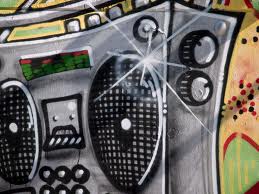
I remember, when I lived in New York, thinking that people had no shame when it came to making noise: people had loud  conversations about personal business on the subways; vendors shouted to (at?) delivery guys on street corners; sirens blared their way through the streets; boomboxes competed with car speakers for the ears and stares of passersby. But no one complained. If anything it was a competition of soundtracks in, on and around the streets of New York. Do the lipstick lesbians outside the bar across from my apartment mind, relish in the fact perhaps, that the iconic sound of Stevie Nicks growling out of the jukebox codifies them as queer women on the scene? That kid in the business suit and expensive Wall Street shoes on the train, bobbing his head to the rhythms of Jay-Z rapping loudly through his earbuds: does he really want those of us around him to know he was a hip-hopper? The 6’4” theatrical designer from the second floor who struts down 12th Street like a linebacker: does he simply want the world to know that Barbra’s star-making turn as Miss Marmelstein soothed his soul and that the Pippin version of “Corner of the Sky” is what gets him through the day?
And what was my noise telling the world? I was the queer black writer dude upstairs. But if someone had walked by the apartment, not knowing who was inside, and stopped to tap a toe or shed a tear at the mopey, fop-rock of Morrissey that so often cleared my door jamb, would I be what they expected? Perhaps; perhaps not.
But then I think about the times that I just had to hear Martika. And I had to hear her loud. Or I had to hear some 80s-style deep house, especially the tracks defined by the soul-shouting diva-fied orgasmic melismas that not only date me age-wise, but most definitely queer the space that was blasting the Rolling Stones’ Let It Bleed just a half hour before. I used to be self-conscious of those sonic shifts in my noise soundtrack, as if they highlighted a larger, deeper confusion about my own position, culturally-, racially-, and sexually-speaking.
But then I joined the team to start VIBE, a magazine once called NOISE. And my sensitivity over its possible name settled my own personal dilemma: We may want the world to hear our noise, because of its shorthand to who we are. But what we really want them to do is feel our noise, vibe it if you will, and hopefully feel our joy, pain, shame, love and contradictions in the process.
–SPB (Scott Poulson-Bryant)


Share this:


Current Top Posts





April 2021

January 2020

November 2019

October 2019

August 2019

April 2014

November 2017

March 2015

December 2017

October 2015
 Sounding Out!
Recent Comments