
Sound and Sanity: Rallying Against “The Voice”
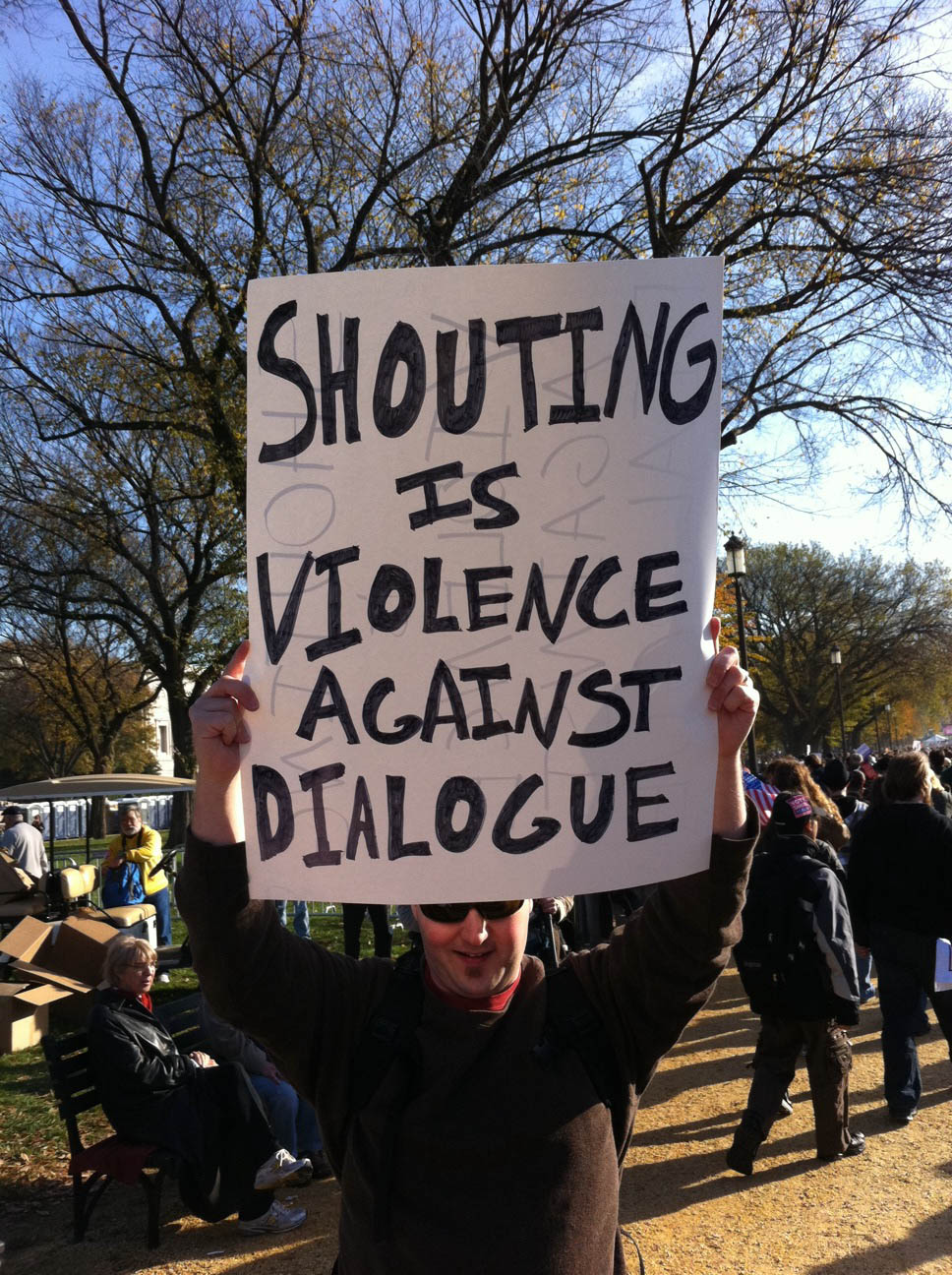 John Stewart’s recent Rally to Restore Sanity was an important political demonstration for all of the fairly-busy people in the USA. It was a moment when those who work forty hours per week or who have too many social bookings were able to come to the United States Capitol in order to proclaim with their “indoor voices” that the current political debates in America are characterized by too much irrationality and fear. As the RTRS website states, Stewart’s rally was expressly for “the people who think shouting is annoying, counterproductive, and terrible for your throat; who feel that the loudest voices shouldn’t be the only ones that get heard; and who believe that the only time it’s appropriate to draw a Hitler mustache on someone is when that person is actually Hitler. Or Charlie Chaplin in certain roles.” It’s interesting that the aim of this rally was ostensibly against the “shouting” and the “loudest voices” rather than any specific ideas, statements, or political positions. In other words, the problem, as Stewart sees it, is that public debates are too full of noise. And it is this noise that must be vanquished—or that, at least, should be modulated to an “indoor” level.
Stewart’s opposition between sound and sanity is actually quite common. Public noise is senseless sound, while rational debate is meaningful sound. The logic goes, then, that public debates need to have less sound or, at least, regulated sound. They must have two people who are willing to speak quietly and rationally, hear each other’s points, and raise and answer each other’s objections until some kind of consensus is built. Good public debates require less sound and more sanity.
But is this sonic modulation the right way to conduct public debate and to persuade others? The truth is that the relation between noise and reason, between senselessness and sanity, is very, very complicated. In fact, although it is a collective national fantasy that good debate is built on reason, there are lots of reasons to suggest that reason doesn’t always (or even predominately) come first. Rather, it’s often the sound that convinces people in an argument—not the reason. And in public debate, the particular sound is “The Voice.”
By looking at an episode of the animated TV show Batman: The Brave and the Bold let’s listen to how The Voice can persuade people to act against their own sanity. In “Mayhem of the Music Meister,” Neil Patrick Harris gives voice to the Music Meister, a singing villain whose tone and rhythm instantly hypnotize those who hear him and bend their actions to his will:
As the opening sequence begins, the audience is prepped for a standard showdown between three villains: Black Manta, Gorilla Grodd, and Clock King, who plan to steal a communications satellite; and three heroes: Black Canary, Green Arrow, and  Aquaman, who are prepared to save the day and stop the theft of the industrial hardware. But this showdown is interrupted when–to his surprise and seemingly against his self-control–Black Manta bursts into song, crooning, “I’m sounding shrill against my will.” Soon the other villains and heroes follow suit. All lose control of their voices and begin singing and acting against their own will. What’s interesting about this moment is that losing control of their voices signals a complete loss of self-control. Yet this loss brings with it a division within themselves. On one hand, they recognize that they are singing. On the other hand, they are conscious of the fact that they are equally unable to prevent their own actions. They must sing; they must dance; they must dissolve the initial division between heroes and villains and join together in a revised plan to launch the communications satellite.
From this vantage point, we can return to the alleged difference between sound and sanity. The first problem is that The Voice bypasses reason, making people comply without, or even in spite of, critical reflection. It generally does this in two ways. As the Music Meister episode illustrates, The Voice divides the hearer against himself, taking over his body while he remains fully aware of the situation. In other words, the Voice exerts a direct control over a body while the hearer remains in control of his or her consciousness. The Voice is a science fiction staple. For example, in Frank Herbert’s Dune, the Bene Gesserit are able to speak directly to the unconscious of the hearer while the conscious mind is aware that the body is controlled by The Voice. In the filmed version, an extra quality is added to The Voice in order to highlight the difference between its conscious and subconscious aspects. The Voice must sound different from the voice.
The second way that the Voice bypasses reason is in the way in which a voice– often described musically–makes people lose control of their ability for critical reflection. An example of this form of The Voice also comes from science fiction: the Jedi Mind Trick made famous in Star Wars. In this case, Obi Wan Kenobi bypasses the storm troopers’ ability to recognize the droids they are looking for, even as C3-PO and R2-D2 hang awkwardly from the back of his sandspeeder.
 When the logical reasons inevitably fail to account for the act of persuasion in public discourse, others come to the forefront. Often people will say the speaker has charisma, but often they are really referring to The Voice’s role as the persuasive element. What persuades? Not the logical argument, not sanity, but The Voice. And, often, this is against our better judgments or in spite of ourselves. So when Stewart acknowleges the role that “senseless” sound plays in public debates, he goes too far when he calls for “meaningful” sound instead. The two are not in opposition as the RTRS suggested. When all is said and done, sanity almost always depends on so-called senseless sound.


Share this:

Sound at ASA 2010
A Cast of the Statue of Liberty’s Ear
Normally you would see a brand-new post from Sounding Out! on a Monday like this one, but this week I am traveling to the American Studies Association Conference in San Antonio, Texas, where I will be speaking on what promises to be an excellent sound studies roundtable on Thursday morning. I am excited to be part of a growing sound studies presence at ASA and I would love to facilitate an even larger auditory footprint. So as to bring the conference experience a little closer to those that cannot be down in TX, I will be. . .
A) posting my opening gambit to my roundtable “Huhh!..Hahh!..Huhh!..Hahh!..: Sound, Working, Chain” Thursday evening and welcoming your thoughts and responses
B) Tweeting real-time sound-related thoughts and ideas inspired by the panels I attend at our twitterfeed: http://twitter.com/soundingoutblog; follow us for the scoop!
& C) Listing all of the sound related panels below–which are full of lovely hotlinks to full abstracts. If you are planning to attend ASA, please come give these folks a listen. If you can’t make it, participate via Sounding Out!
See you Thursday! If I somehow missed you, please let me know!: jsa@binghamton.edu
Access the full searchable program here: This years’s theme is “Crisis, Chains, and Change.”
Thursday, 11/18

“Lightnin’” Washington, an African American prisoner, singing with his group in the woodyard at Darrington State Farm, Texas, Alan Lomax, photographer, April, 1934
Scheduled Time: Thu, Nov 18 – 10:00am – 11:45am
Building/Room: San Antonio Convention Center / Room 206B
Chair: Bryan Wagner (University of California, Berkeley (CA))
Panelist: Roshanak Kheshti (University of California, San Diego (CA))
Panelist: Shana Redmond (University of Southern California (CA))
Panelist: Gustavus Stadler (Haverford College in Pennsylvania (PA))
Panelist: Jennifer Stoever-Ackerman (State University of New York, Binghamton (NY)
Panelist: Tara Rodgers (McGill University)
Abstract:
In his hit song “Chain Gang” sledge hammer clangs against railroad tie as Sam Cooke’s honey-dipped voice narrates a sonic scene in which men “moanin’ their lives away” lose themselves in a choral anguish, each grunt metronomically marking the passage of servile time, their spirits carried off to an imagined homeland inhabited by loved ones, a place of possibility and hope. “Give me water, I’m thirsty, my work is so hard” the collective body reveals a fundamental yearning for a material and spiritual quenching that is not yet. Riding the refrain “Huhh!..Hahh!..Huhh!..Hahh!,” the working men carry on in a sonic meditation, hovering just above their toiling bodies in sound worlds of redemptive, libratory possibility.
Cooke’s evocative lyrics and guttural howls along with his bands rhythmic precision set to record in an RCA studio by Hugo Peretti and Luigi Creatore’s production skills represents a synergy of sonic performances and events. This panel brings together scholars working on similar synergies in which sound reaches just beyond its boundaries exceeding its perceptual mode to create contact with other worlds, times, places and possibilities. Whether in the context of commodity chains, chains of signification, busking for change or disruptions to the chain of command, sound can function as medium, message, massage, weapon, prison and fantasy. This panel explores the poetics of sound, examining its capacity as a vehicle of time travel, distraction, alarm, liberation, restraint and pleasure.
Scheduled Time: Thu, Nov 18 – 4:00pm – 5:45pm
Building/Room: San Antonio Convention Center / Room 214C
Licensed Begging: Mayor La Guardia’s Street Music Ban and Noise Abatement as Labor Surveillance: Robert Hawkins (Saint Louis University (MO))
A Short History of American Wiretapping: David Suisman (University of Delaware (DE))
Anarchy in the U.S.A.: Immigrant Punk, Hybridity and the Incarceral Politics of American National Identity: Megan Turner (University of California, San Diego (CA))
Double Voices of Musical Censorship: Martin Scherzinger (New York University (NY))
Scheduled Time: Thu, Nov 18 – 4:00pm – 5:45pm
Building/Room: San Antonio Convention Center / Room 213B
Chair: Barry Shank (Ohio State University, Columbus (OH))
Paisagem Útil : Modernity and the Nation in Brazilian Popular Song: Brendan McGillicuddy (University of Minnesota, Twin Cities (MN))
The Punk Event: The CBGB’s Scene and Avant-Garde Aesthetics: Shaun Cullen (University of Virginia (VA))
Can’t Quit Your Day Job: The Liminal Space of the Semiprofessional Musician: Colin Helb (Elizabethtown College (PA))
Comment: Barry Shank (Ohio State University, Columbus (OH))
Friday, 11.19
Scheduled Time: Fri, Nov 19 – 10:00am – 11:45am
Building/Room: San Antonio Convention Center / Room 201
Chair: Ben V. Olguin (University of Texas, San Antonio (TX))
The Sounds of Shackles: African American Work Songs on Texas Prison Farms : James Deutsch (Smithsonian Institution)
Promises, Problems, and Cultural Crises: The Reverberating Sounds from Gideon v. Wainwright: Mary Seliger (University of California, Santa Barbara (CA))
Radio Raheem’s Broken Boom-Box: Artistic and Musical Responses to Police Brutality and Racial Violence: Johanna Almiron (University of Hawaii, Manoa (HI)
Comment: Ben V. Olguin (University of Texas, San Antonio (TX))
Scheduled Time: Fri, Nov 19 – 10:00am – 11:45am
Building/Room: San Antonio Convention Center / Room 214C
Chair: Ulrich Adelt (University of Wyoming (WY))
The Ethical Vision of “el Adios Tejas” in El Corrido Pensilvanio Jaime Javier Rodriguez (University of North Texas (TX))
Making Face, Making Space: The Aesthetics of Brown Identity in Jim Mendiola’s Girl In A Coma Universe Alexandra Mendoza Covarrubias (University of Minnesota, Twin Cities (MN))
Asian American Hip Hop and the Inter-national Christopher Ramos (University of Florida (FL))
Comment: Alexandra Vazquez (Princeton University (NJ))
Scheduled Time: Fri, Nov 19 – 12:00pm – 1:45pm
Building/Room: San Antonio Convention Center / Room 206A
Chair: Lawrence La Fountain Stokes (University of Michigan, Ann Arbor (MI))
Sonic Crisis: Girl in a Coma: Deborah R. Vargas (University of California, Irvine (CA))
Si tú creías que yo no venía: NuYoRico, Salsa, and Puerto Rican “National” Culture: Marisol Negrón (University of Massachusetts, Boston (MA))
Censúrarme: Underground Rap and Neoliberal Policing in Puerto Rico: Marisol LeBrón (New York University (NY))
Sexing the Game: Black Women and the Sexual Politics of Hip-Hop Pornography:Mireille Miller-Young (University of California, Santa Barbara (CA))
Comment: Lawrence La Fountain Stokes (University of Michigan, Ann Arbor (MI))
Scheduled Time: Fri, Nov 19 – 2:00pm – 3:45pm
Building/Room: San Antonio Convention Center / Room 203B
Chair: Aaron Lecklider (University of Massachusetts, Boston (MA))
Jazz Subjectivities in Neoliberal Culture: Dale Edward Chapman (Bates College (ME)
Where’s the Gig At?: Taking Missions and Creating Space with Punk Rock on the Greater Eastside: Jonathan Daniel Gomez (University of California, Santa Barbara (CA)
Comment: Aaron Lecklider (University of Massachusetts, Boston (MA))
Saturday, 11.20
Scheduled Time: Sat, Nov 20 – 10:00am – 11:45am
Building/Room: San Antonio Convention Center / Room 207A
Chair: Sherrie Tucker (University of Kansas (KS))
Fine Art/Black Art: Roy DeCarava and the Jazz Image: Benjamin Cawthra (California State University, Fullerton (CA))
Monterey and Ray: The Impact of the Jazz Image on American Consumerism: Heather Pinson (Robert Morris College (PA))
Impressions of America in the Tropics: Jazz, Creolization, and the Racial Imagination: Jerome Camal (Washington University in St. Louis (MO))
Comment: Sherrie Tucker (University of Kansas (KS))
Sound-Related Individual Papers:
- The Aural Border Patrol?: Migracorridos, Movidas, and Migrant Subjectivity at the U.S.-Mexico Border, Israel Pastrana, University of California, San Diego (CA), Scheduled Time: Sat, Nov 20 – 8:00am – 9:45am Building/Room: San Antonio Convention Center / Room 213B, In Session “Negotiating Nationalisms in Popular Culture”
- Embodying Collapse, Performing Change: Of Tango and Jazz as “Effects”, Marcela Fuentes, University of California, Los Angeles (CA), Scheduled Time: Sat, Nov 20 – 10:00am – 11:45am, Building/Room: San Antonio Convention Center / Room 213B, part of panel, “In the Event of Emergence: Revolutionary Politics and the Hemispheric Crisis State”
- Jews, Catholics, and the Color Line in Jazz Age Houston, Tyina Steptoe, University of Washington, Seattle (WA), Scheduled Time: Sun, Nov 21 – 8:00am – 9:45am Building/Room: San Antonio Convention Center / Room 207B, In Session “Internationalism in the Americas”
- The Sound of Authority: Aural Observation and Hallucinatory Culture at the Government Hospital for the Insane, 1895-1905: Kathleen Brian (George Washington University (DC)), Scheduled Time: Fri, Nov 19 – 2:00pm – 3:45pm Building/Room: San Antonio Convention Center / Room 214D in session, “ASA Students’ Committee. Spotlight on Student ASA Regional Award Winners”
Receptions:
Journal of Popular Music Studies | JPMS
Friday, November 19 · 3:00pm – 5:00pm
Location Zinc Bar and Bistro (in the Charles Courtyard)
207 N. Presa, San Antonio, TX
Come meet the new editorial team of the Journal of Popular Music Studies and learn more about JPMS. Gnosh, drink, mingle, debate the merits of “Like a G6.”
Editors in Chief:Gustavus Stadler (Haverford) and Karen Tongson (USC)
Associate Editors: Anthony Kwame Harrison (Virginia Tech)Wayne Marshall (M.I.T.)David Suisman (U of Delaware) | book reviewsAlexandra Vazquez (Princeton) | performance reviews Eric Weisbard (U of Alabama)Mina Yang (USC)
SnacksOpen bar for the first hour (or until our tab is full) and cash bar. Good Company!


Share this:


Current Top Posts





April 2021

January 2020

November 2019

October 2019

August 2019

April 2014

November 2017

March 2015

December 2017

October 2015
 Sounding Out!
Recent Comments