
Only the Sound Itself?: Early Radio, Education, and Archives of “No-Sound”
 Early cinema scholars are faced with statistics that suggest that possibly eighty percent of moving pictures produced in the first thirty years of their existence are lost—that is, they were thrown away because they were no longer profitable, or destroyed through fire or overuse. Likewise, radio historians researching early radio programming formats are confronted with a daunting inability to listen to many of the programs we write about. What does it mean to write about sound without being able to listen to the sounds firsthand? Where can radio scholars like myself track down sound in other places besides recorded media? Must we have to access “the sound itself” in order to be able to write about and understand it? While missing or incomplete sound archives in some ways narrow the depth and breadth of the historical inquiries possible, I find that these gaps of “no-sound” open up other possibilities for examining the material that does remain, in the form of station records, document archives, and programming notes.
For example, my research examines the discourse around the multifaceted campaigns for the classroom and living room educational use of (old) new media, specifically film in the 1910s, radio in the 1920s, and television in the 1950s. Often I find that the discourse around proposed and actual programs details their content quite specifically, including how these shows planned to address their audiences. But sometimes what I am looking for is a paper trail of sorts that will help me visually recreate the missing audio of these lost programs.
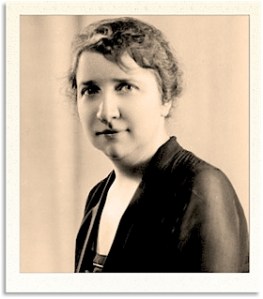
Judith Waller in the mid-1920s
In this regard, as I delved into the events around early radio and education, I became interested in Judith Waller, whose “accidental” radio success began in Chicago in 1922 as programming manager at WMAQ and continued as the Educational/Public Service Director for NBC’s Central division. At WMAQ in the 1920s, Waller helped craft a number of educational programs, including a joint venture between the Chicago Public Schools that successfully connected city-wide special exhibits and the Chicago Daily News into an audio/visual/experiential learning experience.
However, by the 1930s Waller had grown disillusioned with “educational radio.” In 1934 Waller gave an address titled “Achievements of Educational Radio,” where she spoke of her “pessimism” at what she felt was the lack of accomplishments and advancements in education by radio. She felt that most listeners were “frankly bored” by educational radio and that it only appealed to those who wanted to “appear to be very highbrow before their friends and associates.” One of her chief complaints was that many educational programs were “usually a dull and stupid reading of a prepared geography, history, or arithmetic lesson.” Besides further experimentation, she suggested a name change, from “educational” radio to “public service” broadcasting. This superficial remedy seemed like an ideal first step in reclaiming the types of programs that had elements worthy of larger audiences, but that had largely been ignored. This name change did little to suggest, however, any actual changes that might benefit the construction of educational programming.
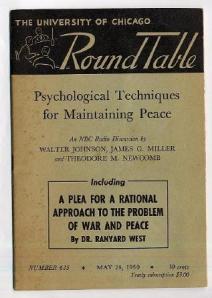 I use this example for the sheer fact that I would very much like to listen to these “dull” programs in order to examine what Waller perceived to be their fatal flaws. Now, some of the programs that Waller created and produced do still exist. The University of Chicago Round Table, for example, was a popular public service program Waller worked on for many years—which has an extensive archive of transcripts, although not recordings. In terms of other educational programming, some of the more prominent commercial network programs like the American School of the Air appear to have some availability. The programs I am interested in hearing, however, used the radio, a program guide, the newspaper, and local city events to weave an intricate educational lesson. Were programs like this, so seemingly well crafted and specifically engineered, really as “boring” as Waller lamented? Would it be clear to me, as a listener nearly a century removed, that there are clear issues or faults with their presentation of educational lessons? Or would Waller’s problems with these programs stem from more complex issues, involving her own personal ideals of what education by radio constituted and how it should be conceived?
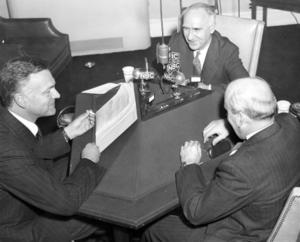
Robert M. Hutchins, Floyd Reeves, and John McCloy record The University of Chicago Roundtable, November 26, 1944
Regardless of the answerability of these questions, they are still worth thinking about in order to understand as much as possible about these missing programs in the context of their “no-sound” status. Not having these sounds to refer to forces us to pose different questions, while tougher to address, that force us to look beyond the audio text to understand what exactly about these programs produced their contemporary reactions. Reading what Waller wrote may supplant the need to hear these programs, but it does not necessarily replace our innate curiosity about them.
The discourse around these “no-sound” programs gives historians a particular reception, in this case, a critical perspective from one radio producer. However, Waller’s public disavowal of educational radio cannot speak to the private consumption of these programs, which may or may not have produced the same negative reaction. Really, then, the Waller example suggests two avenues of inquiry, both equally difficult—a full understanding of what these programs sounded like and contained, and how other listeners felt about them. At the very least, a record of these programs and a selected set of reactions lives on in the print media that avidly reported on and debated so many facets of radio programming.
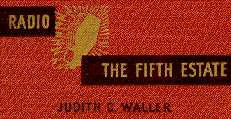
Waller's book, Radio: The Fifth Estate (1946)
—
Sate a little of your curiosity and hear Waller speak in this October 2000 re–broadcast of a 1948 interview she gave on the early days of WMAQ, from broadcaster/historian Chuck Shaden’s “Those Were the Days” radio program.
—
Amanda Keeler (Ph.D., Indiana University, 2011) is a Visiting Assistant Professor at Bucknell University. She teaches courses in film and media studies. Her current research focuses on historical emergent film, radio, and television; media history; media industries; and contemporary television.
Share this:

Pushing Record: Labors of Love, and the iTunes Playlist

Borrowed from allwomentalk.com
Last month as my sister and I drove to the store, she started to joke with me. “You’re crazy,” she began, “you’re so high-tech, with your computers, and XBOX. You love music. But, you’ve got a cassette player in your car.” I shot her a look. “So what? I like it.” I said, hoping that she would back off. “So what!” she proclaimed in response, “don’t you want a CD player? Or a jack for your iPod?” I responded, “But how will I play my tapes?” She stared at me. “Who cares? They sound like crud. You’re crazy.”
Here at Sounding Out! we’ve featured a number of articles about analog tape. It persists in popular culture (Jennifer Stoever-Ackerman’s Play it Again (and Again), Sam: Part 1, Part 2, and Part 3), underground communities (Matt Laferty’s On Hand Made Music), and even our personal histories (Gus Stadler’s Pushing Play). Even though tape is generally understood to be obsolete, niche, and just plain noisy – I will insist that, despite my sister’s concerns, there is something special (even forgotten) about the medium itself. I had tried to articulate this in last year’s article What Mixtapes Can Teach Us About Noise. But, when I re-read it, I can’t help but think that I somehow missed the point. Let me try again with a new question: What is the difference between a mix on cassette tape and an iTunes playlist?
Care is the difference. The material limitations of the cassette recorder demand that care is taken during the act of inscription. In other words, cassette mixes cannot be automated like an iTunes playlist. The practice of recording a mix on cassette requires, at minimum, that some attention is paid to the moment a song begins (as record is pushed), and the moment a song ends (as stop is pressed). The cassette must be tended, as it were, during the encoding process. It is impossible to program a cassette mix otherwise.

Borrowed from velvetron.com
After tracks have been chosen and messages encoded, frequently cassette mixes are shared, or gifted. If the receiver chooses to listen to the cassette, they must locate, first, a cassette player. This was not a problem in 1990 when cassette players were a more or less ubiquitous technology. But, in the present day, they are notably rare. Furthermore, even if some care has been taken to locate a listening platform, the tape is far more treacherous than the CD to navigate. Awkward transitions governed by the fast-forward and rewind buttons, encouraged listeners to listen through all but the most wretched sequences of a cassette mix. And, let us not forget, how leaving a cassette in the wrong player could result in a mangle of 1/8″ tape. Or, how speakers, magnets, and poor weather all eventually erode at the contents of poorly stored tape. Care had to be taken in maintaining and storing a good cassette mix; tapes are a fragile technology and that, for me at least, serves to valorize the labor at stake in their creation.
Am I giving the playlist enough credit? Even though the platform may not limit its listeners, and producers, in the same ways that cassette recorders have, who is to say that any less care is taken when producing a playlist? To this point, I must bring up a question of labor. While, the receiver of a cassette mix knows that at least an hour (as cassettes are generally 60 minutes or more) of work has been put into its construction, the receiver of a mix CD, or playlist, cannot be as certain. iTunes playlists can be constructed in five minutes or less. Implicated within this labor divide is both an emerging and ephemeral culture of listening.
As Sterne (2006) has argued in his paper, The MP3 as Cultural Artifact, our bodies respond to MP3s in a way that is fundamentally different than listening to a tape, or record. “[The MP3] represents a liberation of just-in-time sound production, where systems give listeners less and ask their bodies to do more of the work” (p.838). If the very compression algorithms that constitute MP3s make demands on the brains and bodies of listeners, it is interesting to think of the iTunes playlist in parallel. The iTunes playlist makes comparatively few demands on the body of the producer. This, paradoxically, results in a culture that does not valorize the labor of its constituent producers. Most apparent in the nebulous legal credibility of Mashups, the mix exists predominantly within an economy of care. Unfortunately, the digital turn toward playlisting conspires to render the labor of care, in this context, invisible.

Borrowed from downloadatoz.com
Is there hope for iTunes? Can we trust our playlists to be received with the love that was put into them? Some theorists like Hardt (1999) see an upside to caring labor. As he points out in his essay, Affective Labor, “Caring labor is certainly entirely immersed in the corporeal, the somatic, but the affects it produces are nonetheless immaterial. What affective labor produces are social networks, forms of community, biopower” (p. 96). Sharing is caring, the accessibility and ease of production that playlisting provides, is, at least, a way to foster community. I am not so optimistic. For caring labor is not adequately valued, at least not in the context of building a playlist. Playlists rely on an audience to value them, they provide no guarantees. The labor at stake in their construction may only become visible to those who listen. The cassette mix, on the other hand, has care inscribed into its magnetic tape. The listener knows that some work has been put into making the mix, even before play is pressed.
Although cassette tapes may have all but disappeared as a way to share music, the caring labor involved in their production might be salvaged in other forms. Taking a page from Andreas Duus Pape’s recent, Building Intimate Performance Venue’s on the Internet, podcasts (produced on platforms like Garageband or Audacity), provide a viable alternative. Like cassettes, they subject their listeners to a linear play style. And, there is a certain degree of care taken by the producer when splicing, cross-fading, arranging, and sequencing a set of tracks. It is implicit in the construction of a Podcast that some degree of care was taken during its development. Of course, I will keep the cassette player in my car. I have a special tape adaptor, which lets it play music from my iPod.
–
Aaron Trammell is co-founder and multimedia editor of Sounding Out! He is also a Media Studies PhD student at Rutgers University.
Share this:


Current Top Posts





April 2021

January 2020

November 2019

October 2019

August 2019

April 2014

November 2017

March 2015

December 2017

October 2015
 Sounding Out!

Recent Comments