
The Dark Side of Game Audio: The Sounds of Mimetic Control and Affective Conditioning


It’s an all too familiar movie trope. A bug hidden in a flower jar. A figure in shadows crouched listening at a door. The tape recording that no one knew existed, revealed at the most decisive of moments. Even the abrupt disconnection of a phone call manages to arouse the suspicion that we are never as alone as we may think. And although surveillance derives its meaning the latin “vigilare” (to watch) and French “sur-“ (over), its deep connotations of listening have all but obliterated that distinction.
This month, SO! Multimedia Editor Aaron Trammell curates a forum on Sound and Surveillance, featuring the work of Robin James and Kathleen Battles. And so it begins, with Aaron asking. . .”Want to Play a Game?” –JS
—
It’s eleven o’clock on a Sunday night and I’m in the back room of a comic book store in Scotch Plains, NJ. Game night is wrapping up. Just as I’m about to leave, someone suggests that we play Pit, a classic game about trading stocks in the early 20th century. Because the game is short, I decide to give it a go and pull a chair up to the table. In Pit, players are given a hand of nine cards of various farm-related suits and frantically trade cards with other players until their entire hand matches the same suit. As play proceeds, players hold up a set of similar cards they are willing to trade and shout, “one, one, one!,” “two, two, two!,” “three, three, three!,” until another player is willing to trade them an equivalent amount of cards in a different suit. The game only gets louder as the shouting escalates and builds to a cacophony.
As I drove home that night, I came to the uncomfortable realization that maybe the game was playing me. I and the rest of the players had adopted similar dispositions over the course of the play. As we fervently shouted to one another trying to trade between sets of indistinguishable commodities, we took on similar, intense, and excited mannerisms. Players who would not scream, who would not participate in the reproduction of the game’s sonic environment, simply lost the game, faded out. As for the rest of us, we became like one another, cookie-cutter reproductions of enthusiastic, stressed, and aggravated stock traders, getting louder as we cornered the market on various goods.
We were caught in a cybernetic-loop, one that encouraged us to take on the characteristics of stock traders. And, for that brief period of time, we succumbed to systems of control with far reaching implications. As I’ve argued before, games are cybernetic mechanisms that facilitate particular modes of feedback between players and the game state. Sound is one of the channels through which this feedback is processed. In a game like Pit, players both listen to other players for cues regarding their best move and shout numbers to the table representing potential trades. In other games, such as Monopoly, players must announce when they wish to buy properties. Although it is no secret that understanding sound is essential to good game design, it is less clear how sound defines the contours of power relationships in these games. This essay offers two games, Mafia, and Escape: The Curse of the Temple as case studies for the ways in which sound is used in the most basic of games, board games. By fostering environments that encourage both mimetic control and affective conditioning game sound draws players into the devious logic of cybernetic systems.
Understanding the various ways that sound is implemented in games is essential to understanding the ways that game sound operates as both a form of mimetic control and affective conditioning. Mimetic control is, at its most simple, the power of imitation. It is the degree to which we become alike when we play games. Mostly, it happens because the rules invoke a variety of protocols which encourage players to interact according to a particular standard of communication. The mood set by game sound is the power of affective conditioning. Because we decide what we interact with on account of our moods, moments of affective conditioning prime players to feel things (such as pleasure), which can encourage players to interact in compulsive, excited, subdued, or frenetic ways with game systems.
A game where sound plays a central and important role is Mafia (which has a number of other variants like Werewolf and The Resistance). In Mafia, some players take the secret role of mafia members who choose players to “kill” at night, while the eyes of the others are closed. Because mafia-team players shuffle around during the game and point to others in order to indicate which players to eliminate while the eyes of the other players are closed, the rules of the game suggest that players tap on things, whistle, chirp, and make other ambient noises while everyone’s eyes are closed. This allows for the mafia-team players to conduct their business secretly, as their motions are well below the din created by the other players. Once players open their eyes, they must work together to deduce which players are part of the mafia, and then vote on who to eliminate from the game. Here players are, in a sense, controlled by the game to provide a soundtrack. What’s more, the eeriness of the sounds produced by the players only accentuate the paranoia players feel when taking part in what’s essentially a lynch-mob.
The ambient sounds produced by players of Mafia have overtones of mimetic control. Protocols governing the use of game audio as a form of communication between bodies and other bodies, or bodies and machines, require that we communicate in particular ways at set intervals. Different than the brutal and martial forms of discipline that drove disciplinary apparatuses like Bentham’s panopticon, the form of control exerted through interactive game audio relies on precisely the opposite premise. What is often termed “The Magic Circle of Play” is suspect here as it promises players a space that is safe and fundamentally separate from events in the outside world. Within this space somewhat hypnotic behavior-patterns take place under the auspices of being just fun, or mere play. Players who refuse to play by the rules are often exiled from this space, as they refuse to enter into this contract of soft social norms with others.

Not all panopticons are in prisons. “Singing Ringing Tree at Sunset,” Dave Leeming CC BY.
Escape: The Curse of the Temple relies on sound to set a game mood that governs the ways that players interact with each other. In Escape, players have ten minutes (of real time) where they must work together to navigate a maze of cardboard tiles. Over the course of the game there are two moments when players must return to the tile that they started the game on, and these are announced by a CD playing in the background of the room. When this occurs, a gong rings on the CD and rhythms of percussion mount in intensity until players hear a door slam. At this point, if players haven’t returned to their starting tile, they are limited in the actions they can take for the rest of the game. In the moments of calm before players make a mad dash for the entrance, the soundtrack waxes ambient. It offers the sounds of howling-winds, rattling chimes, and yawning corridors.
The game is spooky, overall. The combination of haunting ambient sounds and moments where gameplay is rushed and timed, makes for an adrenaline-fueled experience contained and produced by the game’s ambient soundtrack. The game’s most interesting moments come from points where one player is trapped and players must decide whether they should help their friend or help themselves. The tense, haunting, soundtrack evokes feelings of high-stakes immersion. The game is fun because it produces a tight, stressful, and highly interactive experience. It conditions its players through the clever use of its soundtrack to feel the game in an embodied and visceral way. Like the ways that horror movies have used ambient sounds to a great effect in producing tension in audiences (pp.26-27), Escape: The Curse of the Temple encourages players to immerse themselves in the game world by playing upon the tried and true affective techniques that films have used for years. Immersed players feel an increased sense of engagement with the game and because of this they are willingly primed to engage in the mimetic interactive behaviors that engage them within the game’s cybernetic logic.
These two forms of power, mimetic control and affective conditioning, often overlap and coalesce in games. Sometimes, they meet in the middle during games that offer a more or less adaptive form of sound, like Mafia. Players work together and mimic each other when reproducing the ambient forms of quiet that constitute the atmosphere of terror that permeates the game space. Even the roar of bids which occurs in Pit constitutes a form of affective conditioning that encourages players to buy, buy, buy as fast as possible. Effectively simulating the pressure of The Stock Exchange.
Although there is now a growing discipline around the production of game audio, there is relatively little discourse that attempts to understand how the implementation of sound in games functions as a mode of social control. By looking at the ways that sound is implemented in board and card games, we can gain insight of the ways in which it is implemented in larger technical systems (such as computer games), larger aesthetic systems (such as performance art), economic systems (like casinos and the stock market), and even social systems (like parties). Furthermore, it is easy to describe more clearly the ways in which game audio functions as a form of soft power through techniques of mimetic control and affective conditioning. It is only by understanding how these techniques affect our bodies that we can begin to recognize our interactions with large-scale cybernetic systems that have effects reaching beyond the game itself.
–
Aaron Trammell is co-founder and Multimedia Editor of Sounding Out! He is also a Media Studies PhD candidate at Rutgers University. His dissertation explores the fanzines and politics of underground wargame communities in Cold War America. You can learn more about his work at aarontrammell.com.
—
Featured image “Psychedelic Icon,” by Gwendal Uguen CC BY-NC-SA.
—
 REWIND!…If you liked this post, you may also dig:
Papa Sangre and the Construction of Immersion in Audio Games- Enongo Lumumba-Kasongo
Sounding Out! Podcast #31: Game Audio Notes III: The Nature of Sound in Vessel- Leonard J. Paul
Experiments in Aural Resistance: Nordic Role-Playing, Community, and Sound- Aaron Trammell
Share this:

Sounds of Science: The Mystique of Sonification

 Welcome to the final installment of Hearing the UnHeard, Sounding Out!‘s series on what we don’t hear and how this unheard world affects us. The series started out with my post on hearing, large and small, continued with a piece by China Blue on the sounds of catastrophic impacts, and Milton Garcés’ piece on the infrasonic world of volcanoes. To cap it all off, we introduce The Sounds of Science by professor, cellist and interactive media expert, Margaret Schedel.
Dr. Schedel is an Associate Professor of Composition and Computer Music at Stony Brook University. Through her work, she explores the relatively new field of Data Sonification, generating new ways to perceive and interact with information through the use of sound. While everyone is familiar with informatics, graphs and images used to convey complex information, her work explores how we can expand our understanding of even complex scientific information by using our fastest and most emotionally compelling sense, hearing.
– Guest Editor Seth Horowitz
—
With the invention of digital sound, the number of scientific experiments using sound has skyrocketed in the 21st century, and as Sounding Out! readers know, sonification has started to enter the public consciousness as a new and refreshing alternative modality for exploring and understanding many kinds of datasets emerging from research into everything from deep space to the underground. We seem to be in a moment in which “science that sounds” has a special magic, a mystique that relies to some extent on misunderstandings in popular awareness about the processes and potentials of that alternative modality.
For one thing, using sound to understand scientific phenomena is not actually new. Diarist Samuel Pepys wrote about meeting scientist Robert Hooke in 1666 that “he is able to tell how many strokes a fly makes with her wings (those flies that hum in their flying) by the note that it answers to in musique during their flying.” Unfortunately Hooke never published his findings, leading researchers to speculate on his methods. One popular theory is that he tied strings of varying lengths between a fly and an ear trumpet, recognizing that sympathetic resonance would cause the correct length string to vibrate, thus allowing him to calculate the frequency. Even Galileo used sound, showing the constant acceleration of a ball due to gravity by using an inclined plane with thin moveable frets. By moving the placement of the frets until the clicks created an even tempo he was able to come up with a mathematical equation to describe how time and distance relate when an object falls.

Illustration from Robert Hooke’s Micrographia (1665)
There have also been other scientific advances using sound in the more recent past. The stethoscope was invented in 1816 for auscultation, listening to the sounds of the body. It was later applied to machines—listening for the operation of the technological gear. Underwater sonar was patented in 1913 and is still used to navigate and communicate using hydroacoustic phenomenon. The Geiger Counter was developed in 1928 using principles discovered in 1908; it is unclear exactly when the distinctive sound was added. These are all examples of auditory display [AD]; sonification-generating or manipulating sound by using data is a subset of AD. As the forward to the The Sonification Handbook states, “[Since 1992] Technologies that support AD have matured. AD has been integrated into significant (read “funded” and “respectable”) research initiatives. Some forward thinking universities and research centers have established ongoing AD programs. And the great need to involve the entire human perceptual system in understanding complex data, monitoring processes, and providing effective interfaces has persisted and increased” (Thomas Hermann, Andy Hunt, John G. Neuhoff, Sonification Handbook, iii)
Sonification clearly enables scientists, musicians and the public to interact with data in a very different way, particularly compared to the more numerous techniques involving vision. Indeed, because hearing functions quite differently than vision, sonification offers an alternative kind of understanding of data (sometimes more accurate), which would not be possible using eyes alone. Hearing is multi-directional—our ears don’t have to be pointing at a sound source in order to sense it. Furthermore, the frequency response of our hearing is thousands of times more accurate than our vision. In order to reproduce a moving image the sampling rate (called frame-rate) for film is 24 frames per second, while audio has to be sampled at 44,100 frames per second in order to accurately reproduce sound. In addition, aural perception works on simultaneous time scales—we can take in multiple streams of audio data at once at many different dynamics, while our pupils dilate and contract, limiting how much visual data we can absorb at a single time. Our ears are also amazing at detecting regular patterns over time in data; we hear these patterns as frequency, harmonic relationships, and timbre.
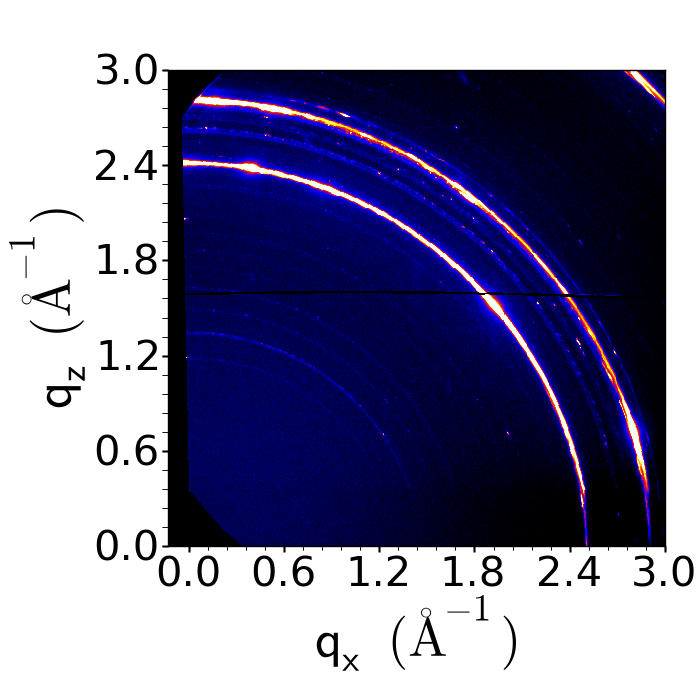
Image credit: Dr. Kevin Yager, Brookhaven National Lab.
But hearing isn’t simple, either. In the current fascination with sonification, the fact that aesthetic decisions must be made in order to translate data into the auditory domain can be obscured. Headlines such as “Here’s What the Higgs Boson Sounds Like” are much sexier than headlines such as “Here is What One Possible Mapping of Some of the Data We Have Collected from a Scientific Measuring Instrument (which itself has inaccuracies) Into Sound.” To illustrate the complexity of these aesthetic decisions, which are always interior to the sonification process, I focus here on how my collaborators and I have been using sound to understand many kinds of scientific data.
My husband, Kevin Yager, a staff scientist at Brookhaven National Laboratory, works at the Center for Functional Nanomaterials using scattering data from x-rays to probe the structure of matter. One night I asked him how exactly the science of x-ray scattering works. He explained that X-rays “scatter” off of all the atoms/particles in the sample and the intensity is measured by a detector. He can then calculate the structure of the material, using the Fast Fourier Transform (FFT) algorithm. He started to explain FFT to me, but I interrupted him because I use FFT all the time in computer music. The same algorithm he uses to determine the structure of matter, musicians use to separate frequency content from time. When I was researching this post, I found a site for computer music which actually discusses x-ray scattering as a precursor for FFT used in sonic applications.
To date, most sonifications have used data which changes over time – a fly’s wings flapping, a heartbeat, a radiation signature. Except in special cases Kevin’s data does not exist in time – it is a single snapshot. But because data from x-ray scattering is a Fourier Transform of the real-space density distribution, we could use additive synthesis, using multiple simultaneous sine waves, to represent different spatial modes. Using this method, we swept through his data radially, like a clock hand, making timbre-based sonifications from the data by synthesizing sine waves using with the loudness based on the intensity of the scattering data and frequency based on the position.
We played a lot with the settings of the additive synthesis, including the length of the sound, the highest frequency and even the number of frequency bins (going back to the clock metaphor – pretend the clock hand is a ruler – the number of frequency bins would be the number of demarcations on the ruler) arriving eventually at set of optimized variables.
Here is one version of the track we created using 10 frequency bins:
.
Here is one we created using 2000:
.
And here is one we created using 50 frequency bins, which we settled on:
.
On a software synthesizer this would be like the default setting. In the future we hope to have an interactive graphic user interface where sliders control these variables, just like a musician tweaks the sound of a synth, so scientists can bring out, or mask aspects of the data.
To hear what that would be like, here are a few tracks that vary length:
.
.
.
Finally, here is a track we created using different mappings of frequency and intensity:
.
Having these sliders would reinforce to the scientists that we are not creating “the sound of a metallic alloy,” we are creating one sonic representation of the data from the metallic alloy.
It is interesting that such a representation can be vital to scientists. At first, my husband went along with this sonification project as more of a thought experiment rather than something that he thought would actually be useful in the lab, until he heard something distinct about one of those sounds, suggesting that there was a misaligned sample. Once Kevin heard that glitched sound (you can hear it in the video above), he was convinced that sonification was a useful tool for his lab. He and his colleagues are dealing with measurements 1/25,000th the width of a human hair, aiming an X-ray through twenty pieces of equipment to get the beam focused just right. If any piece of equipment is out of kilter, the data can’t be collected. This is where our ears’ non-directionality is useful. The scientist can be working on his/her computer and, using ambient sound, know when a sample is misaligned.

It remains to be seen/heard if the sonifications will be useful to actually understand the material structures. We are currently running an experiment using Mechanical Turk to determine this kind of multi-modal display (using vision and audio) is actually helpful. Basically we are training people on just the images of the scattering data, and testing how well they do, and training another group of people on the images plus the sonification and testing how well they do.
I’m also working with collaborators at Stony Brook University on sonification of data. In one experiment we are using ambisonic (3-dimensional) sound to create a sonic map of the brain to understand drug addiction. Standing in the middle of the ambisonic cube, we hope to find relationships between voxels, a cube of brain tissue—analogous to pixels. When neurons fire in areas of the brain simultaneously there is most likely a causal relationship which can help scientists decode the brain activity of addiction. Computer vision researchers have been searching for these relationships unsuccessfully; we hope that our sonification will allow us to hear associations in distinct parts of the brain which are not easily recognized with sight. We are hoping to leverage the temporal pattern recognition of our auditory system, but we have been running into problems doing the sonification; each slice of data from the FMRI has about 300,000 data points. We have it working with 3,000 data points, but either our programming needs to get more efficient, or we have to get a much more powerful computer in order to work with all of the data.
On another project we are hoping to sonify gait data using smartphones. I’m working with some of my music students and a professor of Physical Therapy, Lisa Muratori, who works on understanding the underlying mechanisms of mobility problems in Parkinsons’ Disease (PD). The physical therapy lab has a digital motion-capture system and a split-belt treadmill for asymmetric stepping—the patients are supported by a harness so they don’t fall. PD is a progressive nervous system disorder characterized by slow movement, rigidity, tremor, and postural instability. Because of degeneration of specific areas of the brain, individuals with PD have difficulty using internally driven cues to initiate and drive movement. However, many studies have demonstrated an almost normal movement pattern when persons with PD are provided external cues, including significant improvements in gait with rhythmic auditory cueing. So far the research with PD and sound has be unidirectional – the patients listen to sound and try to match their gait to the external rhythms from the auditory cues.In our system we will use bio-feedback to sonify data from sensors the patients will wear and feed error messages back to the patient through music. Eventually we hope that patients will be able to adjust their gait by listening to self-generated musical distortions on a smartphone.
As sonification becomes more prevalent, it is important to understand that aesthetic decisions are inevitable and even essential in every kind of data representation. We are so accustomed to looking at visual representations of information—from maps to pie charts—that we may forget that these are also arbitrary transcodings. Even a photograph is not an unambiguous record of reality; the mechanics of the camera and artistic choices of the photographer control the representation. So too, in sonification, do we have considerable latitude. Rather than view these ambiguities as a nuisance, we should embrace them as a freedom that allows us to highlight salient features, or uncover previously invisible patterns.
__
Margaret Anne Schedel is a composer and cellist specializing in the creation and performance of ferociously interactive media. She holds a certificate in Deep Listening with Pauline Oliveros and has studied composition with Mara Helmuth, Cort Lippe and McGregor Boyle. She sits on the boards of 60×60 Dance, the BEAM Foundation, Devotion Gallery, the International Computer Music Association, and Organised Sound. She contributed a chapter to the Cambridge Companion to Electronic Music, and is a joint author of Electronic Music published by Cambridge University Press. She recently edited an issue of Organised Sound on sonification. Her research focuses on gesture in music, and the sustainability of technology in art. She ran SUNY’s first Coursera Massive Open Online Course (MOOC) in 2013. As an Associate Professor of Music at Stony Brook University, she serves as Co-Director of Computer Music and is a core faculty member of cDACT, the consortium for digital art, culture and technology.
—
Featured Image: Dr. Kevin Yager, data measured at X9 beamline, Brookhaven National Lab.
—
Research carried out at the Center for Functional Nanomaterials, Brookhaven National Laboratory, is supported by the U.S. Department of Energy, Office of Basic Energy Sciences, under Contract No. DE-AC02-98CH10886.
—
 REWIND! ….. If you liked this post, you might also like:
The Noises of Finance–N. Adriana Knouf
Revising the Future of Music Technology–Aaron Trammell
A Brief History of Auto-Tune–Owen Marshall
Share this:


Current Top Posts





April 2021

January 2020

November 2019

October 2019

August 2019

April 2014

November 2017

March 2015

December 2017

October 2015
 Sounding Out!
Recent Comments