
Pushing Play: What Makes the Portable Cassette Recorder Interesting?
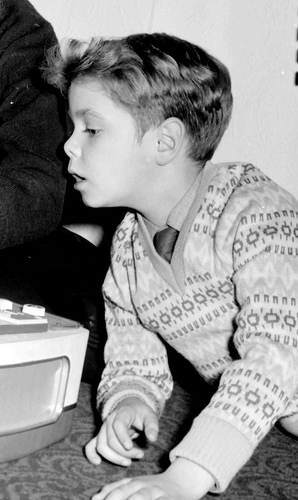
"Change the Speed": image from the "Vintage Kids" archive of flickr user theirhistory
One of my earliest memories of sound recording is one of my earliest memories, period: an isolated image of my own index and middle finger trying to push down the “record” and “play” buttons on my father’s portable cassette tape recorder. More prominent than the visual element of this memory is the haptic one: I can still call up the sensation of the effort required to make the red button go down and latch and the stress on the top joint of my index finger as the resistance bent it backward. Also still with me is a trace sense of the threat of sharp pain, as if at some point previous I had been wounded (perhaps pinched?) by these buttons. How young must I have been to have experienced this degree of opposition from such a small, unassuming device? And whence this desire to persist in the face of it?And: how and where does this object–so unprepossessing with its five big buttons, volume slider, cartridge tray, and little speaker–fit into sound studies and the history of sound recording technology?
There’s a small, rich, growing body of work on tape recording–including work by scholars as different as Kathleen Hayles, Steven Connor, Michael Davidson, and this blog’s doyen, Jennifer Stoever-Ackerman–but almost invariably it focuses on the reel-to-reel recorder, the device the cassette recorder was meant to simplify and miniaturize, at the expense of sound quality. The reel-to-reel was a vital contributor to the development of stereo and hi-fi hobbyism; it was also the mechanism at the center of a series of bold modernist literary experiments with tape recording by Samuel Beckett, William S. Burroughs, David Antin, and others.
Aside from Andy Warhol’s use of it to tape huge swaths of his everyday life (in 1965, he “wrote” a novel consisting of 24 largely consecutive hours of transcribed cassettes) the cassette recorder has no such avant-garde pedigree. The name of the first model, the Norelco Carry-Corder 150, which appeared in 1963, shows the primary focus of its manufacturers’ vision. Ads and trade journal articles from around this time touted the ease with which the device could be toted around on a vacation with the aim of producing an “audio album” of the trip. Doubtless, such albums were made and some may even still exist. But I suspect that the most vibrant history of the Carry-Corder and its descendants lies in the device’s easy adapability into the play world of children. As I and many others of my generation remember it, the pleasure of playing with the device was the way it instigated various sorts of performance, usually based in mimicry of ones we’d consumed through other electronic media. In a manner not unlike Warhol, we created our own little media empires: Dj-ing, news announcing, sportscasting, hosting talk shows with the baby and the dog as guests, singing like Cher on TV, re-enacting TV comedy sketches, recording one’s own comedy sketches, and on and on.
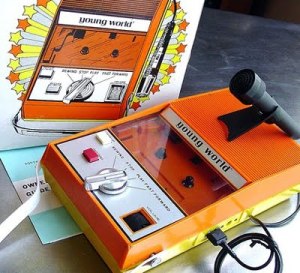
Child's play?: Young World BIC-202 Cassette Recorder
It’s not obvious how sound figures in the context of children’s play. Certainly, the quality with which the tape recorder recorded and played back sound mattered little, if at all. What mattered was the way the device initiated and constructed scenes, provided roles to play. Analogously, as David E. James has noted, one of the most powerful aspects of Warhol’s practice of bringing his Carry-Corder 150 everywhere he went (he was an early adopter, purchasing one in 1964) was that it “ma(de) performance inevitable” and “constitute(d) being as performance” (Allegories of Cinema, page 69). Even playback itself was a matter of secondary interest; how many times do you think I listened to the tape of myself “broadcasting” two innings of a random mid-70s Mets game, delivered as I watched on TV with the sound turned down? My wager is on none. Still, sound is the raison d’etre of the cassette recorder. A few years later, kids might have done similar things with a video camera, but to a lot of kids, the early mass-marketed versions of that device felt much more formal, complicated, authoritative. That was the instrument through which the “official” history of the family was to be told; the tape recorder picked up the creative fragments, the bored interstices, the embarrassments, the extremes–parts of a world that wasn’t to appear before guests. Plus, the sound-based device actually offered greater reach and flexibility along with more forms of integration into other media like television.
My early memory of the recorder, however, seems more primal. Given its intensity, it seems clear that the tape recorder served as a vehicle toward several important forms of self-demarcation, helping me to discover and negotiate certain limits: of my body, of my agency vis-à-vis machines, of my relationships to my parents, of my family’s position in a larger social and economic world. (And in fact, the device was an important part of my family’s livelihood, vital to my father’s work as a radio reporter.) In retrospect, I seem almost impossibly young to be left to my own devices with the machine, and I also have a vague sense that I had been violating some prohibition, perhaps a decree that the recorder is “not a toy.” I wonder how much the force of such a decree originated precisely in the ease with which it could and did become a toy.

gramophone, film, typewriter, and cassette tape recorder?
It’s unlikely that Friedrich Kittler was going to list “cassette tape recorder” next in his book title after “gramophone, film, and typewriter.” It’s unlikely he had an image of the device in mind when he wrote his bravura dictum, “media determine our situation.” Some technologies don’t stand up to such sweeping statements, toward which media studies sometimes seems particularly drawn. Certain devices, I think, necessitate a broadened and diversified understanding of the things both sound and technology do—even things that aren’t “about” sound in a conventional sense. For many historical narratives of sound reproduction, the cassette tape recorder is a regressive device, a drag on the pursuit of greater audio fidelity, with fidelity defined as “presence.” But the qualities of the cassette recorder that make it significant to our field are manifold, and some of them will be qualities that arise out of their adjacency to the central fact of recording and playing back sound. The “forgotten” areas of the history of sound reproduction technologies aren’t the notable failures—the 8-track players, which after all still draw camp-retro interest–but the most mundane successes. The portable cassette tape recorded never truly failed, it just got left back.
—
Gustavus Stadler teaches English and American Studies at Haverford College. He is the author of Troubling Minds: The Cultural Politics of Genius in the U. S.1840-1890 (U of Minn Press, 2006) and co-editor (with Karen Tongson) of the Journal of Popular Music Studies. His 2010 edited special issue of Social Text on “The Politics of Recorded Sound” was recently named a finalist for a prize in the category of “General History” by the Association of Recorded Sound Collections. He is currently working on Andy Warhol’s sound world, Woody Guthrie’s sexuality, and other stuff.
Share this:

Prison Music: Containment, Escape, and the Sound of America
We used our voices, whistles, and blow horns to make contact with those on the inside… Prisoners flickered the lights in their cells on and off throughout the building, banged on windows, and we could see the shadows of many of those on the inside waving and pumping fists. — Activists outside the Metropolitan Corrections Center, NYC, July 8, 2011
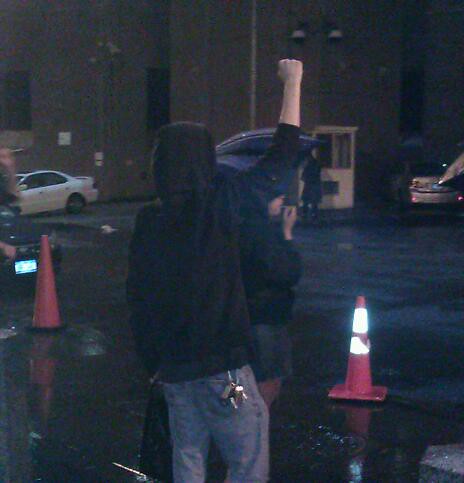
Activists outside Metro Corrections Center, NYC, 7/8/11
Noise demonstrations, like the one described above, occurred outside jails, detention centers, and prisons in cities like New York City, St. Louis, Oakland, Los Angeles, Montreal and Kitchener, Ontario throughout the weekend following July 4th, 2011. Activists rallied by playing music, chanting, launching flares and fireworks, and banging pots and pans– communicating their solidarity with the Pelican Bay Hunger Strike, and their demand for justice for prisoners in each city. The noisy international demonstrations “connected local struggles against dehumanization to the California hunger strike and the conditions of the Pelican Bay Security Housing Unit, as well as both the U.S. and Canada’s prioritization of policing and imprisonment over social welfare.” (San Francisco Bayview, 2011).
If music can be understood as “the organization of noise” (Attali, 1977), these audible signs of solidarity across prison walls would certainly be considered a form of music: prison music, perhaps. Prison has been a form of political organization for the United States, at least since the beginning of the 19th century; music (or organized noise) from or about prisons helps trace this history of containment sonically. Prison music also points to the possibilities of sonic and political escape from this carceral state.
The beginnings of the history of prison music in the United States can be traced to the War of 1812. A poet named Francis Scott Key met with British officers aboard a ship off the coast of Maryland to negotiate the release of American prisoners. He was detained overnight, having gained knowledge of the position of British military units and their plan to soon attack Baltimore. From detention in a ship floating on the Atlantic, Key watched the Battle of Baltimore at Fort McHenry and reported at dawn to the prisoners below deck that he was still able to see the American flag waving.

"To Anacreon in Heaven" by J.S. Smith
He chronicled the experience in a poem titled, “In Defence of Fort McHenry,” and later put it to music with John Stafford Smith’s “To Anacreon in Heaven.” The title of Key’s poem changed in October of 1814 when a Baltimore actor performed the song in public and called it “The Star-Spangled Banner.” In 1889, the Secretary of the Navy designated “The Star Spangled Banner” as the official tune to be played at the raising of the U.S. flag, and in 1916 the song was declared the national anthem of the United States. Key’s experience in detention along with other American prisoners in the middle of the Atlantic was memorialized as the U.S. anthem, but it is rare, if ever, that the country’s ode to freedom is understood as its opposite – as an ode to unfreedom, as prison music. Set against contemporary examples of organized noise across prison walls, as well as examples of prison themes in U.S. popular music and culture, the U.S. national anthem can be understood as a beginning point for an American tradition of prison music.
Jimi Hendrix’s guitar version of “The Star Spangled Banner” allows us to see this dimension of the American anthem. Offering a scathing and raucous rendition of the national anthem at the 1969 Woodstock Festival off the heels of his song “Purple Haze,” Hendrix blurred the lines between a drug-induced delirium and the reality of U.S. containment, at home and abroad. Hendrix improvised on Smith and Key’s tune, allowing the notes and sounds to escape the page, and signified on the sonic and political constraints the song represented: major chords, patriotic lyrics, “American freedom.” In riffing on the national anthem, Hendrix perhaps released what was being held behind these classic American “bars”: the pain, the chaos, the possibility. Note the intervals bending from major to minor to major (harmony to disharmony and back again); the (song) structure being destroyed, re-formed, rebuilt anew; the reduction of the refrain to organized noise— sonic escapes in the forms of cries, screams, explosions. Here Hendrix’s performance fits into a trajectory of U.S. prison music by retooling the U.S. national anthem as a song of unfreedom, or perhaps, a different kind of freedom.
The relationship between prison and music in the United States can be heard most clearly through Black soundings of voice, tools, instruments, technology. Hendrix’s music, for example, represented another transnational trajectory of prison music arriving on U.S. shores from ships in the Atlantic, the genealogy of Black music. What began as tribal African songs remixed over plantation work in slavery conditions became field hollers, gospel, chain gang songs, work songs, the blues, jazz, country, rock, hip-hop. It is here that “logics of U.S. white supremacy”: slavery/capitalism, genocide/colonialism, Orientalism/war (Andrea Smith, 2008) coalesce and are rendered illogical, problematic, and questionable, simply (or not so simply) by their audibility. Take the following song, “Early in the Mornin’,” sung by Black prisoners in a 1940′s Mississippi work farm, as another example.
In this example of prison music, one hears sounds that confound the work that is being performed. The music makes the work illogical. It sounds like the work is not productive, at least not for the bodies performing it. This is destructive, or more precisely deconstructive, physical and sonic work: breaking down (song) structures, bodies, minds in the process. It is a sonic protest against imprisonment, even as prison labor is being performed. This is the sound of prison music, simultaneous containment and escape, and helps explain why prison (music) is so popular in the United States. Prison is a necessary function of white supremacist patriarchal capitalism– a necessary warehousing of surplus (bodies) for exploitation or elimination. Prison music is a documentation of this process. Listening to, and perhaps playing, prison music is our attempt to hear ourselves survive within these dehumanizing systems.
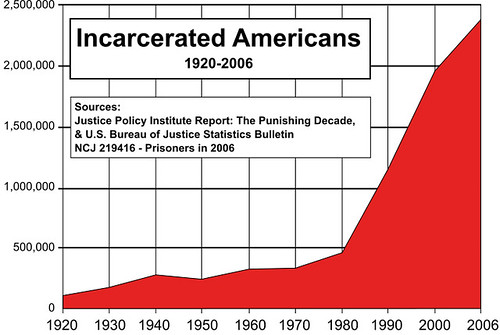
Incarceration in the U.S., 1920-2006
Prisons are popular in the United States, and not just in music (from anthems to work songs to blues to country to rock to hip-hop, imbued with the sounds and sights of prison). It’s the popularity and predominance of actual prisons, and the increasing rate of incarceration of U.S. residents, that undergirds the general public’s simultaneous aversion to, and fascination with, these literal echo chambers. Prisons in the United States are hyper-inaudible/invisible, and simultaneously hyper-audible/visible. The location of U.S. prisons behind distant, opaque, and quiet walls, sits strangely against the reality of prison as an increasingly intimate, transparent, and loud source of entertainment for the general public– think Cops (23 seasons), Law & Order (20 seasons), CSI (12 seasons), and Lockup (11 seasons), below.
Regrettably, sounds (musical or otherwise) from those incarcerated are rarely audible above the din of the prison spectacle in popular music, culture and policy. Jacques Attali wrote, “Music is a herald, for change is inscribe in noise faster than it transforms society…. Listening to music is listening to all noise.” The question is: when prisoners make noise, will we hear their music?
—
Jeb Middlebrook holds a Ph.D. in American Studies and Ethnicity from the University of Southern California, and is a Lecturer in Race, Social Movements, and Popular Culture at USC, University of Colorado–Colorado Springs, Loyola Marymount University, and People’s University, an online, low-cost college for first-time and returning students. He can be reached at jeb@solidarityinstitute.org and on Facebook and Twitter.


Share this:


Current Top Posts





April 2021

January 2020

November 2019

October 2019

August 2019

April 2014

November 2017

March 2015

December 2017

October 2015
 Sounding Out!
Recent Comments