
Post-Soul Pusherman: Curtis Mayfield’s “Pusherman” and The Hangover 2

DOI: https://doi.org/10.59350/b8y2w-d6q29
My husband and I looked forward to seeing The Hangover 2 for our weekly movie date. A sequel to the wildly popular The Hangover, The Hangover 2 centers around Stu’s wedding (played by Ed Helms), bachelor party and its aftermath. Following the first film’s bottom line, The Hangover 2 unfolds after a drugged and drunken stupor leaves the friends unsure of the previous night’s events—and a missing brother-in-law. Sleazy motels, drug deals, homosexual encounters, and a monkey are the friends’ only clues about what happened and where Stu’s missing brother-in-law is located. Considering the awkward and absurd plot trying to pass for humor in The Hangover 2, I wasn’t surprised to see the monkey was a drug dealer. I was struck, however, by one of the monkey’s scenes where he completes a drug transaction. Sitting atop a light pole, a buyer signals for the monkey’s attention. The monkey struts across the wire and completes the transaction. After taking the buyer’s money, the monkey drops it off to his masters (two French men), eats an apple, goes back to his post, and lights a cigarette. The dope boy, er, monkey worked to the sonic backdrop of Curtis Mayfield’s “Pusher Man.” My husband laughed. I cocked my head to the side.
One of the most recognizable tracks from Mayfield’s extensive body of work, “Pusher Man” (which is street slang for “drug dealer”) was on the Super Fly soundtrack released in 1971. In its original context, “Pusher Man” provided insight into the purpose and agency of drug dealing in the inner city. However, in The Hangover 2 “Pusher Man” is subverted for comic relief and consumption by a multicultural audience. The result is that the film neutralizes “Pusher Man” and overrides the cultural significance behind the song for the film’s comedic purposes.
In order to discuss the subversion of “Pusher Man” in The Hangover 2, one must consider its original context as a sonic complement to Super Fly. A blaxploitation film directed by Gordon Parks, Jr. (son of famed African American photographer and Shaft producer Gordon Parks, Sr.), Supafly focused on the tug-and-pull of poverty, drugs, and the urban black experience in the immediate aftermath of the Civil Rights and Black Power movements. The plot revolves around the narrative of Priest, a dope dealer who wants to reform his ways and “do good.” Priest is continuously tempted throughout the movie by associates and friends who see drug dealing as the only way out of a hard inner city life. The film highlights drug dealing as a coping mechanism instead of an illegal activity. Although critics argue that the film glorifies pathological blackness through drug culture, Mayfield’s soundtrack provided hard-hitting social commentary that followed suit of similar themed albums like Marvin Gaye’s What’s Going On (1971).
Borrowing from and building upon a blues aesthetic showcasing an instrumental ensemble of percussions, horns, and guitars Mayfield updates the “bad man” trope to reflect the post-Civil Rights urban black experience. (By post-Civil Rights I’m suggesting that urban blacks encounter in this period more subtle forms of discrimination that are deemed irrelevant or non-existent due to the Civil Rights legislation put in place.) The immediate update to the trajectory of the bluesy/folkloric trouble man to reflect this shift is the drug dealer, whom is celebrated and highlighted in many of the 1970s blaxploitation films. Previous manifestations of the bad man reflected an opposition to open racial discrimination held in place by Jim Crow laws and other forms of white supremacy. In blaxploitation films, this type of racism is signified by “The Man,” an anonymous, “hands off” yet omniscient body of white (male) supremacy.
“Pusher Man,” complicates an anonymous drug dealer’s narrative by weaving introspective thoughts with popular and accepted characteristics of a drug dealer. The track opens with the latter, essentializing the power of a drug dealer in the inner city:
I’m your mama
I’m your daddy
I’m that nigga in the alley
I’m your doctor when in need
Want some coke?
Have some weed
You know me
I’m your friend
Your main boy
Thick and Thin
I’m your pusher man
The pusher man’s depiction of himself as a universal power – parent, healer, friend, brother – is established through hard hitting percussion and guitars. His delivery, however, is “cool,” signified in Mayfield’s soft voice. Aside from direct suggestions of black cool, i.e. “Ain’t I clean/bad machine” and “super cool/super mean,” Mayfield’s voice is critical in establishing this coolness. His smooth delivery symbolizes the tension between popular definition and the drug dealer’s humanity as well as opposing the hardness of the song’s sonic backdrop. The steady, quiet aggression of Mayfield’s voice – he never raises his voice – further solidifies the coolness of the track. The drug dealer’s reasoning for pushing illegal drugs, “silent life of crime/a man of odd circumstance/a victim of ghetto demands,” is afforded space through Mayfield’s voice and delivery. The loudness and “noise” of the instrumentals substitutes Mayfield’s voice as a gauge of the chaos and instability of the inner city. The song signifies the frustration of being urban, poor, and black with few options in a moment where racial equality should be heralded but has not yet been achieved. “Pusher Man” is tethered to the understanding that the laws changed but the social practices remained intact.
Yet this connection between the song and the social context is distorted if not lost by how The Hangover 2 situates the track into the plot. While the film maintains the surface narrative – drug dealing – numerous other signifiers have shifted to reflect this more contemporary moment of American culture and history. The track is globalized by providing background to a drug deal taking place in Bangkok (which, I hope, is not strictly for comedic purposes). It helps situates the reality that poverty is not necessarily black or American but global. The African American male drug dealer is replaced with a chain-smoking monkey. While it is possible that the film uses the track to emphasize the monkey’s drug dealing ways, it is also quite possible that the track’s original intentions and context are watered down in order to resonate with a multicultural audience.
Instead of making the audience think about the angst of the African-American working class, the song becomes a comedic prop. The humanity of Mayfield’s drug dealing protagonist, emphasized through the juxtaposition of Mayfield’s cool voice and gritty lyrics is overwhelmed by the inhumanity of the drug dealing monkey—not to mention the absurd situations the characters face. Even more disturbing, “Pusher Man” serves as a sonic signifier of the audience’s racial and social-economic detachment from the seriousness of the scene (and song) instead of an indicator of its social relevance. Instead of the focus being Mayfield’s attempt to shed light on the drug dealer’s harsh realities, the focus shifts to the monkey’s illegal activities as humorous.
Indeed, Curtis Mayfield certainly wrote his fair share of songs for films – Claudine and Sparkle immediately come to mind – but this particular song was a sharp piece of social commentary put to music.“Pusher Man” is reduced to background noise instead of a complement to the discourse struggling to remain intact despite the film’s efforts.
–
R.N. Bradley is a PhD candidate in African American Literature at Florida State University. She writes about African American literature, race and pop culture, Hip Hop, and her own awesomeness. She earned her BA in English from the Unsinkable Albany State University (GA) and a MA in African American and African Diaspora Studies from Indiana University Bloomington. Her dissertation project looks at negotiations of white hegemonic masculinity and race consciousness in 21st century African American literature and popular culture. You can read her work atAllHipHop, Newsone, TheLoop21, or her monthly column “The Race to Post” over atPopMatters. Scholar by day, unapologetic Down South Georgia Girl 24/7/365. Catch up with her awesomeness via twitter: @redclayscholar and her blog Red Clay Scholar (http://redclayscholar.blogspot.com).
Share this:

Prison Music: Containment, Escape, and the Sound of America
DOI: https://doi.org/10.59350/r3xqx-qrv76
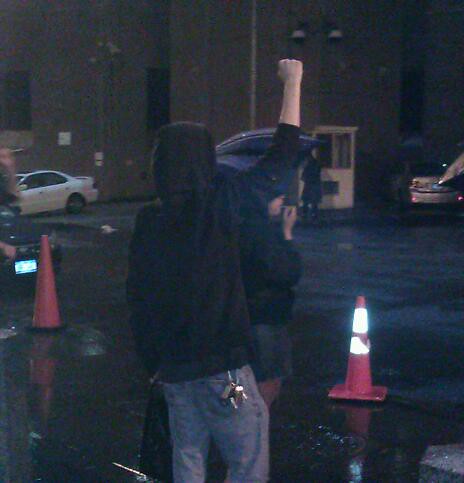
We used our voices, whistles, and blow horns to make contact with those on the inside… Prisoners flickered the lights in their cells on and off throughout the building, banged on windows, and we could see the shadows of many of those on the inside waving and pumping fists. — Activists outside the Metropolitan Corrections Center, NYC, July 8, 2011
Noise demonstrations, like the one described above, occurred outside jails, detention centers, and prisons in cities like New York City, St. Louis, Oakland, Los Angeles, Montreal and Kitchener, Ontario throughout the weekend following July 4th, 2011. Activists rallied by playing music, chanting, launching flares and fireworks, and banging pots and pans– communicating their solidarity with the Pelican Bay Hunger Strike, and their demand for justice for prisoners in each city. The noisy international demonstrations “connected local struggles against dehumanization to the California hunger strike and the conditions of the Pelican Bay Security Housing Unit, as well as both the U.S. and Canada’s prioritization of policing and imprisonment over social welfare.” (San Francisco Bayview, 2011).
If music can be understood as “the organization of noise” (Attali, 1977), these audible signs of solidarity across prison walls would certainly be considered a form of music: prison music, perhaps. Prison has been a form of political organization for the United States, at least since the beginning of the 19th century; music (or organized noise) from or about prisons helps trace this history of containment sonically. Prison music also points to the possibilities of sonic and political escape from this carceral state.
The beginnings of the history of prison music in the United States can be traced to the War of 1812. A poet named Francis Scott Key met with British officers aboard a ship off the coast of Maryland to negotiate the release of American prisoners. He was detained overnight, having gained knowledge of the position of British military units and their plan to soon attack Baltimore. From detention in a ship floating on the Atlantic, Key watched the Battle of Baltimore at Fort McHenry and reported at dawn to the prisoners below deck that he was still able to see the American flag waving.

He chronicled the experience in a poem titled, “In Defence of Fort McHenry,” and later put it to music with John Stafford Smith’s “To Anacreon in Heaven.” The title of Key’s poem changed in October of 1814 when a Baltimore actor performed the song in public and called it “The Star-Spangled Banner.” In 1889, the Secretary of the Navy designated “The Star Spangled Banner” as the official tune to be played at the raising of the U.S. flag, and in 1916 the song was declared the national anthem of the United States. Key’s experience in detention along with other American prisoners in the middle of the Atlantic was memorialized as the U.S. anthem, but it is rare, if ever, that the country’s ode to freedom is understood as its opposite – as an ode to unfreedom, as prison music. Set against contemporary examples of organized noise across prison walls, as well as examples of prison themes in U.S. popular music and culture, the U.S. national anthem can be understood as a beginning point for an American tradition of prison music.
Jimi Hendrix’s guitar version of “The Star Spangled Banner” allows us to see this dimension of the American anthem. Offering a scathing and raucous rendition of the national anthem at the 1969 Woodstock Festival off the heels of his song “Purple Haze,” Hendrix blurred the lines between a drug-induced delirium and the reality of U.S. containment, at home and abroad. Hendrix improvised on Smith and Key’s tune, allowing the notes and sounds to escape the page, and signified on the sonic and political constraints the song represented: major chords, patriotic lyrics, “American freedom.” In riffing on the national anthem, Hendrix perhaps released what was being held behind these classic American “bars”: the pain, the chaos, the possibility. Note the intervals bending from major to minor to major (harmony to disharmony and back again); the (song) structure being destroyed, re-formed, rebuilt anew; the reduction of the refrain to organized noise— sonic escapes in the forms of cries, screams, explosions. Here Hendrix’s performance fits into a trajectory of U.S. prison music by retooling the U.S. national anthem as a song of unfreedom, or perhaps, a different kind of freedom.
The relationship between prison and music in the United States can be heard most clearly through Black soundings of voice, tools, instruments, technology. Hendrix’s music, for example, represented another transnational trajectory of prison music arriving on U.S. shores from ships in the Atlantic, the genealogy of Black music. What began as tribal African songs remixed over plantation work in slavery conditions became field hollers, gospel, chain gang songs, work songs, the blues, jazz, country, rock, hip-hop. It is here that “logics of U.S. white supremacy”: slavery/capitalism, genocide/colonialism, Orientalism/war (Andrea Smith, 2008) coalesce and are rendered illogical, problematic, and questionable, simply (or not so simply) by their audibility. Take the following song, “Early in the Mornin’,” sung by Black prisoners in a 1940′s Mississippi work farm, as another example.
In this example of prison music, one hears sounds that confound the work that is being performed. The music makes the work illogical. It sounds like the work is not productive, at least not for the bodies performing it. This is destructive, or more precisely deconstructive, physical and sonic work: breaking down (song) structures, bodies, minds in the process. It is a sonic protest against imprisonment, even as prison labor is being performed. This is the sound of prison music, simultaneous containment and escape, and helps explain why prison (music) is so popular in the United States. Prison is a necessary function of white supremacist patriarchal capitalism– a necessary warehousing of surplus (bodies) for exploitation or elimination. Prison music is a documentation of this process. Listening to, and perhaps playing, prison music is our attempt to hear ourselves survive within these dehumanizing systems.
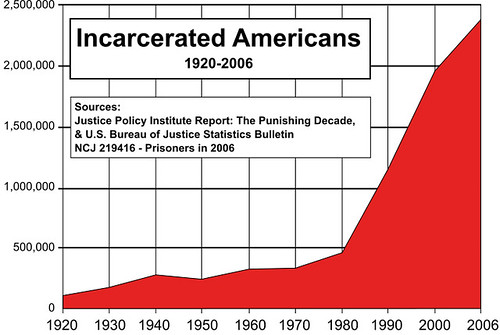
Prisons are popular in the United States, and not just in music (from anthems to work songs to blues to country to rock to hip-hop, imbued with the sounds and sights of prison). It’s the popularity and predominance of actual prisons, and the increasing rate of incarceration of U.S. residents, that undergirds the general public’s simultaneous aversion to, and fascination with, these literal echo chambers. Prisons in the United States are hyper-inaudible/invisible, and simultaneously hyper-audible/visible. The location of U.S. prisons behind distant, opaque, and quiet walls, sits strangely against the reality of prison as an increasingly intimate, transparent, and loud source of entertainment for the general public– think Cops (23 seasons), Law & Order (20 seasons), CSI (12 seasons), and Lockup (11 seasons).
Regrettably, sounds (musical or otherwise) from those incarcerated are rarely audible above the din of the prison spectacle in popular music, culture and policy. Jacques Attali wrote, “Music is a herald, for change is inscribe in noise faster than it transforms society…. Listening to music is listening to all noise.” The question is: when prisoners make noise, will we hear their music?
—
Jeb Middlebrook holds a Ph.D. in American Studies and Ethnicity from the University of Southern California, and is a Lecturer in Race, Social Movements, and Popular Culture at USC, University of Colorado–Colorado Springs, Loyola Marymount University, and People’s University, an online, low-cost college for first-time and returning students. He can be reached at jeb@solidarityinstitute.org and on Facebook and Twitter.
—
Share this:




Current Top Posts





April 2021

January 2020

November 2019

October 2019

August 2019

April 2014

November 2017

March 2015

December 2017

October 2015
 Sounding Out!
Recent Comments