
SO! Amplifies: Die Jim Crow Record Label
 SO! Amplifies. . .a highly-curated, rolling mini-post series by which we editors hip you to cultural makers and organizations doing work we really really dig. You’re welcome!
Die Jim Crow (DJC) is the first US record label dedicated to recording formerly and currently incarcerated musicians. The mission of DJC is to provide formerly and currently incarcerated musicians a high-quality platform for their voices to be heard. DJC sprang from Executive Director Fury Young’s communications with currently incarcerated individuals by letter and was originally slated to be a single concept album, inspired by Michelle Alexander’s The New Jim Crow and Pink Floyd’s The Wall. The project quickly grew into much more than that.
For me, death to Jim Crow means a death to stereotypes, to misconceptions of the ‘Other.’ There is no Other. The term ‘Jim Crow’ comes from a song which satirizes a slave. I see much parallel to the way our society views those incarcerated: that they are ‘lesser than;’ merely criminals. We are changing this narrative through music. – Fury Young
DJC records, produces, and releases music written and performed by formerly and currently incarcerated individuals. Prison staff and others working inside, such as volunteers or other program facilitators, refer incarcerated collaborators to DJC. Executive Director Young and Deputy Director BL Shirelle correspond by mail or digitally with these individuals to help prepare their musical contributions for in-prison recording sessions. Young, Shirelle, and other producers identify promising Project Managers inside each facility who help guide the music creation and recording process.
Music is recorded in prisons, homes of the formerly incarcerated, and Brooklyn studio revolutionsound, produced in the same studio, and then widely released through digital and physical channels. We currently have ongoing programming at 2 prisons in South Carolina and have recorded at a total of 5 prisons since 2015, 3 of which we are seeking to regain access to because of prison administration changes.
Our Board of Directors comprises 40% formerly and currently incarcerated individuals, ensuring that Die Jim Crow is steered by those who have direct lived experience with the issues informing our work. Deputy Director Shirelle is a formerly incarcerated musician acting as co-Label Manager with Young, bringing her unique set of experiences and talents to Die Jim Crow.
Over the past several years, Young has formed solid relationships built on trust with a number of formerly and currently incarcerated artists and has learned how to navigate the challenging process of gaining access to prisons to work with incarcerated individuals. As Fury told SO!’s Managing Editor Liana Silva,
Gaining access is tough. It can take months, even years to navigate through to the right people and get an Okay. Once you’re in, you’re in. But then you need to deal with censorship from the top brass and navigating through that. There are all types of unforeseen challenges that pop up when you least expect them to — but it really comes from above. In terms of recording on the inside, besides the typical band shit like “this guy’s ego is getting in the way” or “this guy won’t play with the band,” the making music part is the fun part.
Earlier this year–March 2019–Young took a trip to Louisiana, Mississippi, and South Carolina, the experience inspired a big shift In Die Jim Crow toward founding the non-profit label. The journey began in New Orleans with a home recording of Albert Woodfox, who lent his voice to music for the first time. Mr. Woodfox spent 43 years in solitary confinement in Louisiana, the longest of any solitary prisoner in US history. Fury also recorded a video interview with Albert about his experiences with music while inside.
From NOLA, Fury picked up co-producer and engineer Doc (aka Dr. Israel) in Mississippi–who has been part of the DJC team since 2015– where they spent two days recording four rappers at a juvenile prison — Central Mississippi CF Youthful Offender Unit. They spent the next 10 days in South Carolina recording a total of 22 artists at a men’s and a women’s prison: Allendale CI and Camille Griffin Graham CI. When they got home, Fury noted at a Board of Directors meeting: “This is becoming a record label.” He had already discussed it with Shirelle and senior advisor Maxwell Melvins, both DJC artists and board members, and the consensus was clear. A similar reaction was palpable at the board meeting. Stefanie Lindeman, a non-profit veteran and board member, brought up, “OK, we need to put together a three year strategic plan immediately.” And from there, Die Jim Crow Records was born.
And what will Die Jim Crow records sound like? Fury told SO! that
There’s a lot of hip hop and soul. Most of our artists are black and that is the music many of them grew up on. But as we transition into a record label and open up to new projects, we’re becoming more of a melting pot. All types of influences go into the stew. Right now we’re working on a straight hip hop EP at a women’s prison in South Carolina — kinda like a Lauren HIll/Rapsody vibe, and then a project called The Masses at a men’s SC prison — which has a full band and several emcees. They’re sorta like The Roots meets Wu Tang in a southern prison. But in other states we’ve recorded plenty of rock and even Native American chants. If you listen to the EP, you’ll get a sense of the sundry sounds.
Young has already recorded and released a high-quality EP with these musicians and recorded a significant library of unreleased music.
Over the next few years, DJC will continue to grow through re-releasing and repackaging existing content, cultivation of current and new artists, and development of new projects, as well as live shows, events, and tours. DJC will release 1 EP and 1 mixtape per year. The first release will be the Die Jim Crow LP, accompanied by a book and feature film documentary in 2022. By November 2020, DJC will release The Masses EP. On May 1, 2020, DJC will re-release the Die Jim Crow EP, release the “First Impressions” single and video from the EP, and begin the “Single of the Month” initiative, putting out both prerecorded songs and new works.
Die Jim Crow is currently engaged in a Kickstarter campaign for their project through 8 pm tonight, Monday 28, 2019– click here to donate to launch the label and/or read (and hear) more about the project!
—
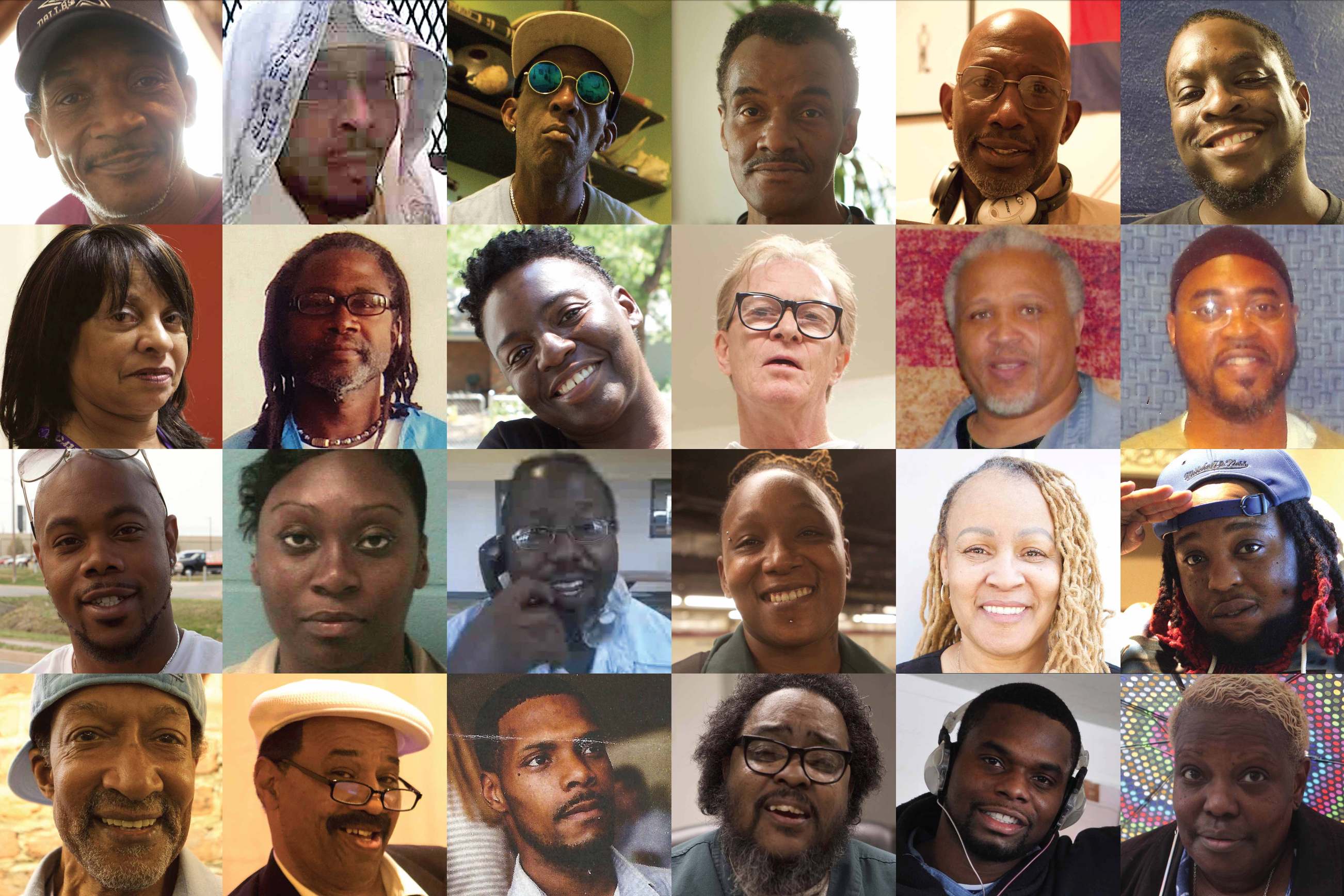
Featured Image: Some of the artists Die Jim Crow has worked with in GA, OH, IN, CO, PA, CA, NY, NJ, MD, KS, AL, TX, and LA. (L-R each row): Johnnie Lindsey, Leon Benson, Malcolm Morris, Maxwell Melvins, Michael Austin, Dexter Nurse, Valerie Seeley, Spoon Jackson, Tameca Cole, Michael Tenneson, Mark Springer, Obadyah Ben-Yisrayl, Cedric “Versatile” Johnson, Lee Lee, Anthony “Big Ant” McKinney, Ezette Edouard, Pastor Anna Smith, BL Shirelle, Carl Dukes, Norman Whiteside, Sedrick Franklin, Charles “C-Will” Williams, Apostle Heloise
—
 REWIND!…If you liked this post, you may also dig:
Regulating the Carceral Soundscape: Media Policy in Prison—Bill Kirkpatrick
Prison Music: Containment, Escape, and the Sound of America—Jeb Middlebrook
SO! Podcast #75: Wring Out Fairlea—Emma Russell
SO! Amplifies: Carleton Gholz and the Detroit Sound Conservancy
Share this:

Prison Music: Containment, Escape, and the Sound of America
DOI: https://doi.org/10.59350/r3xqx-qrv76
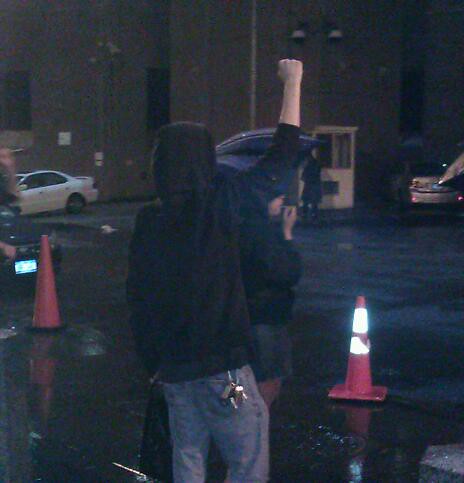
We used our voices, whistles, and blow horns to make contact with those on the inside… Prisoners flickered the lights in their cells on and off throughout the building, banged on windows, and we could see the shadows of many of those on the inside waving and pumping fists. — Activists outside the Metropolitan Corrections Center, NYC, July 8, 2011
Noise demonstrations, like the one described above, occurred outside jails, detention centers, and prisons in cities like New York City, St. Louis, Oakland, Los Angeles, Montreal and Kitchener, Ontario throughout the weekend following July 4th, 2011. Activists rallied by playing music, chanting, launching flares and fireworks, and banging pots and pans– communicating their solidarity with the Pelican Bay Hunger Strike, and their demand for justice for prisoners in each city. The noisy international demonstrations “connected local struggles against dehumanization to the California hunger strike and the conditions of the Pelican Bay Security Housing Unit, as well as both the U.S. and Canada’s prioritization of policing and imprisonment over social welfare.” (San Francisco Bayview, 2011).
If music can be understood as “the organization of noise” (Attali, 1977), these audible signs of solidarity across prison walls would certainly be considered a form of music: prison music, perhaps. Prison has been a form of political organization for the United States, at least since the beginning of the 19th century; music (or organized noise) from or about prisons helps trace this history of containment sonically. Prison music also points to the possibilities of sonic and political escape from this carceral state.
The beginnings of the history of prison music in the United States can be traced to the War of 1812. A poet named Francis Scott Key met with British officers aboard a ship off the coast of Maryland to negotiate the release of American prisoners. He was detained overnight, having gained knowledge of the position of British military units and their plan to soon attack Baltimore. From detention in a ship floating on the Atlantic, Key watched the Battle of Baltimore at Fort McHenry and reported at dawn to the prisoners below deck that he was still able to see the American flag waving.

He chronicled the experience in a poem titled, “In Defence of Fort McHenry,” and later put it to music with John Stafford Smith’s “To Anacreon in Heaven.” The title of Key’s poem changed in October of 1814 when a Baltimore actor performed the song in public and called it “The Star-Spangled Banner.” In 1889, the Secretary of the Navy designated “The Star Spangled Banner” as the official tune to be played at the raising of the U.S. flag, and in 1916 the song was declared the national anthem of the United States. Key’s experience in detention along with other American prisoners in the middle of the Atlantic was memorialized as the U.S. anthem, but it is rare, if ever, that the country’s ode to freedom is understood as its opposite – as an ode to unfreedom, as prison music. Set against contemporary examples of organized noise across prison walls, as well as examples of prison themes in U.S. popular music and culture, the U.S. national anthem can be understood as a beginning point for an American tradition of prison music.
Jimi Hendrix’s guitar version of “The Star Spangled Banner” allows us to see this dimension of the American anthem. Offering a scathing and raucous rendition of the national anthem at the 1969 Woodstock Festival off the heels of his song “Purple Haze,” Hendrix blurred the lines between a drug-induced delirium and the reality of U.S. containment, at home and abroad. Hendrix improvised on Smith and Key’s tune, allowing the notes and sounds to escape the page, and signified on the sonic and political constraints the song represented: major chords, patriotic lyrics, “American freedom.” In riffing on the national anthem, Hendrix perhaps released what was being held behind these classic American “bars”: the pain, the chaos, the possibility. Note the intervals bending from major to minor to major (harmony to disharmony and back again); the (song) structure being destroyed, re-formed, rebuilt anew; the reduction of the refrain to organized noise— sonic escapes in the forms of cries, screams, explosions. Here Hendrix’s performance fits into a trajectory of U.S. prison music by retooling the U.S. national anthem as a song of unfreedom, or perhaps, a different kind of freedom.
The relationship between prison and music in the United States can be heard most clearly through Black soundings of voice, tools, instruments, technology. Hendrix’s music, for example, represented another transnational trajectory of prison music arriving on U.S. shores from ships in the Atlantic, the genealogy of Black music. What began as tribal African songs remixed over plantation work in slavery conditions became field hollers, gospel, chain gang songs, work songs, the blues, jazz, country, rock, hip-hop. It is here that “logics of U.S. white supremacy”: slavery/capitalism, genocide/colonialism, Orientalism/war (Andrea Smith, 2008) coalesce and are rendered illogical, problematic, and questionable, simply (or not so simply) by their audibility. Take the following song, “Early in the Mornin’,” sung by Black prisoners in a 1940′s Mississippi work farm, as another example.
In this example of prison music, one hears sounds that confound the work that is being performed. The music makes the work illogical. It sounds like the work is not productive, at least not for the bodies performing it. This is destructive, or more precisely deconstructive, physical and sonic work: breaking down (song) structures, bodies, minds in the process. It is a sonic protest against imprisonment, even as prison labor is being performed. This is the sound of prison music, simultaneous containment and escape, and helps explain why prison (music) is so popular in the United States. Prison is a necessary function of white supremacist patriarchal capitalism– a necessary warehousing of surplus (bodies) for exploitation or elimination. Prison music is a documentation of this process. Listening to, and perhaps playing, prison music is our attempt to hear ourselves survive within these dehumanizing systems.
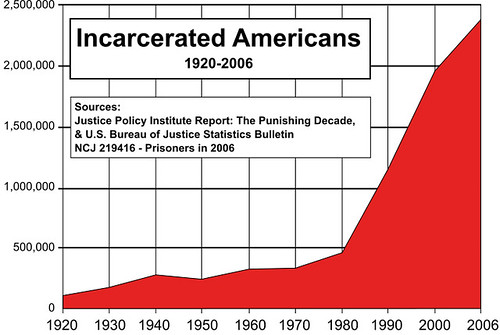
Prisons are popular in the United States, and not just in music (from anthems to work songs to blues to country to rock to hip-hop, imbued with the sounds and sights of prison). It’s the popularity and predominance of actual prisons, and the increasing rate of incarceration of U.S. residents, that undergirds the general public’s simultaneous aversion to, and fascination with, these literal echo chambers. Prisons in the United States are hyper-inaudible/invisible, and simultaneously hyper-audible/visible. The location of U.S. prisons behind distant, opaque, and quiet walls, sits strangely against the reality of prison as an increasingly intimate, transparent, and loud source of entertainment for the general public– think Cops (23 seasons), Law & Order (20 seasons), CSI (12 seasons), and Lockup (11 seasons).
Regrettably, sounds (musical or otherwise) from those incarcerated are rarely audible above the din of the prison spectacle in popular music, culture and policy. Jacques Attali wrote, “Music is a herald, for change is inscribe in noise faster than it transforms society…. Listening to music is listening to all noise.” The question is: when prisoners make noise, will we hear their music?
—
Jeb Middlebrook holds a Ph.D. in American Studies and Ethnicity from the University of Southern California, and is a Lecturer in Race, Social Movements, and Popular Culture at USC, University of Colorado–Colorado Springs, Loyola Marymount University, and People’s University, an online, low-cost college for first-time and returning students. He can be reached at jeb@solidarityinstitute.org and on Facebook and Twitter.
—
Share this:




Current Top Posts





April 2021

January 2020

November 2019

October 2019

August 2019

April 2014

November 2017

March 2015

December 2017

October 2015
 Sounding Out!
Recent Comments