
Playing with Bits, Pieces, and Lightning Bolts: An Interview with Sound Artist Andrea Parkins
 Editor’s Note: Welcome to Sounding Out!‘s fall series titled “Sound and Play,” where we ask how sound studies, as a discipline, can help us to think through several canonical perspectives on play. While Johan Huizinga had once argued that play is the primeval foundation from which all culture has sprung, it is important to ask where sound fits into this construction of culture; does it too have the potential to liberate or re-entrench our social worlds? SO!’s regular contributor Maile Colbert interviews sound artist Andrea Parkins and gets her to talk about her creative process, and the experience of playing with sound, composition, and instruments.–AT
—
In 2003, working towards my graduate degree in Integrated Media at California Institute for the Arts, I met and worked with a visiting artist by the name of Andrea Parkins, with whom I became a friend and colleague. Although I’ve been familiar with her work for more than a decade, every time I see Andrea perform my mind is blown. And, every time we discuss her practice, her methodology, and her thoughts on art and work, I’m always compelled and inspired in my own practice as a sound artist. In particular, I am impressed by her insights on the relationship between art, play, and the act of improvisation. The interview that follows is both a sampling of the conversations we have been gifted with throughout the years and a rare opportunity to listen in to the creative process of a working sound artist.
1. Hi Andrea, how are you today? What are you in the middle of?
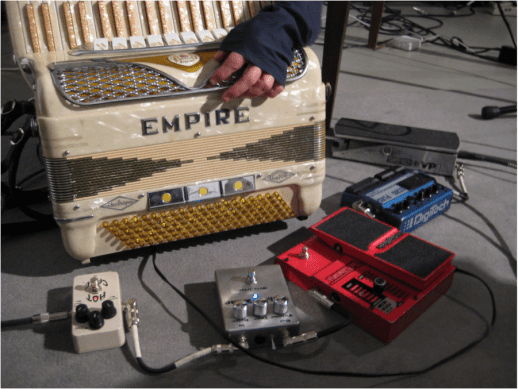
I’m well – working on a number of different projects at the moment, including preparing for a residency at Q-02: workspace for experimental music and sound art, in Brussels, where I’m going to be working on a new multi-diffusion sound piece, addressing the interaction of moving objects with human gesture in idiosyncratic acoustical spaces. I’m also working on some new recordings – one is a catalogue of short pieces, combining electric accordion-generated feedback with processed field recordings; and another incorporates 15 short object-based electronic pieces into a live ensemble work.
2. Can you describe your entrance into the world of sound and music?
I grew up in Western Pennsylvania, acutely aware of the drones and sonic events in the surrounding rural landscape. At the same time my early experience of sound through my teens resided in realm of the “musical” and the social; it connoted family (nearly all of my family members were/are musicians, and music and sound was always present); culture; and musical practice as ritual. Most family members were serious classical musicians, some were rock musicians and singer/songwriters; some were both. I studied classical piano from the age of 6 through my early twenties, and from the beginning had access to and absorbed a wide range of musics– immediately attracted to dissonance, or music with subtle harmonic and timberal changes. After high school, I moved to Boston and studied jazz piano and free improvisation. In my early 20s, I bought an analog synth, and experimented with oscillators and filters, playing synth in punk, free jazz, and new wave bands. Probably most important in my sonic development was that I went to art school and in that context began making experimental films and video, drawings and installation. I believe that my exposure to non-narrative film especially had a profound effect on how I began thinking of compositional possibilities for sound, and about art that happens in time, and also space
3. Speaking of worlds, what is the line experienced, if there is one, between the experimental sound art world and improvisation? How did you find yourself with one foot in each of these worlds, and how do you navigate between them?
While I know that some artists and theorists do draw a line between sound art and improvisational “music” performance, I don’t usually think about it that way, and for the most part that is not how I experience my relationship with sound. Having said this, I recognize that there are communities that identify themselves as one thing or the other, and performance and exhibition spaces that are organized based on one side or the other of this dichotomy, so at times I do have to “navigate between them.” This isn’t necessarily a bad thing: this allows artists to build a common discourse around their particular focus, and can even develop a creative legacy among artists. For myself, I try to think about my intentions regarding a particular installation or performance: especially in consideration of site and audience, and formulate language around this that can speak to the specifics of the situation.
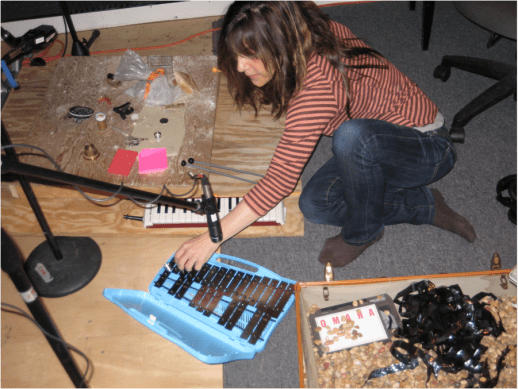
Photo Credit: Paul Geluso 2009
4. And being a woman in these worlds, have you found a difference between when you were starting out and now? Have you found a difference within the generations you work with?
I believe that for younger women, things have changed a lot: peer communities of young artists are more integrated gender-wise, and it seems that there are many more women worldwide are active and visible as experimental musicians and sound artists than when I began. I came “of age” at a different juncture and did not have this experience. To some extent this was because of the class and milieu that I came from, which meant there was no model in front of me. I do think this would have been mitigated if I had learned sooner about some of the female innovators of electronic music, among them: Bebe Barron, Wendy (Walter) Carlos, Eliane Radigue, Maryanne Amacher, Laurie Spiegel, and Pauline Oliveros. This exposure came later.
When I began working as an improvising musician, I found myself on the periphery, and never wholly part of, a group of mostly male colleagues. There were aspects to this experience that I actually now appreciate. It had value because I remained in the position of an outsider, and while I felt some sense of displacement because of this, it allowed me to develop my own critique of whatever prevailing processes and products were happening at that time, and a new assessment of what I wanted to create. I should mention that when working alone or in collaboration in other forms: intermedia, sound and performance installation, I have found that these contexts offer a more inclusive politics and discourse.
5. Something interesting came up in our last conversation that inspired me to change this question around a bit. Instead of asking you to talk about your works, and since our readers can access many different interviews, documents, and articles online, can you talk about how to talk about your work?
This is something I am learning how to do (yet again), as I become more aware that my work engages with multiple practices, multiple voices, multiple processes. It’s about beauty too (that dirty word) – in the sense that beauty (for me) is about viscerality, atmosphere, presence, fragility; this calls my attention to the physical space I am in and to how time is passing: that is to say, to mortality. Most recently I have been seeking different forms of sonic structure that are not based on “history” as forward motion, as a narrative driving through time, but that can allow for stasis, multiplicity, simultaneity, and chaos and acceptance of a potentially forward moving structure to fall totally apart.
Since 2005, in addition to exploring these modalities as an improviser and composer (for live instruments), I have been working to reintegrate a more interdisciplinary approach to my work – referencing the materiality of objects, and the body in motion, and engaging in wider range of sonic sources and processes, visual elements, and acoustical spaces. This has resulted in my creation of several fixed media works for the gallery/installation setting, as well as some electronic music pieces scored only for objects.
6. The term improvisation confuses a lot of people, and can be hard to articulate. What does it mean to you? And within improv, what does “work” and what does “play” means to you?
Speaking most simply, improvisation is (for me) a series of compositional decisions made in real time that are then immediately acted upon, with acute attention: to self, other, site and context. Being an improviser entails so much listening (to oneself and others, at the same time) and also connecting with others while maintaining one’s own sonic space/language; in a way it’s social and interiorized process at the same time. So it’s work! You are — at times – straining your ears; listening for the clues for what others are “saying,” even if they are not quite saying it. Perhaps this even involves a kind of telepathy. However, at its best moments it can be exhilarating work; there can be lively engagement among fellow performers — or when performing alone when moving among one’s own sonic materials and instruments – that is highly stimulating and fun.
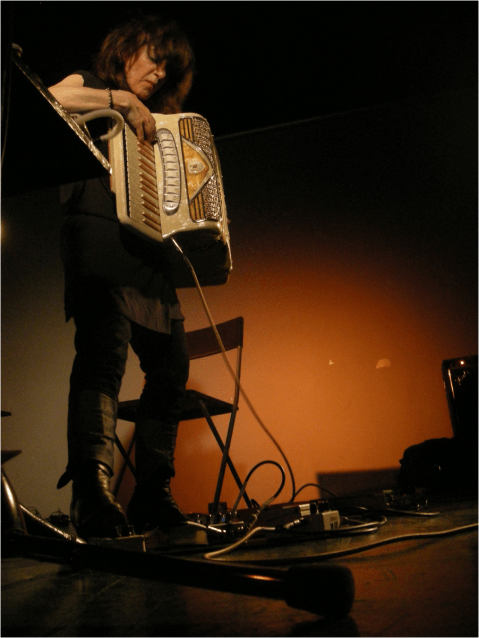
Photo credit: Maile Colbert 2010
7. Is there a hierarchy of process versus presentation for you?
I often find that my best-laid plans must be jettisoned because I have an idea or epiphany that suddenly strikes me, and it just won’t wait. For me, these “lightening bolts” often quickly resolve into having to face a challenging new work process — challenging perhaps because I have been afraid that somehow it won’t produce a result that I can readily identify as successful. But the old ways will always be there, and in the meantime it is possible that by trying something else, a new discovery will come that transforms everything – including the way I think about what a “successful result” should look like. I now feel that the notion of a “successful result” in itself has become pretty relative, and in some cases, a moot point. This is because what I now define as successful can often have much to do with my assessment of the process I employ in making something, rather than how well I have fulfilled the requirements of a pre-meditated structure: the result. This has made my engagement with my work much more open-ended in a way that I have learned to appreciate over time.
For me, composition mostly happens in the editing: that is where I find (uncover, sculpt) structure from the sound that I collect and/or record, building up a mass of material from which I can “find the piece” through editing, assemblage and layering. I think this is similar to the way some filmmakers might shoot video/film and then from raw footage hone in on or discover a film’s structure via the editing process. I like the idea that instead of filling a pre-ordained structure with content one can move the content around until the structure emerges. Maybe one recognizes the completed structure when one sees it. I like to remember that a structure, even if unusual, asymmetric, messy, seemingly random, or just plain weird – if that is what emerges – is still a structure, howsoever idiosyncratic. And it can be presented.
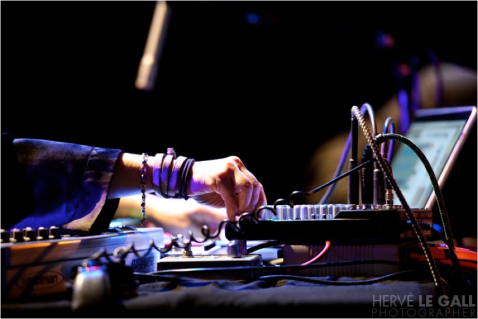
Photo Credit: Herve Le Gall 2012
8. Can you talk about differences between performance vs. play and performance vs. studio to you, and your relationship with the instruments you play?
In 2002, I began developing a MAX-based extended processing instrument inspired by Rube Goldberg and his machines. It has built into its programming seemingly “randomized” sonic processing that highlights and/or alters specific frequencies and densities, with emphasis on repetitions, interruptions, stasis and malfunction. When I began working with the instrument, I was exploring processes related to Fluxus in my compositional and improvisational practices. I was also thinking about a kind of poetics that I saw as related to my independent studies in feminist and psychoanalytic theory, and to the body of an improvising performer who is up against the limits of his or her own virtuosity. Once I designed the instrument I realized there really was a connection to these things – and to how approach decision-making as an artist – the importance of chance – but also slippage and failure and moments of physical awkwardness as what I try to accomplish on a technical level comes perilously (and for me, interestingly) close to falling apart – especially when performing with multiple instruments in simultaneity. My virtual instrument is a collaborative partner who doesn’t cooperate. It makes “sense and non-sense,” The slippage and failure relates to meaning, and for me is a metaphor for loss or displacement. For me, this is important … to me this is daily, everyday life.

Photo Credit: Glenn Cornett 2013
—
Featured Image Photo Credit: Julia Berg 2010
—
Andrea Parkins is a composer, sound/installation artist and improvising electroacoustic performer who engages with interactive electronics as compositional/performative process, and explores strategies related to Fluxus’ ordered, ephemeral activities. She is a key participant in the New York sound art and experimental music scene, and worldwide she is known for her pioneering gestural/textural approach on her electronically-processed accordion and self-designed virtual sound-processing instruments. Described as a “sound-ist,” of “protean,” talent by The New York Times music critic Steve Smith, Parkins’ laptop electronics and Fender-amped accordion create sonic fields of lush harmonics and sculpted electronic feedback, punctuated by moments of gap and rift. Her work has been presented at the Whitney Museum of American Art, The Kitchen, Diapason, and Experimental Intermedia; and international festivals/venues including Mexico City’s 1st International Sound Art Festival, NEXT in Bratislava, Cyberfest in St. Petersberg, and q-02 in Brussels. Parkins’ recordings have been published by Important Records, Atavistic, and Creative Sources, and her work has received support from American Composers Forum, NYSCA, the French-American Cultural Exchange, Meet the Composer, Harvestworks Digital Media Arts Center, and Frei und Hanseastadt Hamburg Kulturbehoerde. Parkins is on faculty at Goddard College’s MFA in Interdisciplinary Arts program.
—
Maile Colbert is a multi-media artist with a concentration on sound and video who relocated from Los Angeles, US to Lisbon, Portugal. She is a regular writer for Sounding Out!
—
 REWIND! . . .If you liked this post, you may also dig:
Wayback Sound Machine: Sound Through Time, Space, and Place— Maile Colbert
Sounding Out! Podcast #15: Listening to the Tuned City of Brussels, The First Night— Felicity Ford and Valeria Merlini
Sounding Out! Podcast #10: Interview with Theremin Master Eric Ross— Aaron Trammell
Share this:

The Sounds of Selling Out?: Tom Zé, Coca-Cola, and the Soundtrack to FIFA Brazil 2014
 Welcome back to our summer series on “Sound and Sport.” In today’s post, Kariann Goldschmitt discusses the gamechanging controversy over Brazilian musician Tom Ze’s commercial for Coca-Cola’s FIFA 2014. For an instant replay of July’s post click Josh Ottum‘s “Sounding Boards and Sonic Styles: The Music of the Skatepark” or of June’s post, click Tara Betts‘s “Pretty, Fast, and Loud: The Audible Ali.” For May’s post, click Melissa Helquist‘s “Goalball: Sport, Silence, and Spectatorship.” This Thursday’s grand finale will continue our discussion of Brazil, with a podcast by Andrea Medrado entitled “The Sounds of Rio’s Favelas: Echoes of Social Inequality in an Olympic City” AND keep you on the edge of your seat with a bonus Olympic doubleheader post excerpted from David Hendy‘s recent Noise broadcasts for BBC Radio 4 on the sounds of Olympic crowds. And now. . .the sounds of FIFA’s sponsors. —J. Stoever-Ackerman, Editor-in-Chief
—
Tensions in Brazil have been running high as the the country ramps up preparations for next year’s FIFA World Cup. Brazil’s economy is one of the world’s strongest, but its middle class has suffered as economic growth has stagnated amid rapidly rising costs of living. Yet, FIFA demands that Brazil’s government spend large amounts of money to renovate stadiums and further bolster tourism-based services at the expense of everything else. This last June, news of another hike in transit fees was the final straw for many citizens and they took to the streets to protest corruption and the routing of public funds to tournament preparations while basic services suffered. Protesters argue that the country is burnishing its international brand on the backs of its citizens. It is thus no surprise that much of the Brazilian public is fed up with FIFA and its multinational partners. As a consequence, musicians who participate in World Cup-related ad campaigns risk damaging their relationship with the public.
In Spring 2013, the Facebook page of one of Brazil’s most eccentric musical iconoclasts, Tom Zé, was bombarded by negative comments. Unforgivably to some of his most ardent fans, Zé had lent his vocal talents to a Coca-Cola commercial that sought to connect Brazil’s oft-mythologized cultural diversity to the universals of the World Cup and Coca-Cola’s alleged populism. Zé inflected his delivery of the ad copy with an especially musical speaking cadence and rhythm. It was a peculiar take that drew on his signature vocal eclecticism.
The ad opens with Zé stating,
Muita gente se pergunta como vai ser a copa
A coca-cola vai falar como ela não vai ser
[Many people are asking themselves what this cup will be like
Coca-Cola is going to tell you what it won’t be like]
as the shot features a group of people smoothing out a giant kite with the Brazilian flag. There is a strong syncopated rhythm to Zé’s voice that matches the carnival samba drums (especially the caixa) that accompany the ad throughout. As it continues, the imagery matches what Zé describes, in either stills or brief shots, often recalling the frenzy surrounding world cups of the past. In a rapid cadence, he says:
não vai ser só a copa de vuvuzela, do vidente, da celebridade
da menina bonita, do jogadores com cabelo da moda…”
[it won’t be the Cup of the vuvuzela, the psychic, nor of celebrity
of beautiful women, nor of players with fashionable hair]
The synchronization of Zé’s rapidly rhythmic delivery over archetypal images of Brazil’s tournament excitement is crucial to the ad’s message. This passage mentions two icons of the 2010 tournament, the vuvuzela and the psychic (vidente) octopus, with accompanying images. In under four seconds, the camera jumps from a man holding a celebrity magazine (celebridade), a woman cheering (menina bonita), some player figurines (jogadores) and a boy with an elaborate buzz cut. By aligning himself with an official sponsor of the upcoming tournament through ad copy that valorizes Brazil’s present, Zé also lent the sound of his voice to the sports-industrial complex, thereby opening himself up to accusations that he was a “sell-out” (vendido).
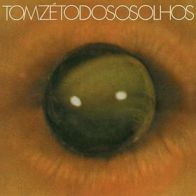
Tom Zé – Todos os Olhos (1973)
Zé is famous for taking part in the tropicália of the late 1960s – a cultural movement that was most effective through popular music. Tropicália musicians bucked Brazilian musical conventions by blending imported rock ‘n’ roll with national music protest songs during a period when musical taste often indicated one’s support or disapproval of the military dictatorship. While most involved in tropicália eventually became Brazilian musical mega-stars (Caetano Veloso, Gilberto Gil, Gal Costa, Os Mutantes, and Mara Bethânia), Zé drifted to obscurity by rejecting many of the machinations of the record industry. He only found an international audience when David Byrne’s Luaka Bop Records released some of his music in the 1990s, the most successful of which was Fabrication Defect [Com Defeito de Fabricação] (1998). Due to his peculiar status, Zé disrupted fan expectations and threatened his brand when he embraced a corporate power so intricately connected to an increasingly unpopular athletic tournament.
The controversy surrounding the Coca-Cola ad took a turn towards farce when, on April 22nd, 2013, Zé released a free 5-song EP on his website titled Tribunal do Feicebuque – a clear play on the way that Brazilians tend to pronounce “Facebook.” Accompanying the songs was a parody of tribunal orders listing the performing and collaboration credits along with lyrics to the songs. Zé’s actions exposed how the incident was a different kind of sonically-driven sports spectacle – this time it was played out over social media, in Brazil’s most influential newspaper, in Tribunal references and fights with fans during his shows at Rio’s famed Circo Voador, and in the ensuing blog reviews of his shows.
The chaotic structure of the EP’s title track, while typical of Zé catalog, disrupts his fans’ claims of “selling out.” He employs a variety of sonically disjunct approaches, opening with the startup sound for Microsoft’s Vista OS before jumping into a psychedelic samba-rock tune with a staccato guitar and a brass section. Zé recorded his vocals over multiple tracks, at times simultaneously sung/spoken at a low pitch and sung at a high pitch. The first half is familiar – the voices trade between Zé and a female companion in something sounding like a duet over a samba-rock beat. The lyrics directly reference infamous moments when Brazilian audiences have turned on their musical icons thought to be too involved in international business influences.
Vendido, vendido, vendido!
A preço de banana
Já não olha mais pro samba
Tá estudando propaganda
[Sell-out, sell-out, sell-out!
The price of a banana
He no longer looks to samba
He’s studying advertising]
At the mid-point, rock gives way to a serious march and more voices enter (including famed São Paulo hip-hop artist Emicida) making the song’s structure more like a trial, complete with competing arguments, before returning to samba-rock under Emicida’s rapping. The song is creative and fun, but it is far from Brazil’s top-40 fare which often favors smoother genre blends and urban pop hits.
Given all of the attention paid to musicians’ efforts to supplement their meager income from digital sales and streaming royalties by forging partnerships with a variety of multinational corporations, it is a little surprising that Tom Zé’s participation in a Coca-Cola commercial would be this controversial. It is difficult to find a musician in Brazil that hasn’t benefitted from some kind of corporate sponsorship. Most artists accept funding from a granting arm of a national corporation (oil company Petrobras, major bank Itaú), license music to national ad campaigns, or embark on a more direct co-branding effort from the likes of mobile phone providers and skin care companies.

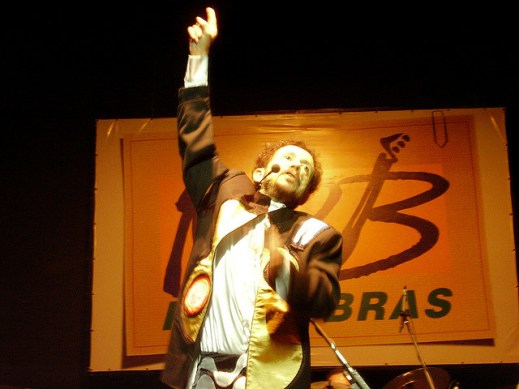
Tom Zé in 2008 performing in front of a Petrobras sign, photo used by CC license, Neto Silveira
One of the hallmarks of the recent changes that have affected the music industry is that musicians rarely refuse opportunities for their music to be used as the soundtrack for mainstream audio/visual entertainment and advertisements. The practice is so common that one of the best-regarded music industry survival books explains possible changes to a musician’s brand when they participate in the advertising of other products. Instead of “don’t license your music,” musicians should license their music in a way that will benefit their brand. It is rare for a song’s success among World Cup spectators to harm musicians; anthems that reflect well on the host nation(s) and express the energy of cheering crowds are a central feature of the tournament. Shakira’s “Waka Waka” actually bolstered her credibility among music fans across the African continent because it sampled Golden Sounds’ hit “Zamina Mina,” a popular song among hip-hop artists in Camaroon and Senegal. In Zé’s case, he misjudged how the tournament and its corporate sponsors were being read by the Brazilian public just weeks before tensions exploded in protest. Indeed, as compared to other Brazilian artists who have recorded potential 2014 World Cup anthems, the reaction to Zé is unique.
As others have noted, television advertising played an important role in the June protest soundtrack. Protesters appropriated the song from a Fiat commercial (released just weeks after Zé’s Facebook episode) that explicitly connects cheering soccer crowds in the street to a new car.
The meaning of “torcer,” a common expression for “cheer” in both advertisements’ copy, is transformed back to its original meaning to wrench or twist thereby exposing the conflicts that have been exacerbated by Brazil’s preparations for the tournament and the sports industrial complex.
These crowds twisted an ad’s soundtrack to challenge the role of multinational agencies and corporations in Brazil’s skewed socio-economic priorities. Indeed, as Leo Cardoso wrote in Sounding Out! a year ago, some of these priorities include regulating sound in Brazil’s largest cities.
For both of these cases involving sonic responses to advertisements that explicitly seek to capitalize on excitement for the soccer tournament, their original intended meaning was twisted and wrenched, forcing musicians to re-evaluate their publics. In the current political climate, Zé found that musical sounds can be aligned with the FIFA World Cup, so long as they are about celebrating sport rather than its multinational sponsors.
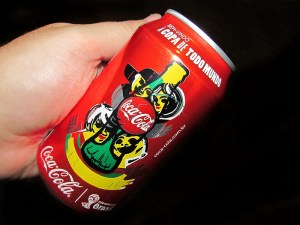
Promotional FIFA 2014 Can, Photo used by CC license, José Roitberg
—
Featured Image: Tom Zé in 2008 performing in front of a Petrobras sign, photo used by CC license, Neto Silveira
—
Kariann Goldschmitt is an Adjunct Assistant Professor at New College of Florida and Ringling College of Art and Design. She holds a Ph.D. in Musicology from UCLA (2009) and was the 2009-2011 Mellon Fellow of Non-Western Music at Colby College in Maine. Her scholarly work focuses on Brazilian music, modes of listening, and sonic branding in the global cultural industries. She has published in The Journal of Popular Music Studies, American Music, Yearbook for Traditional Music, and Luso-Brazilian Review and contributes to the South American cultural magazine, Sounds and Colours.
—
REWIND! . . .If you liked this post, you may also dig:
“Sound-politics in São Paulo, Brazil”–Leonardo Cardoso
Quebec’s #casseroles: on participation, percussion and protest–Jonathan Sterne
Hello, Americans: Orson Welles, Latin America, and the Sounds of the “Good Neighbor”–Tom McEnaney
Share this:


Current Top Posts





April 2021

January 2020

November 2019

October 2019

August 2019

April 2014

November 2017

March 2015

December 2017

October 2015
 Sounding Out!
Recent Comments