
In the Flesh: Embodiment, Listening, and Transcription
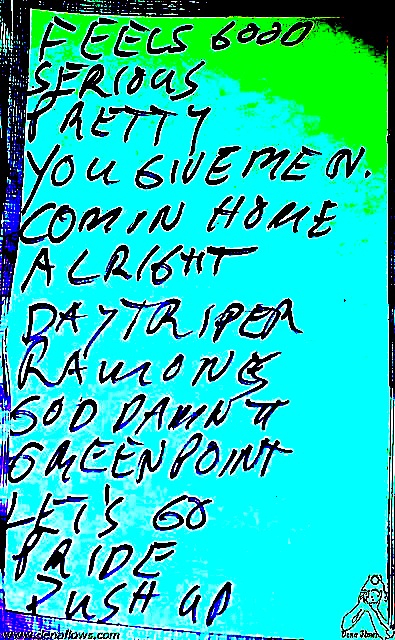
The Fleshtones Setlist, 9/11/12 show in Bilbao, Spain,
 Editor’s Note: July 18th, 2012 has been designated as World Listening Day by the World Listening Project, a nonprofit organization founded in 2008 “devoted to understanding the world and its natural environment, societies and cultures through the practices of listening and field recording.” World Listening Day is a time to think about the impacts we have on our auditory environments and, in turn, its affects on us. This year, Sounding Out! has decided to observe World Listening Day by planning a month-long special forum of posts exploring several different facets of listening such today’s offering by SO!‘s Multimedia Editor Aaron Trammell on listening’s relationship to the body and next week’s discussion by novelist Bridget Hoida on the impact of listening on her writing process. We will also explore questions that we need to remember when we celebrate listening as a cultural, embodied act. What happens when listening is interrupted? distorted? A post on tinnitus by Mack Hagood will help us think through what happens when we take listening (and the able body) for granted as a universal, normative experience. We’ll also publish a special bonus multi-sensory post by our newest regular writer, Maile Colbert, on World Listening Day itself and we will launch our regular quarterly spring podcast for on July 12th, which will feature Eric Leonardson, director of the World Listening Project. In addition to being interesting as all hell, the podcast will suggest some ideas for how to get involved in WLD activities–or how to embark on a listening project of your own this July. Enjoy our ear-opening extravaganza and please keep those comments coming. We’d love to hear from you! –JSA, Editor-in-Chief
—
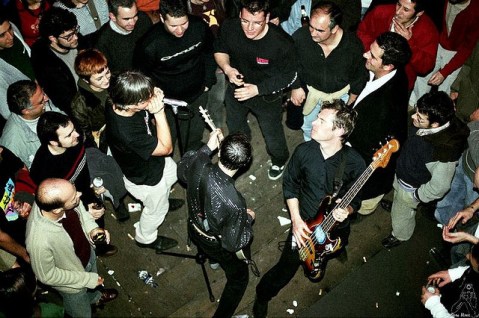
The Fleshtones, October 23, 2008, Image by Flickr User Dena Flows
What happens when the body translates sound from one medium to another? How is the body both affected by a song (when listening), and affecting it’s content (when writing)? In this post, I will relate my experience transcribing the lyrics of the song “Hexbreaker!” by The Fleshtones in an effort to answer these questions.
I love to sing. Often, I feel that it is only through singing that I feel that I can adequately relate to the emotions, ideas, and narrative of the songwriter. This relational practice is called embodiment. While psychologists such as Sigmund Freud and Carl Jung had at one point considered this sort of emotional relationship to be a libidinal drive – either to the phallus (in Freud’s case), or a unifying mythological symbol like the mandala (in Jung’s). These feelings, or drives, in classical psychoanalytic theory are part of our interior psyches, the unconscious mind.
Contemporary physiological research has departed from the sharp dichotomy of the conscious/unconscious mind. Instead, emotions are looked at as exterior phenomena – invisible links which form between bodies. As Lisa Blackman (2010) explains in her essay Embodying Affect: Voice-hearing, Telepathy, Suggestion and Modelling the Non-conscious: “The voices can be materialized through particular technologies of inscription such as neuro- imaging scans, and can even be located within the right temporal-parietal lobe, showing the capacity of the right brain not only for psychological attunement, but also for registering the affects of others” (166). Other theorists such as Sara Ahmed (2004) have argued that emotions float between and stick to bodies. Julian Henriques (2010) has even noted the ways that sonic vibrations work to activate reciprocal affective moods in others (75), a point very much in line with Blackman’s musings on the voice’s centrality to “psychic,”right brain, linkages. To these points, it is important to consider exactly what it means for the body to work as a medium of translation. What emotions can a song activate in my body, and how do these feelings become words, stored in the mnemonic confines of paper?
Because listening is central to the transmission and construction of emotional bonds, I will now detail my experience transcribing “Hexbreaker!”.
The Fleshtones are a band that I love. Their songs find the perfect balance of Animal House cool, Swinging Medallions style garage rock, and campy B-movie flavor. They have cred too, as they were a frequent act in the late-70s CBGB punk scene who shared a rehearsal space with The Cramps (a similar, but notably more famous band). Their song “American Beat” was key in the soundtrack of Tom Hanks’ shlocky 1984 film Bachelor Party. Peter Zaremba, the group’s singer, was a host on MTV’s interview based program, I.R.S. Records Presents the Cutting Edge. And, best of all, The Fleshtones have been largely eclipsed by bands with more visible albums, members, and histories. The band is all mine, and they serve as the perfect accent to any mixtape or conversation trivia at a mixer.
The digital footprint left by The Fleshtones is surprisingly sparse. Only a handful of key songs (from movie soundtracks) come up when a search for “fleshtones lyrics,” is queried on Google. A search for guitar notation or chord charts is completely fruitless, a rare feat in today’s search ecosystem. Even their vintage releases, 1982’s Roman Gods and 1983’s Hexbreaker!, were hard to pin down until the Australian label Raven re-released them on CD in 2011. For whatever reason, this sense of scarcity does nothing but excite me. It makes me feel an increased sense of intimacy and ownership. The Fleshtones, in this sense, are a knowledge commodity that has been underappreciated. By transcribing “Hexbreaker!”, and submitting it to the lyrics archive at lyrics.com (yet to be posted), I feel that I am laying claim to a space of knowledge and expertise neglected by many others.
Transcription is generally dull. Having transcribed many interviews in the past, I admit to regarding it as a job that requires patience more than practice: Press play. Listen for ten seconds. Jot down what was said. Forget half of what I was writing. Rewind five seconds. Listen again. Not quite enough to replace when I missed. Rewind eight seconds. Finish constructing the first sentence. Repeat. Hang in there for a few hours. Slow, repetitive, and monotonous is the work of interview transcription. In lieu of my previous experiences, I was happy to learn that the work of song transcription is notably more pleasurable. Although it came with its own share of frustrating and repetitive points, the presence of melody, cadence, and rhyme schemes made the entire process much more endearing and predictable.
One of the most engaging portions of song transcription came with the puzzling-out of unintelligible lyrics. The second verse of “Hexbreaker!” begins with a line that sounded like “With ____-____ mud and a hoodlum stack, finding fire in a mangled park” on first listen. It wasn’t until I had listened to each phrase five times in a row that I was able to revise to, “Well knee-high mud, and a moon lit shack, fightin’ flies in a mangled marsh.” Still not confident with that wording, I decided to do a dictionary search for similar words. To my elation after I had typed m-a-n-g into the dictionary the first word to appear was “mangrove,” the perfect word which I would never have guessed (it’s a weed-like tree found in coastal swamps!). Next I was spirited to discover that the following line evoked images of conquistadors sailing and exploring: “Well knee-high mud, and a moon lit shack, fightin’ flies in a mangrove marsh / Sendin’ sabres across the seven seas, or any foreign shores they may wash / I need a hexbreaker!”
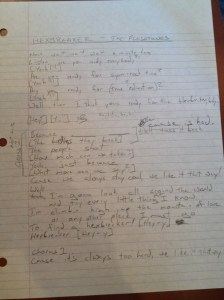
A transcript well done!
After I was able to get a gist of the overall narrative through transcription, I went back through the piece and was better able to make educated guesses about what the lyrics were. Although Zaremba often takes an unintelligible pitch when singing, the context of 17th century exploration helped me to piece together many of the tougher bits of the song. For instance, I revised the beginning of the chorus from “Well toss it back / [The bottles they break],” to fit the overall theme of colonial exploration, “The cause is had. / [The bodies they break].” Although, I’m not certain that these are the words to the song, I’m very confident because they match the overall theme. The practice of song-transcription has been fulfilling in the same way that figuring out a jigsaw, or tangram is exciting. It is a creative sort of problem solving, one that combines both analytic (left brain) and spatial, metaphoric (right brain) intelligence.
Emotionally, however, I did not feel the same satisfaction that I do when singing. Perhaps this has something to do with transcription alternate mode of embodiment. Transcription, and the pleasures associated – problem solving, precision, and permanence – are all of an analytical, and somewhat strategic sort. These are the pleasures of a conduit, processes associated more with the enduring construction of emotional bonds (belonging, and community), than the lucid enjoyment of them. It is my hope that one day another Fleshtones fan plumbs the depths of Google to find the lyrics of “Hexbreaker!” and that the fruit of my efforts, a completed transcript on lyrics.com, greets them and helps them to sing along and revel. Until then, it is enough to know that the work of transcription, for myself at least, is analytic and dry–definitely worlds apart from the euphoric mode of singing where my entire body vibrates in rhapsody to the melody, rhythm, and harmony of song.
—
Aaron Trammell is co-founder and multimedia editor of Sounding Out! He is also a Media Studies PhD candidate at Rutgers University.
Share this:

“The Happiest Day of the Year”: A Reparative (I Hope) Approach to Record Store Day
 Editor’s Note: This post, by media scholar Norma Coates, was originally published on May 9, 2011, by the excellent folks over at Flow TV, a critical forum on television and media culture published by theDepartment of Radio, Television, and Film at the University of Texas at Austin. We thank them for permission to give this gem another spin for Record Store Day 2012. It was modified only infinitesimally to fit the SO! stylesheet. Enjoy! And don’t forget put the virtual needle on Sounding Out!‘s new Record Store Day 2012 Podcast, produced by Multimedia Editor Aaron Trammell and featuring interviews with Eric Lott, Damien Keene, Benjamin Gold, Rebecca Berkowitz, Quinn Bishop, Dave Truesdell, Miranda Taylor, and yours truly. –JSA, Editor-in-Chief
—-
Several of my graduate students, in separate meetings, have shared their recent inspiration from the late Eve Kosofsky Sedgwick’s work on affect, especially as compiled in her book Touching Feeling. After the third student talked about it, I figured that I’d better read it. I was instantly plunged back into that wonderful feeling, or more appropriately affect, of discovering something compelling and useful, that could change the ways in which I think about certain things, or at least complicate my approaches. Hence this post about Record Store Day is going to be a bit different than my first drafts. I must proceed with the caveat that although my reading of Sedgwick’s theory of affect is still shallow and my approach necessarily speculative, I’m going to jump into it and use it anyway, in the hope of jumpstarting more careful thought and theorizing for later projects.
 On April 16, this year’s Record Store Day [2012’s Record Store Day is April 21st], I proclaimed it to my family as “the Happiest Day of the Year.” My reading of Record Store Day was at the same time, in Sedgwick’s terminology, paranoid and reparative. Implicit in my paranoid stance, and in the first draft of this post, was my deep suspicion of and sadness about its commercial and consumerist co-optation. What began as a celebration of the continuing economic health and vibrancy of some independent record stores four years ago now has a glossy web site and sponsorship by major labels and industry players. Special “one-day-only” releases, usually on vinyl, sell for somewhat exorbitant prices and end up, unsealed and resold for even more exorbitant prices on Ebay the next day. This in turn feeds the “baseball card” collector mentality that in turn perpetuates gendered discourses and practices of inclusion and exclusion, as well as the vinyl fetishism that separates the “real” music fan from the poseur. I could go on and on with this paranoid reading, one laden with negative affect that critical theorists use to ward off any surprises and to comfort ourselves with the knowledge that the sources of our cultural oppression can be exposed. Sedgwick asks us to think about what such knowledge or exposure does for us. Perhaps it justifies a cynical and critical fatalism that ultimately goes nowhere.
The path that Sedgwick offers out of this conundrum is reparative reading, one open to surprises rather than to sureties. Record Store Day is, for me, a happy day. I even anticipate it. It celebrates several things that I love: music, community, independent cultural production and businesses, browsing racks of records and CDs, talking about music, hearing live music, and more. Despite the presence of corporate logos on the slick website, Record Store Day does manage to retain an element of, in the immortal words of Jack Black in School of Rock, “sticking it to the man.” That is, Tower Records and Virgin Megastores are gone, but a few local record stores are still thriving. That there are “few” is indeed problematic, as they are perhaps the last left standing after a ferocious cull over the past decade, with an uncertain future despite their alleged economic health.
A reparative reading, according to Sedgwick lacks the tight control of a paranoid reading, in which we fatalistically intuit or even call into being what we expect to find or expose. Record Store Day makes me, and I assume the others who were responsible for a 30-minute long check-out line at 10:30 am, feel good, even if we “shouldn’t.” For example, record stores and record collecting are assumed by scholars and laypeople to be space dominated by males, often but not always young ones. What to make, then, of the more than a handful of older women in the store? Or the general sense of camaraderie and celebration that seemed to transcend age and gender, at least? (Race and class weren’t as well-represented in my local record store.) What brought the biggest smile to my face was a woman, perhaps in her late twenties, whose arms were over-flowing with records and CDs. My initial, paranoid reading saw her as both an aberration or a updated version of one of Adorno’s “rhythmic obedients” [from “On Popular Music], blithely purchasing the tools of her own oppression. Or perhaps she was generally caught up in the celebration and needing to catch up on purchases. Maybe, like myself, she was genuinely caught up in the tactile and aural pleasures of music, especially that available in tangible form. I, too, succumbed to the lure of special editions, one-day only availability, and contests that tested my knowledge of rock trivia.

While in the middle of it Record Store Day tapped into what are for me dense layers of affective pleasure made available by listening to and otherwise interacting with recorded music. The hunt is itself enjoyable. Ripping the plastic off a CD provides the joyful and familiar sound of anticipation. The smell of vinyl, the crackle of the needle in the groove, even the preparatory cleaning of a record before playing all provide pleasurable feelings of positive affect. All of these things fit neatly into my original paranoid reading of Record Store Day. Special editions that are only available on record store day feed into two consumer economies: that of the major labels who produce some of these instant rarities, and those who buy them to take advantage of collectors on Ebay later. Plus, these affective “pleasures” could all be reduced to fetishism, or to false consciousness, but my reading of Sedgwick causes me to argue that they don’t have to be either of these things (or other negative things). Through a reparative lens, these feelings, the affect, generated by Record Store Day, could lead to different questions and answers that linger alongside and are equally valid as the set we already ask and the conclusions that we draw from them.
The paranoid critic in me wonders, though, if reparative approaches of media texts are nothing more than the return of 1980s and 1990s ideas about producerly consumption, theories roundly, if sometimes unfairly criticized for a lack of political efficacy. Moreover, affect theory can also return to a possibly problematic return to some notion of something innate, in this case affect or more simply, feeling. I do wonder, though, with Sedgwick, whether our existing critical tools may lead to the triumph of the paranoid reading and of negative affect. That is, our only way to deal with the present condition is tantamount to capitulation. Reparative readings enable us to place our pleasure alongside the negative aspects; that is, they may be capable of thinking beyond binaries, originations, and desires to unveil things that we already know are there. What does alongside mean? Is theorizing the alongside just another way of submitting to an increasingly depressing status quo? For now, I’ll just submit that Record Store Day is “the happiest day of the year,” (you can do what you want with the scare quotes) and that happiness and other positive affects are latent with political possibility, even if we are still figuring out how to access that potential.
For Poly Styrene, Hazel Dickens, and Phoebe Snow. Originally published on May 9, 2011, by the excellent folks over at Flow TV.
—
Norma Coates is Associate Professor with a joint appointment in the Don Wright Faculty of Music and the Faculty of Information and Media Studies at the University of Western Ontario. She writes and studies about popular music and sound and their interactions and intersections with other things such as gender, television, film, age, and the entertainment industry.
Share this:


Current Top Posts





April 2021

January 2020

November 2019

October 2019

August 2019

April 2014

November 2017

March 2015

December 2017

October 2015
 Sounding Out!
Recent Comments