
The Listening Body in Death

DOI: https://doi.org/10.59350/35fwf-ehp12
Editors’ note: As a discipline Sound Studies is unique in its scope—under its purview we find the science of acoustics, cultural representation through the auditory, and, to perhaps mis-paraphrase Donna Haraway, emergent ontologies. Not only are we able to see how sound impacts the physical world, but how that impact plays out in bodies and cultural tropes. Most importantly, we are able to imagine new ways of describing, adapting, and revising the aural into aspirant, liberatory ontologies. The essays in this series all aim to push what we know a bit, to question our own knowledges and see where we might be headed. In this series, co-edited by Airek Beauchamp and Jennifer Stoever you will find new takes on sound and embodiment, cultural expression, and what it means to hear. –AB
—
My voice melds with the sound of the water pouring from the hose, as I gently massage the waste, blood, and tears from the body of the deceased. In the act of washing the dead, water is simultaneously sound, spirit, and sensory experience for the deceased and for the washer herself.
Washing the deceased in groups of three, our individual solo voices punctuate space at our own paces and intensities. Our sound soothes and cleanses the deceased as much as our washing. The melodic recitations we provide when gently holding the deceased are the most important components of ritual cleansing before one is buried. We repeatedly sound “Forgiveness, o Teacher [e.g., God]” while exhaling and inhaling. Often we recite the Tekbir—which articulates God’s greatness—adding a melodic architecture to our textured calls for forgiveness.
In washing the dead, we touch the deceased with respect and humility. “Please,” a family member will often beg, “please do not use cold water.” We quickly respond, “of course, this sister is still sensing us.”
Approaching the grieving we smile and gently say, “she is only without breath.” We turn on the water and gently command: “bring me your hand.” And the bereaved joins hands with the washer and feels the warmth of the water. We espouse a tactility exclusively belonging to the washer—as the choreographer and improviser of mourning—with the one who is left alive and in grief.
Our touch and voices alter with each separate experiencing of washing the dead. Because each deceased woman is her own person with her different body and causes of death, no encounter is the same. In the way that we leverage our own bodily movements of lifting and turning the deceased’s body, we actively chose to duet with sounds pouring from the mourning family members in the room. If the mourners are silent, we tend to fill the space with our sound. Our recitations are not only for ritual per se, but exist to offer pleasing sounds to the dead herself.
We recite believing, as Muslims do, that her soul still hears us. While “dead,” she can communicate with all or part of her former body, cooperating with us, the living, as we mediate mourning and prepare her body for burial.
One of the most hard-drawn sensory lines we assume and maintain is the border of death. Death ostensibly marks the end of our constellation of sense experience, engenders the limit of the body, and demarcates the edges of aurality. While we know that hearing remains the last of the senses experienced in dying, scholars of sound studies have yet to extend our exceptional inquiries on hearing, aurality, and listening into posthumous auralities practiced by multiple communities throughout the world. How might sound studies scholars attend to the multi-sensory perceptions and auralities that extend beyond the grey where western epistemological structures end?
As a specialist of Ottoman and Turkish classical musics, I have long been interested in how variant Sunni Islamic practices—themselves rooted in centuries of philosophical debates outside of those generated in “the west”—unsettle categories that many scholars globally assume to be fixed and natural. My current projects have led me to consider the intensity of diverse listening structures attuned to violent thresholds of death in Turkey’s Aegean and Mediterranean seas.
In fall of 2016, my ethnography on listening towards posthumous aurality brought me to Karacaahmet Cemetery in Istanbul, a critically important burial ground of the Ottoman Empire and reportedly the second largest cemetery in the world. Here I was apprenticed to the women of Karacaahmet, practicing Sunni Muslims and official state employees who provide the service of conducting the Islamic rituals of washing the dead. During this time I had the privilege of laying dozens of women and girl-children of all ages, diseases, and accidents to rest with sound.

In taking posthumous aurality seriously, I have few paths of translation available to me. I am challenged by normative secular belief structures that we may uncritically reproduce in scholarship. Death is not necessarily the end of aurality. Provincializing western critical theory and engaging ethnographic insight from non-western eschatologies—the areas of theology concerned with death and dying—invites one path for expanding our structures of listening beyond a body’s end.
For decades now, scholars have studied the body not as an accomplished fact but rather as a process. Yet in the body praxis long upheld in Islamic death rituals in Turkey, the vitality, socialization, and subjection of the body does not end in death, but rather passes into an alternate sensory and dialogically sonic realm. Death offers a space akin to what Bohlman and Engelhardt have considered as the sonic emptiness of religious ontologies, or “a space of perception and experience, not of silence and absence.”
Posthumous aurality, as I define and explore it, takes both an ethnographic and a sound studies approach to consider sensory possibilities of death. In this liminal space of mingled bodies—the bodies of the dead, the washers as care laborers, and the deceased’s mourning family members—I listen at a crossroads in which local belief structures mediate and structure sounds, soundings, silences, and voicing.
In Muslim cemeteries in Istanbul, it is believed that there is life in the grave. Death is described in terms of development, progression, pathway, and mere transition from one stage of life to another stage. The barzakh, the barrier of the grave and time spent dwelling posthumously in it, is an interstitial zone entered upon death which the soul can experience pleasure and pain, socialize and commune with others. There exists no necessary binary of life versus death, sound versus silence in these spaces.
The barzakh is a stage of movement, a zone of transference and oscillation. The body is a listening body—its soul communicates and lingers around it, sensing the sounds and touch offered by the washers. Ottoman poetry abounds about such sensings, echoing the understanding the body is a cage and the spirit is incarcerated in it. Artists of the word—with wording historically experienced aurally—narrate the body as wishing for its release (e.g., death) and the possibility of being reunited with its beloved (e.g., the divine) and returning to the earth as soil.
Sonic generosity in the face of death requires washers to engage a modality of listening, touch, and sounding to send an individual to the next realm to await resurrection. Her soul circles the room where we wash her body, listening and participating with us sonically, called back to her body in the grave three times before it is closed.
We believe we hold the body in its second most intimate moment in life, after that of its emergence from the womb. The scent of death fills our nostrils as we sweat to lift the deceased after we finish shrouding her and sprinkling the shroud with rose water. Gently, we ease her into the pine box that transports her to her grave.
And after we are done washing someone—whether we refer to her as “sister,” “aunt,” or “daughter”—we later, in our back tea room, remark upon the grieving of the family members joining us in the room and the discovery of ailments or sores on our sister.
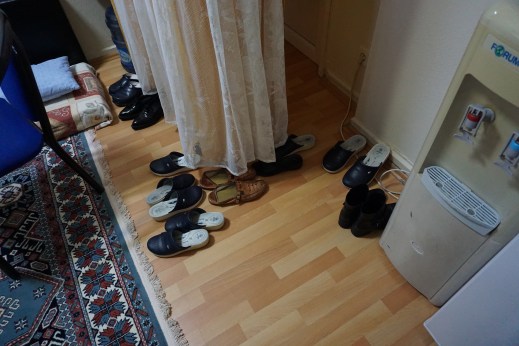
In these moments of collective sharing, we discover ourselves in our shared similarities with the dead. Wisdom is, after all, listening in tandem with others and recognizing that which is most human in all of us.
In the context of Cairo, Egypt, Charles Hirschkind has beautifully analyzed “the ethical and therapeutic virtues of the ear.” Yet in washing the dead, I produce and engage in a space beyond the pieties maintained by circulating listening structures in particular places. I enter a particular and intimate form of relationality—not a relationship to myself as a subject or the subjection of the dead other, but rather to relationality itself as a form of the sonorous. Jean-Luc Nancy reminds us that the sonorous “outweighs form.” In listening towards posthumous aurality, I am ushered into a unique corporeal and sensorial form of access. Posthumous aurality is simultaneously “mine” and also shared.
Posthumous aurality renders all of our bodies—including that of the literal post-human dead—as capable of being influenced by others in that place. Sharing posthumous auralities in tandem with the washers, the grieving, and the deceased echoes in a space that is indissociably material and spiritual, internal and external, singular and plural.
The critical theories and methodologies of sound studies tend to not center diverse non-western tenets of sensory apparatus espoused by individuals and communities who perceive sound outside of the boundaries of western metaphysics. Posthumous auralities—when translated and mediated linguistically—offers a sound path to understanding the continuations and transformations of sense experience that occur in death. Tuning into posthumous auralities in Turkey’s urban Muslim cemeteries has helped me recover sounds long unheard because they have been relegated to the boundaries of our academic disciplines and the fringes of our very lives.
—
Featured Image: A view from Eyüp Sultan. Istanbul, October 2016. Photograph by the author.
—
Denise Gill is assistant professor of ethnomusicology at Washington University in St. Louis in the Departments of Music; Women, Gender, and Sexuality Studies; and Jewish, Islamic, and Near Eastern Languages and Cultures. Her research has been supported by Fulbright and ACLS. Her book, Melancholic Modalities: Affect, Islam, and Turkish Classical Musicians (Oxford, 2017), introduces methodologies of rhizomatic analysis and bi-aurality for scholars of sound, musical practices, and affect. Her current projects focus on listening structures of death, refugee loss, and acoustemologies of Muslim cemeteries and shrines in Istanbul. A kanun (trapezoidal zither) player, Denise has performed in concert halls in Turkey, the U.S., and throughout major cities in Europe.
—

REWIND! . . .If you liked this post, you may also dig:
Something’s Got a Hold on Me: ‘Lingering Whispers’ of the Atlantic Slave Trade in Ghana–Sionne Neely
The Amplification of Muted Voices: Notes on a Recitation of the Adhan–David Font-Navarrette
“An Ear-splitting Cry: Gender, Performance, and Representations of Zaghareet in the U.S.“-Meghan Drury
—
Share this:

Listen to the Sound of My Voice

DOI: https://doi.org/10.59350/8h3ap-q5y65
Betrayal
I first realized there was a problem with my voice on the first day of tenth grade English class. The teacher, Mrs. C, had a formidable reputation of strictness and high standards. She had us sit in alphabetical order row after row, and then insisted on calling roll aloud while she sat at her desk. Each name emerged as both a command and a threat in her firm voice.
“Kelly Barfield?”
“Here,” I mumbled quietly. I was a Honor Roll student with consistent good grades, all A’s and one B on each report card, yet I was shy and softspoken in classes. This was an excellent way to make teachers amiable but largely go unnoticed. The softness of my voice made me less visible and less recognizable.
Mrs. C repeated my name. Caught off guard, I repeated “here” a little more loudly. She rose to her feet to get a better look at me. I knew what she saw: a petite girl with long ash blonde hair, big brown eyes, and overalls embroidered with white daisies on the bib. When her gaze finally met mine, Mrs. C frowned at me and cleared her throat loudly. I curled into my desk, hoping to disappear.

“Miss Barfield, did you hear me call your name twice? In this class, when I call roll, you respond.” I gave a quick nod, but Mrs. C wasn’t finished: “We use our strong voices in here, not our girly, breathy ones.” My cheeks flushed red while Mrs. C droned on about confidence and classroom expectations.
“Do you understand me?”
I stammered a “yes.” Mrs. C turned her attention back to the roll call. Her harsh words rang in my ears. I sank low in my chair, humiliated and angry. I couldn’t help that I sounded girly: I was, in fact, a girl. This was the way my voice sounded. It was not an attempt to sound like the dumb blonde she appeared to think I was.
That day I decided that I would never speak up in her class. Forget the Honor Roll. If the sound of my voice was such a problem, then my mouth would remain firmly shut in this class and all of my others. I would never speak up again.
My vow to stop speaking lived a short life. I enjoyed Mrs. C’s serious fixation on diagramming sentences and her attempts to show sophomores that literature offered ideas and worlds we didn’t quite know. At first, I spoke up with hesitation and fear of the inevitable dismissal, but I continued to speak. Becoming louder became my method to seem confident, even when I felt anything but.
Throughout high school, my voice emerged again and again as a problem. Despite the increased volume, my voice still sounded tremulous, squeaky, hesitant, and shrill to my own ears. Other girls had these steady, warm voices that encouraged others to listen to them. Some had higher voices that were melodic and lovely. I craved a lower, more resonant voice, but I was stuck with what I had. In drama club, our director scolded me with increasing frustration about my tendency to end my lines in the form of a question. My nerves materialized as upspeak. The more he yelled at me, the more pronounced the habit became. He eventually gave up, disgusted by my inability to control my vocal patterns.
It wasn’t just the theater director who commented on my voice; fellow students expressed shock and occasionally dismay that the soft-spoken blonde had smart things to say if you stopped to listen to her. Teenage girls were supposed to sound confident (but not too confident), loud enough to be audible (but not too loud), warm (never cold), and smart (but not smarter than the boys), all while cultural norms suggested that voices of teenage girls were also annoying. Teenage girls were supposed to be seen, but when they spoke they had to master the right combination in order to be heard. I could never master it.
Meanwhile, at a big state university in my native Florida, I learned quickly that a Southern accent marks you as a dumb redneck from some rural town that no one had heard of. Students in my classes asked me to say particular words and then giggled at my pronunciations. “You sound like a Southern belle,” one student noted. This was not really a compliment. According to my peers, Southern belles didn’t have a place in the classroom. Southern belles didn’t easily match up with “college student. As a working-class girl from a trailer park, I learned that I surely didn’t sound like a college student should. I worked desperately to rid myself of any hint of twang. I dropped y’all and reckon.
I listened carefully to how other students talked. I mimicked their speech patterns by being more abrupt and deadpan, slowly killing my drawl. When I finally removed all traces of my hometown from my voice, my friends both from home and from college explained that now I sounded like an extra from Clueless. My voice was all Valley girl. I was smarter, they noted with humor, than I sounded and looked. My voice now alternated between high-pitched and fried. Occasionally, it would squeak or crack. I thought I sounded too feminine and too much like an airhead, even when I avidly tried not to. I began to hate the sound of my voice.
My voice betrayed me because it refused to sound like I thought I needed it to. It refused to sound like anyone but me.
When I started teaching and receiving student evaluations, my voice became the target for students to express their displeasure with the course and me. According to students, my voice was too high and grating. Screechy, even: one student said my voice was at a frequency that only bats could hear. In every set of evaluations, a handful of students declared that I sounded annoying. This experience, however, was not something I alone faced. Women professors and lecturers routinely face gender bias in teaching evaluations. According to the interactive chart, Gender Language in Teaching Evaluations, female professors are more likely to be called “annoying” than their male counterparts in all 25 disciplines evaluated. The sound of my voice was only part of the problem, but I couldn’t help but wonder if how I sounded was an obstacle to what I was teaching them.
Once again, I tried to fix my problematic voice. I lowered it. I listened to NPR hosts in my search for a smooth, accentless, and educated sound, and I attempted to create a sound more like them. I practiced pronouncing words like they did. I modulated my volume. I paid careful attention to the length of my vowels. I avoided my natural drawl. None of my attempts seemed to last. Some days, I dreaded lecturing in my courses. I had to speak, but I didn’t want to. I wondered if my students listened, but I wondered more about what they heard.
Sound
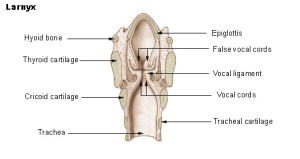
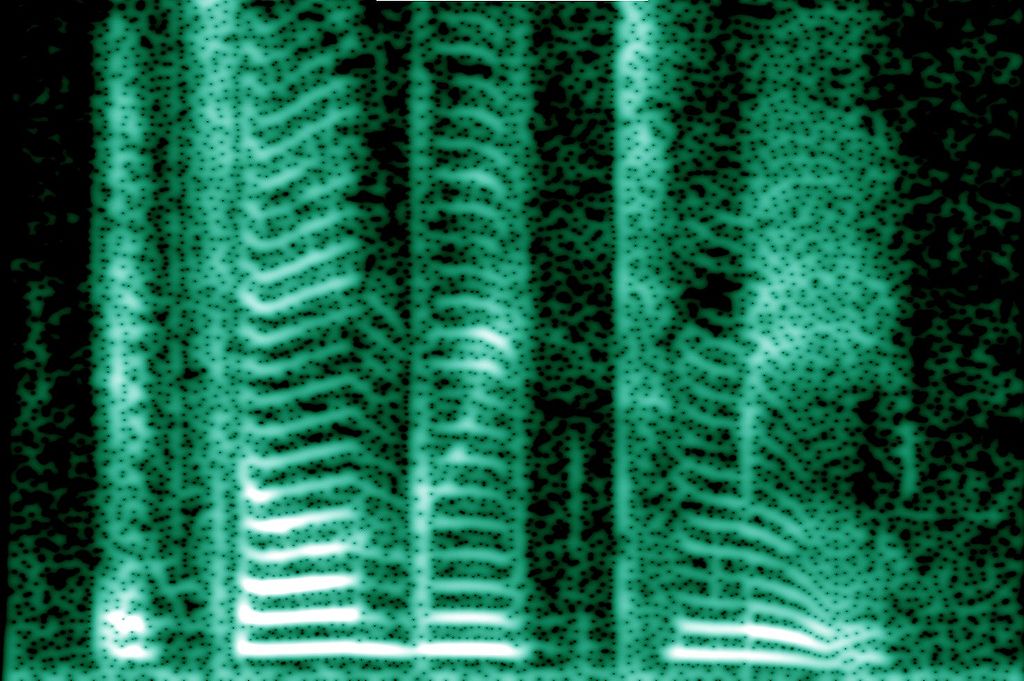
The sound of your voice is a distinct trait of each human being, created by your lungs, the length of your vocal cords, and your larnyx. Your lungs provide the air pressure to vibrate your vocal cords. The muscles of your larnyx adjust both the length and the tension of the cords to provide pitch and tone. Your voice is how you sound beyond the resonances that you hear when you speak. It is dependent on both the length and thickness of the vocal cords. Biology determines your pitch and tone. Your pitch is a result of the rate at which your vocal cords vibrate. The faster the rate, the higher your voice. Women tend to have shorter cords than men, which makes our voices higher.
Emotion also alters pitch. Fright, excitement, and nervousness all make your voice sound higher. Nerves would make a teenage girl have an even higher voice than she normally would. Her anxious adult self would too. Her voice would seem tinny because her larnyx clenched her vocal cords tight. Perhaps this is the only sound she can make. Perhaps she is trying to communicate with bats because they at least would attempt to listen.
Biology, the body, gives us the voices we have. Biology doesn’t care if we like the ways in which we sound. Biology might not care, but culture is the real asshole. Culture marks a voice as weak, grating, shrill, or hard to listen to.

My attempts to change my voice were always destined to fail. I fought against my body and lost. I couldn’t have won even if I tried harder. My vocal cords are determined that my voice would be high, so it is. The culture around me, however, taught me to hate myself for it. Voice and body seem to cast aspersions on intelligence or credentials. It’s the routineness of it all that wears on me. I expect the reactions now.
I wonder if I’m drawn to the quietness of writing because I don’t have to hear myself speak. I crave the silence while simultaneously bristling at it. Why is my voice a problem that I must resolve to placate others? How can I get others to hear me and not the stereotypes that have chased me for years?
Fury
My silence has become fruitful. The words I don’t say appear on the page of an essay, a post, or an article. I type them up. I read aloud what I first refused to say. I wince as I hear my voice reciting my words. I listen carefully to the cadence and tone. This separation of words and voice is why writing appeals to me. I can say what I want to say without the sound of my voice causing things to go awry.
People can read what I write, yet they can’t dismiss my voice by its sound. Instead, they read what I have to say. They imagine my voice; my actual sound can’t bother them. But, they aren’t really hearing me. They just have my words on the page. They don’t know how I wrap the sound around them. They don’t hear me.
Rebecca Solnit, in “Men Explain Things to Me,” writes “Credibility is a basic survival tool.” Solnit continues that to be credible is to be audible. We must be heard to for our credibility to be realized. This right to speak is crucial to Solnit. Too many women have been silenced. Too many men refuse to listen. To speak is essential “to survival, to dignity, and to liberty.”
I agree with her. I underline her words. I say them aloud. The more I engage with her argument, the more I worry. What about our right to be heard? When women speak, do people listen? Women can speak and speak and speak and never be heard. Our words dismissed because of gender and sound. Being able to speak is not enough, we need to be heard.
We get caught up in the power of speaking, but we forget that there’s power in listening too. Listening is political. It is act of compassion and empathy. When we listen, we make space for other people, their stories, their voices. We grant them room to be. We let them inhabit our world, and for a moment, we inhabit theirs. Yes, we need to be able to speak, but the world also needs to be ready to listen us.
We need to be listened to. Will you hear me? Will you hear us? Will you grant us room to be?
When I think of times I’ve been silenced and of the times I haven’t been heard, I feel the sharp pain of exclusion, of realizing that my personhood didn’t matter because of how I sounded. I remember the burning anger because no one would listen. I think of the way that silence and the policing of how I sound made me feel small, unimportant, or disposable. As a teenager, a college student, and a grown woman, I wanted to be heard, but couldn’t figure out exactly how to make that happen. I blamed my voice for a problem that wasn’t its fault. My voice wasn’t the problem at all; the problem was the failure of others to listen.
Loss
While writing this essay on my voice, I almost lost mine, not once but twice. I caught a cold and then the flu. My throat ached, and I found it difficult to swallow. A stuffy nose gave my voice a muted quality, but then, it sounded lower and huskier. I could hear the congestion disrupting the timber of my words. My voice blipped in and out as I were radio finding and losing signal. It hurt to speak, so I was quiet.
“You sound awful,” my husband said in passing. He was right. My voice sounded unfamiliar and monstrous. I tested out this version of my voice. It was rougher and almost masculine. I can’t decide if this is the stronger, more authoritative voice I wanted all along or some crude mockery of what I can never really have. I couldn’t sing along with my favorite songs because my voice breaks at the higher register. I wheezed out words. I croaked my way through conversations. “Are you sick?” my daughter asked, “You don’t sound like you.”
Her passing comment stuck with me. You don’t sound like you. Suddenly, I missed the sound of my voice. I disliked this alien version of it. I craved that problematic voice that I’ve tried to change over the years. I wanted my voice to return.
After twenty years, I decided to acknowledge the sound of me, even if others don’t. I want to be heard, and I’m done trying to make anyone listen.
—
Featured image: “Speak” by Flickr user Ash Zing, CC BY-NC-ND 2.0
—
Kelly Baker is a freelance writer with a religious studies PhD who covers religion, higher education, gender, labor, motherhood, and popular culture. She’s also an essayist, historian, and reporter. You can find her writing at the Chronicle for Higher Education‘s Vitae project, Women in Higher Education, Killing the Buddha, and Sacred Matters. She’s also written for The Atlantic, Bearings, The Rumpus, The Manifest-Station, Religion Dispatches, Christian Century’s Then & Now, Washington Post, and Brain, Child. She’s on Twitter at @kelly_j_baker and at her website.
—
REWIND!…If you liked this post, you may also dig:
Vocal Gender and the Gendered Soundscape: At the Intersection of Gender Studies and Sound Studies — Christine Ehrick
On Sound and Pleasure: Meditations on the Human Voice– Yvon Bonefant
As Loud As I Want To Be: Gender, Loudness, and Respectability Politics — Liana Silva
—
Share this:




Current Top Posts





April 2021

January 2020

November 2019

October 2019

August 2019

April 2014

November 2017

March 2015

December 2017

October 2015


Recent Comments