
Malcolm Gladwell’s Bad Aesthetics

Malcolm Gladwell, who recently wrapped the first season of his podcast Revisionist History, has been on a roll lately. Not a particularly endearing one, though. I’ve been trying to locate his nadir, but it’s not easy with so many options to choose from. Is it in the New Yorker, when he condescendingly exclaims “Of course not!” in response to whether Caster Semenya should be allowed to compete in the 800-meter at the Olympics? He follows up with the assertion that no track-and-field fan disagrees with him, as if the complexity of gender identification is somehow best left to a majority appeal. Or is it in Revisionist History’s Episode 9, “Generous Orthodoxy,” when he chides Princeton students protesting the use of Woodrow Wilson’s name around campus? Calling one student “angry”—a loaded word to lob at a black woman—and surmising she would later “regret her choice of words,” Gladwell advises the students to instead threaten to leave the university if their requests aren’t honored. Why? Because otherwise “every crotchety old Princeton alum” wouldn’t believe they actually care about the university.

For those keeping score, that’s Gladwell, who spent an entire other episode of his podcast lamenting that we don’t “capitalize” people’s educational potential well enough, counseling black students to separate themselves from an Ivy League education as a way to make a point about a pro-segregationist president. Gladwell’s seventh episode, “Hallelujah,” where he discusses musical genius, is not obviously about the kind of systemic inequalities he bumbles in the Semenya and Princeton examples. But the conclusions he draws about genius and the anti-pop aesthetic judgments he claims are informed by the same bad gender and race politics that would put a person’s gender identification in other people’s hands and place the burden of sacrifice on the aggrieved in matters of racial injustice.
The episode “Hallelujah” revolves around two songs that Gladwell argues reached their peak of genius years after they were initially recorded: “Deportees Club” (1984) by Elvis Costello and “Hallelujah” (1984) by Leonard Cohen. In each case, Gladwell asserts that the first recordings were flawed but that they attained a certain beauty in later versions that reveals something about how genius works, though each attained that genius status by different routes. While Costello is responsible for the version of “Deportees Club” that Gladwell loves—he re-recorded it as “Deportee” in 1985 (it wouldn’t be released until 1995 on a re-issue of Goodbye, Cruel World)—“Hallelujah” would peak for Gladwell in a series of covers, most famously by Jeff Buckley (1994), performed by artists other than Cohen. Gladwell’s focus on the process by which a song reaches genius status is a riff on David Galenson’s Old Masters and Young Geniuses theory. Here, Costello and the litany of “Hallelujah” coverers display a process of genius called “experimental innovation,” where the first draft is never the final draft, and genius is only unlocked after years of work. I’ll return to Gladwell’s notion of musical beauty and how it relates to his bad politics momentarily, but I first want to unpack the theory of genius that enthralls him in this episode.
 Galenson’s notion of genius is a binary, where some geniuses (“conceptual innovators”) are very young, decisive artists and others, like the “experimental innovators” responsible for “Deportee” and “Hallelujah,” are endless tinkerers who tend to reach their creative potential later in life. Gladwell uses the same paradigmatic examples that Galenson does to categorize geniuses; conceptual innovators are Pablo Picasso, while experimental innovators are Paul Cézanne. Curiously, Gladwell notes that this theory of genius may be best exemplified in music, but he doesn’t seem aware that music scholars have already laid out this same broad theory of genius with easy comps: Mozart the young genius and Beethoven the old master. Moreover, Gladwell doesn’t seem aware that this is a lousy theory of genius.
I’ve written elsewhere about genius myths, and there’s a rabbit hole of problematic ideas out there about classical music genius that run from benignly self-serving to violently racist. One critique is particularly useful for pushing back against Gladwell, as it highlights the gender and race problems with Gladwell’s approach to genius. Tia DeNora’s Beethoven and the Construction of Genius (1994) is a painstaking deconstruction of Beethoven’s genius. While DeNora’s argument includes a number of moving parts, it can be summarized as a demonstration of the way “genius” isn’t so much innate talent as it is a combination of several social and political ideals intersecting with a person’s talents or insights.
It was the 90s, when postmodernity crested in musicology, and the aim of DeNora’s analysis is quintessentially postmodern: undo the Great White Man myth to make room for other kinds of histories and notions of genius to be accommodated. If we understand Beethoven’s genius to be firmly rooted in a number of social and political attitudes—including the reflexive belief that only a white man could be a genius—that tipped in his favor, then we can understand that history isn’t telling us that only men or only white people can be geniuses; rather, history is showing its biases. This sort of deconstruction doesn’t really move the academic needle now—most college freshmen can articulate the Great White Man critique—largely due to the work of DeNora and other deconstructionists who effectively cleared the space for us to build other kinds of scholarship on top of their work.

“Pop!Tech 2008 – Malcolm Gladwell” by Flickr user Pop!Tech, CC BY 2.0
Alas, though, the 90s truly must be all the rage right now, because Gladwell is wading right back into Great White Man territory. To be clear, he isn’t doing it on purpose, for whatever that’s worth. In Episode 9, the one where he counsels the black Princeton students to threaten to leave the school, he performs a whole Great White Man rant to establish his credibility as A Guy Who Gets It. But beyond understanding that there are too many things named after white men, Gladwell doesn’t indicate that he knows what the rub really is, that the name on a building or School is a tiny piece of a much bigger, systemic problem of race and gender. Perhaps unsurprisingly, then, his ideas about musical genius betray his own tendency to set up hierarchies where Great White Men are always on top. So excuse me while I pump some air in my Reeboks, hitch up my Guess jeans, and douse myself in CK1; we have some 90s theory to attend to.
Gladwell doesn’t—and perhaps can’t—articulate what’s genius about the versions of “Deportee” and “Hallelujah” he reveres, and his assessment of the originals is similarly vague. About 1984’s “Deportees Club,” he exclaims, “Oh, god, It’s awful!” For Cohen’s 1984 “Hallelujah,” Gladwell borrows a line from Michael Barthel, who could’ve just as well been describing Gladwell’s podcast: “The entire performance is so hyperserious that it’s almost satire.” [Historiographic aside: Barthel, who is now a researcher for the Pew Research Center, seems to be the under-cited source for the “Hallelujah” history in both Gladwell’s podcast and Alan Light’s book on the song]. Gladwell may suffer a poverty of aesthetic language to describe what is or isn’t good about these songs, but by considering what he does and doesn’t like—what counts as genius or not for him—we can understand where his aesthetic allegiances lie.

Screenshot of Leonard Cohen’s “Hallelujah” video on YouTube
Gladwell finds beauty in music whose emotional content is as stripped down as the acoustic guitar textures on the later recordings of “Deportee” and “Hallelujah.” The line he quotes from Barthel misses the point: Barthel likes the satirical nature of the original “Hallelujah” and finds the famous Buckley version—which becomes something of an ürtext for all the covers that came after it—an unfortunate telescoping of emotional range, a “Hallelujah” that only knows lament instead of the many “holy, broken, profane, transcendent” hallelujahs Cohen first explored. But all those hallelujahs, along with the “angry, loud, and upsetting” original “Deportees Club,” don’t seem to suit Gladwell, who prefers versions of the songs where both the emotional and musical content are as straightforward as possible.

Screenshot from Jeff Buckley’s video for “Hallelujah”
That Gladwell is drawn to the versions of Buckley’s “Hallelujah” and Costello’s later “Deportee” that feature an acoustic singer-songwriter coffeehouse vibe isn’t a coincidence. The villain in his account of genius is pop. Noting that both songs were initially recorded in 1984, he reminds us that year’s “biggest album” was Michael Jackson’s “Thriller,” “pop music glossed to perfection…not a single stray note or emotion on that record.” “Thriller” was the final single from an album two years old, and it peaked at #4 on the Billboard Hot 100, so Gladwell’s definition of “biggest album” is suspect, but he’s looking for “the antithesis of ‘Deportee’ and ‘Hallelujah,’” so I’ll engage on his terms and zero in on his aesthetics by figuring out what he thinks is wrong with pop music like “Thriller.”
Gladwell offers a couple other assessments of pop aesthetics in his description of producers. Clive Langer and Alan Winstanley, who co-produced the Goodbye, Cruel World album “Deporteees Club” appeared on, are the ill-fitting pop perfectionists who try to harness Costello’s sound but only manage to screw it up. Trevor Horn is the guy spending four weeks—“a month,” Gladwell bemoans—shaping a snare sound for Frankie Goes to Hollywood’s “Two Tribes” (1983). Whether it’s Langer and Winstanley, Horn, or Quincy Jones (who Gladwell doesn’t name but who produced “Thriller”), Gladwell has no space for the behind-the-glass work of sound design and sonic processing in his aesthetics of genius. He argues, citing Costello’s own assessment, that glossy pop perfection couldn’t capture the “dark, emotional, bitter songs, gritty and spare,” pouring out of Costello. For Gladwell, pop music production is the villain because it short circuits the true, raw emotion that he finds beautiful.
The problem with Gladwell’s aesthetics is that he’s mistaking his taste for genius, then reverse-manufacturing an explanation of genius that privileges a specifically white masculine mode of expression. “Glossy pop perfection,” in his estimation, covers up something beautiful, obscuring real emotion. But directly sharing one’s emotions—whether musically or politically—is more acceptable for some than for others. We need look no further than Gladwell for proof. If you’re Elvis Costello or Jeff Buckley singing laments? You’re a genius. If you’re a black woman protesting Woodrow Wilson at Princeton? You’re “angry.”
![Joe Mabel [GFDL (http://www.gnu.org/copyleft/fdl.html) or CC BY-SA 3.0 (http://creativecommons.org/licenses/by-sa/3.0)], via Wikimedia Commons](https://commons.wikimedia.org/wiki/File:Janelle_Mon%C3%A1e_12.jpg)
Joe Mabel [GFDL (http://www.gnu.org/copyleft/fdl.html) or CC BY-SA 3.0 (http://creativecommons.org/licenses/by-sa/3.0)%5D, via Wikimedia Commons
Gladwell’s bad aesthetics, his refusal to recognize beauty in pop music, is also bad politics. By holding up an aesthetic that prizes stripped-down, straightforward emotionality, a form of expression available to some but not others, Gladwell ends up in the same Great White Man genius bind DeNora and others unraveled in the postmodern 90s. So I’ll sum it up with a 90s phrase: genius is always already political. Denora argues—and Gladwell inadvertently demonstrates—that labeling artists as genius relies on politically volatile aesthetic judgments that reinforce existing power hierarchies, in this case along the lines of race and gender. Like his response to Princeton students and his armchair adjudication of Semenya’s gender identity, Gladwell’s theory of musical genius proves to be less a revision of history and more a revival of history’s worst politics.
—
Featured image: “Malcolm Gladwell” by Flickr user Ed Schipul, CC BY-SA 2.0
—
Justin D Burton is Assistant Professor of Music at Rider University, and a regular writer at Sounding Out!. His research revolves around critical race and gender theory in hip hop and pop, and his current book project is called Posthuman Pop. He is co-editor with Ali Colleen Neff of the Journal of Popular Music Studies 27:4, “Sounding Global Southernness,” and with Jason Lee Oakes of the Oxford Handbook of Hip Hop Music Studies (2017). You can catch him atjustindburton.com and on Twitter @justindburton. His favorite rapper is Right Said Fred.
—
 REWIND! . . .If you liked this post, you may also dig:
Pop’s Chill Thrills Aren’t So Cheap-Robin James
Trap Irony: Where Aesthetics Become Politics-Justin D. Burton
This is What It Sounds Like . . . . . . . . On Prince (1958-2016) and Interpretive Freedom-Ben Tausig
Share this:

Listen to the Sound of My Voice

Betrayal
I first realized there was a problem with my voice on the first day of tenth grade English class. The teacher, Mrs. C, had a formidable reputation of strictness and high standards. She had us sit in alphabetical order row after row, and then insisted on calling roll aloud while she sat at her desk. Each name emerged as both a command and a threat in her firm voice.
“Kelly Barfield?”
“Here,” I mumbled quietly. I was a Honor Roll student with consistent good grades, all A’s and one B on each report card, yet I was shy and softspoken in classes. This was an excellent way to make teachers amiable but largely go unnoticed. The softness of my voice made me less visible and less recognizable.
Mrs. C repeated my name. Caught off guard, I repeated “here” a little more loudly. She rose to her feet to get a better look at me. I knew what she saw: a petite girl with long ash blonde hair, big brown eyes, and overalls embroidered with white daisies on the bib. When her gaze finally met mine, Mrs. C frowned at me and cleared her throat loudly. I curled into my desk, hoping to disappear.

“Lincoln High School 9-16-2007 008” by Flickr user Paul Horst, CC BY-NC 2.0
“Miss Barfield, did you hear me call your name twice? In this class, when I call roll, you respond.” I gave a quick nod, but Mrs. C wasn’t finished: “We use our strong voices in here, not our girly, breathy ones.” My cheeks flushed red while Mrs. C droned on about confidence and classroom expectations.
“Do you understand me?”
I stammered a “yes.” Mrs. C turned her attention back to the roll call. Her harsh words rang in my ears. I sank low in my chair, humiliated and angry. I couldn’t help that I sounded girly: I was, in fact, a girl. This was the way my voice sounded. It was not an attempt to sound like the dumb blonde she appeared to think I was.
That day I decided that I would never speak up in her class. Forget the Honor Roll. If the sound of my voice was such a problem, then my mouth would remain firmly shut in this class and all of my others. I would never speak up again.

“Listen” by Flickr user lambda_x, CC BY-ND 2.0
My vow to stop speaking lived a short life. I enjoyed Mrs. C’s serious fixation on diagramming sentences and her attempts to show sophomores that literature offered ideas and worlds we didn’t quite know. At first, I spoke up with hesitation and fear of the inevitable dismissal, but I continued to speak. Becoming louder became my method to seem confident, even when I felt anything but.
Throughout high school, my voice emerged again and again as a problem. Despite the increased volume, my voice still sounded tremulous, squeaky, hesitant, and shrill to my own ears. Other girls had these steady, warm voices that encouraged others to listen to them. Some had higher voices that were melodic and lovely. I craved a lower, more resonant voice, but I was stuck with what I had. In drama club, our director scolded me with increasing frustration about my tendency to end my lines in the form of a question. My nerves materialized as upspeak. The more he yelled at me, the more pronounced the habit became. He eventually gave up, disgusted by my inability to control my vocal patterns.

By Dvortygirl, Mysid [GFDL (http://www.gnu.org/copyleft/fdl.html) or CC-BY-SA-3.0 (http://creativecommons.org/licenses/by-sa/3.0/)%5D, via Wikimedia Commons
Meanwhile, at a big state university in my native Florida, I learned quickly that a Southern accent marks you as a dumb redneck from some rural town that no one had heard of. Students in my classes asked me to say particular words and then giggled at my pronunciations. “You sound like a Southern belle,” one student noted. This was not really a compliment. According to my peers, Southern belles didn’t have a place in the classroom. Southern belles didn’t easily match up with “college student. As a working-class girl from a trailer park, I learned that I surely didn’t sound like a college student should. I worked desperately to rid myself of any hint of twang. I dropped y’all and reckon.
I listened carefully to how other students talked. I mimicked their speech patterns by being more abrupt and deadpan, slowly killing my drawl. When I finally removed all traces of my hometown from my voice, my friends both from home and from college explained that now I sounded like an extra from Clueless. My voice was all Valley girl. I was smarter, they noted with humor, than I sounded and looked. My voice now alternated between high-pitched and fried. Occasionally, it would squeak or crack. I thought I sounded too feminine and too much like an airhead, even when I avidly tried not to. I began to hate the sound of my voice.
My voice betrayed me because it refused to sound like I thought I needed it to. It refused to sound like anyone but me.
When I started teaching and receiving student evaluations, my voice became the target for students to express their displeasure with the course and me. According to students, my voice was too high and grating. Screechy, even: one student said my voice was at a frequency that only bats could hear. In every set of evaluations, a handful of students declared that I sounded annoying. This experience, however, was not something I alone faced. Women professors and lecturers routinely face gender bias in teaching evaluations. According to the interactive chart, Gender Language in Teaching Evaluations, female professors are more likely to be called “annoying” than their male counterparts in all 25 disciplines evaluated. The sound of my voice was only part of the problem, but I couldn’t help but wonder if how I sounded was an obstacle to what I was teaching them.
Once again, I tried to fix my problematic voice. I lowered it. I listened to NPR hosts in my search for a smooth, accentless, and educated sound, and I attempted to create a sound more like them. I practiced pronouncing words like they did. I modulated my volume. I paid careful attention to the length of my vowels. I avoided my natural drawl. None of my attempts seemed to last. Some days, I dreaded lecturing in my courses. I had to speak, but I didn’t want to. I wondered if my students listened, but I wondered more about what they heard.
Sound
Public Domain, https://commons.wikimedia.org/w/index.php?curid=1393933
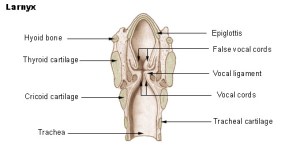
The sound of your voice is a distinct trait of each human being, created by your lungs, the length of your vocal cords, and your larnyx. Your lungs provide the air pressure to vibrate your vocal cords. The muscles of your larnyx adjust both the length and the tension of the cords to provide pitch and tone. Your voice is how you sound beyond the resonances that you hear when you speak. It is dependent on both the length and thickness of the vocal cords. Biology determines your pitch and tone. Your pitch is a result of the rate at which your vocal cords vibrate. The faster the rate, the higher your voice. Women tend to have shorter cords than men, which makes our voices higher.
Emotion also alters pitch. Fright, excitement, and nervousness all make your voice sound higher. Nerves would make a teenage girl have an even higher voice than she normally would. Her anxious adult self would too. Her voice would seem tinny because her larnyx clenched her vocal cords tight. Perhaps this is the only sound she can make. Perhaps she is trying to communicate with bats because they at least would attempt to listen.
Biology, the body, gives us the voices we have. Biology doesn’t care if we like the ways in which we sound. Biology might not care, but culture is the real asshole. Culture marks a voice as weak, grating, shrill, or hard to listen to.

“Speak” by Flickr user Megara Tegal, CC BY-NC-ND 2.0
My attempts to change my voice were always destined to fail. I fought against my body and lost. I couldn’t have won even if I tried harder. My vocal cords are determined that my voice would be high, so it is. The culture around me, however, taught me to hate myself for it. Voice and body seem to cast aspersions on intelligence or credentials. It’s the routineness of it all that wears on me. I expect the reactions now.
I wonder if I’m drawn to the quietness of writing because I don’t have to hear myself speak. I crave the silence while simultaneously bristling at it. Why is my voice a problem that I must resolve to placate others? How can I get others to hear me and not the stereotypes that have chased me for years?
Fury
My silence has become fruitful. The words I don’t say appear on the page of an essay, a post, or an article. I type them up. I read aloud what I first refused to say. I wince as I hear my voice reciting my words. I listen carefully to the cadence and tone. This separation of words and voice is why writing appeals to me. I can say what I want to say without the sound of my voice causing things to go awry.
People can read what I write, yet they can’t dismiss my voice by its sound. Instead, they read what I have to say. They imagine my voice; my actual sound can’t bother them. But, they aren’t really hearing me. They just have my words on the page. They don’t know how I wrap the sound around them. They don’t hear me.
Rebecca Solnit, in “Men Explain Things to Me,” writes “Credibility is a basic survival tool.” Solnit continues that to be credible is to be audible. We must be heard to for our credibility to be realized. This right to speak is crucial to Solnit. Too many women have been silenced. Too many men refuse to listen. To speak is essential “to survival, to dignity, and to liberty.”

“Listen” by Flickr user Emily Flores, CC BY-ND 2.0
I agree with her. I underline her words. I say them aloud. The more I engage with her argument, the more I worry. What about our right to be heard? When women speak, do people listen? Women can speak and speak and speak and never be heard. Our words dismissed because of gender and sound. Being able to speak is not enough, we need to be heard.
We get caught up in the power of speaking, but we forget that there’s power in listening too. Listening is political. It is act of compassion and empathy. When we listen, we make space for other people, their stories, their voices. We grant them room to be. We let them inhabit our world, and for a moment, we inhabit theirs. Yes, we need to be able to speak, but the world also needs to be ready to listen us.
We need to be listened to. Will you hear me? Will you hear us? Will you grant us room to be?
When I think of times I’ve been silenced and of the times I haven’t been heard, I feel the sharp pain of exclusion, of realizing that my personhood didn’t matter because of how I sounded. I remember the burning anger because no one would listen. I think of the way that silence and the policing of how I sound made me feel small, unimportant, or disposable. As a teenager, a college student, and a grown woman, I wanted to be heard, but couldn’t figure out exactly how to make that happen. I blamed my voice for a problem that wasn’t its fault. My voice wasn’t the problem at all; the problem was the failure of others to listen.
“listen” by Flickr user Jay Morrison, CC BY-NC-ND 2.0
Loss
While writing this essay on my voice, I almost lost mine, not once but twice. I caught a cold and then the flu. My throat ached, and I found it difficult to swallow. A stuffy nose gave my voice a muted quality, but then, it sounded lower and huskier. I could hear the congestion disrupting the timber of my words. My voice blipped in and out as I were radio finding and losing signal. It hurt to speak, so I was quiet.
“You sound awful,” my husband said in passing. He was right. My voice sounded unfamiliar and monstrous. I tested out this version of my voice. It was rougher and almost masculine. I can’t decide if this is the stronger, more authoritative voice I wanted all along or some crude mockery of what I can never really have. I couldn’t sing along with my favorite songs because my voice breaks at the higher register. I wheezed out words. I croaked my way through conversations. “Are you sick?” my daughter asked, “You don’t sound like you.”
Her passing comment stuck with me. You don’t sound like you. Suddenly, I missed the sound of my voice. I disliked this alien version of it. I craved that problematic voice that I’ve tried to change over the years. I wanted my voice to return.
After twenty years, I decided to acknowledge the sound of me, even if others don’t. I want to be heard, and I’m done trying to make anyone listen.
—
Featured image: “Speak” by Flickr user Ash Zing, CC BY-NC-ND 2.0
—
Kelly Baker is a freelance writer with a religious studies PhD who covers religion, higher education, gender, labor, motherhood, and popular culture. She’s also an essayist, historian, and reporter. You can find her writing at the Chronicle for Higher Education‘s Vitae project, Women in Higher Education, Killing the Buddha, and Sacred Matters. She’s also written for The Atlantic, Bearings, The Rumpus, The Manifest-Station, Religion Dispatches, Christian Century’s Then & Now, Washington Post, and Brain, Child. She’s on Twitter at @kelly_j_baker and at her website.
—
REWIND!…If you liked this post, you may also dig:
Vocal Gender and the Gendered Soundscape: At the Intersection of Gender Studies and Sound Studies — Christine Ehrick
On Sound and Pleasure: Meditations on the Human Voice– Yvon Bonefant
As Loud As I Want To Be: Gender, Loudness, and Respectability Politics — Liana Silva
Share this:




Current Top Posts





April 2021

January 2020

November 2019

October 2019

August 2019

April 2014

November 2017

March 2015

December 2017

October 2015


Recent Comments