
A Feast of Silence: Listening as Stoic Practice

In honor of International Podcast Day on 30 September, Sounding Out! brings you Pod-Tember (and Pod-Tober too, actually, now that we’re bi-weekly) a series of posts exploring different facets of the audio art of the podcast, which we have been putting into those earbuds since 2011. Enjoy! –JS
Zeno of Citium, the Hellenistic philosopher who founded the Stoic school at the turn of the third century BCE, once had this advice to give to a garrulous young man: “the reason why we have two ears and only one mouth is so that we might listen more and talk less.” The more we speak, Zeno was saying, the more self-absorbed and foolish we become; in learning to listen, we temper our own egos and attune ourselves to the truths of the world around us.
This piece of wisdom from a 2,300-year-old philosophy was a part of the marketer and best-selling author Ryan Holiday’s reflection on stillness and silence on the October 4 edition of his Daily Stoic podcast, a daily affirmational that brings listeners “a meditation inspired by the ancient Stoics illustrated with stories from history, current events, and literature to help you be better at what you do.” In citing Zeno, Holiday’s point was that while our highly mediated culture often rewards loudness, extroversion, and “hot takes,” we might do better to listen, and learn from others, rather than simply talk over them.
Over the past decade, Stoicism, which teaches that self-discipline, moderation, and emotional equanimity are key to overcoming hardship and living a good life, has had something of a revival as a self-help paradigm – and Holiday has been one of its most energetic evangelists. Articles in Vice, the New York Times, the Atlantic, the New Yorker, the Guardian, Forbes, Wired, and Sports Illustrated have all taken note of his influence among Silicon Valley tech workers, corporate executives, professional athletes, military personnel, and celebrities to whom he markets the philosophy as a “life-hack”; his six best-selling books on the subject, meanwhile, have positioned him as perhaps the most commercially successful author in a mushrooming genre of Stoic literature; and The Daily Stoic’s A-level guest list, which has included Malcom Gladwell, Camilla Cabello, Matthew McConaughey, and Charlamagne Tha God, has established Stoicism’s cultural cachet as a practical guide for living, and positioned Holiday as its authoritative interpreter.
Among the lessons Holiday draws from Stoicism, the practice of stillness (as his 2019 book puts it) is key: a way of quieting the mind, of “hear[ing] only what needs to be heard,” and really listening to the truth of the world in order to achieve the kind of tranquility (what the Greeks called apatheia) that will help us “think well, work well, and be well.”
With this emphasis on stillness, silence, and listening, it would seem quite appropriate that Holiday would turn to the aural medium of podcasting to proclaim the ancient wisdoms of Zeno, Cleanthes, Seneca, Epictetus, and Marcus Aurelius. Indeed, for the Stoics, listening was a foundational skill through which one cultivated the habits of discipline, self-control, and self-reflection that are the heart of the Stoic way of life (askesis); for it is in quieting ourselves and listening that we begin to open ourselves to the teachings of the masters and think about their application in our own lives.
And Holiday is hardly the only Stoic podcaster. As I write this, a simple search on Stitcher yields over 30 podcasts with “Stoicism” in their titles or descriptions, many of which have been updated in the past month (December, 2021), including the philosopher Massimo Pigliucci’s Stoic Meditations, Stoicism Discovery, Stoicism on Fire, The Sunday Stoic, The Stoic Handbook, The Walled Garden, Stoic Coffee Break, and Stoic Solutions.
Elsewhere, Stoicism has been promoted by self-improvement podcasters like the tech investor and lifestyle guru Tim Ferriss,and retired Navy SEAL and leadership coach Jocko Willink; and – perhaps unsurprisingly, given that the ancient Stoics were white men who emphasized values like rationality and self-mastery, which are typically coded as male – it has been advocated as a tactic for modern living by masculinity podcasters like Brett McKay and Ryan Michler.
Navigating this space can often feel like a small world (or, perhaps a promotional circuit): Holiday has been a guest on The Tim Ferriss Show, The Art of Manliness, and Order of Man, and has hosted Willink, McKay, and Ferriss on The Daily Stoic.
A full exploration of this network is outside my scope here. For now, I will consider the ways in which podcasting is particularly well-suited to Stoic askesis; and specifically, how the very act of listening – on our commutes, on long drives, at the gym, on hikes, and in moments of quiet meditation – constitutes what Michel Foucault (who himself drew upon Stoic texts in his later work on ethics) called a technology of the self: those techniques, “which permit individuals to effect by their own means or with the help of others a certain number of operations on their own bodies and souls, thoughts, conduct, and way of being, so as to transform themselves in order to attain a certain state of happiness, purity, wisdom, perfection, or immortality.”
Part of a larger project investigating the historical emergence of discourses of sex and sexuality in Western culture, Foucault in his later writings and lectures turned his attention away from the normative and disciplinary systems of subjectivation that had previously concerned him, and toward the study of ethical modalities by which individuals actively fashioned their own subjectivity. Focusing particularly on the ethical practices of the ancient world, he discovered a more autonomous framework for individual conduct, one that centered on self-imposed standards and daily habits rather than a prescribed moral code.
This precept of the “care of the self” (epimeleia heatou), Foucault maintained, could be traced from Alcibiades to the Imperial period, and had impelled individual Greeks and Romans (the free white men, at least) to embark upon their own stylized projects of self-transformation.
Among the practices that interested Foucault – and indeed, the one he understood to be essential to the “subjectivation of true discourse” – was the act of listening. In the first hour of his March 3, 1982 lecture at the Collège de France (published in English in The Hermeneutics of the Subject), for example, Foucault explained that listening is
the first move in as[k]esis … since listening, in a culture which you know was fundamentally oral, is what enables us to take in the logos, to take in what is said that is true. However, if conducted properly, listening also makes it possible for the individual to be convinced of the truth spoken to him, of the truth he encounters in the logos. And, finally, listening is the first moment of the process by which the truth which has been heard, listened to, and properly taken in, sinks into the subject so to speak, becomes embedded in him and begins to become suus (to become his own) and thus forms the matrix for ethos (p. 332).
This emphasis on listening, Foucault noted, is evident as far back as the Pythagoreans, who required initiates to spend five years in silence so as to be able to learn the community’s exercises, practices, and philosophical precepts. The themes of silence and listening were further developed in the culture dominated by Stoicism, Foucault noted, and emerged as a “new pedagogical game” that contrasted with the earlier dialogic model. Now, the master spoke, and the student listened.
But the nature of audition could be somewhat ambiguous for the ancients, Foucault explained, in that it was a passive (pathetikos) activity, yet it is the primary sense through which we receive the logos, the rational substance that the Stoics believed to govern the universe. In his treatise On Listening, for instance, Plutarch (46 CE – c. 116CE) wrote that it was imperative for young men cultivate the art of listening because they must learn to listen to the logos throughout adulthood, and so must learn to distinguish truth from the artifices of flattery or rhetoric. One must listen to the words of the master attentively, so that the logos might penetrate the soul. “The man who has the habit of listening with restraint and respect,” Plutarch wrote, “takes in and masters a useful discourse, and more readily sees through and detects a useless or false one, showing himself thus to be a lover of truth and not a lover of disputation” (On Listening, IV).
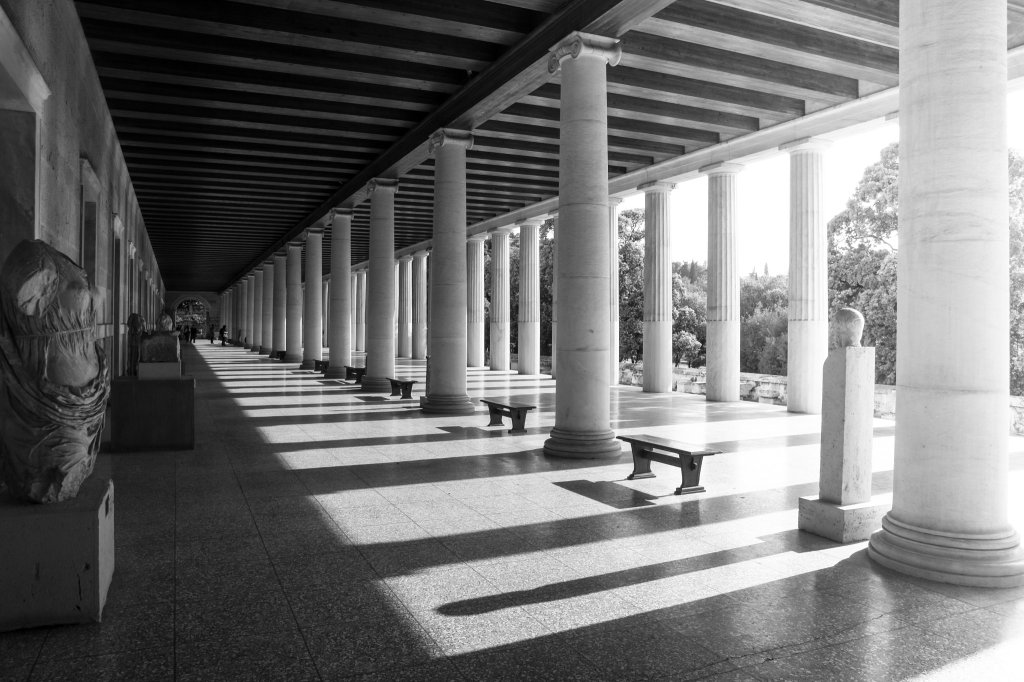
Perhaps the most striking of the texts Foucault discussed, however (see The Hermeneutics of the Subject, pp. 343-344), is Philo of Alexandria’s (20 BCE – c. 50 CE) description of the practices of the Therapeutae, a closed community of ascetics who renounced their earthly possessions in order to pursue “perfect happiness,” and the salvation of their soul (De Vita Contemplativa, §12). In his text, Philo takes specific note of the group’s elaborate banquet rituals, during which an elder comes to the fore and gives a discourse on philosophical doctrine or on sacred scripture (“teaching very slowly, lingering and emphasizing with repetitions, engraving the thoughts on the souls” [§76]). During these talks, the audience remained silent and motionless, adopting a precisely prescribed posture intended to fix their attention on the speaker, so that the discourse “does not stay on the tips of the ears, but comes through the hearing to the soul and there remains securely (§31).” In these feasts of silence, mastery of the body is the foundation of the care of the soul.
Though modern Stoic podcasting does not demand nearly this level of physical discipline of its listeners, we are nevertheless encouraged to incorporate podcasting into a daily ritual of silence and reflection – a new, digital feast of silence. As we listen through our headphones, in our cars, or in some other quiet personal space, we are joined in intimate connection with our hosts, who guide us in our contemplation of timeless Stoic wisdoms, engraving these thoughts in our minds so that we might have them ready at hand in order, as Holiday often says, to make them the principle of our actions.
It is this possibility of principled living that is perhaps at the heart of Stoicism’s twenty-first century appeal. As Elizabeth J. Peterson has written, in our age of seemingly perpetual crisis, Stoicism’s resurgence is undoubtedly due to its reputation as a practical guide for surviving difficult times. “Between President Trump, Brexit, the Middle East and the domestic issues in virtually every country,” she writes, “it’s not difficult to see why many people, across the world, need a source of clarity, calm, and fortitude.” (And that was before the pandemic, which occasioned a spate of articles explaining how Stoicism might help us endure a moment of profound uncertainty).
But the headlines aren’t the only source of our anxieties; we have plenty of it in our own lives. At a time of deepening economic precarity, in which we are routinely urged to become self-reliant, self-enterprising subjects in order to maximize our value in the marketplace, Stoicism offers a ready-made coping mechanism with a pedigree of centuries: at once a framework for cultivating emotional resilience, and a self-help paradigm for transforming ourselves into more disciplined, effective, and successful individuals.

When co-opted by late capitalist culture, when marketed as a “life-hack” and configured as an ethics of personal success, then, Stoic principles quite easily align with neoliberal imperatives that we endlessly labor on ourselves in order to better compete in an agonistic struggle for personal fulfillment and economic security. From this perspective, even the advice that we embrace stillness becomes a way of momentarily refreshing ourselves, only to return to work to “persevere” and “succeed.”
One of the most trenchant critiques of Stoicism is that by advising us not to concern ourselves with that which we cannot control (see Epictetus, The Discourses, 2.5.4-5), it is fundamentally a philosophy for living in the world as it exists, and not for challenging it (indeed, Stoicism’s popularity among the Roman elite indicates something of its congeniality with the established order). And while, as Sara Ahmed has written, “neoliberalism sweeps up too much when all forms of self-care become symptoms of neoliberalism,” it is nevertheless worth considering how an ostensibly self-directed ascetic practice is complicit in more hegemonic (neoliberal, patriarchal, and misogynistic) templates of subjectivity.
—
Featured Image: “Marcus Aurelius Headphone Stand!” by JM3is3D @Etsy. Image used for purposes of critique.
—
Andrew J. Salvati is an adjunct professor in the Media and Communications program at Drew University, where he teaches courses on podcasting and television studies. His research interests include media and cultural memory, television history, and mediated masculinity. He is the co-founder and occasional co-host of Inside the Box: The TV History Podcast, and Drew Archives in 10.
—

REWIND! . . .If you liked this post, you may also dig:
‘No Place Like Home’: Dissonance and Displacement in Gimlet Media’s Fiction Podcast “Homecoming”–-Miranda Wilson
SO! Podcast #78: Ethical Storytelling in Podcasting–Laura Garbes, Alex Hanesworth, Babette Thomas, Jennifer Lynn Stoever
SO! Podcast #79: Behind the Podcast: deconstructing scenes from AFRI0550, African American Health Activism – Nic John Ramos and Laura Garbes
Deep Listening as Philogynoir: Playlists, Black Girl Idiom, and Love–Shakira Holt
Share this:

“Vous Ecoutez La Voix du Peuple”: The Kreyol Language Pirate Radio Stations of Flatbush, Brooklyn

Radyo Ayisyen
Learning from other scholars’ work on Haitian radio was, and still is, one of the greatest pleasures in the process of writing Isles of Noise: Sonic Media in the Caribbean (UNC 2016). People living in or from Haiti widely acknowledged and almost took for granted radio’s outsized role in public and political life. Edwidge Danticat and Jonathan Demme also understood this and paid tribute in Claire of the Sea Light and The Agronomist respectively, but historians remained largely fixated, understandably, on pivotal moments in Haiti’s rich history. Radio is different. Not pivotal, but witnessing the pivotal. Less dramatic and more long lasting and adhering to the same format for days, years, decades. It speaks to people who wouldn’t read newspapers or books. It floods private and public space with the sounds of music, talking, ruling, dissenting, explaining, satirizing, creating, crying, testifying, lying. But it leaves few archival traces. This is why the work of the five scholars in this series is so important. They allow us to hear a little and honor the listeners who make the medium what it is.
To start the series, Ian Coss gave a finely tuned account of a “day in the life” of a radio station in Cap Haïtien that follows the programming rhythm of days and nights. Then, Jennifer Garcon recounted one of the pivotal points in the relationship—its near breakdown and ultimate survival—also a turning point for a 19-year-old Jean Claude Duvalier, newly proclaimed President for life. Last week, Laura Wagner, who listened to each recording Radio Haïti-Inter and its archive (now at Duke University) and wrote its archival descriptors, writes of the work itself, the emotional, financial and intellectual challenges involved, and the reason this archive is essential to anyone interested in Haiti, or radio, or racial justice.
We continue the series in Brooklyn this week, where amidst gentrification and millennials seeking upscale vegan quesadillas, the ‘culture of the transistor’ is alive and well. Pirate radio stations broadcasting music and news in Haitian Creole have loyal followings, mostly of an older generation for whom radio was the primary medium during their youth. Listening brings back memories of a prosperous 1940s and 50s Haiti that recent narratives centered on catastrophe tend to bury. David Goren, who has not just written about but also mapped Brooklyn’s pirate stations, reminds us that these aural communities connect past and present, and perhaps future as well.
Guest Editor– Alejandra Bronfman
Click here for the full series!
—-

‘A lot of these stations, especially the Haitian stations, they have such an extensive music library that a song will come on the radio and all of a sudden my mom is like, ‘Oh my God! Your grandma used to have this record and she played it every Saturday!’ says Joan Martinez, a young Haitian-American born in the US and a former program host on some of the unlicensed Kreyol language stations. “Now she’s transported back to being on the island, with the big radio that’s a piece of furniture in the living room. People are chatting, little drinks are flowing about, my grandmother milling about in a gorgeous dress. It’s kind of like that whole nostalgia era that unfortunately was probably lost because of the political turmoil in Haiti. So it’s harkening back to a good time, to a simpler time, a better time, a more carefree era.”
Every day, the skies of New York City fill up with unseen clouds of radio signals spreading over immigrant neighborhoods. These culturally charged clouds of radio energy burst with a flow of content that continually shifts and transforms, following the lifecycle and rhythm of the streets.
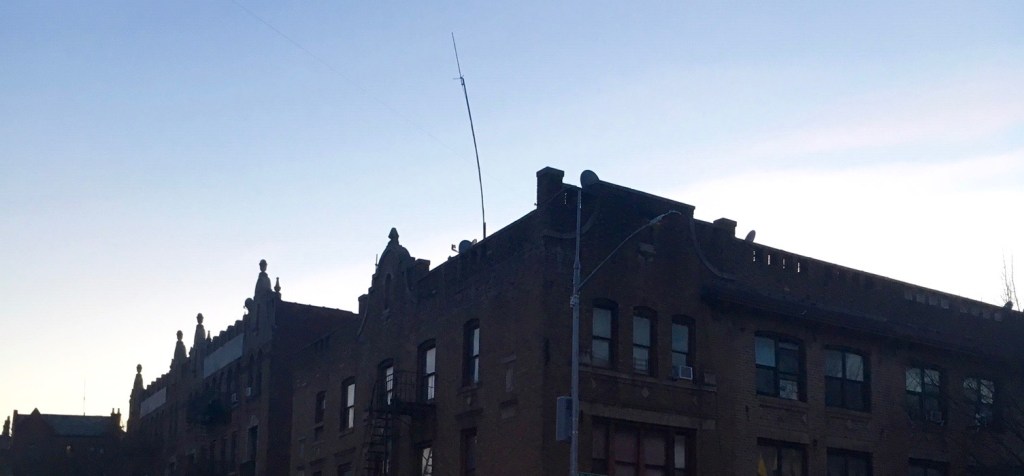
From clandestine studios tucked behind store fronts, DJs transform time and physical space with Konpa, Reggae and Soca music, mixing the sounds of ancestral homes with the thump and challenge of adapting to a new life in the United States. Jolted by electrified fingers of Signal, the old radio poetry of hiss and hum leaps from a scattered forest of antennas connected to transmitters hidden away inside rooftop sheds. In Brooklyn, the signals alight on Flatbush Avenue, blasting from radios in dollar vans, bakeries, churches and on street corners and kitchen tables. By accessing an analog technology that (outside of the radio itself) is essentially free for the listener, economically marginalized communities avoid the subscription and data fees built in to the conveniences of the digital life. Listeners, often the elders of the community, extend metal antennas and position the radios just so, trying to catch the elusive vibrations of crucial music, news and information that are seldom felt in New York City’s legal and mostly corporate owned media soundscape.
“These underground, unlicensed or pirate stations have been around for as long as there has been radio,” Martinez says. The legality of radio stations stems from The Communications Act of 1934, legislation that created the Federal Communications Commission (FCC), the agency tasked with penalizing unlicensed stations and shutting them down. “The focus really was on the listeners.” says Rosemary Harold, chief of FCC Enforcement ‘because what had happened before licensing became what we know as today, was that listeners weren’t able to consistently hear radio broadcasts. And now we’re kind of in a modern iteration of that.”
Others, like pirate radio historian John Anderson, see the Act as unfairly slanted towards commercial interests, awarding “the highest powers and clearest channels” to stations that sold advertising, tilting the medium away from serving specific communities. “By privileging commercial speech over non-commercial speech and by basically saying if you are a special interest, we will not award you a license.” Anderson says. “You create the conditions for there to be dissension over the media policy, which will lead people into radical actions, like putting stations on the air without permission.” In Flatbush, stations broadcast primarily to Haitians, Jamaicans, Trinidadians, Grenadians and Orthodox Jews. The Haitian stations are particularly active in East Flatbush with just under a dozen broadcasting daily in Kreyol to the large Haitian community.


“I came across it at a very young age. There was this really popular station back in the late 80s, Radio Guinee, and it was based in Brooklyn.” Joan Martinez says. “Nobody knows where it was, there are suspicions. But all I know is from Friday night all the way to Sunday night, you would just hear a series of these stations every weekend and it would be the place where you could listen to the latest in Haitian pop music, rap music. It was also the news, my parents and their friends would all sit around the radio and they would just be politicking in the living room getting really loud, you know, dancing, singing along that sort of thing. It was just like a meeting ground and the radio was guiding it.”
This phase of New York City pirate radio rose from the ashes of a previous scene dating to the late sixties: a dozen or so stations sporadically run mostly by white teenagers: a mix of hippies, radicals and electronically inclined misfits. By 1987, this loose collective of friends and rivals devolved into infighting after a short-lived attempt to broadcast from international waters off Jones Beach. This created room for new pirate radio voices from diverse communities that were increasingly being pushed off the legal airwaves by high costs, format consolidation, and “the low power desert”, an FCC-led phaseout of small community broadcasters. The local pirates joined a growing national wave of progressive pirate radio activity taking advantage of a new generation of cheap FM transmitters imported from China or homebrewed in makeshift workshops by free radio activists.
Image by Author
By the early 90’s, immigrant community-focused broadcasters In New York City flipped the unspoken rules of the earlier pirates who broadcast mainly late at night on a few pre-determined “safe” frequencies, instead filling the FM dial from bottom to top, day and night. In 2000, under pressure from a nationwide increase in pirate radio activity, the FCC introduced a new license class: Low Power FM (LPFM) but opposition from National Public Radio and the National Association of Broadcasters shut down the issuing of new licenses. That severely limited LPFM’s availability in major urban markets due to rules requiring LPFM’s to be “three click aways” from existing stations. Local pirates felt they had no alternative but to continue broadcasting and some stations in Flatbush have been on the air for decades. Despite the passage of the Local Community Radio Act in 2011, opening a new licensing window with relaxed spacing requirements, few new frequencies were available in NYC due to an already crowded dial. The continued pirate presence is enabled by a sort of safety in numbers, an FCC enforcement team hampered by a low budget and a bureaucratic process of enforcement.
Though the stations exist to serve their communities with news and culture and maybe make a little money for their owners and dj’s, they can and do cause interference for listeners of licensed stations, particularly low-powered non-commercial broadcasters like WFMU, a beloved freeform music station. Interference near their frequency has inspired the Brooklyn Pirate Watch Twitter group to keep a wary eye on pirate operations.

Interference aside, FCC commissioners and staff publicly fume at the pirates for a range of potential public safety violations, some more theoretical than others and claim they are somehow harming their own communities, and wonder finally, why don’t they just stream on the internet. By viewing radio piracy purely from a legal perspective, critics miss the cultural and historic forces driving the Haitian pirates. During the Duvalier dictatorship (1957-1986) Haitians had access to only two stations broadcasting in Kreyol, rather than French, the language of the elite. One was Radio Lumiere, a religious station and the other Radio Haiti-Inter, a fiercely independent voice whose director Jean Dominque was assassinated in 1999.
“The peasant in Haiti, while he’s working on his farm you know he had a transistor.” Says Dr. Jean Eddy St. Paul, Director of the Haitian Studies Institute at the City University of New York. ‘And many peasants, they don’t have money to buy tobacco to smoke, but they will have money to buy the battery to put in the transistor. The first generation of migration, in the US, was during the 1960s and for many of those people the culture of transistor was part of their everyday life, so they’re still maintaining the culture of transistor. For them, having a radio station is very important.’
In July 2019, on a side street in East Flatbush, I met a man calling himself “Joseph” aka “Haitian” (“because I’m a pure Haitian!”), part of a group that keeps Radio Comedy FM on the air. “There’s no owners and committee. It’s a bunch of young guys”. Joseph says, “We have to do something positive for our community. Right now the Marines are in Haiti and we don’t know what’s next! CNN don’t show you this! BBC don’t show you this! So what we do, we have people in Haiti that call us and tell us what’s going on and will send us pictures. This is how we get our information. And bring it to the people…. I have family over there, my mother’s still there. So I have to know what’s going on.
At this point in the digital age, it’s an open question how long these analog pirate stations will remain relevant, as their audiences age, neighborhoods gentrify and younger listeners gravitate to social media platforms. The answer seems to lie with their elderly and impoverished listeners. “They don’t have enough money to buy the newspapers understand?.” Joseph says.” For him that makes it worth it to keep Radio Comedy on the air despite a crackdown from the FCC backed by the PIRATE Act signed into law in 2020 that increases fines to $100,000 a day up to $2 million. But the legislation lacks funding to enforce the new regulations. With a federal statute still in place reducing fines down to the ability to pay, it’s unclear whether the PIRATE Act will be anything more than another in an escalating series of scare tactics.
“If they don’t want us to do it just make it easy for us. Let’s make a meeting with those guys [the FCC],” Joseph says. ‘We’re going to provide the air for you. A frequency. You’re going to pay for example, $500 a month even $1,000 a month.’ We will be more than happy to do it. “
Though the FCC has recently suggested the possibility of a new round of LPFM licenses in the future, the already crowded nature of NYC’s FM band makes it unlikely that new frequencies will be made available to the current pirate stations. In addition the FCC doesn’t want to be seen as rewarding illegal activity by granting a license to former pirate broadcasters, which was a prohibition in LPFM’s earlier licensing periods. And for the moment, Joseph, who’s been running unlicensed stations since 1991 (‘it’s an addiction’) is equally unlikely to cede the airwaves. He sees Radio Comedy as not just a radio station, but a community lifeline.
“You know many children we save? There was a bunch of guys…Jamaican, Trinidadian, Haitian trying to form a gang. We talked to them, bring them to the station. Most of them have a diploma now. Without the radio, most of them probably get locked up or dead.”
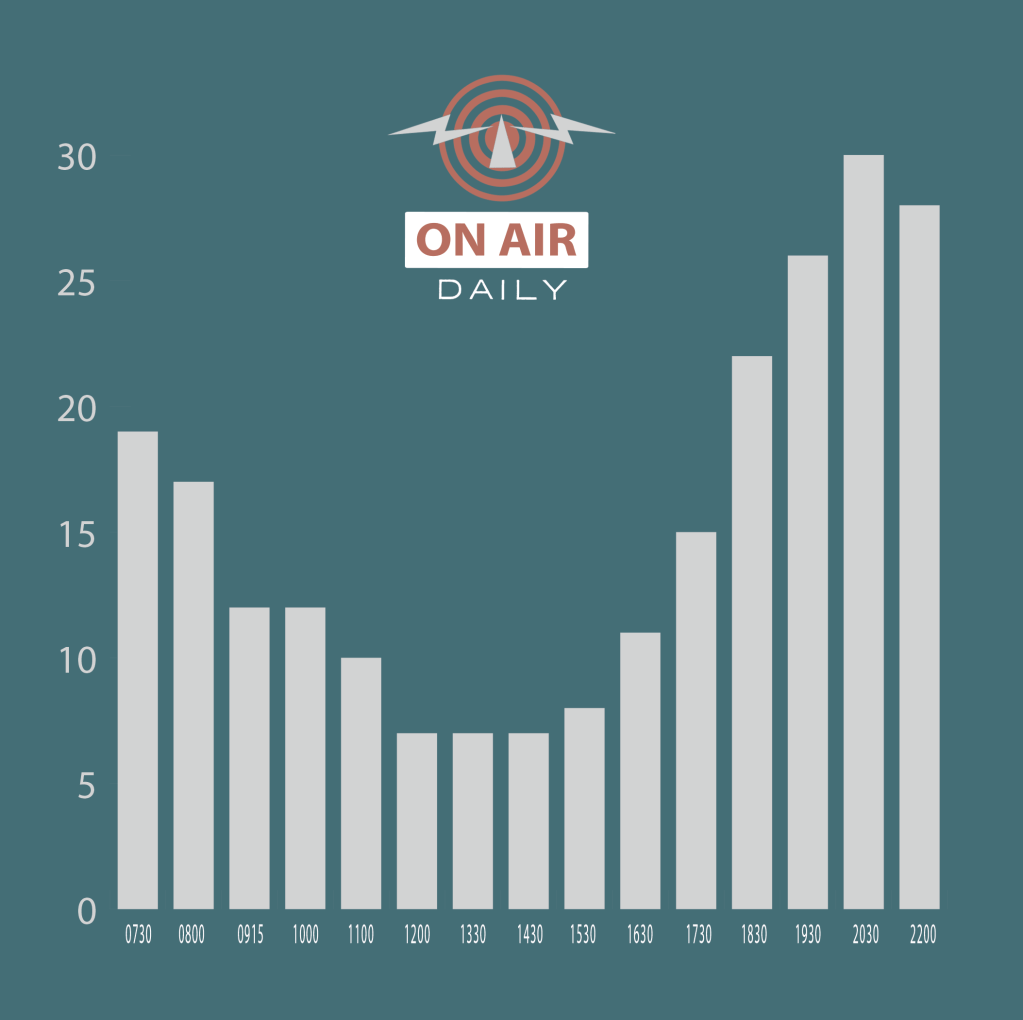
Even with the PIRATE act on the books, the number of stations on the air in Brooklyn has remained steady with an average of about 25 per day and the advent of the Coronavirus pandemic has only sharpened their mission. In March 2020 as the spread of Covid-19 lead to NYC’s lockdown, the unlicensed Haitian broadcasters and the other West Indian stations in Brooklyn took a step closer to their listeners, increasing their air time and enhancing their formats to deliver information about the virus both in New York and in their countries of origin amid the heavy toll it took on the community.
Click here to hear Station IDs for Radio Lumiere, Radio Independans, and La Voix du Peuple!
—
Featured Image: Antenna in Flatbush, courtesy of David Goren
—
An award-winning radio producer, David Goren has created programming for the BBC, Jazz at Lincoln Center Radio, the Wall Street Journal Magazine, and NPR’s “Lost and Found Sound” series, as well as audio-based installations for Proteus Gowanus Radio Cona and the Ethnographic Terminalia Collective. In 2016, he was an artist-in residence at Wave Farm, a center for the transmission arts.
Since 2014, David has been recording New York City’s prodigious pirate radio activity and researching the evolution of this grassroots community radio movement resulting in the release of “Outlaws of the Airwaves: The Rise of Pirate Radio Station WBAD” (2018) for KCRW’s “Lost Notes” podcast, New York City’s Pirates of the Air for the BBC World Service (2019) and the “Brooklyn Pirate Radio Sound Map 2.0” (2020) which was featured in The New Yorker. He presented “Tracing Neighborhoods in the Sky,” as part of the Fall 2019 Franke Lectures at Yale University. In January 2021, the Brooklyn Pirate Radio Sound Map became a partner of the Library of Congress’ Radio Preservation Task Force.
—

REWIND! . . .If you liked this post, you may also dig:
Archivism and Activism: Radio Haiti and the Accountability of Educational Institutions–Laura Wagner
Listen to yourself!: Spotify, Ancestry DNA, and the Fortunes of Race Science in the Twenty-First Century–Alexander Cowen
SO! Amplifies: Marginalized Sound—Radio for All–J Diaz
Share this:


Current Top Posts





April 2021

January 2020

November 2019

October 2019

August 2019

April 2014

November 2017

March 2015

December 2017

October 2015
 Sounding Out!
Recent Comments