
“Vous Ecoutez La Voix du Peuple”: The Kreyol Language Pirate Radio Stations of Flatbush, Brooklyn

Radyo Ayisyen
Learning from other scholars’ work on Haitian radio was, and still is, one of the greatest pleasures in the process of writing Isles of Noise: Sonic Media in the Caribbean (UNC 2016). People living in or from Haiti widely acknowledged and almost took for granted radio’s outsized role in public and political life. Edwidge Danticat and Jonathan Demme also understood this and paid tribute in Claire of the Sea Light and The Agronomist respectively, but historians remained largely fixated, understandably, on pivotal moments in Haiti’s rich history. Radio is different. Not pivotal, but witnessing the pivotal. Less dramatic and more long lasting and adhering to the same format for days, years, decades. It speaks to people who wouldn’t read newspapers or books. It floods private and public space with the sounds of music, talking, ruling, dissenting, explaining, satirizing, creating, crying, testifying, lying. But it leaves few archival traces. This is why the work of the five scholars in this series is so important. They allow us to hear a little and honor the listeners who make the medium what it is.
To start the series, Ian Coss gave a finely tuned account of a “day in the life” of a radio station in Cap Haïtien that follows the programming rhythm of days and nights. Then, Jennifer Garcon recounted one of the pivotal points in the relationship—its near breakdown and ultimate survival—also a turning point for a 19-year-old Jean Claude Duvalier, newly proclaimed President for life. Last week, Laura Wagner, who listened to each recording Radio Haïti-Inter and its archive (now at Duke University) and wrote its archival descriptors, writes of the work itself, the emotional, financial and intellectual challenges involved, and the reason this archive is essential to anyone interested in Haiti, or radio, or racial justice.
We continue the series in Brooklyn this week, where amidst gentrification and millennials seeking upscale vegan quesadillas, the ‘culture of the transistor’ is alive and well. Pirate radio stations broadcasting music and news in Haitian Creole have loyal followings, mostly of an older generation for whom radio was the primary medium during their youth. Listening brings back memories of a prosperous 1940s and 50s Haiti that recent narratives centered on catastrophe tend to bury. David Goren, who has not just written about but also mapped Brooklyn’s pirate stations, reminds us that these aural communities connect past and present, and perhaps future as well.
Guest Editor– Alejandra Bronfman
Click here for the full series!
—-

‘A lot of these stations, especially the Haitian stations, they have such an extensive music library that a song will come on the radio and all of a sudden my mom is like, ‘Oh my God! Your grandma used to have this record and she played it every Saturday!’ says Joan Martinez, a young Haitian-American born in the US and a former program host on some of the unlicensed Kreyol language stations. “Now she’s transported back to being on the island, with the big radio that’s a piece of furniture in the living room. People are chatting, little drinks are flowing about, my grandmother milling about in a gorgeous dress. It’s kind of like that whole nostalgia era that unfortunately was probably lost because of the political turmoil in Haiti. So it’s harkening back to a good time, to a simpler time, a better time, a more carefree era.”
Every day, the skies of New York City fill up with unseen clouds of radio signals spreading over immigrant neighborhoods. These culturally charged clouds of radio energy burst with a flow of content that continually shifts and transforms, following the lifecycle and rhythm of the streets.
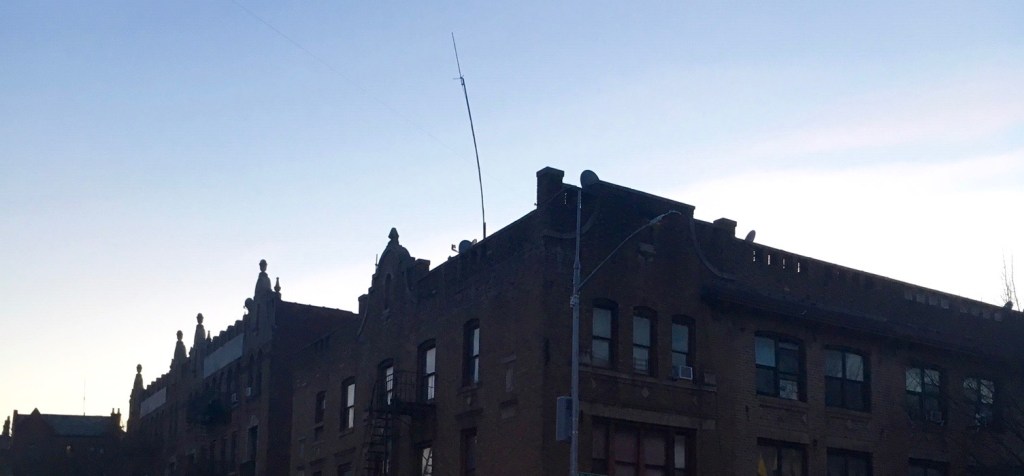
From clandestine studios tucked behind store fronts, DJs transform time and physical space with Konpa, Reggae and Soca music, mixing the sounds of ancestral homes with the thump and challenge of adapting to a new life in the United States. Jolted by electrified fingers of Signal, the old radio poetry of hiss and hum leaps from a scattered forest of antennas connected to transmitters hidden away inside rooftop sheds. In Brooklyn, the signals alight on Flatbush Avenue, blasting from radios in dollar vans, bakeries, churches and on street corners and kitchen tables. By accessing an analog technology that (outside of the radio itself) is essentially free for the listener, economically marginalized communities avoid the subscription and data fees built in to the conveniences of the digital life. Listeners, often the elders of the community, extend metal antennas and position the radios just so, trying to catch the elusive vibrations of crucial music, news and information that are seldom felt in New York City’s legal and mostly corporate owned media soundscape.
“These underground, unlicensed or pirate stations have been around for as long as there has been radio,” Martinez says. The legality of radio stations stems from The Communications Act of 1934, legislation that created the Federal Communications Commission (FCC), the agency tasked with penalizing unlicensed stations and shutting them down. “The focus really was on the listeners.” says Rosemary Harold, chief of FCC Enforcement ‘because what had happened before licensing became what we know as today, was that listeners weren’t able to consistently hear radio broadcasts. And now we’re kind of in a modern iteration of that.”
Others, like pirate radio historian John Anderson, see the Act as unfairly slanted towards commercial interests, awarding “the highest powers and clearest channels” to stations that sold advertising, tilting the medium away from serving specific communities. “By privileging commercial speech over non-commercial speech and by basically saying if you are a special interest, we will not award you a license.” Anderson says. “You create the conditions for there to be dissension over the media policy, which will lead people into radical actions, like putting stations on the air without permission.” In Flatbush, stations broadcast primarily to Haitians, Jamaicans, Trinidadians, Grenadians and Orthodox Jews. The Haitian stations are particularly active in East Flatbush with just under a dozen broadcasting daily in Kreyol to the large Haitian community.


“I came across it at a very young age. There was this really popular station back in the late 80s, Radio Guinee, and it was based in Brooklyn.” Joan Martinez says. “Nobody knows where it was, there are suspicions. But all I know is from Friday night all the way to Sunday night, you would just hear a series of these stations every weekend and it would be the place where you could listen to the latest in Haitian pop music, rap music. It was also the news, my parents and their friends would all sit around the radio and they would just be politicking in the living room getting really loud, you know, dancing, singing along that sort of thing. It was just like a meeting ground and the radio was guiding it.”
This phase of New York City pirate radio rose from the ashes of a previous scene dating to the late sixties: a dozen or so stations sporadically run mostly by white teenagers: a mix of hippies, radicals and electronically inclined misfits. By 1987, this loose collective of friends and rivals devolved into infighting after a short-lived attempt to broadcast from international waters off Jones Beach. This created room for new pirate radio voices from diverse communities that were increasingly being pushed off the legal airwaves by high costs, format consolidation, and “the low power desert”, an FCC-led phaseout of small community broadcasters. The local pirates joined a growing national wave of progressive pirate radio activity taking advantage of a new generation of cheap FM transmitters imported from China or homebrewed in makeshift workshops by free radio activists.
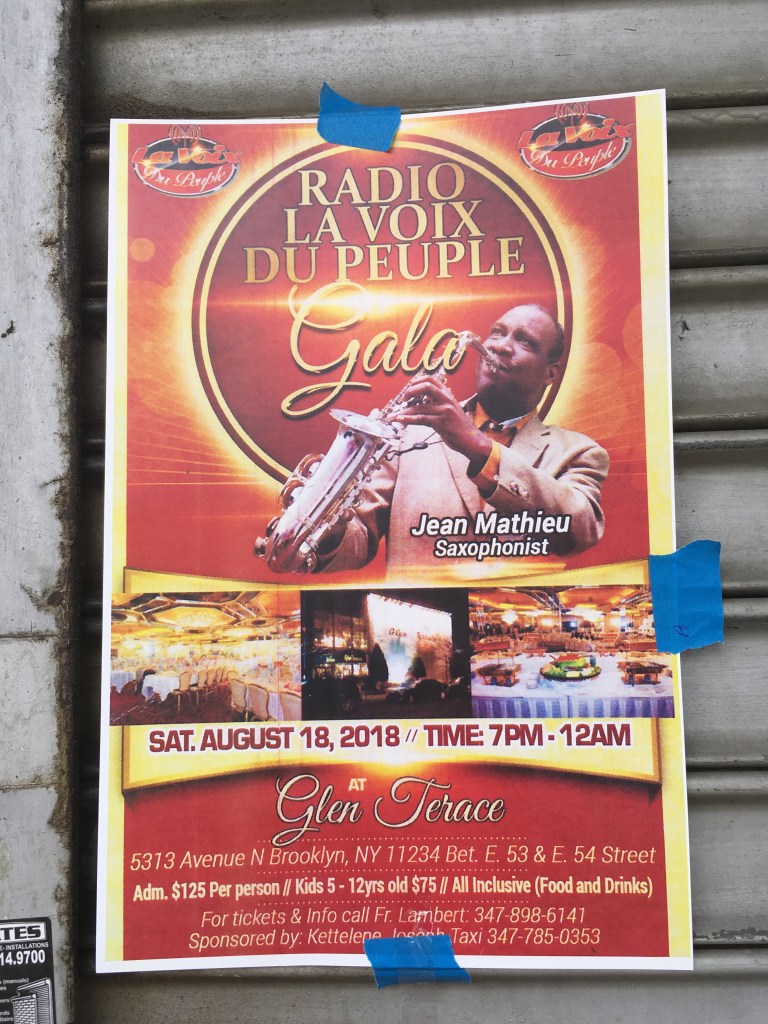
Image by Author
By the early 90’s, immigrant community-focused broadcasters In New York City flipped the unspoken rules of the earlier pirates who broadcast mainly late at night on a few pre-determined “safe” frequencies, instead filling the FM dial from bottom to top, day and night. In 2000, under pressure from a nationwide increase in pirate radio activity, the FCC introduced a new license class: Low Power FM (LPFM) but opposition from National Public Radio and the National Association of Broadcasters shut down the issuing of new licenses. That severely limited LPFM’s availability in major urban markets due to rules requiring LPFM’s to be “three click aways” from existing stations. Local pirates felt they had no alternative but to continue broadcasting and some stations in Flatbush have been on the air for decades. Despite the passage of the Local Community Radio Act in 2011, opening a new licensing window with relaxed spacing requirements, few new frequencies were available in NYC due to an already crowded dial. The continued pirate presence is enabled by a sort of safety in numbers, an FCC enforcement team hampered by a low budget and a bureaucratic process of enforcement.
Though the stations exist to serve their communities with news and culture and maybe make a little money for their owners and dj’s, they can and do cause interference for listeners of licensed stations, particularly low-powered non-commercial broadcasters like WFMU, a beloved freeform music station. Interference near their frequency has inspired the Brooklyn Pirate Watch Twitter group to keep a wary eye on pirate operations.

Interference aside, FCC commissioners and staff publicly fume at the pirates for a range of potential public safety violations, some more theoretical than others and claim they are somehow harming their own communities, and wonder finally, why don’t they just stream on the internet. By viewing radio piracy purely from a legal perspective, critics miss the cultural and historic forces driving the Haitian pirates. During the Duvalier dictatorship (1957-1986) Haitians had access to only two stations broadcasting in Kreyol, rather than French, the language of the elite. One was Radio Lumiere, a religious station and the other Radio Haiti-Inter, a fiercely independent voice whose director Jean Dominque was assassinated in 1999.
“The peasant in Haiti, while he’s working on his farm you know he had a transistor.” Says Dr. Jean Eddy St. Paul, Director of the Haitian Studies Institute at the City University of New York. ‘And many peasants, they don’t have money to buy tobacco to smoke, but they will have money to buy the battery to put in the transistor. The first generation of migration, in the US, was during the 1960s and for many of those people the culture of transistor was part of their everyday life, so they’re still maintaining the culture of transistor. For them, having a radio station is very important.’
In July 2019, on a side street in East Flatbush, I met a man calling himself “Joseph” aka “Haitian” (“because I’m a pure Haitian!”), part of a group that keeps Radio Comedy FM on the air. “There’s no owners and committee. It’s a bunch of young guys”. Joseph says, “We have to do something positive for our community. Right now the Marines are in Haiti and we don’t know what’s next! CNN don’t show you this! BBC don’t show you this! So what we do, we have people in Haiti that call us and tell us what’s going on and will send us pictures. This is how we get our information. And bring it to the people…. I have family over there, my mother’s still there. So I have to know what’s going on.
At this point in the digital age, it’s an open question how long these analog pirate stations will remain relevant, as their audiences age, neighborhoods gentrify and younger listeners gravitate to social media platforms. The answer seems to lie with their elderly and impoverished listeners. “They don’t have enough money to buy the newspapers understand?.” Joseph says.” For him that makes it worth it to keep Radio Comedy on the air despite a crackdown from the FCC backed by the PIRATE Act signed into law in 2020 that increases fines to $100,000 a day up to $2 million. But the legislation lacks funding to enforce the new regulations. With a federal statute still in place reducing fines down to the ability to pay, it’s unclear whether the PIRATE Act will be anything more than another in an escalating series of scare tactics.
“If they don’t want us to do it just make it easy for us. Let’s make a meeting with those guys [the FCC],” Joseph says. ‘We’re going to provide the air for you. A frequency. You’re going to pay for example, $500 a month even $1,000 a month.’ We will be more than happy to do it. “

Though the FCC has recently suggested the possibility of a new round of LPFM licenses in the future, the already crowded nature of NYC’s FM band makes it unlikely that new frequencies will be made available to the current pirate stations. In addition the FCC doesn’t want to be seen as rewarding illegal activity by granting a license to former pirate broadcasters, which was a prohibition in LPFM’s earlier licensing periods. And for the moment, Joseph, who’s been running unlicensed stations since 1991 (‘it’s an addiction’) is equally unlikely to cede the airwaves. He sees Radio Comedy as not just a radio station, but a community lifeline.
“You know many children we save? There was a bunch of guys…Jamaican, Trinidadian, Haitian trying to form a gang. We talked to them, bring them to the station. Most of them have a diploma now. Without the radio, most of them probably get locked up or dead.”
Even with the PIRATE act on the books, the number of stations on the air in Brooklyn has remained steady with an average of about 25 per day and the advent of the Coronavirus pandemic has only sharpened their mission. In March 2020 as the spread of Covid-19 lead to NYC’s lockdown, the unlicensed Haitian broadcasters and the other West Indian stations in Brooklyn took a step closer to their listeners, increasing their air time and enhancing their formats to deliver information about the virus both in New York and in their countries of origin amid the heavy toll it took on the community.
Click here to hear Station IDs for Radio Lumiere, Radio Independans, and La Voix du Peuple!
—
Featured Image: Antenna in Flatbush, courtesy of David Goren
—
An award-winning radio producer, David Goren has created programming for the BBC, Jazz at Lincoln Center Radio, the Wall Street Journal Magazine, and NPR’s “Lost and Found Sound” series, as well as audio-based installations for Proteus Gowanus Radio Cona and the Ethnographic Terminalia Collective. In 2016, he was an artist-in residence at Wave Farm, a center for the transmission arts.
Since 2014, David has been recording New York City’s prodigious pirate radio activity and researching the evolution of this grassroots community radio movement resulting in the release of “Outlaws of the Airwaves: The Rise of Pirate Radio Station WBAD” (2018) for KCRW’s “Lost Notes” podcast, New York City’s Pirates of the Air for the BBC World Service (2019) and the “Brooklyn Pirate Radio Sound Map 2.0” (2020) which was featured in The New Yorker. He presented “Tracing Neighborhoods in the Sky,” as part of the Fall 2019 Franke Lectures at Yale University. In January 2021, the Brooklyn Pirate Radio Sound Map became a partner of the Library of Congress’ Radio Preservation Task Force.
—

REWIND! . . .If you liked this post, you may also dig:
Archivism and Activism: Radio Haiti and the Accountability of Educational Institutions–Laura Wagner
Listen to yourself!: Spotify, Ancestry DNA, and the Fortunes of Race Science in the Twenty-First Century–Alexander Cowen
SO! Amplifies: Marginalized Sound—Radio for All–J Diaz
Share this:

Broadcast Kidnapping: How the Rise of the Radio led to the Fall of Jean-Claude Duvalier
Radyo Ayisyen
Learning from other scholars’ work on Haitian radio was, and still is, one of the greatest pleasures in the process of writing Isles of Noise: Sonic Media in the Caribbean (UNC 2016). People living in or from Haiti widely acknowledged and almost took for granted radio’s outsized role in public and political life. Edwidge Danticat and Jonathan Demme also understood this and paid tribute in Claire of the Sea Light and The Agronomist respectively, but historians remained largely fixated, understandably, on pivotal moments in Haiti’s rich history. Radio is different. Not pivotal, but witnessing the pivotal. Less dramatic and more long lasting and adhering to the same format for days, years, decades. It speaks to people who wouldn’t read newspapers or books. It floods private and public space with the sounds of music, talking, ruling, dissenting, explaining, satirizing, creating, crying, testifying, lying. But it leaves few archival traces. This is why the work of the five scholars in this series is so important. They allow us to hear a little and honor the listeners who make the medium what it is.
Last week, Ian Coss gave a finely tuned account of a “day in the life” of a radio station in Cap Haïtien that follows the programming rhythm of days and nights. This week, Jennifer Garcon shows how the long marriage between Haitian politics and Haitian radio has endured, despite multiple and conflicting alliances, high drama, and attacks from all sides. The powerful and the powerless have even in their enmity presumed that if they could harness radio’s power they would ascend to political power. Her story recounts one of the pivotal points in the relationship—its near breakdown and ultimate survival—also a turning point for a 19-year-old Jean Claude Duvalier, newly proclaimed President for life. Guest Editor– Alejandra Bronfman
Click here for the full series!
—-
On January 23, 1973, Jean-Claude Duvalier, only 18 months into his life-long appointment, received a call that threatened to profoundly destabilize his nascent presidency. On the other end was Clinton E. Knox, a close political ally and advisor, who also happened to be the US Ambassador to Haiti. Knox, Jean-Claude was informed, along with US consul general Ward Christensen were being held hostage at a residence just outside of Port-au-Prince. To secure the safe return of two high-ranking US officials, the captors demanded the release of political prisoners, a hefty ransom, and a plane to facilitate their escape. The kidnappers “meant business,” reported The Washington Post, Times Herald on Jan 26, 1973, and during the call, Knox warned Jean-Claude of the severity of the situation, that they ”threatened to blow my head off, if they didn’t get what they wanted.”

Just hours before, Knox, boasting of Haiti’s improved political situation, told a Miami Herald reporter that, “everything [was] calm.” Since Francois Duvalier’s death in 1971, the new president had been aggressively courting international aid. In a marked departure from his father’s political rhetoric, Jean-Claude openly declared his intention to lessen authoritarian conditions in Haiti. He called for the organization of new political parties and the reestablishment of a “freer” press. Thanks to Knox, millions in international and humanitarian aid–previously suspended because of Francois’s long history of human rights abuses– began pouring into the country. In truth, Jean-Claude never intended to fully democratize Haitian society, he instead hoped that a few small concessions would help him to secure the benefits of appearing to do so. But soon, his new “liberal policies” allowed for the public expression of widespread discontent and opposition that had long festered just beneath the surface.
Since Francois Duvalier’s 1957 election, Haiti’s government had systematically and strategically cut off avenues of civic participation in political life. During his 14-year rule, Francois co-opted any existing institutions that could oppose his consolidation of power, including the church, the army, and the press. This was a stark contrast to the political campaign season that led to his election, wherein aspiring political figures frequently made impassioned radio speeches in the hopes of courting new supporters. Over the airwaves, presidential hopeful Daniel Fignole sometimes summoned his woulo konmpresè, a popular force of over 10,000 supporters to the street in protest. Duvalier shaped his Noirist ideology in part via public discourse over the airwaves. However, after taking power, he closed off these avenues of political engagement. By limiting the flow of information, the regime fostered social alienation and mistrust amongst different sectors of the population.
The vibrant political debates that characterized the 1940s and 1950s Haitian media were replaced with round-the-clock pro-government propaganda. Nearly all independent radio stations and newspapers were shuttered, leaving only pro-Duvalier stations, like La Voix de la Révolution Duvalieriste, and papers like newspapers Le Nouveau Monde and Panorama. When, in 1971, a gravely ill Francois announced the transfer of the presidency to his politically inexperienced 19-year-old son, Jean-Claude, there were no national outlets for citizens to register their resistance. However, many anticipated that the death of Papa Doc would create a political vacuum too large for his son to fill. This possibility inspired new anti-government efforts.

At 4 pm on January 23, as he was leaving his office in Port-au-Prince, Ambassador Knox was accosted and forced into an unmarked sedan. He was driven to his home just outside the city. The kidnappers, brandishing a small arsenal, demanded an audience with the young president. Instead, and in a breach of protocol, Knox contacted the consul general and lured him to the residence, where he too was taken hostage. Two hours later, Jean-Claude Duvalier received the distressing call.
The young president found himself in a dire situation, given his long-regarded political disinterest. Both critics and supporters of the Duvalier regime believed he would be too weak and ineffectual to hold power. Up until then, Duvalier’s reliance on loyal old guard Duvalierists and his close relationship with Knox had sustained his presidency. Encouraged by the prospect of millions in international aid, Jean-Claude began distancing himself from the violence of his father’s regime. Jean-Claudisme would tolerate criticism, promote free speech, embrace dissent and welcome repatriating exiles. As Knox frequently argued, Jean-Claude had “embarked on a course diametrically opposed to the one [Francois Duvalier] pursued.”
The 1973 kidnapping would be the first public reckoning for the new regime; the first open challenge to Jean-Claude’s political legitimacy. The kidnappers, anti-government leftists, demanded the immediate release of 31 political prisoners, safe passage out of the country, and $100,000 ransom. A final demand would not materialize until the early morning on January 24. After hours of negotiations with Duvalier’s administration, the kidnappers tacked on one last demand; that the details of the kidnappers be shared with Haitian citizens via a national radio broadcast. In defiance of the advice of his father’s most trusted advisers, and to save Knox’s life, Jean-Claude acquiesced.
At approximately 10am on January 24, French Ambassador Bernard Dorin interrupted existing radio programming with a special announcement: Ambassador Clinton Knox had been kidnapped and held captive by three anti-government rebels. To secure his release the Haitian government had agreed to release 12 political prisoners, pay $70,000 US dollars in ransom, and charter an aircraft to transport the kidnappers and released prisoners to exile in Mexico.
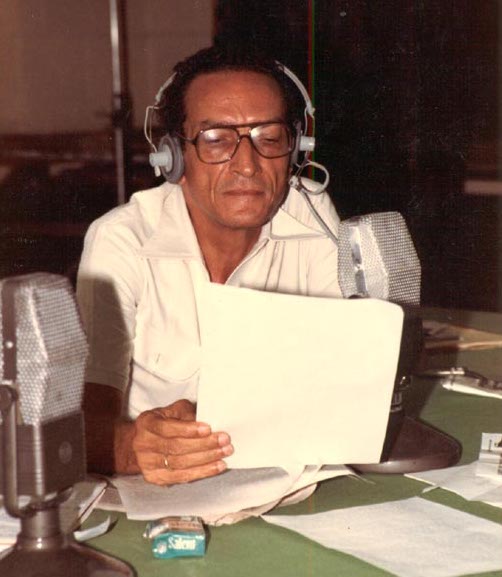
By conceding, Jean-Claude acted outside of the existing political framework set in place by his father. The Haitian public had come to expect consistency in political culture; any and all opposition was to be immediately crushed. That morning the airwaves carried the news of the dictatorship’s fragility to listeners far and wide. On the heels of the unprecedented announcement, Radio Haïti-Inter began reporting on the kidnapping developments to audiences around the nation. When Jean L. Dominique, a former agronomist, went on-air, it was the first time since 1957 that domestic news was transmitted without censorship. Listeners were now given unfettered access. Dominique and co-anchor Marcus Garcia were the first reporters to arrive at the Knox’s residence, while he, Ward, and the kidnappers were still inside. Radio Haiti journalists described the surreal scene in detail, and conducted interviews with newly released political prisoners. When Knox finally emerged, listeners were privy to his fragile state, he appeared intoxicated and was clutching a bottle of rum; a stark contrast to his strongman image. When the kidnappers safely boarded an Air-Haiti plane bound for Mexico City, where they were promised (and granted) asylum, Dominique reported from the runway. For the listening public, the scene was simply remarkable.
The broadcast would undoubtedly be the most politically consequential of the kidnappers’ demands. It would mean that, for the first time of Jean-Claude’s young presidency, and for the first time in decades, news of the dictatorship’s fragility and fallibility would reach the entire Haitian populace. Almost immediately, one journalist noted a change in the country, noting in “Haiti: Trouble Ahead in Latin America in February 1973 that, when Jean-Claude conceded to the kidnapper’s demands, “Haitians finally realized that Papa Doc was gone forever” (Special Collection and University Archives, Rutgers University, Robert J. Alexander Papers, [MC974.1 Box 3]).
Citizens awoke to find themselves now living in a Haiti where anti-government resistance could succeed. In Isle of Noise: Sonic Media in the Caribbean, Alejandra Bronfman argues that, “as listeners understood themselves to be listening along with others,” new possibilities for social and political life were revealed. For Haitian citizens living under the yoke of an authoritarian government, radio listening became a way to engage in politics and reclaim political agency in defiance of government overreach and repression. Widely accessible radio receivers could bridge areas otherwise geographically disconnected from urban, and often political, centers. Moreover, uncensored kidnapping coverage transformed Haiti’s political arena by radically changing popular ideas of what kinds of resistance were possible.

In the aftermath of the kidnapping, Jean-Claude moved quickly to plug the political vacuum that has emerged in the wake of the kidnapping. He was determined to change popular memory of the event. Haitian newspapers began to praise Duvalier’s political acumen in saving the life of two US officials. A mass rally was organized two days later to celebrate the President’s achievement. There, Jean-Claude gave his first ever public speech entirely in Haitian Kreyòl. “Little Duvalier,” he said, “would never hesitate to crush two or three vagabonds if he wanted to.” Addressing any would-be imitators, he warned, “I will be waiting for them with a big coco macaque.”
As the government tried to hold onto power, new journalists and broadcasters were increasingly singled out by the administration. In 1980, a press crackdown led to the arrest of over 100 independent print and radio journalists. Despite government repression, radio broadcasting has been credited with the eventual ouster of Jean-Claude in 1986. The Knox Kidnapping was an early moment that signaled the possibility of a political alternative to Duvalierism. Even Knox agreed. Years later, he’d describe the ordeal as “one the most amazing things to happen in [Haiti] [“Envoy Relates Haitian Rebel Death Threats.” The Washington Post, Times Herald, Jan 26, 1973].
—
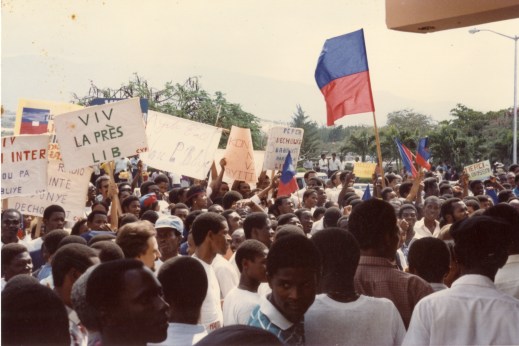
Featured Image: Jean Dominique and Michèle Montas return to Haiti in from exile in 1986 after the fall of Jean-Claude Duvalier, met by 60,000 plus people. Radio Haiti Collection, David M. Rubenstein Rare Book & Manuscript Library, Duke University CC BY-NC-SA 4.0
—
Jennifer Garcon is the Digital Scholarship Librarian at the University of Pennsylvania Libraries’ Center for Research Data and Digital Scholarship. Garcon instructs on the use of digital tools, methods, and literacies via tutorials and one-on-one consultations and provides project management and infrastructural support that helps faculty, students, and staff build innovative and sustainable digital projects. She collaborates closely with Penn and Philadelphia-area partners to develop and expand sustainable models for the care of vulnerable collections of data. Garcon received her Ph.D. in History from the University of Miami, an MA in English and American Literatures from Hunter College, a BA in English Literature and Cultures from Brown University. Her academic research interests include radio broadcasting, populist political rhetoric, and grassroots social movement in the Cold War Caribbean. Since 2016, she’s been a research associate with the Library of Congress’s Radio Preservation Task Force.
—
REWIND! . . .If you liked this post, you may also dig:
Radio de Acción: Violent Circuits, Contentious Voices: Caribbean Radio Histories–Alejandra Bronfman
Kawa: Rediscovering Indigeneity in China via Reggae–Junting Huang
SO! Reads: Tsitsi Jaji’s Africa in Stereo: Modernism, Music, and Pan-African Solidarity–Celeste Day Moore
Share this:


Current Top Posts





April 2021

January 2020

November 2019

October 2019

August 2019

April 2014

November 2017

March 2015

December 2017

October 2015
 Sounding Out!
Recent Comments