
“Welles,” Belles, and Fred Allen’s Sonic Pranks: Making a Radio Auteur Laugh at Himself
DOI: https://doi.org/10.59350/zxgkz-kr310

Welcome back to From Mercury to Mars, our series of posts (in conjunction with Antenna) that reflect on Orson Welles’s radio career, and the upcoming anniversary of its highlight, “The War of the Worlds.”
When scholars discuss the effect of that play on people, they often fall into reveries about its most serious dimensions — what the Martian Panic says about human susceptibility, about the power of the media, about sound and the unknown. But it’s important to realize that, besides being terribly humorless, this approach also isn’t historically just. Although Welles was — like some of his listeners — spooked the night of the event, in the days that followed he and many others came to recognize some humor in the the whole thing, too. Later in life, Welles focused on that dimension of his memory, repeatedly recalling with laughter that when the actor John Barrymore (something of a “grand old man” of the American stage in 1938), heard the Martian invasion broadcast he tearfully decided to free his beloved dogs, so they could taste freedom before meeting the inexorable doom.

Such tall tales aren’t trivial. Actually, we misunderstand the WOTW escapade if we don’t recognize that immediately adjacent to modern America’s propensity for panic stood its equally fascinating capacity to laugh at itself. Both tendencies do cultural work, often in concert with one another. With that in mind, this week our Mercury to Mars series moves from the macabre (see Debra Rae Cohen’s piece on Welles and Dracula) to the ridiculous, focusing on the relationship between Welles’s puffed-up fame and how it was lampooned by Fred Allen, one of the great absurdist comics in modern entertainment, and perhaps the most creative radio comedian of his era.
To introduce this crucial entertainer and to explain why his relationship to Welles matters so much, we are lucky to have one of the most important voices in radio studies today: Kathleen Battles, Associate Professor of Communication at Oakland University, author of a paradigm-shifting study of the relationship between radio and policing, Calling All Cars: Radio Dragnets and the Technology of Policing (Minnesota, 2010). Battles is also one of the co-editors of a book you should all be reading, assigning, and handing out like Halloween candy — War of the Worlds to Social Media: Mediated Communication in Times of Crisis (Peter Lang, 2013).
Here’s a taste, just to get you started.
– nv
—

Contemporary public memory of Orson Welles seems bent on remembering him as mercurial, imperious, haughty genius, driven in equal parts by ambition and artistic vision. It is hard to remember that this image of the auteur – not Welles but “Welles” – was one crafted not by the man alone, but by a host of actors and other performers, all with their own interest in attaching themselves to such a “genius.” As Welles’s reputation grew in the wake of the “War of the Worlds” broadcast, furthering his transformation into “Welles,” it was simply a matter of time before he became a fodder for another kind of auteur, the radio comedian. One of the most popular was Fred Allen, who made a career archly satirizing the cultural conventions of the day, with the radio industry itself being one of his favorite targets. “Welles” was too rich a subject to forego.
This post explores two key moments of Allen’s satire. The first came on November 9, 1939, when Allen’s show featured a comic skit, entitled “The Soundman’s Revenge, or, He Only Pulled the Trigger a Little, Because the Leading Man was Half Shot Anyway,” a radio skit that deftly mimes the Mercury/Campbell style to comic effect. The second is from three years later, October 18, 1942, when Welles himself appeared on Allen’s show, joining in the fun as the pair rehearse Les Miserables, with Welles gamely mocking “Welles.” In these two short skits, Allen and his team of writers and performers quickly dismantle what had become the more recognizable elements of the Mercury/Campbell style–as exemplified in Welles’s version of A Tale of Two Cities–including the elevation of Welles to the genius “author” of the plays, its narrative and performance techniques, and the use of sound effects.

Mercury Theater was strongly marked with the authorial imprint of the real Welles, but the legend of “Orson Welles” was also crafted quite deliberately by CBS, and then later by show sponsor Campbell’s Soup, for their own aims at cultural legitimacy. As Michele Hilmes argued, such moves were key to legitimizing the medium as operating in the “public interest” (183-88). Here is a clip from just after Campbell Soup began sponsoring the Welles program:
As other writers have pointed out, such as Debra Rae Cohen in her entry to this series, Neil Verma, and Paul Heyer, the show was among the best in emphasizing the sonic properties of radio to maximum effect in storytelling. The quality acting of members of the Mercury Theater, the music of Bernard Herrmann, the ambitious use of sound effects, and some stellar examples of adapting literary tales make the show worthy of praise.
The emotional and narrative power of Welles himself is evident in the Mercury Theater dramatization of A Tale of Two Cities. Taking on Dickens’ sprawling classic in one hour certainly demanded some creative choices. One was to open with Dr. Mannette’s letter from the Bastille prison, with Welles as Mannette emotionally dictating the words that would later serve to betray his own family.
This is contrasted against the later reading of the same letter in a courtroom scene, where the emotional poignancy of Welles’s performance is counterpointed against its dry reading as a piece of evidence.

Dynamic use of sound effects was another key element of the Mercury/Campbell style. From his work in March of Time and The Shadow, which both used sound effects to enact key narrative devices (Time varied times and locations, the Shadow’s invisibility), Welles used his own radio program to push the boundaries of what such effects could achieve. In A Tale of Two Cities, sound effects are used to punctuate key moments, none to greater effect than the final scene in which the sound of the guillotine serves as the morbid backdrop to Carton’s final, famous speech of self sacrifice:

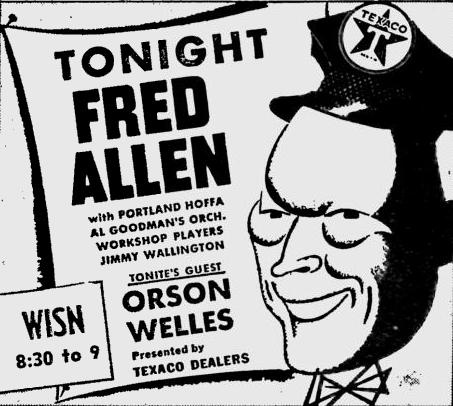
All of these tendencies are key to Allen’s “Soundman’s Revenge,” in which Orson Welles and the Campbell’s Playhouse become “Dorson Belles” and “Finnegan’s Playhouse,” with the evening’s entertainment an adaptation of Jack and Jill fetching a pail of water.
Belles, acted by Fred Allen, tells his listeners that “My program is famous, and rightly so, for my sound effects, conceived in solitude by me.” The skit reaches ridiculous heights during a dramatization of “Jack’s” first meeting with “Jill.” As Jack and Jill wax enthusiastically at each other merely by repeating each others’ names, the host breaks in to tell listeners that “This dialogue, ladies and gentleman, is not to be found in the original Mother Goose version. It has been interprellated by Dorson Belles. We return you now to the play.”
The always potential high culture pretentiousness of Mercury/Campbell aesthetic choices are brought to the fore by the ridiculous choice of a Mother Goose nursery rhyme as the “play” within the skit. But other things do as well. The skit opens in typical Mercury first person narrative style, where Jack tells the tale from his own perspective in a ponderous, overwrought dramatic fashion. Jack does not live in postcard ready New England, he lives in a “land of penury and misery.” He does not merely make a mess while preparing his dinner, but “licks the albumen of owl’s egg off his fingers.”’
In its most pointed reference to Mercury style, the skit directly plays off a memorable moment in War of the Worlds when, as Professor Pierson narrates his travels in New Jersey, he states that “I saw something crouching in a doorway, and it rose up and became a man. A man armed with a large knife.” Here is the clip:
In similar dramatic style, Jack narrates his journey up the hill, hauling his “heavy oaken pail” and asks “What was that huddled form crouching in my path? Was it a girl? It was!”
The comic tour-de-force, however, comes with its satire of sound effects. Allen’s team goes for broke as listeners laugh along to the gradual undoing of the hapless Theodore Slade, Welles’s sound effects engineer in the skit, who is driven to madness by the excessive number of effects. Slade makes many mistakes throughout, but his errors really add up when Jack kills his father and he describes the “long arm of the law” reaching out, coming from the north on horseback, the east by train, the west by “aeroplane,” and the north by sleigh. Each description is punctuated by its appropriate sound; hooves, whistles, engines, and of course, sleigh bells.
It works the first time, but when Jack dramatically asks if he and Jill can escape each of these modes of capture, Slade plays the wrong effects. When Jack tells us he stabbed the Sherriff, Slade plays a gunshot. This time, when Belles chastises him, Slade lets loose, telling Belles that he is going “nuts,” then trying to rectify the mistake by killing the Sherriff again. Belles yells out that “this is confusing!” to which Slade retorts, “you’re telling me!” As Jill tries to continue the scene, telling us she is shooting herself, Slade plays the train whistle. Finally Jack narrates that Jill, the Sherriff, and his father are dead, and that “I alone live.” Slade replies, “yeah, but not for long,” and after listing off years worth of complaints, shoots Belles. Belles, in a pitch perfect rendition of Welles’s weekly closing of his radio show, says “This is Dorson Belles, signing off permanently. Pending rigor mortis, I remain, obediently yours.”

Perhaps Welles was offended, or perhaps he yearned to be in on the joke. He certainly seemed to relish the chance for that opportunity, when he appeared as a guest on Allen’s show, 3 years later on October 18, 1942. Here he plays along in the skewering of his own genius image, tied to his authorial control over all his projects. As the cast nervously awaits the arrival of the great “Welles,” Allen tries to calm them. Once “Welles” enters the studio, Allen himself comes in for his own ribbing. “Welles” tells him that they will be performing a new version of one of Welles’s early radio dramatizations, Les Miserables. Here Welles successfully mocks both “Welles” and Allen, insisting on sole authorship, giving an overwrought performance, using the first person singular mode of delivery, and most humorously by reducing Allen’s contribution to a few sound effects.
In those few moments where Welles himself cannot help from laughing along with the mockery, “Welles” becomes Welles, and we in the audience get to laugh with, not at, the man.
While CBS, Campbell Soup, and the press turned Welles into “Welles,” Allen undermined that move, puncturing the grandiose myth, a project in which Welles himself was only too willing to participate. By breaking it down to its constituent elements, the “Soundman” and Les Miserables skits celebrate the unique style of the Mercury/Campbell radio productions. Yet, they also pierce its cultured veneer by pointing to the unsung efforts of the always-necessary team to make radio performances work, and skewering the pretentiousness of the program’s extra-textual discourses. In the process Welles and Allen mutually constructed and deflated each other’s reputation as radio geniuses.
—
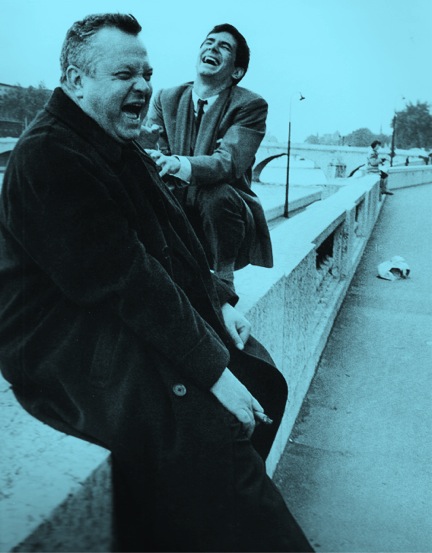
Featured Image: Orson Welles and Anthony Perkins sharing a laugh on the set of The Trial.
—
Kathleen Battles is Associate Professor and Graduate Director in the Department of Communication and Journalism at Oakland University (MI not CA). She is recently co-editor (with Joy Hayes and Wendy Hilton-Morrow) of War of the Worlds to Social Media: Mediated Communication in Times of Crisis (Peter Lang, 2013), a volume that seeks to draw connections between the War of the Worlds broadcast event and contemporary issues surrounding new media. She is also the author Calling All Cars: Radio Dragnets and the Technology of Policing (University of Minnesota Press, 2010). Her research interests include Depression era radio cultures, the interrelationship between radio, telephones, and automobiles, media and space/time, the historical continuities between “old” and “new” media, and contemporary issues surrounding sexuality and the media.
—

Want to catch up on the Mercury to Mars series?
Click here to read Tom McEnaney’s thoughts on the place of Latin America in Welles’s radio work.
Click here to read Eleanor Patterson’s reflections on recorded re-releases of the “War of the Worlds” broadcast.
Click here to read Debra Rae Cohen’s thoughts on vampire media in Orson Welles’s “Dracula.”
And click here to read Cynthia B. Meyers on the challenges and rewards of teaching WOTW in the classroom.
While I’ve still got you here … be sure to join our WOTW anniversary Facebook group. Next month we’re planning exciting events around the anniversary of the Martian Panic on October 30, 2013 from 7-10 EST, and hoping to get as many of you as we can to liveTweet the Invasion broadcast. Sign up to join in!
—
Share this:

Sonic Spirituality: Meditations on Eminem’s “Beautiful” and “My Darling”

DOI: https://doi.org/10.59350/eyz5p-zfe33
Guest writer Marcia Alesan Dawkins’s new book on rapper Eminem, Eminem: The Real Slim Shady is now available. We here at Sounding Out! are thrilled, so for this week’s post we asked Dr. Dawkins to give us a glimpse into a side of the notorious rapper that few may have heard: the intersection between artist and spirituality. This comes just in time too, considering Kanye West’s latest release, Yeezus, not to mention Touré’s recent biography of Prince, I Would Die 4 U: Why Prince Became an Icon (2013), which examines the confluence of celebrity and spirituality for a generation of Prince fans. Without further ado, give it up for Dr. Dawkins! Pump it up pump it up pump it up! —Liana M Silva-Ford, Managing Editor
Eminem caught my ear a year before The Slim Shady LP hit record stores in 1999, when I came across a single released by Rawkus Records called “5 Star Generals” (1998) on which he made a guest appearance. I would later learn that this was an old track the rapper recorded for cash while he was unsigned and then forgot. Nevertheless, Em’s first lines about sinning boldly, shooting nuns in Bible class, and damning hell itself hit me like a ton of bricks. I knew that lines like his, which were sure to enrage anyone within earshot, would make him (in)famous.
To my surprise, I learned a year later that my 89-year-old Cuban American grandfather, a poet and a reverend, had been listening to Eminem too. This struck me as strange for two reasons. First, my grandfather wasn’t fluent in English. Second, he’d never expressed much interest in rap music other than commenting that he noticed kids rapping in the parks near his house in Hollis, Queens every now and then. Of course, I knew that many of those boom-box-toting kids were now superstars like Run-DMC and LL Cool J, but my Grandfather didn’t.
When I entered the living room to the sound of Slim Shady, my grandfather sat transfixed. After the song ended, I asked him if he knew what he was hearing. Sitting up in his blue La-Z-Boy recliner he said, “I’m listening to some guy who calls himself Eminem. I can tell he’s probably a heathen and I don’t care. I love what he’s doing with his words.” I was shocked. My grandfather went on to tell me that despite the obvious language and experiential barriers that stood between him and Eminem, he was in awe of the way the rapper was using his voice and his words as instruments. What really got me was when my grandfather said that Eminem’s unapologetic tone reminded him of many preachers’ fiery delivery over the years. I could not believe it. Grandpa’s encounter with Eminem was not just sonic. It was spiritual.

Fifteen years later I am still listening for what my grandfather heard. In the process, my ears have been captivated by Eminem’s sonic spirituality, open to its every sound. So open, in fact, that I dedicated three chapters in my forthcoming book to understanding how his music can be seen as a dynamic sphere of spiritual activity in terms of guilt-purification-redemption, love-hate, and relationship-awareness. While paying attention to Eminem’s sonic spirituality began as a personal exercise, it now represents an important part of understanding how spirituality operates culturally and is just like sound: recognizable, uncontainable and elusive.
In other words, I’ve finally understood what my grandfather was trying to tell me — how, rather than simply what, he heard in Eminem’s music. Here’s the revelation: sonic spirituality is a listening attitude, a personalized relationship with music that allows us to mark time, experience the intangible, track movement, engage otherness and, in the end, encounter more honest versions of ourselves. Sonic spirituality, then, might be characterized as open instead of closed, exploratory and experimental rather than static. Eminem’s spiritual themes play out in terms of solidarity with the supernatural, a mistrust of organized religion due to its inherent hypocrisy, a desire for redemption from guilt through purification, and an intense personal battle between love and hate. Following are two potent examples of what I’ve found in Eminem’s oeuvre from 2009’s Relapse: Refill, examples that showcase the development of his sonic spirituality over the decade since my grandfather first introduced it to me.
In “Beautiful” (2009), Eminem poses a powerful question: What would you think if you saw someone important, like a government official or celebrity, digging around in the trash? The answer: you’d probably think that this kind of behavior was suitable for beggars only and certainly not for yourself or someone very important. But this is exactly what the rapper does in “Beautiful.” He looks for himself, others, and their fallen world or Eden (aka Detroit, Michigan) and finds everyone and everything in the garbage. In this way, “Beautiful” is a lovely parable. As with any parable, its objective is to illustrate a moral or a spiritual lesson using a simple human relation. The lesson in this case is looking for something or someone that has been lost. In Eminem’s parable, there are seven ideas expressed about how to find what we have lost and develop our spiritual selves along the way: loss (the starting point of humanity’s spiritual condition), light (a force created through words), movement (standing in another person’s shoes), discovery (finding what’s lost in low places), salvation (anyone can be redeemed), connection (exchange traditional religion for a new culture of communication with the supernatural), and celebration (that everyone can be made beautiful again).
These seven images are evoked by the lyrics and music. The slow and deliberate beat invites listeners to connect the subject and object; the song and themselves, the song and the rapper. The release provided as Eminem sings the chorus doesn’t just change the course of the song, but converts the shared loss into an opportunity for discovery, salvation, connection and celebration. Just as the discovery begins, the drums suddenly increase in volume; the bass and guitar begin to cry out as a background harmony in a major key builds and adds to the intensity. The sounds remind us even if we choose to shield our eyes, we cannot shield our ears from the plight of our fellows and that this is a call to action, salvation and celebration. In “Beautiful” Eminem listeners become aware of others’ oppression while remembering that they are no stronger or more beautiful than anyone else. In this way listeners are engaged not just with the sounds, but also with the spirits of the people who produce them in active relationship.
The experiences and encounters inherent in Eminem’s alternative spiritual portrait, “My Darling” (2009), still emphasize the same spiritual themes I pointed out earlier: personal struggles between light and darkness, finding a purpose in suffering, and seeing a connection between societal and supernatural powers. Only this time, the supernatural power belongs to the Devil. Yet, unlike other songs in which Eminem does battle with the Devil or suffers for his sins through eternal damnation, “My Darling” is about a soul living in hell on earth. In this way, “My Darling” is both a lamentation and a dark parable whose moral complements that of “Beautiful.” Eminem shares this moral in “My Darling” through six ideas about what happens when a person is losing his or her battle with the demons he or she carries inside. These ideas are uncertainty (never being sure about redemption), possession (selling one’s soul), darkness (force maintained by the absence of words), harm (effects of love turning to hate), wholeness (spiritual relationships based on labor and exchange rather than on salvation and forgiveness), and lament (mourning one’s losses of self and loved ones).
As in “Beautiful,” the lyrics and the music evoke spiritual elements. The song is set to a minor key, which communicates penitential lamentation, intimate conversation with the Devil, and echoes with sighs of disappointment, divorce and disillusion. Possession, darkness and harm are communicated through call and response between Eminem and the Devil, who hears and accepts Eminem’s invitation and appears in his mirror where he whispers seductively for Eminem to draw close. The increasing intensity and harm of the spiritual exchange between Mathers and the Devil is reflected in their verbal back-and-forth. Their “souls, minds and bodies” are increasingly connected as they exchange more and more words. And the words become more desperate and cruel. At the end of the song, Eminem submits. Listeners come to understand that Eminem and the Devil are one and whole as the Devil’s final solo becomes the pair’s solemn duet. The two have become one spirit through a relationship of exchange and possession.

The recurrence of spiritual themes in Eminem’s soundscape suggests that music is a way to communicate with the other who is both present and hidden. Sometimes the other is God. Sometimes the other is the Devil. Sometimes the other is other people. Sometimes the other is the other within. The tones, rhythmic patters, key changes, intensity and release patterns combine with Eminem’s lyrics to create an experience within which listeners can be still, in which their souls can take refuge, and the other can be encountered. However, though sonic spirituality exists in Eminem’s music, and rumors abound regarding his “born again” status, it cannot be argued that Eminem adheres to a particular religion. Rather, the sonic spiritual element suggests that Eminem communicates a genuine awareness of supernatural powers, guilt-redemption-purification and love-hate that allows him to relate to the world at large. In this way Eminem is one of many artists whose pop culture content carries a strong spiritual dimension that is sonic, confirming results of Chris Rojek’s study, entitled “Celebrity and Religion,” which argues that “celebrity culture is secular society’s rejoinder to the decline of religion and magic” (393).

As “Beautiful” and “My Darling” demonstrate, the spiritual reflections heard in Eminem’s music are not just harmonic, they are also discordant, revealing how conflicted we often are about ourselves and the supernatural. Just as Eminem walks with God in “Beautiful” and dances with the Devil in “My Darling,” audiences listening to his music are able to escape from their own worlds and find temporary refuge in sonic spirituality. This idea didn’t start with Eminem, or with the Judeo-Christian tradition, as many faiths across time and space utilize the power of music to evoke higher powers and acquire spiritual insight through prayers, storytelling, meditation, chanting, mantras, singing, silent vows, etc. But Eminem has added his own unique touch by using his personas Slim Shady and Marshall Mathers to speak with demonic and godly authority, respectively. As Peter Ward writes in Gods Behaving Badly, the spiritual power of Eminem’s music for audiences lies in its representations of a “conflicted and complex self clothed in the metaphors of the divine and reflected back to us” (107). In other words, sonic spirituality is about engaging with something beyond the world around us while grappling with the personas and situations into which we’re immersed. As the music plays we are challenged to develop a listening heart.
The popularity of Eminem’s music supports the conclusion that his brand of sonic spirituality is set to the same rhythm as the hearts of fans that buy and listen to his messages. But his work can also speak to those who consider themselves spiritually committed, even if that commitment is often not manifested in traditional religious activities. In this way the dynamic nature of sonic spirituality manifests as a way of listening that allows for communication and communion through music and language. If the above is true, then we can take Eminem’s claim, expressed via tweet, that “music has the power to heal” as a spiritual declaration. And we can also take a fan’s response to this tweet as an Amen: “All Eminem songs has [sic] a spiritual connection… you have to have the ear to find that for yourself.”
—
Featured Image: “Slim Shady” by Flickr user Walt Jabasco, CC BY-NC-ND 2.0
—
Marcia Alesan Dawkins, PhD is an award-winning writer, speaker, educator, and lecturer at the University of Southern California’s Annenberg School for Communication and Journalism. She is the author of Clearly Invisible: Racial Passing and the Color of Cultural Identity (Baylor UP, 2012) and Eminem: The Real Slim Shady (Praeger, 2013).
Marcia writes about racial passing, mixed race identities, media, popular culture, religion and politics for a variety of high-profile publications. She earned her PhD in communication from USC Annenberg, her master’s degrees in humanities from USC and NYU and her bachelor’s degrees in communication arts and honors from Villanova. Contact: www.marciadawkins.com
—
REWIND! . . .If you liked this post, you may also dig:
The Victoria’s Secret Fashion Show and the Soundtrack of Desire–Marcia Alesan Dawkins
Love and Hip Hop: (Re)Gendering The Debate Over Hip Hop Studies–-Travis Gosa
“I Love to Praise His Name”: Shouting as Feminine Disruption, Public Ecstasy, and Audio-Visual Pleasure—Shakira Holt
—
Share this:




Current Top Posts





April 2021

January 2020

November 2019

October 2019

August 2019

April 2014

November 2017

March 2015

December 2017

October 2015


Recent Comments