
#WOTW75 — It’s Time for “War of the Worlds!”
DOI: https://doi.org/10.59350/432wt-yds94
Click here to stream our broadcast in your web browser from WHRW in Binghamton, New York, beginning at 7pm EST!
Tweet along with us at #WOTW75
7:00-8:00 EST An all-new audio documentary hosted by Brian Hanrahan (Cornell) and featuring critical reflections from a dozen prominent radio historians, including Kate Lacey, Kathleen Battles, Jason Loviglio, Damien Keane, Alex Russo, Shawn VanCour and Tom McEnaney.
8:00-9:00 EST The re-broadcast of the original “War of the Worlds”!
9:00-10:00 EST Hosted by SO!’s own Jennifer Stoever (Binghamton University), this hour includes live post-broadcast chats with Keane, McEnaney, and VanCour, and experimental soundscapes and drama produced by Binghamton University students and community members.
___
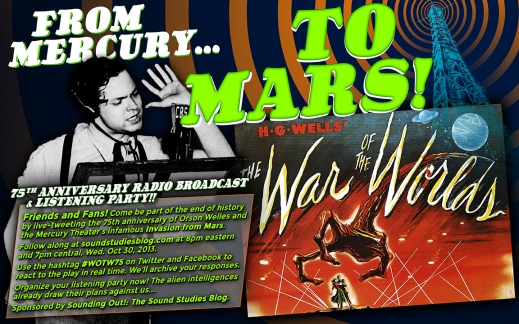
Looking for the end of the world? Don’t panic, you’ve come to the right place. Our #WOTW75 project invites you to listen to and live-tweet Orson Welles’ classic “War of the Worlds” radio play tonight alongside hundred (thousands?) of others. This page has all you will need to participate.
When to Listen. Our project starts at 7 pm Eastern Standard Time on Wednesday, Oct. 30. Our goal is to keep in sync across listening sites everywhere.
How to Listen. Click here to stream our broadcast in your web browser from WHRW in Binghamton, New York. If this feed won’t work or goes down, see Alternative Listening Options below.

How to Respond. Use Twitter, Instagram and post on our Facebook group page using the hashtag #WOTW75. Be sure to follow @WOTW75 on Twitter and reply to one another). Posting a comment on this page is another option. Want to follow the conversation as a whole? Try our hashtag in tagboard.
Alternative Listening Options. There are several other listening options available. You can stream the play from wellesnet, youtube or archive.org. These should be suitable to play on an ipod, phone or laptop. Please keep these links handy just in case something goes wrong with the WHRW feed (although we don’t anticipate this).
Public Radio Options. Want a real radio experience? KPCC Southern California Public Radio has generously given a feed out for free to a variety of public broadcasters, so check your local NPR, BBC or college station. KPCC will have its own broadcast on pacific time. They are sharing our hashtag, too. Here is a link with more information.
How to Help. All we need are your ears and keyboards, but if you want to build the project, add your friends to our FB group and post items from that feed to your wall.
How to Document. Doing something creative while listening? Installing WOTW on a streetcorner, in a bar, an observatory? Roaming rural New Jersey with a flashlight? We need images and artwork. Snap a few for us and send them our way. Your responses will archived both digitally and in print.

There’s more. Here is a link to the most recent entry in our From Mercury to Mars web series about Welles and radio, for which #WOTW75 is the centerpiece. Here is a link to Howard Koch’s WOTW script, in case you’d like to read along. Here is a recent radio play contest, and here is a recent episode of the podcast Aca-media on WOTW. Check out PBS American Experience, which aired a major documentary on Tuesday night. Also, here is a new version of the story by Campfire Radio. Visiting New Jersey? There are live events out there in the moonlight, check out Raconteur Radio. Many more events and news items for the anniversary are up on wellesnet.
Thanks for joining in on the fun. We’re eager to read your tweets and posts, and proud to annihilate the world before your very ears.
Questions, ideas? wotw75@soundingoutblog.com

—
Share this:

Experiments in Aural Resistance: Nordic Role-Playing, Community, and Sound
DOI: https://doi.org/10.59350/168jz-17295
Editor’s Note: Welcome to Sounding Out!‘s fall series titled “Sound and Play,” where we ask how sound studies, as a discipline, can help us to think through several canonical perspectives on play. While Johan Huizinga had once argued that play is the primeval foundation from which all culture has sprung, it is important to ask where sound fits into this construction of culture; does it too have the potential to liberate or re-entrench our social worlds? SO!’s Multimedia editor Aaron Trammell reflects upon using sound in role-playing games as a form of resistance. Ready, players?
—
When we play with sound, how does it influence the ways in which we understand, configure, and experience the world? I have already argued that non-diegetic sound can produce a visceral and emotive effect when connected to player interaction within a game world, that sounds are often structured within games to construct a sort of feedback between player and system, and that often within this feedback loop the narrative voice perpetuates problematic tropes of sexism and racism through its scripting. While I focused on the often dystopic production efforts of large and middle sized game companies in those prior essays, here I will be focusing on autonomous and grassroots examples of how sound is used as a way to stage social experiments which resist these often hegemonic ways that these dominant narratives constrict our views of the world.
Role-playing games, the focus of my post today, offer a more viable path of social resistance than better-known video games. Nordic larp style-games, for example, are written and played within not-for-profit communities, and they utilize themes of social inequality, transformation, and activism within their very scripts. Second, role-playing games, unlike computer games, do not require that their developers are able to code. Instead, games are often circulated by word-of-mouth, or in script format through player communities. In this sense, the genre itself is untethered from many of the problems of consumer capitalism. Many underground role-playing games are designed both around social issues and for local community needs as opposed to the market demands that necessitate big budgets, big programming teams, and few risks in the video game industry today. Finally, because role-playing games necessitate neither big budgets, the ability to code, nor mass audiences, they are an ideal site wherein game designers and referees can stage social experiments that speak to the unique wants and desires of the communities within which they are run.
In The Larpfactory Book Project, a forthcoming book containing several ready to play examples of Nordic larp (a big shout out to Lizzie Stark for hooking me up with an advance copy of this portion of the manuscript!), larpwrights Matthijs Holter and Fredrik Hossmann propose a game entitled “Before and After Silence,” focused on thinking through the collective experience of silence. From the game description:
In a world of more and more sound, silence is becoming more valuable. Before and After Silence is about limitations and listening, and about doing almost nothing. It is non-verbal and uses silence as its starting point. It is about shifting the point of view from “what is” to “what is not,” about shifting the focus from “the sounds” to “the spaces between the sounds,” from “the actions” to what is “between the actions,” and to “what is not done.” Rather than playing characters, we examine how we look at ourselves and how different filters can change how we see ourselves and others.
The game is structured as a social experiment for five to twelve players who are made to select two cards, one of which prompts players with an action they must complete only once during the hour of silence (one example reads “Go over to someone and whisper something in a language you don’t know”), and another which prompts players with a setting through which they should interpret the actions of the other players in the room (one example suggests a player imagine themselves in a community of prisoners, another makes a player imagine themselves as one in a society of telepaths). Before the game there are a set of workshops aimed at orienting players to the scope and silence of the game, and afterward there is a debriefing session where players compare their experiences of silence during the game.
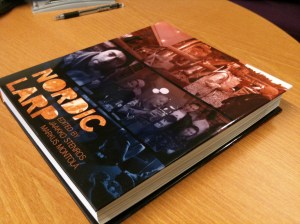
Unlike American larps, which often take place in high-fantasy settings and direct their action around combat scenarios, Nordic larps often focus on the everyday and comparatively mundane, and as such tend to be more concerned the problems of the everyday as well. Even those that take place in more exotic environments, such as System Danmarc, a game set in the cyberpunk future of Copenhagen, engage players in real issues regarding class and poverty. After living in a shanty-town simulating the future streets of Copenhagen for a week of game-time (In Nordic-style larps, game-time is often equivalent to real time, and so a week in-game is equivalent to a week out of game) players are shown a documentary about the actual slums of Copenhagen where they realize that their experience within the space of play was made to mirror the experience of those struggling with the these very issues in the real world.
In the case of “Before and After Silence,” it is interesting to consider the ways in which the game designers here play with sound, and how these experiments in sonic game design might provoke new modes of subjectivity. As described earlier, players are both given a particular action and or noise to perform, but also are prompted with a way to imagine the actions that the rest of the players in the room are performing. The resulting group performance is an acid dream of sorts wherein each player is made to imagine the room’s soundscape in a very different way. Is the setting a long-lost silent film, or are you drifting through an ether of emotions and past romances? The game focuses on playing with silence in a way that makes the din of communication an unfamiliar and distant memory. The game affords players an opportunity to imagine the world sound. In doing this, “Before and After Silence” displaces the dominance of the voice as a mode of communication and through this questions the ways in which we imagine the world.
Not all is perfect, however, in this utopia of resistance. As Lisa Blackman (2009) argues in her essay “Embodying Affect: Voice-hearing, Telepathy, Suggestion and Modelling the Non-Conscious,” play with the exchange of subjectivities and sound marks an ontological shift from a praxiology of what bodies are to what bodies can do (p. 170). Moving forward from her work in understanding the ritual practices of voice-hearing communities, Blackman explains that similar forms of sonic play (including play with silence) allow for the experience, embodiment, and trade of desire, fear, and trauma. In the context of “Before and After Silence,” this means that as players sculpt and adjust the sonic space of the room, they run the risk of also shaping and altering each others psychic conditions, in unpredictable and perhaps dangerous ways.
The conflation which occurs between these spaces of real emotion and play emotion is, in fact, well documented, and referred to in larp communities as “bleed.” As role-playing scholar Sarah Bowman (2013), explains in her essay “Social Conflict in Role-Playing Communities: An Exploratory Qualitative Study,” even though bleed does occasionally create rifts in relationships (some participants that she has interviewed reported in-game events disturbing their out of game relationships), others seek it out as a form of extreme play. For this reason Nordic larps require ethical behavior on the parts of their players, and because of the nature of the psychic and social sculpting which can occur within the play spaces of the game, the possibility exists that a single unethical player could create a negative and perhaps concerning experience for many others. That said, there are several ways the community mitigates the possibility of this problem including meticulous casting processes, before-game workshops, after-game debrief sessions, and safe words for use during play.
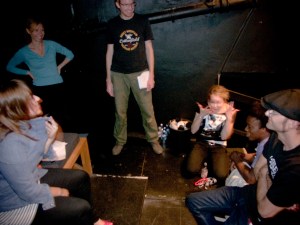
“Before and After Silence” is a valuable cultural artifact that lies at the intersection of scholarship on sound studies and serious play. At the same time that it promises several new ways to think through how sound, communication, and silence influence the how we frame and approach the world, it also raises deeper questions regarding the nature of social control and the viability of autonomous modes of organization. As silence allows players to explore and interact with a world where the soundscape takes on an increased prominence, do sexist, racist, and homophobic modes of socialization still manage to creep into the play space? And does the voice, along with its physiological and cultural embodiment of race, class, and gender, offer an escape from these experiments in silence if and when they turn dystopic?
—
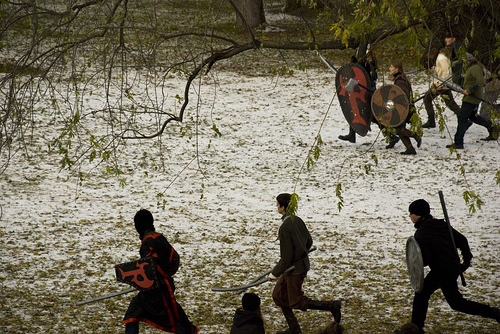
Featured image: “Larp” by Flickr user marten vaher, CC-BY-NC-SA 2.0
—
Aaron Trammell is co-founder and Multimedia Editor of Sounding Out! He is also a Media Studies PhD candidate at Rutgers University. His dissertation explores the fanzines and politics of underground wargame communities in Cold War America. You can learn more about his work at aarontrammell.com.
—

REWIND! . . .If you liked this post, you may also dig:
Goalball: Sport, Silence, and Spectatorship— Melissa Helquist
GLaDOS, The Voice of Postfeminist Control— Aaron Trammell
Video Gaming and the Sonic Feedback of Surviellance: Bastion and the Stanley Parable— Aaron Trammell
—
Share this:




Current Top Posts





April 2021

January 2020

November 2019

October 2019

August 2019

April 2014

November 2017

March 2015

December 2017

October 2015


Recent Comments