
A Day at the Rock and Roll Hall of Fame Annex
DOI: https://doi.org/10.59350/34arq-mnj17
When I went down to NYC at the beginning of the summer, I saw an ad for the John Lennon exhibit at the Rock and Roll Hall of Fame Annex in Soho. The exhibit focuses on Lennon’s stay in New York and the music he produced while he lived in the city. My curiosity stemmed not just from my own research interest in immigrants and their connection to New York City, but also from the fact that I am a music fan and a Beatles fan in particular. Considering that the actual Rock and Roll Hall of Fame is located in Cleveland, I was excited about the Annex experience. I made it to the Annex in late August and indulged my rock and roll fantasies in the basement-level space.
Even though this is not the place for an exhibit review, what I want to focus on regarding my Rock and Roll experience is the importance of sound to the Annex experience. (Once again, I have not been to the actual museum in Cleveland, so I am not sure if this is just standard for the Rock and Roll Hall of Fame.) When you walk into the Hall of Fame Gallery–they sell you tickets for particular times, so that entrance to the Annex is allowed only at the time on your ticket–you are surrounded by tiles with the inductees’ signatures and that light up when the artists’ music plays. The lights dim while the music starts out slowly, shifting from tile to tile, then gains speed until you are surrounded by music and voices. It ends abruptly, and you are led into a room where there are tv screens and stools, a room meant to recreate the experience of being at a live concert. Again, the music is loud, you are shrouded in darkness, and the screens light up with images of famous musical artists (thankfully from yesteryear and today) as well as quotes. After spending some time watching “The Power and the Glory,” a screen opens up and you move into a large room full of pop music memorabilia, but only after you pick up what looks like a Walkman with a headset. The room is segmented, either by time period, by influences, by artists, or by region–there’s one section devoted to New York City music. The Walkman allows you to hear the tunes while you look at the memorabilia and read the descriptions.
My brother, nine years older than me and a music aficionado as well, agreed with me that having the music come on at every station was a great perk. I expected your run-of-the-mill museum tour tapes, but I was pleasantly surprised to hear music playing while we ogled the bustiers, guitars, and letters. Score! Oftentimes we found ourselves singing along or calling to the other to come over to a station and tune in. I enjoyed the Lennon exhibit, but my favorite part was “The Power and the Glory.” For a young person like me who grew up in a small town, devouring page after page of Rolling Stone, this was the highlight for it was supposed to emulate what it would have been like to see The Sex Pistols in concert, hear Muddy Waters play, feel the shrieks of the female fans when the Beatles came onto the stage.
However, what really caught my eye was that sound was always tied to the visual. The sounds complemented the viewing of the objects–even though the objects were there because their owners produced music. Except for the concert room, where at times the audience was left in the dark, with just the music track playing while you tried to guess who was next, the music was a part of the exhibit as a way to showcase the memorabilia. This was especially evident in the John Lennon exhibit. It was heartwarming to watch a music video with John Lennon, Yoko Ono, and Sean Lennon on holiday, but I wanted to hear more. There were plenty of John Lennon artifacts on display (like the INS letter to Lennon that asked him to leave the country), but what about the music he made? I commend the Annex’s idea of having the music play when you walk up to a piece of memorabilia, but the music should play a bigger role.

You can’t go to a concert and not buy a souvenir, right?
__
Liana Marie Silva
__
Share this:

The Grain of the Voice or the Contour of the Ear?

DOI: https://doi.org/10.59350/pgkhx-70g14
One of the most exciting possibilities emerging within sound studies is the emphasis on the listener and his/her role in shaping a sound’s meaning and content. Sounds disconnected from their contexts of reception rarely answer our questions about the past, but merely make for new listening experiences in the present. Thinking with our ears is profound, but thinking through our ears can be life-changing—moving us closer to an understanding of sound’s power and its intensive connection to memory and the emotive forces of both life and death.
Until very recently, I had not heard the sound of my Grandmother’s voice in over eight years. I had actually never expected to hear it again, as she died in 2001. It is a clichéd understatement that I loved my grandmother very much; when she died, I was barely a “real” adult and I felt like we had just gotten acquainted. However, I thought I had already made peace with the passing of her beloved throaty crackle into the world of furtive dreams and spotty memory, until one night in 2004, when this loss was suddenly found.
Somewhere around two a.m. on a weekday, the phone rang. Once you are past a certain age, the shrill peal of a telephone after midnight can be downright terrifying. Someone has died. Someone is calling from jail. Someone’s life is in shreds. Nothing good. My hand hovered over the receiver for a second, as I rubbed my tired eyes and steeled myself for whatever might be at the other line.
“Hello,” I mumbled, hesitatingly.
Silence, for a second. And, then, the keen of my sister’s voice, choked through tears, “I found it.”
Inexplicably, my groggy listening ears automatically knew precisely what “it” was : an oral history of my grandmother I recorded in 1998, on teeny-tiny tapes in an itsy-bitsy recorder my sister used to record her professor’s lectures. I borrowed it, and like a good sister, I returned it. Tapes included. At the time, I thought there would be plenty more opportunities to have deep convos with Grandma. I had always assumed my sister recycled it, replacing my grandmother’s words with her bio prof’s. With three little gasped words, I realized she hadn’t.
You’d think my first reaction would be excitement—and I was thrilled, but in the nineteenth-century sense. My heart was pierced by even the thought of hearing my Grandmother’s voice again; the imagined sound tremored through me and, in a moment of pure protective reflex, I immediately cast the receiver away. In a sense, I had heard my grandmother’s ghost. The sounds magnetized on that tape seemed to resurrect her and mock the promise of that hour of conversation, when we had no idea what lay ahead.
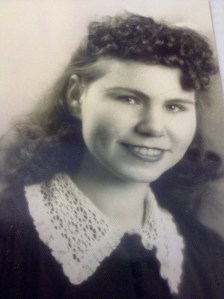
Even though I made the conscious decision not to listen to the tape, I let the thought of her audio presence haunt me for five years. I could not escape the thought of her voice both in my memory and in this new audio embodiment. Oddly enough, I surrounded myself with pictures of my Grandmother as remembrances—cheeky 1940s shots from her youth as well as seasoned photos of us together—but those images brought me cool comfort. Their framed borders demarcated a long-gone past. When my chest got too tight, I could look away. Not so with the vibrations of her voice, which sounded out the contours of her absent body. Her voice threatened too much wonder, and with it, an attendant dose of insatiable longing. Unlike the frozen photographic slices of life, the sound had an animated heft to it. It breathed.
Ultimately, I was unable to listen to the tape through my own ears. It wasn’t until the birth of my son that I even considered playing it. Suddenly, my grandmother wasn’t mine alone, but also the great-grandmother my son would never really know. The new relation between the two of them allowed me to fashion another set of ears; I became a new listener, connected to the voice by life rather than death, by shared possibility rather than the solipsism of grief. So on a snowy night last January, I finally pressed play. With my infant son in my arms, I listened, at long last, to that beautiful crackling voice spinning stories of her childhood in Iowa and adult life in California. Ironically, I almost immediately realized there were actually two dead voices on that tape. I had long since shed the happy-but-halting girlish voice of my youth like an ill-fitting skin, but hadn’t quite realized it until I heard my old nervous laughter fill the speakers. I realized that, someday, I’ll have to introduce my son to that young woman too.
My Grandma and I talk about WWII and the sinking of the Ruben James:
Grandma Maryanne’s Interview Segment 1
My Favorite part of the interview:
Grandma Maryanne’s Interview Segment 2
Jennifer Lynn Stoever
Share this:




Current Top Posts





April 2021

January 2020

November 2019

October 2019

August 2019

April 2014

November 2017

March 2015

December 2017

October 2015
 Sounding Out!
Recent Comments