
(Re)Locating Soundscapes of Schooling: Learning to Listen to Children’s Lifeworlds

 Here at Sounding Out! we like to celebrate World Listening Day (July 18) with a blog series that focuses on the importance of listening. This year, we bring your attention to the role of listening when it comes to the sounds of the K-12 classroom, and by extension, the school.
Any day in a K-12 school involves movement and sounds day in and day out: the shuffling of desks, the conversations among classmates, the fire drill alarm, the pencils on paper, the picking up of trays of food. However, in many conversations about schools, teaching, and learning, sound is absent.
This month’s series will have readers thinking about the sounds in classrooms in different ways. They will consider race, class, and gender, and how those aspects intersect how we listen to the classrooms of our past and our present. More importantly, the posts will all inspire assignments that educators at all stages can use in their classrooms. Our first post came from Shakira Holt, a playlist of her black girl students’ songs as philogynoir. Our second post was penned by Caroline Pinkston, and in it she questions common classroom management strategies for quieting a classroom instead of listening to students. Today’s post comes from the point of view of a student, teacher, and now researcher, who reflects upon how we listen to the sounds (and students!) in our classrooms.
Time’s up, pencils down, let’s take our notebooks outside to the playground and listen along with Cassie J. Brownell. –Liana Silva, Managing Editor
—
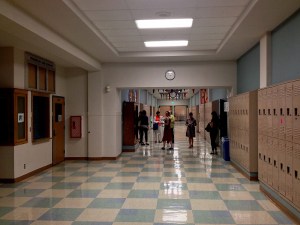
“Franklin High School, Seattle WA: Representative Hallway” by Flickr user Joe Wolf, CC BY-ND 2.0
I have spent much of my life listening in schools. I essentially grew up in the public elementary school in Montana where my mother taught for over 40 years. The sounds of my childhood are those of feet squeaking on the tile floor of the hallways, the bounce of a kickball in the gym, and the slam of desks opening and closing throughout the day.
Across my elementary school years, I spent many early mornings attempting to write my name in cursive with a squeaky dry erase marker on the whiteboard in her classroom. Other mornings, I rapidly clicked the keyboard as I played Oregon Trail alongside two friends whose guardians also worked at the school. After school, I chased these same friends across the schoolyard, shot hoops with them in the gym, or discovered new worlds in the stacks of the library. The whipping Montana winds on the open playground later gave way to new sonic experiences, as I transitioned from elementary student to classroom teacher and, eventually, educational researcher.

“School Supplies 02” by Flickr user Derek K. Miller, CC BY-NC 2.0
When I later became a teacher at an elementary school in post-Katrina New Orleans, Louisiana, the chorus of sounds from my childhood reverberated around me. The delightful shrieks of children on the playground and the sounds of trays being stacked after lunch were familiar. So, too, was the daily stacking of chairs. The frequencies of childhood, both my own and that of my students, informed my entrée into teaching. The familiar rhythms of pencil sharpeners and stapled butcher paper were welcoming waves as I settled into not only my new role, but my new school community in the neighborhood of Algiers Point. Yet, with the opening bells of the school year at this New Orleans elementary school, I began to hear schooling in new registers.
***
On my first day of teaching, I was acutely attuned to the “noise” the second-grade children in my classroom made—sounds I had not been aware of as a student. I quickly tried to “correct” their behavior with promises of external rewards if they could only make better “choices,” including quieting themselves to listen to me. Yet, few of the classroom management “tricks” I had learned in my educational training seemed to work. After the last child walked away from the schoolyard, I crumbled in the classroom of my mentor teacher. Crying, I told her I was not cut out for such work. She laughed as she told me that to be a teacher I must (re)learn to listen to the sounds of my classroom.
In time, I learned to listen. The day-to-day sounds of teacher-directed schooling, or what I now know as the banking model of education, quickly gave way to my listening to children. I slowly learned the value of listening to the whispers of children as they read, the scuffle of their feet as they sought a different color crayon from a child at another table, and the wise words they shared with one another about how they used an alternative route to solve a given math problem. I listened to them too when they found my hand to hold during recess and the high-fives before they departed each day. Rather than hearing their sounds as unruly chatter, I opened my ears to the excitement and learning children were sharing with one another.

“Reading%20Fun%20Day%202013%20Jun%2014,%202013%2010-20%20AM” by Flickr user K.W. Barrett, CC BY 2.0
That semester Hurricane Gustav appeared in the Gulf Coast. The impending arrival of the storm coincided with the three-year anniversary of Hurricane Katrina. As the whole city of New Orleans was encouraged to evacuate, I felt the resonances from Katrina’s devastating impact in the stories and questions of my second-grade students. As Gustav approached, many of the children shared In the final days before we evacuated, we commemorated Katrina and shared hopes for protection during Gustav.
While I listened to their words, I also learned to listen to their bodies. I could hear their worries about the storm in their hugs, the intonation of their voices, and in their reactions to thunderstorms shaking our classroom windows. As a bodily experience, multimodal listening quite literally moves beyond just what our ears can hear to how sound moves across/through/with bodies, materials, and contexts. Through multimodal listening, listeners can develop their skills as both critical consumers and producers of sound. Listeners are thus better positioned to reflect on and identify how sound informs other sensations and feelings. Although I have only recently put words to what it means to engage in multimodal listening, my body was already experienced with it.

“Gustav 038” by Flickr user Jim Hobbs, CC BY-NC 2.0
I returned to the city almost two weeks later, after the Gulf Coast suffered the one-two-punch of Hurricanes Gustav and Ike. Whispers of wind rustled art supplies by sneaking through fresh cracks in the windows. As my colleagues and I hurriedly re-vamped our classrooms, the traditional staccato sounds of schooling slowly echoed in my ears. In the quiet clean-up of the storm, new frequencies of the school soundscape could be heard. This soundscape was not new in and of itself, but rather it was the absence of the consistent beat that harmonized the everyday sounds to which I had become attuned. Without the slap of a jump rope on the ground or the cheers of children playing kickball to punctuate the silence, waves of emotion—despair, hope, and uncertainty—underlying the soundscape of schooling I thought I knew became apparent to me for the first time.
***
As an educational researcher in an urban, elementary classroom in the Midwest, I now find myself hearing other frequencies of schooling that remained unheard even in my early teaching. In my new role, my job is to engage in multimodal listening at all times as I participate in elementary classrooms. As a teacher in New Orleans, I was only just beginning to engage in the task of multimodal listening that Ceraso describes. Still today, I am often still attempting to hear and feel all the vibrations happening around me. Yet, as a researcher, I can attend more fully to the task of listening.
Unlike when I was teaching, I do not need to adhere to strict policies regarding the learning of a group of students, but I can instead take an exploratory approach to learning alongside children. Specifically, in collaboration with a culturally and linguistically diverse group of 3rd-grade children in Mr. Holiday’s classroom this past year, I started to earwitness the ambient soundscapes of children’s life spaces. Although I first began listening with the children at Community School J three years earlier, I entered in to Mr. Holiday’s class this year interested in considering the ways children were engaging with and drawing upon various cultural, linguistic, and modal experiences to communicate. I did so aware that, for many historically marginalized children, such communicative practices are often overlooked or unheard in standardized curricular materials.
Mr. Holiday challenged his students to think—and hear—beyond the standardized curriculum by considering how sound can be a tool to write with and through.
“You’re writing, but you can use words, pictures, you can sketch…anything you want to,” Mr. Holiday shared with his class of diverse 3rd graders one day. “Just remember to listen. When we come back inside, we will all share what we heard and then we will talk about how we could use this in our stories about our school.”
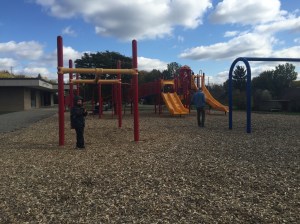
Photo courtesy of author
Outdoors, a low-flying plane could be heard. With little bodies quietly kicking them back-and-forth, swings creaked. On the playground, we listened to the whipping wind and felt the cool fall weather on our skin. From the slide, one child sounded out for his peers the word chilly, stretching the ls as long as he could. The mulch of the dry ground was kicked by one child as another, with her stomach on the seat of a swing, pushed the ground under her feet to glide back-and-forth.
Some children imagined the empty playground to be filled with the familiar sounds of their daily recesses. Others began to set strict boundaries for how they and their peers might begin to listen. In an attempt to control the bodies of her peers, one girl sent away her friend, suggesting that they could not hear together. Almost simultaneously, another child silently waved from the highest playground tower to the three boys from her class seated closely next to each other on a bench.
As Mr. Holiday called for all children to make a line outside his classroom door, a cacophony of cheers and groans lurched from the children as they sprinted from their observation sites.
“Look at how much I noticed!” one little boy shouted as he handed his notebook to me with a list of sounds. He included sounds heard in the moments we were outdoors like the airplane, but he also included imagined shrieks of children at play.
***
The sounds of elementary schooling have shown me that much of classroom teaching and learning needs to be grounded in listening. From the structured directions—like those presented by Mr. Holiday—to the daily screams of children racing across the school grounds. In other words, we must listen to children, to their experiences, and to their emotions in order to critically consider how schooling, as a space, informs and is informed by children’s bodies and sounds.

“Teachers” by Flickr user Jane Selomulyo, CC BY-NC-ND 2.0
I sometimes wonder what frequencies and rhythms are unheard. With each passing observation in a school, I question whether Western schooled notions of listening contaminate the uniquely trained ears of children. As I observed in the listening exercise with Mr. Holiday’s class, children were capable of engaging in multimodal listening: they not only heard, but felt the wind; they created and felt the vibrations of the swings. They imagined the movement of bodies across the playground and cacophony of sounds and emotions that accompanied them. All of these were embodied sounds I missed as an adult and classroom teacher.
At the same time, I remain hopeful. I am hopeful because the children I came to know in Mr. Holiday’s classroom took the task of listening seriously. They understood hearing as more than simply about the cars passing by or the birds in the nearby trees, but instead engaged in listening with their bodies. Throughout the year, I noticed they were acutely aware of the sniffles or the slow shuffle of feet of a peer who was having a rough day. Their eyes grew large as they danced along with their friends on brain breaks and they often cheered with the whir of a fidget spinner balanced on their teacher’s thumb.
This hope is also based in my various sonic experiences, across spaces and places that visually appear quite different. Teachers interested in learning to listen with their students might consider how they, like Mr. Holiday, might foreground sound as a mode of primacy within the perceived constraints of the mandated curriculum. Engaging in a multi-sensory experience may be as simple as Mr. Holiday’s listening task on the familiar grounds of the schoolyard. Or, perhaps, it is starting your curriculum with the children’s stories of their lived experiences as I did in New Orleans. As others have discussed, when it comes to listening, there is not a clearly defined beginning or end as there does not exist a “blink of an ear.” I am slowly becoming more attuned to the sonic possibilities of how children’s stories and experiences of schooling may be amplified if we, as Mr. Holiday shared, “Just remember to listen.”
—
Featured image: “listen” by Flickr user Ren:), CC BY-ND 2.0
—
Cassie J. Brownell is a doctoral candidate and Marianne Amarel Teaching and Teacher Education Fellow in the Department of Teacher Education at Michigan State University. A corecipient of a 2015 NCTE-CEE Research Initiative Grant, Cassie’s most recent collaborative project—#hearmyhome—explores how writing with and through sound might help students and teachers attune toward literacies and communities of difference.
—
 REWIND!…If you liked this post, you may also dig:
SO! Amplifies: #hearmyhome and the Soundscapes of the Everyday–Cassie J. Brownell and Jon M. Wargo
(Sound)Walking Through Smithfield Square in Dublin— Linda O’Keeffe
A Listening Mind: Sound Learning in a Literature Classroom–Nicole Furlonge
Share this:

The Listening Body in Death

Editors’ note: As a discipline Sound Studies is unique in its scope—under its purview we find the science of acoustics, cultural representation through the auditory, and, to perhaps mis-paraphrase Donna Haraway, emergent ontologies. Not only are we able to see how sound impacts the physical world, but how that impact plays out in bodies and cultural tropes. Most importantly, we are able to imagine new ways of describing, adapting, and revising the aural into aspirant, liberatory ontologies. The essays in this series all aim to push what we know a bit, to question our own knowledges and see where we might be headed. In this series, co-edited by Airek Beauchamp and Jennifer Stoever you will find new takes on sound and embodiment, cultural expression, and what it means to hear. –AB
—
My voice melds with the sound of the water pouring from the hose, as I gently massage the waste, blood, and tears from the body of the deceased. In the act of washing the dead, water is simultaneously sound, spirit, and sensory experience for the deceased and for the washer herself.
Washing the deceased in groups of three, our individual solo voices punctuate space at our own paces and intensities. Our sound soothes and cleanses the deceased as much as our washing. The melodic recitations we provide when gently holding the deceased are the most important components of ritual cleansing before one is buried. We repeatedly sound “Forgiveness, o Teacher [e.g., God]” while exhaling and inhaling. Often we recite the Tekbir—which articulates God’s greatness—adding a melodic architecture to our textured calls for forgiveness.
In washing the dead, we touch the deceased with respect and humility. “Please,” a family member will often beg, “please do not use cold water.” We quickly respond, “of course, this sister is still sensing us.”
Approaching the grieving we smile and gently say, “she is only without breath.” We turn on the water and gently command: “bring me your hand.” And the bereaved joins hands with the washer and feels the warmth of the water. We espouse a tactility exclusively belonging to the washer—as the choreographer and improviser of mourning—with the one who is left alive and in grief.
Our touch and voices alter with each separate experiencing of washing the dead. Because each deceased woman is her own person with her different body and causes of death, no encounter is the same. In the way that we leverage our own bodily movements of lifting and turning the deceased’s body, we actively chose to duet with sounds pouring from the mourning family members in the room. If the mourners are silent, we tend to fill the space with our sound. Our recitations are not only for ritual per se, but exist to offer pleasing sounds to the dead herself.
We recite believing, as Muslims do, that her soul still hears us. While “dead,” she can communicate with all or part of her former body, cooperating with us, the living, as we mediate mourning and prepare her body for burial.
One of the most hard-drawn sensory lines we assume and maintain is the border of death. Death ostensibly marks the end of our constellation of sense experience, engenders the limit of the body, and demarcates the edges of aurality. While we know that hearing remains the last of the senses experienced in dying, scholars of sound studies have yet to extend our exceptional inquiries on hearing, aurality, and listening into posthumous auralities practiced by multiple communities throughout the world. How might sound studies scholars attend to the multi-sensory perceptions and auralities that extend beyond the grey where western epistemological structures end?
As a specialist of Ottoman and Turkish classical musics, I have long been interested in how variant Sunni Islamic practices—themselves rooted in centuries of philosophical debates outside of those generated in “the west”—unsettle categories that many scholars globally assume to be fixed and natural. My current projects have led me to consider the intensity of diverse listening structures attuned to violent thresholds of death in Turkey’s Aegean and Mediterranean seas.
In fall of 2016, my ethnography on listening towards posthumous aurality brought me to Karacaahmet Cemetery in Istanbul, a critically important burial ground of the Ottoman Empire and reportedly the second largest cemetery in the world. Here I was apprenticed to the women of Karacaahmet, practicing Sunni Muslims and official state employees who provide the service of conducting the Islamic rituals of washing the dead. During this time I had the privilege of laying dozens of women and girl-children of all ages, diseases, and accidents to rest with sound.

Walking in Karacaahmet. Istanbul, September 2016. Photograph by the author.
In taking posthumous aurality seriously, I have few paths of translation available to me. I am challenged by normative secular belief structures that we may uncritically reproduce in scholarship. Death is not necessarily the end of aurality. Provincializing western critical theory and engaging ethnographic insight from non-western eschatologies—the areas of theology concerned with death and dying—invites one path for expanding our structures of listening beyond a body’s end.
For decades now, scholars have studied the body not as an accomplished fact but rather as a process. Yet in the body praxis long upheld in Islamic death rituals in Turkey, the vitality, socialization, and subjection of the body does not end in death, but rather passes into an alternate sensory and dialogically sonic realm. Death offers a space akin to what Bohlman and Engelhardt have considered as the sonic emptiness of religious ontologies, or “a space of perception and experience, not of silence and absence.”
Posthumous aurality, as I define and explore it, takes both an ethnographic and a sound studies approach to consider sensory possibilities of death. In this liminal space of mingled bodies—the bodies of the dead, the washers as care laborers, and the deceased’s mourning family members—I listen at a crossroads in which local belief structures mediate and structure sounds, soundings, silences, and voicing.
In Muslim cemeteries in Istanbul, it is believed that there is life in the grave. Death is described in terms of development, progression, pathway, and mere transition from one stage of life to another stage. The barzakh, the barrier of the grave and time spent dwelling posthumously in it, is an interstitial zone entered upon death which the soul can experience pleasure and pain, socialize and commune with others. There exists no necessary binary of life versus death, sound versus silence in these spaces.
The barzakh is a stage of movement, a zone of transference and oscillation. The body is a listening body—its soul communicates and lingers around it, sensing the sounds and touch offered by the washers. Ottoman poetry abounds about such sensings, echoing the understanding the body is a cage and the spirit is incarcerated in it. Artists of the word—with wording historically experienced aurally—narrate the body as wishing for its release (e.g., death) and the possibility of being reunited with its beloved (e.g., the divine) and returning to the earth as soil.
Sonic generosity in the face of death requires washers to engage a modality of listening, touch, and sounding to send an individual to the next realm to await resurrection. Her soul circles the room where we wash her body, listening and participating with us sonically, called back to her body in the grave three times before it is closed.
We believe we hold the body in its second most intimate moment in life, after that of its emergence from the womb. The scent of death fills our nostrils as we sweat to lift the deceased after we finish shrouding her and sprinkling the shroud with rose water. Gently, we ease her into the pine box that transports her to her grave.
And after we are done washing someone—whether we refer to her as “sister,” “aunt,” or “daughter”—we later, in our back tea room, remark upon the grieving of the family members joining us in the room and the discovery of ailments or sores on our sister.

The shoes that we shed at the entrance to our back tea room. Istanbul, October 2016. Photograph by the author.
In these moments of collective sharing, we discover ourselves in our shared similarities with the dead. Wisdom is, after all, listening in tandem with others and recognizing that which is most human in all of us.
In the context of Cairo, Egypt, Charles Hirschkind has beautifully analyzed “the ethical and therapeutic virtues of the ear.” Yet in washing the dead, I produce and engage in a space beyond the pieties maintained by circulating listening structures in particular places. I enter a particular and intimate form of relationality—not a relationship to myself as a subject or the subjection of the dead other, but rather to relationality itself as a form of the sonorous. Jean-Luc Nancy reminds us that the sonorous “outweighs form.” In listening towards posthumous aurality, I am ushered into a unique corporeal and sensorial form of access. Posthumous aurality is simultaneously “mine” and also shared.
Posthumous aurality renders all of our bodies—including that of the literal post-human dead—as capable of being influenced by others in that place. Sharing posthumous auralities in tandem with the washers, the grieving, and the deceased echoes in a space that is indissociably material and spiritual, internal and external, singular and plural.
The critical theories and methodologies of sound studies tend to not center diverse non-western tenets of sensory apparatus espoused by individuals and communities who perceive sound outside of the boundaries of western metaphysics. Posthumous auralities—when translated and mediated linguistically—offers a sound path to understanding the continuations and transformations of sense experience that occur in death. Tuning into posthumous auralities in Turkey’s urban Muslim cemeteries has helped me recover sounds long unheard because they have been relegated to the boundaries of our academic disciplines and the fringes of our very lives.
—
Featured Image: A view from Eyüp Sultan. Istanbul, October 2016. Photograph by the author.
—
Denise Gill is assistant professor of ethnomusicology at Washington University in St. Louis in the Departments of Music; Women, Gender, and Sexuality Studies; and Jewish, Islamic, and Near Eastern Languages and Cultures. Her research has been supported by Fulbright and ACLS. Her book, Melancholic Modalities: Affect, Islam, and Turkish Classical Musicians (Oxford, 2017), introduces methodologies of rhizomatic analysis and bi-aurality for scholars of sound, musical practices, and affect. Her current projects focus on listening structures of death, refugee loss, and acoustemologies of Muslim cemeteries and shrines in Istanbul. A kanun (trapezoidal zither) player, Denise has performed in concert halls in Turkey, the U.S., and throughout major cities in Europe.
—
REWIND! . . .If you liked this post, you may also dig:
Something’s Got a Hold on Me: ‘Lingering Whispers’ of the Atlantic Slave Trade in Ghana–Sionne Neely
The Amplification of Muted Voices: Notes on a Recitation of the Adhan–David Font-Navarrette
“An Ear-splitting Cry: Gender, Performance, and Representations of Zaghareet in the U.S.“-Meghan Drury
Share this:


Current Top Posts





April 2021

January 2020

November 2019

October 2019

August 2019

April 2014

November 2017

March 2015

December 2017

October 2015
 Sounding Out!
Recent Comments