
I Will Always (Sonically) Love You: Whitney Houston on the Radio

"Whitney Houston Central Park, NYC September 1, 2009" by Flickr user asterisk611 under Creative Commons license
I knew Whitney Houston’s voice before I knew her face. She was a constant record on deck in my house, setting off a family get together or a typical Saturday night at home where I begged to stay up a little bit longer to listen to records—for-real records, vinyl—like the grown folks. Houston’s voice represented ‘grown folks talking’ but had enough effervescence that I could relate to as girlish charm. Houston’s vocal range relayed feelings and representations of sugary sweet to straight, no chaser. She could sing about loving a married man—definitely grown folks’ business—but still maintain the innocence of a school girl crush. My mom and I would dance around our great room lip synching her songs, her asking me who I loved, me declaring my name was not Susan. It was Gina and Whitney Houston’s voice was magic. Alongside Michael Jackson, she was the playlist of my childhood.
Sadly, it was my mom and me again as we listened to Houston’s funeral on the radio. We were stuck in traffic. It had to be fate, me listening to Houston one last time in the same way we were introduced: through the radio. Listening to the funeral instead of watching it on television or as it streamed across the internet triggered a nostalgic ache for Houston in the pit of my stomach, returning me to the same place as a five-year-old child who fell in love with the pretty voice from those Saturday nights.
For me, listening to Houston’s records and funeral on the radio resituated Houston as a vocalist. Detached from Houston’s well-documented shortcomings, listening to her funeral removed the static of her life that filtered her mastery of song and sound. In the last years of her life, Houston’s image was far removed from her stellar singing career. Houston’s personal conflicts and battles situated her as a fallen celebrity, quickly associating her with ill fitting jokes of drug abuse and caricatures of her former glory. Removing Houston from her sonic legacy strips her of the complexities of her persona that she highlighted and acknowledged using her voice, or as Dr. Guthrie Ramsey points out, her “instrument.” It is important to note Houston attempted to make her way back to music, slowly creeping back into public spotlight as a vocalist instead of a wayside star. Celebrity overpowered Houston’s humanity and it is unfortunate that her funeral reclaimed it. Thus, sound provides a space for rehabilitating Houston’s bruised reputation, providing an alternative, nonparodic reading of her life.
While listening to Houston’s funeral, I realized the significance of her sonic legacy, a reaffirmation of Houston’s mastery of song and voice through unending playlists and funeral performances. The radio provided a sonic space of reconciliation between Houston and her fans, uninterrupted by the visual whirl and the busyness of pomp and circumstance of a televised celebrity funeral. By listening to Houston’s funeral, the radio became a discursive space of performance, simultaneously retaining and (re)shaping Houston’s iconicity using sound as favorable space of reflection. Strictly listening to the funeral situated the listener in a position to recontextualize Houston’s legacy within sonic discourse and think about her against a musical backdrop which she constructed.
In considering Houston as not only a music but cultural icon, one must understand the significance of her prominence as a singer. Her career maps the trajectory of a post-Civil Rights black (women’s) experience, framing struggles of seeking out and validating new black identity markers within situating herself as a ‘black voice.’ Her catalog blends the secular with the sacred, effortlessly moving between gospel and pop music, frequently collapsing and creating a complex humanity within sonic soundscapes often restricted by industry and consumers alike. It is around these hybrid sonic-scapes that Houston’s funeral revolved.
Also, Houston’s funeral negotiated reconsiderations of the black church in the current popular cultural imagination, personifying grief and healing through sound. In a word, Houston’s funeral “took folks to church.” On display were prominent tropes of black cultural and musical tradition, parlaying call and response between speakers and attendees and improvisation of performers. In particular, Kim Burrell’s redressing of Sam Cooke’s “A Change Is Gonna Come” caters on numerous levels to intersection of Houston’s narrative and the role of spirituality in her life. Burrell used her voice and spirituality as a reflection of Houston’s spirituality while dictating how Houston’s life and image are redirected through song. Burrell’s retelling of Houston’s life pivots off Cooke’s original song as an acknowledged site of struggle and redemption. She improvises Cooke’s song to align with Houston’s literal birth (“She was born in New Jersey”) and the understanding of spiritual rebirth and death (“a change gonna come”).
In similar fashion to a church revival, Burrell performs her rendition of “A Change Gonna Come” as a testimony, pulling from her audience’s familiarity with the intonations, vocal runs, and whines of Sam Cooke’s performance. Burrell’s ‘remixing’ of Cooke’s song is, to an extent, an innovative form of sampling. By borrowing the familiarity of Cooke’s sound, Burrell is able to create a new sonic accompaniment. Overarching tropes of faith and redemption hinged upon the black oral tradition are intensified through using them to aurally frame Houston’s funeral. By strictly hearing Houston’s funeral, the listener becomes privy to not only the intersections of the black church and oral traditions but the unique interventions of sound and identity frequently understated in visual culture and discourse.
A fitting close to Houston’s funeral was the recording of her popular rendition of Dolly Parton’s “I Will Always Love You.” Houston’s voice rang out in the perfect intonation that solidified her place in music and cultural history, situated as a fitting goodbye to fans and this world. The tenderness of Houston’s delivery personifies the somberness of her funeral, a self-eulogy that harnesses its power from not only the moment but the untimeliness of her death. Houston’s last performance of “I Will Always Love You” detaches her from the paparazzi and scandal that suffocated her life. It is through sound that Houston’s legacy is revived.
As my mother dabbed tears away from the corners of her eyes while listening to the funeral, I silently hoped she would ask me who I loved. I would tell her I wasn’t Susan. And that I loved Whitney.
—
R.N. Bradley is a PhD candidate in African American Literature at Florida State University. She writes about African American literature, race and pop culture, Hip Hop, and her own awesomeness. She earned her BA in English from the Unsinkable Albany State University (GA) and a MA in African American and African Diaspora Studies from Indiana University Bloomington. Her dissertation project looks at negotiations of white hegemonic masculinity and race consciousness in 21st century African American literature and popular culture. You can read her work atAllHipHop, Newsone, TheLoop21, or her monthly column “The Race to Post” over atPopMatters. Scholar by day, unapologetic Down South Georgia Girl 24/7/365. Catch up with her awesomeness via twitter:@redclayscholar and her blog Red Clay Scholar (http://redclayscholar.blogspot.com).
Share this:

The Plasticity of Listening: Deafness and Sound Studies

“Listening Post” by Flickr User Theory
Editor’s Note: Steph Ceraso‘s post wraps up Sounding Out!’s three-part February forum on the intersection of deafness, Deaf Studies, and sound studies. However, SO! would like this series to open an ongoing conversation. If you would like to respond to these posts and/or pursue your own avenue of inquiry, please direct your pitches to jsa@soundingoutblog.com. We’d love to hear from you. By the way, if you missed (or want to re-read) Liana Silva‘s “Listen to the Word: Deafness and Participation in Spiritual Community” click here and C.L. Cardinale‘s “my mother’s voice, my father’s eye, and my other body: the sound of deaf photographs” click here.
There is no difference in being deaf or hearing—one will always appreciate the subtleties of sound because of the ability to feel things in greater depth to what the ear alone will allow us to hear. -Evelyn Glennie from Shirley Salmon’s Hearing—Feeling—Playing: Music and Movement with Hard-of-Hearing and Deaf Children
I am not deaf, nor am I someone who is affiliated with the scholarly field of disability studies. However, I am someone who is very interested in expanding notions about what it means to listen. For my dissertation research, I have been working on developing a theory of what I call “multimodal listening.” Rather than understanding listening as something that is dependent upon the ears, “multimodal” listening refers to the various ways in which sound is felt throughout the body (via vibration), and to the multiple senses in addition to the auditory sense that are employed during a listening event.

Photo by Flickr User jimmiehomeschoolmom
Because of my interest in moving beyond ear-centric models of listening, I really appreciated Liana M. Silva’s recent post on the Deaf International Community Church (DICC). I was especially struck by how her experience as a hearing individual attending a Deaf church service suddenly defamiliarized her own relationship to sound and voice. The visual nature of this service, which was conducted through the use of American Sign Language (ASL), prompted her to consider listening practices that do not rely on a fully functioning auditory system.
I wonder, though, if swapping the ears for the eyes is still too limiting—too dependent on a single mode. For instance, if a non-signing deaf person was attending a service similar to the one Silva described, visual listening (in a discursive sense) would not be a possibility. My use of “deaf” (with a small “d”) is a strategic choice here. The descriptor “Deaf” (with a capital “D”), as Silva uses it in her discussion of the church, is almost always employed to refer to the Deaf Community as a cultural and linguistic entity, whereas “deaf” refers to an audiological deficiency. Since the use of ASL is most often associated with individuals in the Deaf community, those who do not sign would most likely avoid churches like the DICC. However, depending on the acoustics and the material features of the church, a non-signing deaf person might be able to experience the sound of music through vibration in a more full-bodied kind of listening practice.
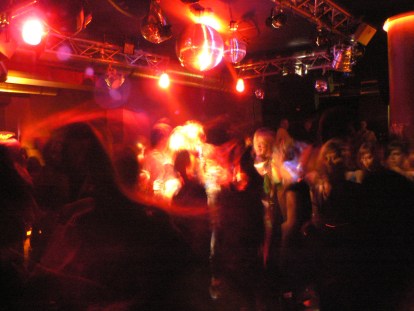
Photo by Flickr User curran.kelleher
Listening via vibration is something that Cara Cardinale Fidler writes about in her poetic account of growing up with deaf parents. She remembers,
In high school, I went to a dance at the Fremont School for the Deaf where my parents were chaperones. It was easy to find the dance; you could hear the throbbing bass from across campus. It was so loud, it hurt. When I walked in, I wasn’t surprised to see a wall full of uncomfortably dressed teenagers holding balloons to feel the sound and bobbing their heads in tempo.
In this passage, Cardinale Fidler amplifies the tactile experience of sound—the ability of all bodies to listen-feel through the force of vibration. Sometimes we feel sound in our guts or throats or teeth, but this is not usually an aspect of listening that most people with a working auditory system meditate on, or try to refine in any way.
I think it is important to acknowledge, as Silva and Cardinale Fidler do by example, that the labels “deaf” and “hearing” are not as clear-cut as they may seem. There is a whole range of auditory function among people who are given these labels, or who fit somewhere between them. Sound scholars might think of deafness, then, not as a uniform lack, but as a range of listening practices in which sensory modes other than the ears are employed. Some people rely more on one mode than others, and some might develop synesthetic listening practices.

Evelyn Glennie, playing the marimba faster than the camera can cope with, Photo by Flickr User Bankside
For instance, in the documentary Touch the Sound, percussionist Evelyn Glennie uses the convergence of sound, sight, and touch in her own listening training. We need to start thinking about listening less in terms of binaries (e.g. you either have the capacity to listen or you do not), and more in terms of possibilities. The fact that bodies can be retrained to experience listening via multiple modes highlights the extremely flexible, plastic nature of listening habits and practices. In considering this diverse range of listening possibilities, I wonder how we might design more listening experiences that are truly multimodal—that require or at least present the possibility of listening with more than one sensory mode. How might we expand the listening capacities of all bodies?
Deaf space and architecture is one area that is beginning to take up such questions. Based on the concept of universal design, which emphasizes the production of products and environments that are accessible to both so-called “disabled” and “able-bodied” individuals, deaf architecture considers the ways in which deaf listening bodies move through and communicate within space. These spaces seem particularly well-designed for visual and tactile listening situations. For example, according to blogger Scott Rains, some key principles of deaf architecture include: the use of partial walls or open concept spaces, no sharp angles and curved corners to increase visual range, no sources of glaring light that might impede vision, and wooden floors for more pronounced vibration. Bodies, spatial and material configurations, and the senses were all taken into account in this kind of design. The visual and tactile elements in these spaces accommodate particular bodies and communication practices, but there would be no need for such spaces without the existence of those particular bodies and communication practices. The design of deaf architecture is based on the reciprocal relationship between cultural and physiological needs, which in turn broadens the listening possibilities of the inhabitants of deaf spaces.

The Myer Music bowl, where the Melbourne Symphony Orchestra accompanies Evelyn Glennie, photo by Flickr User learza.
Deaf studies and deaf scholars have much to contribute to sound studies. Expanding ideas about what it means to listen, coming up with new ways to extend the capacities of all listening bodies, and developing more dynamic and complex theories of listening will require sound studies scholars to think about listening not only in terms of the ears, but in terms of bodies, affects, behaviors, design, space, and aesthetics. In this sense, deafness may be one of the most significant and generative areas of research in the continuing development of sound and listening studies.
Conversely, sound studies can offer deaf studies fresh ways to think about how sound shapes/enhances/disrupts deaf cultural practices. As we have seen from the examples above, sound plays a powerful and sometimes complicated role in deaf contexts. Using sound studies approaches and methodologies, then, could help to augment the ways in which sound figures into deaf culture–a subject that has received very little attention thus far. Collaborations between these seemingly contradictory areas of study have the potential to enliven and enrich each other in mutually beneficial ways. Sound studies and deaf studies have a lot to say to each other. They just need to start listening.
__
Steph Ceraso is a 4th year Ph.D. student in English (Cultural/ Critical Studies) at the University of Pittsburgh specializing in rhetoric and composition. Her primary research areas include sound and listening, digital media, and affect. Ceraso is currently writing a dissertation that attempts to revise and expand conventional notions of listening, which tend to emphasize the ears while ignoring the rest of the body. She is most interested in understanding how more fully embodied modes of listening might deepen our knowledge of multimodal engagement and production. Ceraso is also a 2011-12 HASTAC [Humanities, Arts, Science, and Technology Advanced Collaboratory] Scholar and a DM@P[Digital Media at Pitt] Fellow. She regularly blogs for HASTAC.
Share this:


Current Top Posts





April 2021

January 2020

November 2019

October 2019

August 2019

April 2014

November 2017

March 2015

December 2017

October 2015
 Sounding Out!
Recent Comments