
Sounding Out! Podcast #47: Finding the Lost Sounds of Kaibah

CLICK HERE TO DOWNLOAD: Finding the Lost Sounds of Kaibah
SUBSCRIBE TO THE SERIES VIA ITUNES
ADD OUR PODCASTS TO YOUR STITCHER FAVORITES PLAYLIST
In the early 1960s Native American women had few opportunities and rights as citizens. During this politically charged era, a young Navajo woman, Kay Bennett, or “Kaibah”, defied those restrictions by recording and releasing her own albums. Almost fifty years later, we present this conversation with Rachael Nez, a Navajo scholar and filmmaker, whose research explores “Songs from the Navajo Nation” through Kaibah’s records. Kaibah self-published her own albums until she was signed by Canyon records, wrote and published her own books, and traveled the world performing Navajo music everywhere from the Middle East to Europe. Rachael looks at how Kaibah’s music acts as a site for the circulation of Indigenous knowledge, oral history, and resistance.
In this podcast Marcella Ernest speaks with Rachael about the scarcity of materials relating to Kaibah’s history. Although there is no archive of her work, and no coherent trace of her story in one site, she explains how we can piece together a story of Kaibah based on her albums and songs. This dialogue considers the ways in which Indigenous erasure can be recuperated through sound. The project of finding the lost sounds of Kaibah is a fascinating story of how sound can be used to reconstitute indigeneous identity. What social and cultural norms conspire to obfuscate a Navajo woman of such prestige and talent? Finding the lost sounds of Kaibah is a conversation about (re)searching to find a lost sound.
–
Marcella Ernest is a Native American (Ojibwe) interdisciplinary video artist and scholar. Her work combines electronic media with sound design with film and photography in a variety of formats; using multi-media installations incorporating large-scale projections and experimental film aesthetics. Currently living in California, Marcella is completing an interdisciplinary Ph.D. in American Studies at the University of New Mexico. Drawing upon a Critical Indigenous Studies framework to explore how “Indianness” and Indigenity are represented in studies of American and Indigenous visual and popular culture, her primary research is an engagement with contemporary Native art to understand how members of colonized groups use a re-mix of experimental video and sound design as a means for cultural and political expressions of resistance.
–
Featured image is used with permission by the author.
—
 REWIND! . . .If you liked this post, you may also dig:
Sounding Out! Podcast #24: The Raitt Street Chronicles: A Survivor’s History – Sharon Sekhon and Manuel “Manny” Escamilla
Sounding Out! Podcast #20: The Sound of Rio’s Favelas: Echoes of Social Inequality in an Olympic City— Andrea Medrado
The “Tribal Drum” of Radio: Gathering Together the Archive of American Indian Radio–Josh Garrett Davis
Share this:

Sounding Out! Podcast #46: Ruptures in the Soundscape of Disneyland
CLICK HERE TO DOWNLOAD: Ruptures in the Soundscape of Disneyland
SUBSCRIBE TO THE SERIES VIA ITUNES
ADD OUR PODCASTS TO YOUR STITCHER FAVORITES PLAYLIST
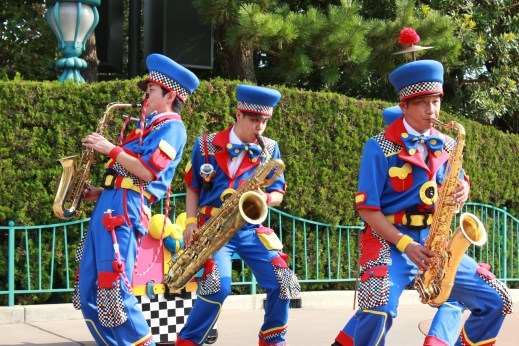
In this podcast, Cynthia Wang shares examples taken from a soundwalk she performed at Disneyland. Disneyland has been an idealized space for the middle-class white American experience, and the aural signals and music used throughout the park encourage visitors to become cultural tourists and to share in this mindset. Here Cynthia considers the moments of rupture that disturb Disney’s controlled soundscape. Join us as we listen for a pathway out of the hyper-consumerist labyrinth of Disney. And, if you would like to learn more about this soundwalk, visit it’s website here.
–
Cynthia Wang is currently a PhD candidate at the Annenberg School of Communication at USC, a USC Endowed Fellow, and a USC Diploma in Innovation grant recipient (for an LGBTQ stories mapping project called GlobaltraQs). Her work is framed in critical cultural perspectives. In the past she has done research on how Asian American musicians use digital media to build community and collaborate, and how crowdfunding sites like Kickstarter and Indiegogo provide new avenues of creative production and distribution for independent artists. Her current research seeks to bring health care into this conversation of power, examining how health professionals manage and organize their time throughout the day, using practitioner-facing methods to identify where institutional systems and processes break down through a lens of time and temporality. In particular, she is interested in how communication technologies impact the organization of time and social relations within the health care system while enacting and/or reinforcing hegemonic power dynamics. In addition to research and academic stuffs, Cynthia is also a singer-songwriter, and just released her EP album (Find it on iTunes, Amazon, or wherever else you get your music).
–
Featured image “Toontown Sound Makers” by Ryutaro Koma @Flickr CC BY-NC.
—
REWIND! . . .If you liked this post, you may also dig:
Park Sounds: A Kansas City Soundwalk for the Fall – Liana Silva
Sounding Out! Podcast #43: Retail Sounds and the Ambience of Commerce – James Hodges
Sound(Walking) Through Smithfield Square in Dublin – Linda O Keeffe
Share this:


Current Top Posts





April 2021

January 2020

November 2019

October 2019

August 2019

April 2014

November 2017

March 2015

December 2017

October 2015
 Sounding Out!
Recent Comments