
GLaDOS, the Voice of Postfeminist Control

Warning, spoilers ahead. Image borrowed from ElderGeek.
Much has been written about Portal, it has won at least seven “Game of the Year” awards and has been ranked as the “Best Game of all Time” by Gamesradar. Perhaps because both the hero and antagonist are women, it has also been the object of several cultural critiques. One blogger writes, “GLaDOS [the game’s villian] is the archetypical oppressed woman.” In an article published by GamePro (a mass-market game review magazine) GLaDOS is considered a “feminist icon.” Although “feminist icon” is a bit extreme, GLaDOS does have a lot to do with feminism. When seen in light of Rosalind Gill’s (2007) essay, “Postfeminist media culture,” GLaDOS, and her wry, disembodied voice, hold striking parallels to the immanence of surveillance in today’s world.

GLaDOS and Chell. Borrowed from gryphonworks @ deviantART.
At their core, the games in Valve Software’s Portal series are relatively straightforward: you are put in control of a female character named Chell, who is attempting to escape from the Aperture Science Laboratory complex. Equipped, mainly, with a portal gun (think Yellow Submarine, “Hole in My Pocket”), Chell traverses precipices, laser drones, acid pits and everything in-between. As she navigates and manipulates these obstacles, a disembodied Orwellian voice guides Chell from one puzzle to the next. This is the voice of GLaDOS (Genetic Lifeform and Disk Operating System), a self-aware computer who runs the joint (at least in Portal 1) and is keeping you around for further “testing.” Where Portal is claustrophobic, just you and GLaDOS, Portal 2 is a little more dynamic. A third character, Wheatley, is introduced. In both games, however; there is an inescapable feeling of surveillance and scrutiny. GLaDOS’s monotonous voice is everywhere, the robotic platforms of the Aperture complex are the only appendages of her body to be found.
What to make of the GLaDOS’s character? Although she is helpful at first when guiding Chell through the early tests, GLaDOS quickly adopts a sarcastic tone – putting Chell down, and belittling her mistakes. G. Christopher Williams of PopMatters reads into the backstory a bit. He points out that GLaDOS is modeled on the personality of the Aperture Science CEO, Cave Johnson’s, wife: Caroline. In the second game there is a tape of Johnson elaborating:
Brain Mapping. Artificial Intelligence. We should have been working on it thirty years ago. I will say this—and I’m gonna say it on tape so everybody hears it a hundred times a day: If I die before you people can pour me into a computer, I want Caroline to run this place.
Now she’ll argue. She’ll say she can’t. She’s modest like that.
But you make her.
Hell, put her in my computer. I don’t care.
GLaDOS, then, has a bit of a history. Within this history there is a glass ceiling. GLaDOS has had a dampening sphere installed to limit her “irrational thinking,” and curb her “misbehavior.” Tellingly, this sphere whispers terrible ideas to her in a babbling male voice. At the end of Portal 1, Chell destroys the dampening sphere, and GLaDOS is free to get revenge on the society that has caged her. At this key moment, the tonality of her voice shifts from accommodating to sultry.
This change in voice accompanies a change in disposition. As Chell continues her adventures in Portal 2, GLaDOS returns with a set of suspiciously cutting remarks. Several barbs are made about Chell gaining weight, being unintelligent, and being adopted. In the sequel, GLaDOS is especially critical of Chell’s body. These pot-shots figure perfectly into Gill’s (2007) hallmarks of postfeminism: 1) the increased self-surveillance of the female body, 2) the increase of surveillance in new social sectors, and 3) a focus on the psychological transformation of one’s self, or interior life. Chell, the avatar, isn’t being judged on her weight (or lack thereof). Instead, GLaDOS’s remarks cut to the player, who recognizes that neither they nor Chell fit GLaDOS’s ideal. Although, in the narrative, GLaDOS typifies an extension of invisible and disembodied surveillance into new spheres of life, her comments act to foster self-surveillance in the embodied player.
GLaDOS’s comments have even jarred some users in the Steam Users’ Forums (Steam is Valve’s online distribution platform). In a thread entitled, “Portal 2 Sexist,” one user, loodmoney, asked if anyone else found GLaDOS’s fat jokes off-putting. To this, another user, Killalaz replied, “GLaDOS is trying to discourage/dishearten the testers. Chell is a woman, what bothers a woman more than being called fat? Not much. . .psychological warfare so to speak.” Although Killalaz may be reading too literally into Portal 2’s narrative, he is right about one thing: to some extent, GLaDOS, and therefore Valve Software, is waging psychological warfare on us all. Later in the thread another user, BC2 Cypher, demonstrates the extent that attitudes of self-surveillance can work to mold one’s psyche, “I don’t see the issue he’re. I actually used to BE fat. Lost 72 pounds when I was 15. 232 – 160. It’s not like Chell is even fat. That is the joke.” The real joke, if there is one, is that so many players are content to reduce GLaDOS’s comments to a self-contained dialogue between fictional characters. What is heard, actually, relates directly to the way dialogue from Portal is internalized. In these forums, the voice of GLaDOS is reproduced; it mediates the bodies of some fans (by supposing an ideal weight), and surveils the bodies of others (by guiding the dialogue).
But, when I play Portal, I occasionally smirk at GLaDOS’s comments. They are cutting satire. If GLaDOS is a feminist icon, it is because she is a voice that everyone carries with them at all times. The voice in our heads, that causes us to judge and shape ourselves, while simultaneously passing unkind judgment on to others. GLaDOS is iconic of the postfeminist condition – a condition where surveillance is assumed and internalized. And, our bodies are shaped through the hyper-mediation of games like Portal, and characters like GLaDOS, as they replicate themselves in web forums, and in our own voices.
AT


Share this:

Y2K, Collective Ritual, and Sound in the New Millennium
 The recent New Year brought back some slightly embarrassing memories of past ball-droppings, 1999 in particular. That was the year, you’ll remember, when the world as we know it was to end due to all the clocks in all computers reading 0000 instead of 2000 – nuclear plants were to implode, bank accounts would be scrambled and a month later, the world would resemble some scene from The Road Warrior. I’ll fess up. I bought into the Y2K hype hook-line-and-sinker. I hunkered down in my living room with some old friends playing Risk that New Year’s Eve, I awaited an event of cataclysmic proportions. As the countdown droned on TV, it seemed every dice roll took me one step closer to the end . . . 10, 9, 8, 7, 6, 5, 4, 3, 2, 1. Upon zero, nothing changed and anxiety slowly began to leak from my body. Sting appeared on TV and introduced the new millennium with his jazzy “Brand New Day.” With lyrics about time and second chances, I grew to associate the song with a sense of profound relief. No matter how hokey Stings lyrics were (he uses the term “fuddy-duddy” at one point), “Brand New Day” will forever remind me of second-chances and possibility. Part of a clever advertising coup designed to reinvigorate Sting’s flagging career, the gospel tropes used in “Brand New Day” fit as a discursive response to the apocryphal (and apocalyptic) conversations circulating about Y2K at the time.
The history of technology is filled with utopian and dystopian visions of the future. Famously depicted in Apple’s “1984” commercial, the technocratic American narrative (Think Reaganomics) goes something like this: While developments in technology can allow for an increased sense of autonomy and individuality, they are unerringly used for evil. This evil strongly resembles a stereotypical Soviet culture where individuality is sacrificed for the good of the collective whole. Therefore, good technology promotes the individual while evil technology supports the collective.
 If this seems a little heavy handed, it should be noted that the whole endeavor of mass computing has its roots in American Cold War history. After the atomic catastrophes of Hiroshima and Nagasaki, Vannevar Bush, then Director of the Office of Scientific Research and Development, predicted the Internet with the “memex machine” in his article to The Atlantic, “As We May Think.” Written to an unassuming audience, Bush suggests the destructive potential of atomic weaponry heralded a concrete limit to traditional methods of warfare, because of this the next battlefronts would be informatic. Y2K is a dystopic variation on this theme, atomic blow up by-way-of nuclear power had even become incorporated into some of its myths. These myths were a fantasy, to be sure, but they were rooted in the collective fears of a confused and dysphoric America, an America which had recently overcome Communism and lauded its rapidly developing technological sector as a new source of economic capital on the world stage. Y2K was scary because it played on a cultural fear of technology, which was paradoxically one of America’s key exports at the time.
It is an interesting contrast between the cultural environment of post-Cold War America and the loose backup calls of “brand new day,” with its rhythmic pleas to “stand up!” increasing in frequency and intensity as the song continues. Though the song has nothing to do with Y2K, or even technology, its position as a televised event after the ball dropped December 31, 1999, had solidified it forever in my imagination as a spiritual reaction to the technological paranoia of the time. Sting conveys a baptism narrative; as a country we had mysteriously been absolved of our technocratic sins. I was (and am) a believer. As I sit writing this on my iMac, I consider the many marketing strategies Apple has used in the last decade to convince me of the ways their software and hardware could define me as an individual. Sting redeems the pursuit of individuality through the use of gospel tropes. Instead of an almighty passing the judgement of heaven or hell, a technocratic neoliberal economy threatened the wrath of Y2K to nonbelievers at the turn of the millennium. As the proverbial gates to a new era of prosperity opened, Sting climbed higher in falsetto, “Stand up and be counted every boy and girl/Stand up all you lovers in the world/We’re starting up a brand new day.”
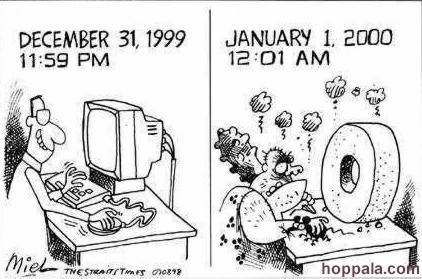
This year, as I watched a web steam of the ball drop January 31, 2010, I was able to later navigate to the MTV website and enjoy a Flaming Lips concert in Oklahoma City live from my computer. In this transition, something struck me. The potentials of computing, particularly video and sound editing (iMovie, Garageband and their disseminatory middle-man YouTube) still rely on an earlier Cold-War rhetoric of individualism and creative innovation to express the potential strengths of technology. Meanwhile any sense of collective ritual is set to the whim of a mouse-click, from New York to Oklahoma in a heartbeat. These new rituals compete with the old in a new context of hyper-individuality; ironically “Brand New Day” has become stuck once more in my head, as it has been routinely on New Years for the past 10 years. From these changes in collective ritual, what will it mean to celebrate the new year in 2011?

Share this:


Current Top Posts





April 2021

January 2020

November 2019

October 2019

August 2019

April 2014

November 2017

March 2015

December 2017

October 2015
 Sounding Out!
Recent Comments