
X! : Blog-O-Versary 10.0

** Click here to head straight to our free, downloadable X! 10.0 Blog-O-Versary Mix! It’s okay, like Tupac, we ain’t mad at ya! It’s cool to come back here though and check this out. **
We didn’t have a clue where the blog was headed when we started out in 2009, packed into AT’s humid apartment on Seminary in Binghamton, alternately helping him pack, looking through his records, and making plans for this writing thing we were going to do together to stay in touch. I had a newborn baby strapped on my chest, Aaron was leaving BU to start a PhD program at Rutgers and Liana was embarking deeply into her dissertation (and just a year later for Kansas City. . .for the full origin story, catch our recent co-authored piece “The Pleasure [is] Principle: Sounding Out! and the Digitization of Community” in Digital Sound Studies). Our tight-knit research crew was facing so much change and uncertainty, that I’m pretty sure we decided to name the blog Sounding Out! as a form of echolocation. If talking and thinking about sound waves had brought us together in the first place, perhaps their resonance could stretch out to fill the unknown contours of the future that lay ahead.
And over the past decade, it has. Not just for us as friends, co-workers, and eventually shared hive-mind cells, but for the field of sound studies, which in the same decade went from “huh?” to “emerging,” then from academic hipster cred and to everybody’s tryna put “soundscape” in everything, to the New York Times magazine does a cover story on it AND you can now get a Masters in it at Northwestern University in Chicago [shout out to SO! special editor Neil Verma, who not only edited a media stream for us from 2013-2016 but—among many other awesome things—helped get this very program up and running]. It’s no coincidence that the field’s trajectory and reach has grown exponentially along with ours, and we are proud as hell of that.
Other things we are most proud of:
- that, on separate occasions in the past year, two brilliant people have told us that reading SO! inspired them to go to grad school because our site hosted and valued research on sound by/about women of color (these stories are literally our favorite 😭 😭 😭 and inspire us to go even harder!).
- growing deep, connected relationships among scholars and professionals in the field infused with fun and feeling amongst the brilliance and rigor.
- surpassing one MILLION unique clicks (not that “metrics” has ever been our goal but holla!!).
- getting on the podcast tip early (2010!!) and staying weird as hell with it (free format por vida!).
- always being down to shout out and collabo (over the years we’ve worked with Antenna, Locatora Radio, The Radio Preservation Task Force, IASPM-US, Soundbox, The Middle Spaces, Tuned City Brussels, WHRW 90.5, Everything Sounds, Not Your Muse, and The UC Riverside Punk Con, among many others. In 2020 we have something going with the Zora Neale Hurston festival in Eatonville, Florida. . . stay tuned!).
- publishing a post on “Old Town Road.” IJS. Our regular writers always bring it. Thank you to Justin Burton and Robin James, our current roster, and to all of our past fam: Regina Bradley, Enongo Lumumba-Kasongo, Maile Colbert, Osvaldo Oyola, and Andreas Pape.
- pushing so hard for our reach, readership, and coverage to become increasingly global (in the past year we hosted pieces from and/or about Argentina, Australia, Canada, China, Cuba, Mexico, New Zealand, Russia, and Ukraine).
- developing a strong undergraduate internship program through Binghamton University that brings us literally the best interns in the WORLD 💯. They bring us new ideas, excitement, and new social media accounts, and we entrust them with everything we know about editing and digital publishing. It’s been a blast, and we are so proud they’ve all gone on to do wonderful work in the world.
- that our roster of writers more accurately represents the diversity of sound studies scholars than any other publication out there by leaps and bounds.
- that SO! has continued to evolve in interesting ways while strengthening and refining our guiding mission over the years: to find, nurture, and share accessible top-notch scholarship/art/thought that investigates how power impacts how we sound and listen, while amplifying sound studies knowledge toward social justice.
- AND MOST IMPORTANTLY, that so many readers have put their faith in us and so many amazing writers have thought of us as a home for their work. We take your trust so very seriously, and remain humbled by your generosity and confidence. Thank you, thank you, THANK YOU for being Sounding Out! along with us.
I’m trying to keep it short and cute today, not saying too TOO much because this post [our 624th!] is neither a retrospective nor a tribute, but a celebration. . .as Diddy once said, we ain’t going nowhere! [Editors’ Note: Other notables JS has referenced in the previous decade of Blog-o-Versary posts includes Bob Marley, LL Cool J, De La Soul, Schoolhouse Rock, Dionne Warwick, the Solid Gold Dancers, S.E. Hinton, Beyoncé, Langston Hughes, X-Ray Spex, A Tribe Called Quest, Fred Moten, Bill Withers, and . . . Taylor Swift. Oof.]. And bet, we have AMAZING things planned for next year, including forums on Soundwalking while POC (starts next week!), the 50th anniversary of Charles Mingus’s Ah Um (guest edited by Earl Brooks), audiobooks (edited by Liana Silva), and sound and climate change (guest edited by Anja Kanngieser), an undergraduate sound studies showcase, and . . . . . . . . . .
[🥁🥁🥁🥁🥁🥁🥁]
we just finished a book proposal for a Sounding Out! anthology: working title Power in Listening: The Sounding Out! Reader.
[🎉 insert airhorn sound here 🎉]
YES! We couldn’t be more grateful for the last ten years, and we couldn’t be more excited for what’s coming up next. Even though we didn’t know where we were headed in 2009, we have arrived nonetheless, and all because we knew what we wanted—to create a community just like this one. Happy X! Blog-o-Versary to all of us, today!
–JLS, LMS, and AT
XXXXXXXXXX Highlight Reel XXXXXXXXXX
- Enongo Lumumba-Kasongo successfully defended her dissertation, and had the chance to open for Bikini Kill in June, under her stage name Sammus. In fall of 2019 she will be starting a two-year postdoc at Brown University’s music department, and will be getting married to fiction writer Lance Akinsiku. She is presenting a Making/Doing session at this year’s 4S Conference in New Orleans in September.
- John Melillo has a new essay on the French sound poet Henri Chopin in Ties: Journal of Text, Image, and Sound. His book, The Poetics of Noise, is under contract for Bloomsbury’s Sound Studies list.
- In summer 2018 Kristin Moriah began a position as an Assistant Professor of African American Literary Studies at Queen’s University in Kingston, Ontario. “Where Are the Black Angels?” her review of Mickalene Thomas’s historic exhibition at the Art Gallery of Ontario is forthcoming in PAJ: A Journal of Performance and Art 123, as is “A Greater Compass of Voice: Elizabeth Taylor Greenfield, Mary Ann Shadd Cary and Black Performance in Nineteenth-Century North America,” which will be published in Theatre Research in Canada. She is excited to attend the ASA annual meeting in Honolulu where she will present “Playing the Red Record: Black Feminist Recording Practices.”
- Phillip Sinitiere published several pieces on W. E. B. Du Bois in The North Star. He also co-organized a forum on Shirley Graham Du Bois at Black Perspectives. He is the 2019-2020 W. E. B. Du Bois Visiting Scholar at UMass Amherst.
- SO! Ed-in Chief Jennifer Lynn Stoever published three essays in 2018/19: “‘Doing fifty-five in a fifty-four’: Cop Voice, U.S. Policing and the Cadence of White Supremacy” (Interdisciplinary Journal of Voice Studies), “Black Radio Listeners in America’s ‘Golden Age'” (Journal of Radio and Media Studies), and “Crate Digging Begins at Home: Black and Latinx Women Collecting and Selecting Records in the 1960s and ‘70s Bronx” in the Oxford Handbook of Hip Hop Studies, which you can download for free here.
And remember, the “notes” on our Facebook page is *still the best place to hear about calls for art, calls for posts, and upcoming conferences, shows, and volumes in sound studies. “Like” us here and please continue to keep us in the loop regarding new projects. We love to signal boost, as you can probably tell by our very active Twitter feed!
Clic here for Sounding Out!‘s Blog-O-Versary “X!” mix 10.0 with track listing (and of course which writers suggested which songs)!
—
Jennifer Lynn Stoever is co-founder and Editor-in-Chief of Sounding Out! She is also Associate Professor of English at Binghamton University, lead organizer of The Binghamton Historical Soundwalk Project and author of The Sonic Color Line: Race and the Cultural Politics of Listening (NYU Press, 2016).
—
REWIND! . . .If you liked this post, you may also dig:
-

- 2018
-

- 2017
-

- 2016
-

- 2015
-

- 2014
-

- 2013
-

- 2012
-
- 2011
-
- 2010
- 2018 “Sound the Alarm” mix 9.0
- 2017 “!!!!Resist!!!!” Blog-O-Versary mix 8.0
- 2016 Blog-O-Versary “!!!!!!!” mix 7.0
- 2015 Blog-o-Versary 6.0 Keep on Pushing! (Our 400th post!!)
- 2014 #flawless 5.0 celebration and mix
- 2013 Blog-o-Versary 4.0: Solid Gold Summer Countdown!
- 2012 #Blog-O-Versary 3.0: Can’t Stop Won’t Stop (The Awesomeness)!
- 2011 “Awesome Sounds from a Future Boombox” 2.0
- 2010 First Blog-O-Versary party mix: A Celebration of Awesomeness
Share this:

SO! Amplifies: The Electric Golem (Trevor Pinch and James Spitznagel)
—
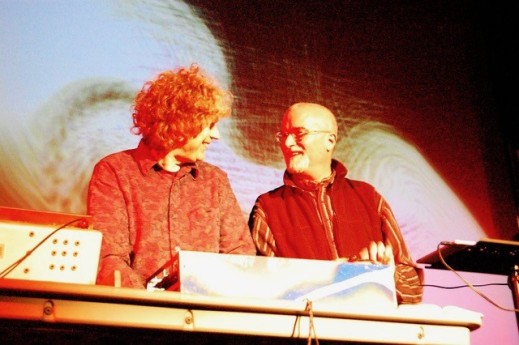
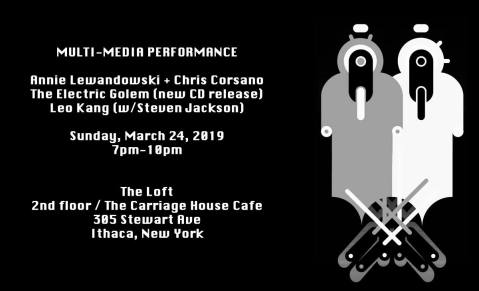
On March 24th, 2019 the record release party for The Electric Golem’s 6th CD Golemology was held at the Loft in Ithaca, New York. The Electric Golem is an avant-garde synthesizer duo featuring Trevor Pinch and James Spitznagel, that has been in existence for about ten years.
Trevor Pinch is a local sound artist and professor at Cornell University. He is an STS (Science and Technology Studies) and Sound Studies scholar. As a key thinker of STS, Trevor is the coproducer of theories about Sociology of Scientific Knowledge, Social Construction of Technology (SCOT), and the role of users in technological history and innovation. However, Trevor’s interest in dates back much farther; he built his first modular synthesizer when he was a physics student in London in the 1970s.
The other half of The Electric Golem, James Spitznagel, is a multi-media artist who uses the iPad as a musical instrument and to create digital paintings. While he has played many roles in the music and culture industries—guitarist in a rock band, record store owner, art gallery and guitar shop investor, and even business manager for the Andy Warhol Museum—he moved to Ithaca to focus on producing abstract art: digital paintings and experimental, improvisational music. Being an energetic and enthusiastic person who has unrestrained fantasies, James finds that everything around him can be his inspiration.
Pinch and Spitznagel formed the group after Spitznagel read Analog Days: The Invention and Impact of the Moog Synthesizer (by Trevor Pinch and Frank Trocco) and realized Pinch also lived in Ithaca. Spitznagel simply looked his name up in the phone book and called him up: “I go, ‘is this Trevor Pinch?’ He said, ‘yes.’ I said, ‘well, you don’t know me, but I just read your book and I love it.’” And then they got together for a beer and have been best friends and collaborators ever since. Once Spitznagel heard about Pinch’s homemade synthesizer, he asked Trevor to try to make something together and it turned out to be a fascinating mixture of analog–Trevor’s synth, Moog Prodigy, and a Minimoog–and James’s digital instruments.
Building from this first moment of discovery, The Electric Golem’s music is electronic, experimental, and totally improvised. Typically, the pieces of music last twenty minutes to half an hour and expresses their interaction with the machines and with each other in the studio. James is much more controlling of the tone and rhythm, and patches the sound as he goes along, whereas Trevor is much more about making spontaneous weird sounds. They complement each other and the creation process is usually by random and spontaneous, as Spitznagel describes: “I didn’t tell Trevor what to do or what to play, but I said, here’s the piece of music I’ve written. He just instinctively knew what add to it.” Reciprocally, “he might just play something that I go, oh, I can weave in and out of the ambient sound he’s putting there.”
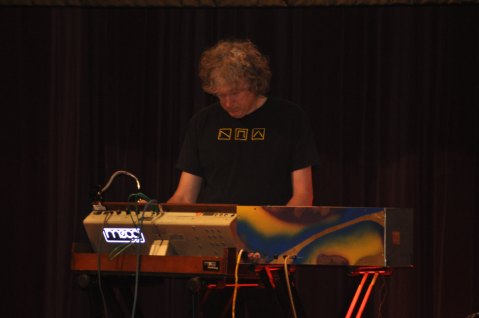
Trevor Pinch, Electric Golem at Elmira College, 2012
For the duo, the process of producing music becomes a shared experience with their listeners. The music is ever changing and evolving. In addition, unexpected drama adds vitality to the palette. “The iPad might freeze up or synthesizer might break somehow,” Spitznagel notes, “that’s happened to us, but we carry on. Like Trevor looks at me and says, it’s not working there. Or, I look at him and go, I have to reboot my computer, it’s not working. But, those times actually inspire us to try new things and go beyond what we are doing.” James explained. Their inspiration comes from the unknown, which just emerges from their practice. “Generally, this sort of music is completely unique to Electric Golem.” Trevor concluded.
The name “Electric Golem” comes from a series of books with Golem in the titles that Trevor collaborated on with his mentor Harry Collins. “The golem is a creature of Jewish mythology,” Pinch and Collins wrote in The Golem, What You Should Know about Science, “it is a humanoid made by man with clay and water, with incantations and spells. It is powerful, it grows a little more powerful every day. It will follow orders, do your work, and protect you from the ever threatening enemy. But it is clumsy and dangerous. Without control, a golem may destroy its masters with its flailing vigour” (1). Noting Trevor’s association with the concept of the Golem, Spitznagel added the “Electric” twist not just as a metaphor for their sound but also because “it’s kind of like a retro name.” The Electric Golem mushroomed from there, and in the past decade they have had many invitations and bookings to play out, receiving the first recording contract from the Ricochet Dream label, and have played with a bunch of notable musicians, such as Malcolm Cecil of Tonto’s Expanding Head Band, Simeon of Silver Apples, and “Future Man” (aka Roy Wooten), and they haven’t stopped there.
According to Pinch, the key feature of The Electric Golem’s music is its ability to encompass different moods. “I think Electric Golem has become good at one thing: its changing and transitioning from one sort of mood of music to another. And we have become quite good at those transitions. I think people would say that’s what they kind of like about us.” These sorts of slow transitions construct a unique texture of sound that can be quite cinematic, so much so that in 2012, the Electric Golem performed the accompaniment to the silent movie A Trip to the Moon, a special Cornell cinema event. Overall, as improvised experimental music, it is sometimes challenging to listen to, with no regular rhythm or reliable melody. Trevor produces warm, rich drones from the analog side that contrast with the sharper digital rhythms that James programs. In short, the Electric Golem varies between these two affects but the music goes far beyond the representation of emotional states; sometimes it conjures up the feeling of the vastness of space and time.
Experimental music, is a collaboration and negotiation process between instruments and their users. No matter if analog or digital, instruments have autonomy; they are non-human actors with their own agency to some extent. As Trevor Pinch intimates, “I understand the general sort of sound that can be produced, but the particular details of how it will work out, you don’t really know, that’s much more spontaneous, you have to react to that.” Instruments can often be uncontrollable–making their own sounds—so that Electric Golem must respond in kind. “So, it’s sort of like higher level meta-control versus actually doing what you’re doing in response to the instrument that combines together,” Trevor describes, “which I think is the secret to controlling these sorts of instruments.” It is incredible that Pinch and Spitznagel know each other so well—and each know their instruments so well–that they can improvise for long periods with no trouble. Trevor says: “Follow the use of these instruments! Follow the instruments! They are not essentialized. They are just stabilized temporarily.”
On the whole, The Electric Golem shows an artistic form which breaks the traditional paradigm, deconstructs and then reconstructs it, seeking to free sound from the instruments. Their music is beyond pure melody and rhythm, beyond the expression of existence, expressing more of an aesthetic state of transcendence. They challenge what music is, and what musical instruments are; they challenge divisions between the identities of engineer and musician. Electric Golem’s music co-constructs art and technology and binds them together; art, for them, is a mode of presenting technology, and vice versa, technology is a pathway through which art can flourish.
My favorite Electric Golem piece is called “Heart of the Golem.” What is the heart of the Golem? According to Pinch, “It is a mystery, a process of unfolding and discovery. It is somewhere where analog and digital sound meet, and an improvisation.” What the magic is remains unknown and unlimited, just like the future of the Electric Golem.
—
Featured Image: Courtesy of The Electric Golem
—
Qiushi Xu is a PhD candidate in the subject of Philosophy of Science and Technology in Tsinghua University, Beijing and in a joint PhD program in the Department of Science and Technology Studies in Cornell University, working with Prof. Trevor Pinch. Her research areas are Sound Studies, STS, Cultural Studies and Gender Studies. Her current research focuses on the sociology of piano sound and the negotiation and construction of piano sound in the recording studio (PhD dissertation), gender issues in recording industry, experimental music, auscultation and sound therapy. She holds an MA in Cultural and Creative Industries from King’s College London; a BA in Recording Arts and a BA in Journalism and Communication from the University of China, Beijing. She is also an amateur pianist, writer, and traditional Chinese painter. As a multiculturalist, she is am fascinated by different forms of art and culture in different cultural contexts.
Share this:


Current Top Posts





April 2021

January 2020

November 2019

October 2019

August 2019

April 2014

November 2017

March 2015

December 2017

October 2015
 Sounding Out!
Recent Comments