
Sounding Visibility in Anglo-Latin Prose
DOI: https://doi.org/10.59350/pt6bk-crg56
Here is a distilled introduction to the latest installment of Medieval Sound, Aural Ecology, by series co-editors Dorothy Kim and Christopher Roman. To read their previous introduction, click here. To read the first run of the series in 2016, click here. To read the full introduction to “Aural Ecology” and to read last week’s post by Thomas Blake, click here.
Aural Ecology
What is considered music, noise, or harmony is historically and culturally contingent. [. . .] The essays in “Aural Ecologies” address the issue of unharmonious sounds, sounds that often mark dissonant critical identities—related to race, religion, material—that reverberate across different soundscapes/landscapes. In this way, this group of essays begins to open up the stakes of Medieval Sound in relation to what contemporary sound studies has begun to address in relation to cultural studies, architectural and environmental soundscapes, and the marking of race through the vibrations of the body. —Dorothy Kim and Christopher Roman
While the raucous rancor of last year’s Super Tuesday was dominating network news and social networks—which, sadly, seems so long ago now—a quieter news story emerged from the tranquil fields of Lincolnshire: an Anglo-Saxon island has been discovered. Its artifacts are some of the most remarkable to have been found in recent decades; among these finds are writing utensils, game pieces, butchered animal bones, and other indicators of a sustained trading community.
The Guardian reported that surveys and software enabled the archaeologists to model the island in its contemporary landscape and seascape, revealing that it had once rested “between a basin and a ditch.”
This placement, the lead archaeologist continued, suggests that the site “was a focal point in the Lincolnshire area, connected to the outside world through water courses.” So if these reimagined waterways can show us how people saw the site, can they tell us how people heard it, as well?
I think so, especially because of the recent work on ancient acoustics in early churches. In February, The Atlantic published an article on the recent scholarly collaboration among an art historian-archaeologist, a music producer-engineer, and the founder of the USC Immersive Audio Laboratory (yes, it’s a real thing). This super-interdisciplinary team was able to “map the acoustic fingerprint of several [Byzantine] churches,” which were shown to have been deliberately “designed to shift a person’s sensory experience.” Now, the USC member explains, they can record a chant, “process it … and all of the sudden we have performances happening in medieval structures.” They can actually rebuild the sounds of our ancient past. [By the way, Allison Meier of hyperallergic reported on this story as well; her article provides links to the Escape Velocity podcast on Acoustic Museums, which is well worth a listen].

If they can recreate the lost sounds of ancient structures, and archaeologists can recreate early medieval topographies, then it stands to reason that the recreation of past landscapes, and even seascapes, might not be far behind.
But was sound different across the cooler, wetter climate of the early Middle Ages? Were the hearers’ auditory contexts drastically different in a pre-modern world? To what effect?
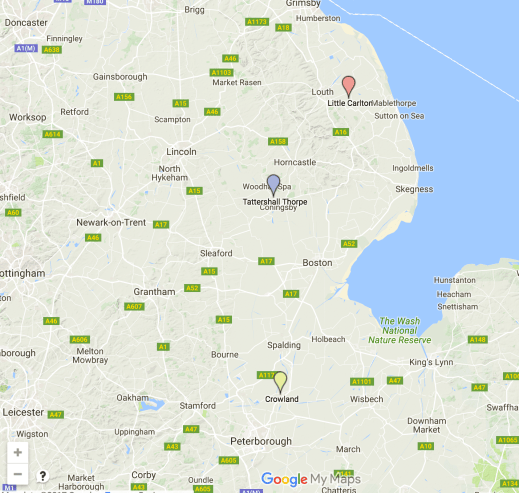
To me, what’s tantalizing about the Lincolnshire island is that it was on the border of the early medieval fenland—an area described by the 8th-century monk Felix as dense and undulating, “now consisting of marshes, now of bogs, sometimes of black waters overhung by fog, sometimes studded with wooded islands and traversed by the windings of tortuous streams” (Ch XXIV, trans Colgrave p 87). In such an aqueous environment, sound would have travelled well, staying close to the cool, dense air hovering over the waters.

In his prose hagiography, the Life of St Guthlac, Felix enshrines certain sounds in the wetland ecology of Guthlac’s surroundings. He does so most explicitly at the landing-place, where visitors must “sound a signal” to alert the hermit that they’ve arrived. But what was this signal, and why would Felix bother to emphasize such a mundane practice of alerting your host when you’ve arrived?
In monastic communities bells were used to sound the Daily Office to calling each member together in prayer. As moderns, we should remember that these bells—frequent, sonic interventions of everyday life—were rung on the shore, or in a church, or on monastic grounds rather than from the larger towers of later belfries (an exception to this is the early Irish Round Tower). These small hand-held bells “of hammered sheets or cast metal” which “would presumably have clanged or tinkled, rather than tolled sonorously across a distance” (Resounding Community, 103).
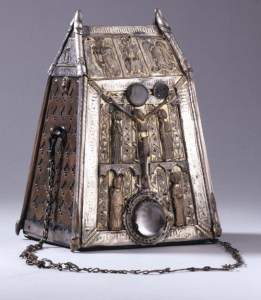
Bells were spiritual and supernatural; they could cleanse or curse, and were kept by clerics and lay people alike. They were sometimes sworn on, as if they were relics. Sometimes, they were made into relics. For more about early Irish bell traditions, click here and or/ here.
In Northwest Europe in the Early Middle Ages, Christopher Loveluck describes David Hinton’s work on a seventh-century smith found buried alone, “next to the marshland and waterways to the sea, with his tools, a bell, a fine seax and a silk-wrapped amulet” and therefore “emblematic of the transition from such ‘outsider’ itinerant artisan/merchants to the vibrant artisan and trading communities of the emporia ports.” Still, the“[p]erception of threat from itinerant ‘outsiders’ is emphasized in the late seventh-century Anglo-Saxon law code of Wihtred, by the obligation on non-local travellers and foreigners to announce themselves with bells or horns, prior to leaving principal roads or trackways to approach settlements.”
For seventh-and eighth century people, then, bells sounded time, community, and stillness as well as place, strangeness, and travel. In either instance, the aural intrusion always betokened a human presence. And of course, these were some of the only sounds that weren’t naturally occurring; this might have been as close as they got to manmade sound pollution.
For Guthlac, sound was especially important because he could not see far from his earthen hermitage. Not having any need for a bell to sound the Daily Office, he nevertheless depended on some kind of signal for approaching visitors.
In one episode, distraught parents bring their once-possessed, now very ill son to Crowland in the hope that he might be cured. This is quite different from an earlier visitation from Wilfrid and Æthelbald, whom Guthlac knew personally, and with whom he might have traded correspondence. To me, this is the real test of Guthlac’s grace: will he help the neediest? The stranger? The tired, desperate parents? Does the bell, or whatever the signal is, proclaim their sameness or difference?
We can sense the tension in the passage, during their sounding of the signal and speaking to Guthlac:
Then when the sun rose in its splendour, they approached the landing place of this said island, and having struck the signal they begged for a talk with the great man. But he, as was his custom, burning with the flame of most excellent charity, presented himself before them…[and after hearing their story] immediately seized the hand of the tormented boy and led him into his oratory, and there prayed on bended knees, fasting continually for three days…(XLI, Colgrave 131).
The parents had expected to wait; they expected to plead on their son’s behalf. They expected a struggle to be heard. But—and I do think that’s a rather crucial autem in the Latin—Guthlac is eager to listen; the sound on the shore was enough.
What’s more, his cure is a series of utterances. He prays (aloud) for three days straight, without pausing to eat. And after ritually rinsing and breathing the “breath of healing” on the boy, the child, “like one who is brought into port out of the billows and the boiling waves, heaved some deep sighs from the depth of his bosom and realized that he had been restored to health”(XLI, Colgrave 131).
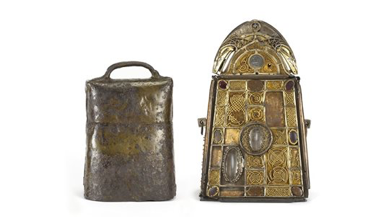
I’m a mom to an asthmatic toddler, so I find myself quite moved by this scene. I can imagine ringing the bell—the thing I might have heard in church, or had in my home; the signal by which monks were called to prayer and children inside for curfew—to make a sound for myself. I can imagine traveling with my husband to a strange place far from home, not knowing what would happen. I can imagine using something everyday for something extraordinary, and having the sound of my arrival echo with anticipation. If I were this mother, I would hear it bounce off the marshes and off the low-lying islands. The dawn would be warming the air above us, amplifying our sound. And I would be standing there, with my child wrapped in my arms, hoping to see someone emerge from a barrow; a man of God whose isolation and entrenchment was supposed to be part of his holiness.
The sound travels outwards to the hermitage and back with the hermit—the echo of her hope, meeting them at the shore. This is a soundscape and a landscape in which time seems still on the shore, but sped through in the oratory. Felix joins both sites, and both temporalities, with the simile of the boy as one rescued from shipwreck catching his breath as he washes ashore. The image recalls the sound of their arrival, and that first bell still seems to ring through this narrative of hope against all odds.
Wouldn’t it be great to hear that again?
—
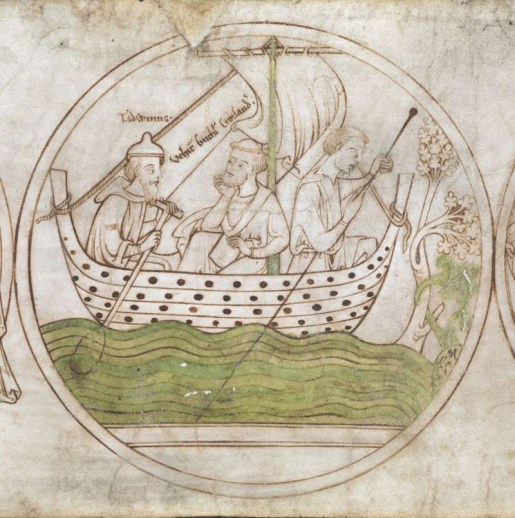
Featured Image: Guthlac sailing to Crowland with Tatwin. © British Library, Harley Roll, Y 6, roundel 4, from Medieval Histories.com
—
Rebecca Shores is a Ph.D. candidate in English Literature at the University of North Carolina at Chapel Hill. Her Dissertation is entitled “Bringing Saints to the Sea: Ships in Old English and Anglo-Latin Hagiography.”
—

REWIND!…If you liked this post, you may also dig:
(Sound)Walking Through Smithfield Square in Dublin–Linda O’Keeffe
Wayback Sound Machine: Sound Through Time, Space, and Place–Maile Colbert
Audiotactility & the Medieval Soundscape of Parchment–Michelle M. Sauer
—
Share this:

(Dis)orienting the Bell: Aural Assault from A Game of Thrones to Richard Coer de Lyon

DOI: https://doi.org/10.59350/s9awx-xvj18
Hear YE! Below is the introduction to the latest installment of Medieval Sound, Aural Ecology, by series co-editors Dorothy Kim and Christopher Roman. To read their previous introduction, click here. To read the first run of the series in 2016, click here.
Aural Ecology
What is considered music, noise, or harmony is historically and culturally contingent. For example, some medieval musical theory, or musica speculative, such as Jan Herlinger’s “Music Theory of the Fourteenth and Early Fifteenth Centuries” in Music as Concept and Practice in the Late Middle Ages, defined music as “contemplation that serves the moral edification of the mind” (293). Influenced by the work of Boethius’s De Musica, music is not just everyday music but “connotes harmony conceived broadly enough to encompass the relationships obtaining in the human body and psyche and governing the motions of planets” (293). This kind of ecological harmony is explored in the work of Boethius, especially in his discussion of abstract qualities in the prelude to the De Musica, The Book of Arithmetic (as translated by Calvin Martin Bower) “Indeed these things themselves are incorporeal in nature and thrive by reason of their immutable substance, but they suffer radical change through participation in the corporeal, and through contact with variable things they change in veritable consistency” (24). For Boethius these “essences” are concordant with mathematical properties expressed in music. Thus, music was both speculative and moral, and these intertwining purposes derived from music’s phenomenological pleasures derived in the environment, “for nothing is more consistent with human nature than to be soothed by sweet modes and disturbed by their opposites” (Bower 32).
Boethius also comments on the psychological effects experienced in hearing music as they “affect and remold the mind into their own character” (Bower 34). Boethius gives examples of how certain groups of peoples, such as the Thracians or Lacedaemonians, delight in different kinds of music that harmonizes with their natures. For Boethius, music is transcendent in that it exists as a kind of eternal sound, but also an immanent sound, in that it appeals to various peoples depending on their nature and environment. Boethius’ speculations lead him to think about harmony and sound as available to reason and sensory perception. Thus the notion of harmony itself is “the faculty of considering the difference between high and low sounds using the reason and senses. For the senses and reasons are considered instruments of this faculty of harmony” (Bower 295). Harmony (and disharmony in the form of noise) became a marker of the aural ecology for an individual or group.
The essays in “Aural Ecologies” also address the issue of unharmonious sounds, sounds that often mark dissonant critical identities—related to race, religion, material—that reverberate across different soundscapes/landscapes. In this way, this group of essays begins to open up the stakes of Medieval Sound in relation to what contemporary sound studies has begun to address in relation to cultural studies, architectural and environmental soundscapes, and the marking of race through the vibrations of the body. —Dorothy Kim and Christopher Roman
In the neo-medieval A Game of Thrones (2011), the medieval Saracen-inspired and violent Dothraki utilize bells as a symbol of victories in battle. Each time a leader or khal defeats a foe, he incorporates the bells from his foe’s shorn black braid into his own braid. Khal Drogo, khal of the most powerful khalasar in Essos, sports an uncut braid sensuously described by George R. R. Martin as “black as midnight . . . hung with tiny bells that rang softly as he moved. It swung well past his belt, below even his buttocks” (37).
Dothraki bells serve both a hypermasculine and deterritorializing function: esteem and prowess for Eastern men comes from the symbolic castration of their enemies and the eradication of civilizations. For the Dothraki, sexualized and territorial conquest is centralized around amplitude of noise made by an aggregate of bells adorning a phallic braid. Drogo is frightening because of his noise: he wears “[b]ells so his enemies w[ill] hear him coming and grow weak with fear” (802). In the pilot episode of Season 1 of HBO’s Game of Thrones, writers David Benioff and D. B. Weiss and director Tim Van Patten emphasized the contrast in noise between the copper-skinned Dothraki and the white Valyrians of the Free Cities:
East disrupts West in this scene through a racialized auditory disruption of white silence.
The association of the Middle East with noise pervades Western culture. One need only recall juxtapositions of quietly carefully groomed news anchors in sterile American news sets conversing with correspondents struggling to be heard in earsplitting raucous streets embroiled in Middle Eastern crises in countries like Iraq and Syria. See Aron Brown of CNN announcing the U.S. War on Iraq in 2003, for example:
However, this association of the Arab world with noise is not a new one. In medieval literature, noise played a crucial role in distinguishing Saracen East from Christian West. Bells and particularly the cacophonous noise they cumulatively make came to be associated with a violent imagining of the East in literature of the medieval period. The late medieval crusading romance Richard Coer de Lyon, centered on the exploits of the twelfth-century crusading king, Richard the Lionheart, situates the pealing bell as its central object. [Note: Richard Coer de Lyon is cited by line number. All quotations come from the widely-used complete modern version, Richard Löwenherz, ed. Karl Brunner, Wiener Beiträge zur Englischen Philologie (Vienna and Leipzig, 1913)].
As in Dothraki warrior culture in A Game of Thrones, bells gain symbolic power in the romance through replication and accumulation. Richard Coer de Lyon features pealing bells in two crucial episodes concerned with the East and a maternal rather than phallic male body: 1) the exorcism of Richard’s demonic Eastern mother at Mass with a sacring bell (l.221-34); and 2) the appearance of Saladin’s demonic mare arrayed in clamorous bells attached to her crupper at the climactic battle of Acre (l.5532-49, 5753-8). Drawing on both medieval treatises on the function of bells and Gilles Deleuze and Felix Guattari’s theory of the refrain, I argue that the bell—initially a symbol of Christian order, the West, and patriarchy—becomes a disorienting aural force associated with chaos, the East, and maternity.
Early on in the romance, the king’s men try the piety of Richard’s mother, Cassodorien of Antioch, a bewitching foreigner whose only apparent fault is that she cannot remain in church to hear Mass, by physically restraining her during a service. To the shock of the English parishioners, at the ringing of the sacring bell, Cassodorien breaks free of her male captors, seizes two of her children, and flies through the church roof never to be seen again:
And whene þe belle began to ryng,
And when the bell began to ring,
The preest scholde make þe sakeryng,
And the priest was about to do the sacring,
Out off þe kyrke sche wolde away…
Out of the church she tried to go away…
Out of the rofe she gan her dyght,
Out of the roof she began to make her way/transform,
Openly before all theyr syght…
Openly before all of their sight…
— Richard Coer de Lyon, 221-5.
At this striking moment of contact between queen and masculine material object, the bell is forever altered, (re)oriented on a trajectory that transmogrifies it from a symbol of priestly power to a chaotic symbol of maternity and the East.

Medieval thinkers conceptualized the church bell as an agent for revealing both foreign and demonic threats from within the community. In The Rationale Divinorum Officiarum of William Durand of Mende thirteenth-century French liturgical writer and bishop, William Durand,xplains the significance of the pealing of bells– “when the bell rings . . . the people are unified with the unity of faith and charity” (51) –but also expounds on this exorcising function of the church bell:
[T]he bells are rung in processions so that the demons who fear them will flee . . . They are so fearful when they hear the trumpets of the Church militant, that is the bells, that they are like some tyrant who is fearful when he hears in his own country the trumpets of some powerful king who is his enemy (51).
Durand conflates the demonic with the East, both qualities embodied by Cassodorien who hails from Antioch (near the border of Syria and Turkey). He also imbues the bell with an emasculating quality; it renders even a tyrant fearful. The measured sounding of the church bells forms a tonal refrain, an aural sequence to familiarize Christian space.
The purpose of the aural refrain, for Gilles Deleuze and Felix Guattari, is to deterritorialize and then reterritorialize unfamiliar space. In A Thousand Plateaus, they explain the refrain/‘ritournelle’ as a threefold place of disorientation, the familiar, and escape:
They are three aspects of a single thing, the Refrain (ritournelle)…. Sometimes chaos is an immense black hole in which one endeavors to fix a fragile point as a center. Sometimes one organizes around that point a calm and stable “pace” (rather than a form): the black hole has become a home. Sometimes one grafts onto that pace a breakaway from the black hole (312).
The bell was arguably the most important and pervasive aural symbol in medieval Europe, one whose refrain regularly demarcated Christian spaces in times of chaos. Sound theorist R. Murray Schafer has called the medieval church bell “the most salient sound signal in the Christian community” in The Tuning of the World (53), and a unifying force “acoustically demarking the civilization of the parish from the wilderness beyond its earshot” (55). Yet, as the bell multiplies through contact with Cassodorien and Richard wanders into the wilderness or black hole of the East, its sound is layered and its signification coopted by the East and transformed into a disorienting force that decenters Saladin’s enemies.

The bell resurfaces once more as Richard prepares for his epic battle against Saladin at the gates of Babylon. In this climactic battle with a second pairing of mother and son, reimagined in the form of a demonic belled “mere” and her “colt” summoned by Saladin’s necromancer, bells occupy a central place of prominence on the mare’s accoutrements. In 1192, Saladin reportedly sent two new horses to Richard after his horse was slain in battle (For an overview of this event, see page 73 of Sir Steven Runciman’s A History of the Crusades, Vol.3: The Kingdom of Acre and the Later Crusades). The mare, as one of only two mothers in the romance, uses the same aural symbol to assault the English Christians that they had used to exorcise Cassodorien. As Saladin’s mare proudly strides onto the battlefield, the poet emphasizes the deterritorializing effect of her cacophonous bells:
þerffore, as þe book vs telles,
Therefore, as the book tells,
Hys crouper heeng al ful off belles,
The mare’s crupper hung all full of bells;
And hys peytrel, and his arsoun.
From the armor, too, and the saddlebow,
þree myle men my3ten here þe soun.
For three miles men could hear the sound.
Þe mere gan ny3e, here belles to ryng,
His mare began to neigh, her bells she rang
Ffor gret pryde, wiþouten lesyng.
With great pride, it is no lie.
–Richard Coer de Lyon, 5753-8.
Fascinatingly, Brunner again diverges in this passage from Caius 175, and changes “þe mere” to “his mere,” further stripping the demonic mare of her agency.
Whereas the church bell is a singular symbol of order, symmetrical and “acoustically demarking” space with its meted refrain, the bells of the mare are multiple, discordant, chaotic, and cacophonous, designed to disorient rather than to unify (see Schafer 55). The medieval illuminator of the Luttrell Psalter (c.1325-1335) similarly emphasizes the clamorous quality of the belled mare, and distinguishes Saladin’s mount from Richard’s by the vast array of bells attached to its crupper and the noise these bells suggest.
The noise, suggested in the Luttrell Psalter by the movement and detail given to the crupper bells, can be heard on a smaller scale in the following video clip of a horse merely walking noisily with a smaller bell-laden crupper:
One can easily infer the discordant sound a running mare might make with a crupper “hung all full of bells.” The poet suggests that the noise encompassed an aural disturbance of three-miles and disrupted the Christian crusaders. The bells also serve an insidious maternal purpose: they serve as a trap to lure her colt to abandon Richard and “knele adoun, and souke hys dame” (kneel down and suck his dame)” (Richard Coer de Lyon, 5547). In A Thousand Plateaus, Deleuze and Guattari suggest the layering of sounds, particularly maternal sounds, can disrupt and deterritorialize space. In their discussion of the reterritorializing effects of layered song, Deleuze and Guattari provide the strikingly maternal example of Debussy’s Sirens, which, they posit, integrates voice with orchestra to make the voices of child and woman inextricable from “the sea and the water molecule” (340). In much the same way in Richard Coer de Lyon, the mare’s imbrication of voice over bells seeks to make the dichotomies of the romance—mother and son, east and west, chaos and order, demonic and angelic—implode as the demarcated boundaries between them are dissolved in her cacophonous demonic lullaby.
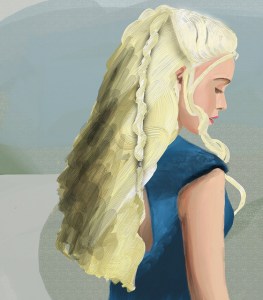
While A Game of Thrones and its HBO counterpart pick up on the resonances of medieval noise to differentiate between East and West, noise is gendered differently. In RCL the threat signaled by the sound of bells is that Richard will be emasculated by his inability to cut ties with the specter of his mother’s influence and disambiguate himself from the Eastern Saracens she represents. However, in Martin’s series, the Dothraki bells, like much of Dothraki culture, exist only to be subsumed under Daenerys’ imperial ambitions for an Iron Throne the Dothraki neither care about nor want. Daenerys’ bell, affixed to her hair after the death of Drogo and the dissolution of his khalasar, becomes a symbol of cultural and racial appropriation Martin stages under the guise of (white) feminism. That is, the issues noise signals have changed from the challenge of excising Christian West from Islamic East (a fear literalized in Richard’s cannibalistic consumption of Saracen flesh) to cultural appropriation (the devouring of Dothraki culture for the benefit of white colonialism).
—
Featured Image: Proceso Khal Drogo by Flickr User Orgita Sucubita, (CC BY-NC-ND 2.0)
—
Thomas Blake is Assistant Professor of English at Austin College.
—
REWIND!…If you liked this post, you may also dig:
Sounding Out! Podcast #54: The Sound of Magic-K.A. Laity
Mouthing the Passion: Richard Rolle’s Soundscapes–Christopher Roman
Playing with the Past in the Imagined Middle Ages: Music and Soundscape in Video Game–James Cook
—
Share this:




Current Top Posts





April 2021

January 2020

November 2019

October 2019

August 2019

April 2014

November 2017

March 2015

December 2017

October 2015


Recent Comments