
Evoking the Object: Physicality in the Digital Age of Music

In our current relationship with technology, we bring our bodies, but our minds rule–Linda Stone, “Conscious Computing”
DOI: https://doi.org/10.59350/52w8z-60015
I begin with an epigraph from Linda Stone, who coined the phrase ‘continuous partial attention’ to describe our mental state in the digital age. The passive cousin of multi-tasking, continuous partial attention is a reaction to our constantly connected lifestyles in which everything is happening right now and where value is increasingly equated with our ability to digest it all. Almost everything we do has the potential to be interrupted, be it by an email, a text or a tweet; often we will give only partial attention to any one thing in anticipation of the next thing that will require our attention. In this internal fight for mental attention, listening to music has been seriously impacted.
The digital era has seen more music releases than ever before. Unfortunately, the massive influx of quantity is by no means a measure of how we are engaging with said music. iPhones and similar devices, for which music players have become mere features, enable listening to become a thing of partial attention. From allowing the shuffle or random modes to choose music selections for you, or even streaming music algorithms to calculate things you might like, to listening while playing Angry Birds or reading your Twitter stream, less commitment is made to the act of listening, and as such only a portion of our working memory is committed to the experience. Without working memory actively processing musical information, it is less likely to be stored for the long term, particularly if other information is continuously vying for space and attention.
These days video games sell better than music. Despite being a digital product, games are able to instill memories (even of the music) into one’s consciousness, because the game interface allows our sensory memories to work together in an active manner with the medium. Iconic memory stores visual cues from the game, echoic memory takes the audible cues from the game and the haptic memory is engaged in controlling game play. There is only so much more which can be done while playing a video game. If something were to interrupt game play, the game would be paused to address the new information rather than giving it partial attention. This is quite different from music which plays a background role in so much of our lives even when we are actively putting music on we tend to only engage it with partial attention.
When I began thinking about turning Concrète Sound System into a record label, one of my main goals was to create works that could engage the audience in active musical experiences that could create long term memories. I felt that as important as the music would be, it would take something material to create these memories, a physical product more evocative of earlier moments in recording history than the CD, its most recent gasp. I wondered if, by creatively evoking the physical object, the listener could be engaged in an active manner that would enable the memory of music and its power to persist through the everyday waves of digital noise.
The first mass duplicated audio medium was the Gold Moulded Edison Cylinder at the turn of the twentieth century. Imagine two cylinder copies of one of these recording today, as musical objects. Each of them would have over a hundred years of physical history. From the wear of the cases to the condition of the wax based on the temperature in which they were stored, each of these cylinders would be unique musical objects, with completely different histories, despite having the same origin. It is reasonable to assume that if the cylinders were played today on the same playback device, despite the fact that the compositions and performances are exactly the same, the differences between the recordings would be audible.
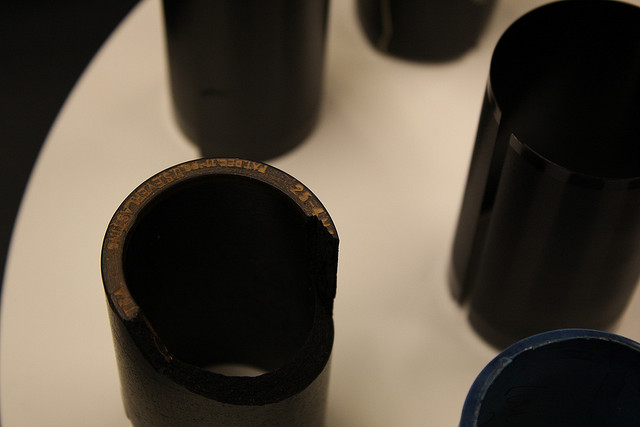
Even without a century of history, there would likely be audible differences between the cylinders. If one cylinder was the first copy made, and another the 150th –master cylinders of Gold Moulded Edison Cylinders could only produce 150 copies reliably–the physical wear in the process of reproduction would leave its own imprint, making each of those copies distinct musical objects. In the analog world, as the technology improved the differences between copies decreased substantially. Cassettes were manufactured in batches of ten to hundreds of thousands without audible differences. But even in circulations so high, over time each of those analog copies took on their own identity and collected their own memories.
The listener as an active agent contributed to the development of these unique musical objects. After a purchase, any number of variables played into the ritual of the first experience of the music. Was there a way to listen upon walking out of the store? Were there liner notes or lyric sheets inside? Would you read those prior to listening or as you listen? Where would you listen? Through headphones? The listening chair in front of the hi-fi stereo? Or on the boombox with some friends? All of these possibilities shaped memories as musical objects that defined the music consumption culture of the past.
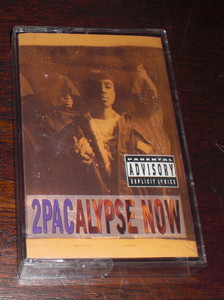
For example, I bought the debut 2Pac album 2Pacalypse Now on cassette the day it was released. I loved the album so much I kept it in regular rotation in my Walkman for months until finally the tape popped. Rather than go out and buy a new copy I decided to perform a surgery. It was in a screwless reel case which meant I couldn’t just open it up to retrieve the ends of the tape trapped inside, but rather had to crack the reel case open and transplant the reels into a new body. So, my copy of the 2Pacalypse Now cassette is now inside of a clear reel holder with no visual markings. It also has a piece of tape that was used to splice it back together, which makes an audible warp when played back. I can pretty much be sure that there is no other copy of 2Pacalypse which sounds exactly like mine. While this probably detracts from the resale value of the cassette (not that I’d sell it), it is imbued with a personal history that is priceless.
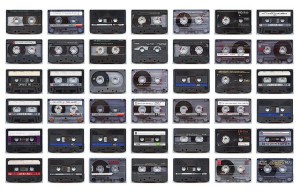
Cassettes, in particular, played a significant role in the attachment of physical memories to music beyond the recordings they held. They gave birth to the mixtape. The taper community was born from personal tape recorders that allowed concert-goers to record performances they attended, and, prior to the rise of peer to peer sharing online, these communities were trading tapes internationally via regular postal mail. European jazz and rock concerts were finding their way back to the states and South Bronx hip-hop performances were traveling with the military in Asia. All of these instances required a physical commitment with which came memories that inherently became their own musical objects.
Needless to say the nature of musical exchange has changed with the rise of the digital age of music. This is not to say that memories as musical objects have gone away, but they are being taken for granted as the objects lose their physicality. I remember going to The Wiz on 96th Street with $10 to spend on music. I spent at least ten minutes trying to decide between Sid and B-Tonn and Arabian Prince. I ended up with Arabian Prince and have regretted it since I got home and listened that day, as I never found Sid and B-Tonn for sale again. Today I could download both in the time it took me to walk to the train station. After skimming through the first few songs of Arabian Prince I could decide it was not for me and drag drop it in the trash where the memory of it would disappear with the files. No matter how I felt about the music then, the memory of it is a permanent fixture in my mind because of the physical actions it took to listen.
The first release for Concrète Sound System, Schrödinger’s Cassette, tackled this issue head on by presenting the audience with its own paradox, an update of physicist Erwin Schrödinger’s famous Thought Experiment, where the ultimate fate of the cassette inside is left up to the individual. Schrödinger’s Cassette sought to take listeners out of digital modes of consumption by using an analog medium to evoke the physical. The cassette release trend has been growing over the last few years, almost in parallel to the rise of the digital music and speaking to the need to separate music from our digital lives and to a desire to work harder for it. At the minimum, listening to a cassette requires having a cassette player, and acquiring one these days takes commitment. Unlike digital media, listeners cannot instantly skip a song on a cassette or put a favorite on repeat. It takes physical manipulation of the medium to move through its songs and doing so is a time investment. All these limitations make the cassette a medium that is best for linear listening, from beginning to end (unless you physically cut, rearrange, and splice it yourself).
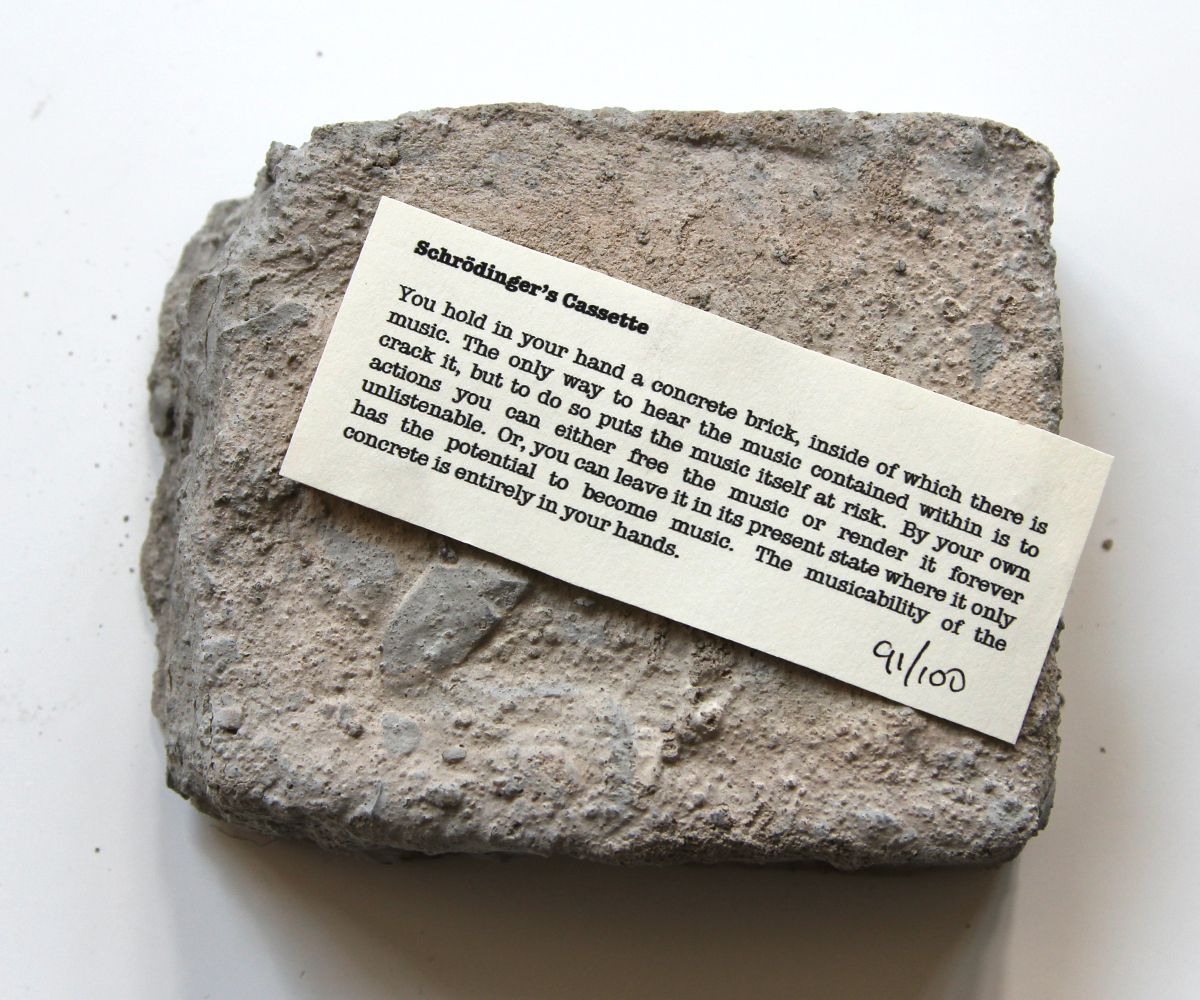
Schrödinger’s Cassette took the required commitment a step further by encasing the cassette itself in industrial grade concrete. This required the user to actively crack the concrete (or the french concrète meaning ‘real’, from which the label derives its name) in order to listen to the music. The paradox is that, depending on the listener’s method for cracking, harm could be done to the cassette that might render it ‘unlistenable’. Upon receiving one of these pieces, the listener holds in their hands a musical object which they must physically act upon in order to create an unrepeatable musical event. Schrödinger’s Cassette has a look, a sound (if shaken you can hear the cassette reels), a feel, a smell, and a taste as well (though I wouldn’t advise it). All of the senses can be actively focused on the object and, as such, the whole of one’s working memory is engaged in the discernment of the object’s musical contents.
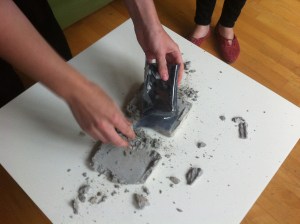
For many, Schrödinger’s Cassette was taken as a work of art and left uncracked. The Wire magazine successfully cracked one edition open, revealing a portion of the musical contents on their regular radio program. For those that decided not to crack it, digital versions were made available so that they could listen, though this option was only made available after the listener spent some time with their physical object. In this way, the music from the project, a compilation called Between the Cracks, was directly connected to physical memories spurred by a material presence.
Triggering active memory during the consumption of music through physical objects need not be this complex. Old medium such as vinyl and cassette releases inherently have the physical properties required without the concrete or much else. Perhaps for this reason they show new signs of life despite the rise of digital. No matter how much our reality is augmented by our digital lives, we still inhabit those bodies that we bring with us, and, as far as the memories those bodies carry with them go, physicality rules.
—
Featured Image: Wax Cylinders in the Library of Congress, Image by Flickr User Photo Phiend
—
Primus Luta is a husband and father of three. He is a writer and an artist exploring the intersection of technology and art, and their philosophical implications. He is a regular guest contributor to theCreate Digital Music website, and maintains his own AvantUrb site. Luta is a regular presenter for the Rhythm Incursions Podcast series with his monthly showRIPL. As an artist, he is a founding member of the live electronic music collectiveConcrète Sound System, which spun off into a record label for the exploratory realms of sound in 2012.
—
Share this:

Further Experiments in Agent-based Musical Composition

Editor’s Note: WARNING: THE FOLLOWING POST IS INTERACTIVE!!! This week’s post is especially designed by one of our regulars, Andreas Duus Pape, to spark conversation and provoke debate on its comment page. I have directly solicited feedback and commentary from several top sound studies scholars, thinkers, artists, and musicians, who will be posting at various times throughout the day and the week–responding to Andreas, responding to each other, and responding to your comments. Look for commentary by Bill Bahng Boyer (NYU), Maile Colbert(Binaural/Nodar, Faculdade de Belas Artes da Universidade do Porto), Adriana Knouf(Cornell University), Primus Luta (AvantUrb, Concrète Sound System), Alejandro L. Madrid (University of Illinois at Chicago), Tara Rodgers (University of Maryland), Jonathan Skinner (ecopoetics), Jonathan Sterne (McGill University), Aaron Trammell (Rutgers University, Sounding Out!) and yours truly (Binghamton University, Sounding Out!). Full bios of our special respondents follow the post. We wholeheartedly wish to entice you this Monday to play. . .and listen. . .and then share your thoughts via the comment page. . .and play again. . .listen again. . .read the comments. . .and share more thoughts. . .yeah, just go ahead and loop that. –JS, Editor-in-Chief
—
DOI: https://doi.org/10.59350/ybq4g-k1x93
I’m a musician and an economist. Sometimes you will find me playing acoustic folk rock and blues on guitar, harmonica and voice. And at other times I will be at work, where I apply my expertise in game theory to the computer modeling of social phenomena. I create simulations of people interacting – such as how people decide which way to vote on an issue such as a tax levy, or how people learn to sort objects given to them in an experiment. In these simulations, the user can set up characteristics of the environment, such as the number of people and their individual goals. After things are set up, users watch these interactions unfold. The simulation is a little story, and one need only tweak the inputs to see how the story changes.
As a musician, I was curious if a program that generates social stories could be refashioned to generate musical pieces. I wanted to build a music-generation engine that the listener could tweak in order to get a different piece each time. But not just any tune – a piece with some flow, some story. I like that tension between randomness and structure. On one hand, I want every song to vary in unpredictable ways; on the other hand, I want to create music and not structureless noise.
I created a basic story of predators and prey, whimsically naming the prey “Peters,” represented by rabbits, and the predators “Wolves.” My simulation depicts a plain in the savannah with a green oasis. The prey seek the oasis and the predators seek the prey. Each character has its own goals and the closer they are to achieving them, the happier they are. Both predators and prey want to have stomachs full of food, so naturally they want to be close to their target (be it prey or oasis). As they travel through the savannah, they learn what choices (directions of movement) make them happier, and use this experience to guide them.
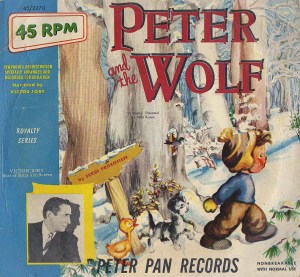
So how does this story become music? To this question there are two answers: a technical one and an intuitive one. The intuitive answer is that in real life the story of predators and prey plays out geographically on the savannah, but musically this is a story that plays out over a sonic landscape. To elaborate, I abstracted the movement of the prey and predator on the geography of the plain into the musical geometry of a sonic landscape. The farther north an agent travels, the higher the pitch. And, the farther east an agent travels the longer the duration. In other words, as an agent travels to the northwest, she makes longer-lasting tones that are higher pitched. I also mapped happiness to volume, so that happy agents make louder tones. Finally, so that each agent would have a distinct voice as they traveled through this space, I chose different instruments for each agent.
In the video below I assigned the “church organ” sound to prey, and the “brass section” sound to predators.
Ultimately, there are some things that I like about this piece and others that I do not.
As a harmonica player, I improvise by creating and resolving tension. I think this piece does that well. The predator will pursue the prey into a quiet, low-pitch corner, creating a distant, rumbling sound – only to watch prey escape to the densely polyphonic northwest corner. There is an ebb and flow to this chase that I recognize from blues harmonica solos. In contrast to my experience as a harmonica player, however, I have found that some of the most compelling parts of the dynamics come from the layering of notes. The addition of notes yields a rich sonic texture, much like adding notes to a chord on an organ.
Unfortunately, for largely technical reasons, there is a lack of coherent rhythm and pacing. The programming platform (agent-based modeling software called NetLogo) is not designed to have the interface proceed in real-time. Basically, the overall speed of the piece can change as the processing load increases or decreases. I found that as agents learnt more about their surroundings (and more system resources are allocated to this “memory”), they became slower and slower. To fix this, I capped the size of their memory banks so that they would forget their oldest memories. The closest I have come to a rhythmic structure is by ordering the way that the agents play. This technique makes the piece have a call-and-response feel. If only the piece to had a coherent rhythm, then I could imagine playing harmonica along with it.
One last comment on pitch: while an earlier version of this piece mapped each step in space to a semitone, things sounded too mechanical. Even though this was the easiest and most intuitive decision from a technical standpoint, it was aesthetically lacking, so I have now integrated traditional musical scales. The minor scale, in my opinion, is the most interesting as it makes the predator/prey dynamic sound appropriately foreboding.

You can play this piece yourself. Simply go to this link with Java enabled in your browser (recommended: Google Chrome). Pressing “Setup” then “Go” will create your own run of the piece. As it is running, you can adjust the slider above the graphic window to change the speed. Press “Go” again to stop the model, adjust any parameters you wish and press “Setup” and “Go” again to see how the piece changes. Here are some parameters to try: instA and instB to change the instruments associated with prey and predators; PlayEveryXSteps to change the pace of the piece (higher results in a slower paced piece); Num-PackAs and Num-PackBs changes the number of prey and predators; the vertical PeterVol and WolfVol adjust the overall volume of prey and predators.
In regards to my version of “Peter and the Wolf,” I have a number of things that I’m curious about.
First, how does this relate to what you think of as music? Do you like listening to it? Which elements do you like and which do you dislike? For example, what do you think about about the tension and rhythm – do you agree the first works and that the second could be improved? Would you listen to this for enjoyments’ sake, and what would it take for this to be more than a novelty? What do you think about the narrative that drives the piece? I chose the predator and prey narrative, admittedly, on a whim. Do you think there might be some other narrative or agent specific goals that might better drive this piece? Is there any metaphor that might better describe this piece? As a listener do you enjoy the experience of being able to customize and configure the piece? What would you like to have control over that is missing here? Would you like more interaction with the piece or less interaction?
Finally, and perhaps most importantly, what do you think of the premise? Can simple electronic agents (albeit ones which interact socially) aspire to create music? Is there something promising in this act of simulation? Is music-making necessarily a human activity and is this kind of work destined to be artificial and uncanny?
Thanks for listening. I look forward to your thoughts.
– – –
Andreas Duus Pape is an economist and a musician. As an economist, he studies microeconomic theory and game theory–that is, the analysis of strategy and the construction of models to understand social phenomena–and the theory of individual choice, including how to forecast the behavior of agents who construct models of social phenomena. As a musician, he plays folk in the tradition of Dylan and Guthrie, blues in the tradition of Williamson and McTell, and country in the tradition of Nelson and Cash. Pape is an assistant Professor in the department of Economics at Binghamton University and is a faculty member of the Collective Dynamics of Complex Systems (CoCo) Research Group.
– – –
Guest Respondents on the Comment Page (in alphabetical order)
Bill Bahng Boyer is a doctoral candidate in music at New York University who is completing a dissertation on public listening in the New York City subway system.
Maile Colbert is an intermedia artist with a concentration in sound and video, living and working between New York and Portugal. She is an associated artist at Binaural/Nodar.
N. Adriana Knouf is a Ph.D. candidate in information science at Cornell University.
Primus Luta is a writer and an artist exploring the intersection of technology and art; he maintains his own AvantUrb site and is a founding member of the live electronic music collective Concrète Sound System.
Alejandro L. Madrid is Associate Professor of Latin American and Latino Studies at the University of Illinois at Chicago and a cultural theorist and music scholar whose research focuses on the intersection of modernity, tradition, globalization, and ethnic identity in popular and art music, dance, and expressive culture from Mexico, the U.S.-Mexico border, and the circum-Caribbean.
Tara Rodgers is an Assistant Professor of Women’s Studies and a faculty fellow in the Digital Cultures & Creativity program at the University of Maryland. As Analog Tara, she has released electronic music on compilations such as the Le Tigre 12″ and Source Records/Germany, and exhibited sound art at venues including Eyebeam (NYC) and the Museum of Contemporary Canadian Art (Toronto).
Jonathan Skinner founded and edits the journal ecopoetics, which features creative-critical intersections between writing and ecology. Skinner also writes ecocriticism on contemporary poetry and poetics.
Jonathan Sterne teaches in the Department of Art History and Communication Studies and the History and Philosophy of Science Program at McGill University. His latest book, Mp3 The Meaning of a Format comes out this fall from Duke University Press.
Jennifer Stoeveris co-founder, Editor-in-Chief and Guest Posts Editor for Sounding Out! She is also Assistant Professor of English at Binghamton University and a former Fellow at the Society for the Humanities at Cornell University (2011-2012).
Aaron Trammell is Multimedia Editor of Sounding Out! and a Ph.D. Candidate in Media and Communications at Rutgers University.
—
Share this:




Current Top Posts





April 2021

January 2020

November 2019

October 2019

August 2019

April 2014

November 2017

March 2015

December 2017

October 2015
 Sounding Out!
Recent Comments