
GLaDOS, the Voice of Postfeminist Control

Warning, spoilers ahead. Image borrowed from ElderGeek.
Much has been written about Portal, it has won at least seven “Game of the Year” awards and has been ranked as the “Best Game of all Time” by Gamesradar. Perhaps because both the hero and antagonist are women, it has also been the object of several cultural critiques. One blogger writes, “GLaDOS [the game’s villian] is the archetypical oppressed woman.” In an article published by GamePro (a mass-market game review magazine) GLaDOS is considered a “feminist icon.” Although “feminist icon” is a bit extreme, GLaDOS does have a lot to do with feminism. When seen in light of Rosalind Gill’s (2007) essay, “Postfeminist media culture,” GLaDOS, and her wry, disembodied voice, hold striking parallels to the immanence of surveillance in today’s world.

GLaDOS and Chell. Borrowed from gryphonworks @ deviantART.
At their core, the games in Valve Software’s Portal series are relatively straightforward: you are put in control of a female character named Chell, who is attempting to escape from the Aperture Science Laboratory complex. Equipped, mainly, with a portal gun (think Yellow Submarine, “Hole in My Pocket”), Chell traverses precipices, laser drones, acid pits and everything in-between. As she navigates and manipulates these obstacles, a disembodied Orwellian voice guides Chell from one puzzle to the next. This is the voice of GLaDOS (Genetic Lifeform and Disk Operating System), a self-aware computer who runs the joint (at least in Portal 1) and is keeping you around for further “testing.” Where Portal is claustrophobic, just you and GLaDOS, Portal 2 is a little more dynamic. A third character, Wheatley, is introduced. In both games, however; there is an inescapable feeling of surveillance and scrutiny. GLaDOS’s monotonous voice is everywhere, the robotic platforms of the Aperture complex are the only appendages of her body to be found.
What to make of the GLaDOS’s character? Although she is helpful at first when guiding Chell through the early tests, GLaDOS quickly adopts a sarcastic tone – putting Chell down, and belittling her mistakes. G. Christopher Williams of PopMatters reads into the backstory a bit. He points out that GLaDOS is modeled on the personality of the Aperture Science CEO, Cave Johnson’s, wife: Caroline. In the second game there is a tape of Johnson elaborating:
Brain Mapping. Artificial Intelligence. We should have been working on it thirty years ago. I will say this—and I’m gonna say it on tape so everybody hears it a hundred times a day: If I die before you people can pour me into a computer, I want Caroline to run this place.
Now she’ll argue. She’ll say she can’t. She’s modest like that.
But you make her.
Hell, put her in my computer. I don’t care.
GLaDOS, then, has a bit of a history. Within this history there is a glass ceiling. GLaDOS has had a dampening sphere installed to limit her “irrational thinking,” and curb her “misbehavior.” Tellingly, this sphere whispers terrible ideas to her in a babbling male voice. At the end of Portal 1, Chell destroys the dampening sphere, and GLaDOS is free to get revenge on the society that has caged her. At this key moment, the tonality of her voice shifts from accommodating to sultry.
This change in voice accompanies a change in disposition. As Chell continues her adventures in Portal 2, GLaDOS returns with a set of suspiciously cutting remarks. Several barbs are made about Chell gaining weight, being unintelligent, and being adopted. In the sequel, GLaDOS is especially critical of Chell’s body. These pot-shots figure perfectly into Gill’s (2007) hallmarks of postfeminism: 1) the increased self-surveillance of the female body, 2) the increase of surveillance in new social sectors, and 3) a focus on the psychological transformation of one’s self, or interior life. Chell, the avatar, isn’t being judged on her weight (or lack thereof). Instead, GLaDOS’s remarks cut to the player, who recognizes that neither they nor Chell fit GLaDOS’s ideal. Although, in the narrative, GLaDOS typifies an extension of invisible and disembodied surveillance into new spheres of life, her comments act to foster self-surveillance in the embodied player.
GLaDOS’s comments have even jarred some users in the Steam Users’ Forums (Steam is Valve’s online distribution platform). In a thread entitled, “Portal 2 Sexist,” one user, loodmoney, asked if anyone else found GLaDOS’s fat jokes off-putting. To this, another user, Killalaz replied, “GLaDOS is trying to discourage/dishearten the testers. Chell is a woman, what bothers a woman more than being called fat? Not much. . .psychological warfare so to speak.” Although Killalaz may be reading too literally into Portal 2’s narrative, he is right about one thing: to some extent, GLaDOS, and therefore Valve Software, is waging psychological warfare on us all. Later in the thread another user, BC2 Cypher, demonstrates the extent that attitudes of self-surveillance can work to mold one’s psyche, “I don’t see the issue he’re. I actually used to BE fat. Lost 72 pounds when I was 15. 232 – 160. It’s not like Chell is even fat. That is the joke.” The real joke, if there is one, is that so many players are content to reduce GLaDOS’s comments to a self-contained dialogue between fictional characters. What is heard, actually, relates directly to the way dialogue from Portal is internalized. In these forums, the voice of GLaDOS is reproduced; it mediates the bodies of some fans (by supposing an ideal weight), and surveils the bodies of others (by guiding the dialogue).
But, when I play Portal, I occasionally smirk at GLaDOS’s comments. They are cutting satire. If GLaDOS is a feminist icon, it is because she is a voice that everyone carries with them at all times. The voice in our heads, that causes us to judge and shape ourselves, while simultaneously passing unkind judgment on to others. GLaDOS is iconic of the postfeminist condition – a condition where surveillance is assumed and internalized. And, our bodies are shaped through the hyper-mediation of games like Portal, and characters like GLaDOS, as they replicate themselves in web forums, and in our own voices.
AT


Share this:

Play it Again (and Again), Sam: The Tape Recorder in Film (Part Two on Walter Murch)
 The second installment of my summer series, “Play it Again (and Again), Sam: The Tape Recorder in Film” continues to unspool chronologically, this time focusing on the recorder’s key role in two films indelibly imprinted by legendary editor Walter Murch: Touch of Evil (1958) and The Conversation (1974). [If you missed my first installment, June’s piece on Noir, you can catch up to speed right here].
Most famous for his work on American Grafitti (1973), The Godfather: Part II (1974), Apocalypse Now (1979) and The English Patient (1996), Murch was one of the first folks catapulted into the critical pantheon of sound studies. Not only is his sound (and image) editing intuitive and innovative, but he is one of the only sound editors to speak and write extensively about his creative process. His collaborative book with Michael Ondjaate, a transcription of their extensive and wide-ranging discussions entitled The Conversations: Walter Murch and the Art of Editing Film (2002), is stunning in its depth, breadth, and accessibility: an intellectual trifecta. It is the kind of summer beach reading that is both gripping and brag-worthy.
In The Conversations, Murch describes the excitement of being age 10 and discovering the tape recorder for the first time, especially how
“That passion, which was a kind of delirious drunkenness with what the tape recorder could do, completely possessed me” (6).
In homage to “that passion,” the next two films on my “Top 6” list of the appearance of the tape recorder in film show how Murch’s oeuvre carefully and affectionately represents not only the early drunken experiences with the machine’s heady possibilities, but also the lingering technological hangover in the 1970s, not just for Murch but for the U.S. writ large.

"Mixed Tape" by Thristian (2008)
For those keeping track, the first two films on my list are: 1. Double Indemnity (1944) and 2. Blackboard Jungle (1955), with a little Mike Hammer for good measure with Kiss Me Deadly (1955). And, before you get comfy on the couch, don’t forget our third and final installment, on the 1980s, coming August 15th.
3. Touch of Evil (Universal, 1958, Dir. Orson Welles):

by presspublish
And how, you ask did Walter Murch possibly have any part in editing 1958’s Touch of Evil, given that he was all of 15 years old? Murch didn’t get his hands on the film until 40 years later, when film preservationist and scholar Rick Schmidlin tracked down the complete version of Orson Welles’s single-spaced, 58 page production memo to Universal’s studio heads, telling them how to fix the mess they had made of his movie. Welles had been pulled from his film as he worked laboriously on the rough cut and the studio completely re-edited the movie, even filming additional scenes. Once Touch of Evil was finished, Universal allowed Welles one shot at the film in a private screening room, with no pauses or rewinds, and the astonishingly detailed (and restrained) memo is the result of that screening. Unfortunately for Welles, Universal completely ignored Welles, releasing the studio re-cut of this late-noir gem as a B-movie. Welles never again directed a major film and his memo was thought to have been placed directly into the circular file until Jonathan Rosenbaum published selections from it in Film Quarterly in 1992. [For full details and a link to the lost memo, check out Lawrence French’s web essay].
Once Schmidlin tracked down the entire piece, he was determined to re-cut Touch of Evil according to Welles’s written directions. Here Schmidlin discusses how Murch became involved:
“When I was given the green light to re-edit Orson Welles’s Touch of Evil, based on his memo, it didn’t take a rocket scientist to know who I wanted to re-edit this film. I got Walter’s phone number through a friend and called him at home. I said, Walter, this is Rick Schmidlin. You don’t know me, but I’m producing a re-edit of Orson Welles’s Touch of Evil and I can’t think of any intellect that could match Orson Welles’s better than yours. Would you be interested? Walter said, Mmmm. Send me the memo and I’ll take a look” (The Conversations, 182).
Murch was able to make all 50 of Welles’s suggested changes and then some; he unearthed an additional 9-page sound memo after tracking down the 89-year-old former head of post-production at Universal, Ernie Nims, who had stashed it in his attic. Tim Tully’s “The Sounds of Evil” from Filmsound.org provides a detailed description of Murch’s editorial process and the end result, which manages to be both subtle and dramatic. Film people actually like (and increasingly, prefer) the 1998 re-release, which speaks volumes about Murch’s work (and Welles’s presience). I refer to Murch’s version in the thoughts that follow.
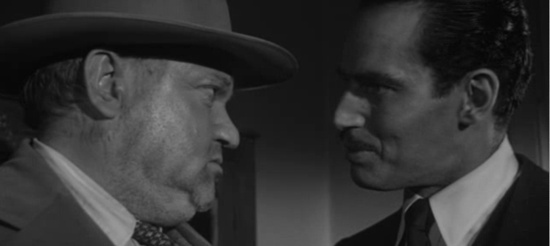
Quinlan vs. Vargas (Screen Capture by AWWS)
So Touch of Evil features Charlton Heston in brownface doing his best to look like Vicente Fernandez; I am not going to deny (or defend) this casting disaster. However, I will say that this 1958 story of U.S. police corruption on the nation’s borders has reinvigorated after last week’s revelations of the FBI’s “Fast and Furious” importation of illegal firearms into Mexico. Our current era of the “Global War on Terror” has produced, imagined, and inflamed an insatiable sense of national vulnerability that demands “illegal alien” scapegoats (peep John McCain’s recent assertion that “substantial evidence” exists that Mexicans crossing the border started Arizona’s recent spate of wildfires). However, the GWOT had its precedent; America’s post-WWII Cold War anxieties ended any semblance of a “Good Neighbor Policy” long before films like Touch of Evil portrayed the border as a lawless, indefensible place where wealthy, pleasure seeking white men can be killed in bomb blasts and white police corrupted by easy money and hard-line policing. As protagonist Miguel Vargas (Heston) tells his American bride Susie (Janet Leigh), “This isn’t the real Mexico, you know that! All border towns bring out the worst in their country.” Although no one ever says it aloud, by film’s end it is clear that Welles intended this barb to cut both sides of the border.
The plot of Touch of Evil pits Vargas, a straight-arrow Mexican drug official on his honeymoon, against the celebrated but hard-drinking and crooked-as-they-come American police captain Hank Quinlan (played by an especially sweaty Orson Welles). Both are working the same case—a car-bomb kills a rich man and his mistress as they cross the border to the U.S.—but from decidedly different angles. Quinlan, in bed with Mexican gangster “Uncle” Joe Grandi (Akim Tamiroff) plants evidence on the investigation’s hastily drummed-up prime suspect, Manelo Sanchez (Victor Millan). Vargas knows it, and sets about trying to prove Quinlan’s guilt to the skeptical and increasingly hostile American police force, led by Sergeant Pete Menzies (Joseph Calleia), even if it means postponing his honeymoon and his trip to Mexico City to testify against the Grandi crime family. Quinlan would prefer that he never gets there, if you catch my drift, and he arranges for the kidnapping of Vargas’s wife, among other cruelties.

Not the Optimum Recording Conditions: Scene of the Climax of "Touch of Evil"
Vargas, compassionate and honor-bound even as he is grimly world-weary—“There are plenty of soldiers who don’t like war,” he tells the Americans when they question his commitment to the job—decides to use the tape recorder as a weapon of truth in his dirty war against Quinlan, “a potent weapon” according to Murch (194). While it is difficult to discuss specifics about the recorder’s prominence in the film without spoiler alerting all over the place, I will say that the machine heightens the tension of the cat-and-mouse game Vargas is forced to play with Quinlan, especially because the technology of the moment did not allow for distant long-range audio surveillance, like we will later see in The Conversation. The intimacy he shares with Quinlan, shadowing him closely to stay in range of the radio-mic without being seen or heard, unnerves Vargas and he displaces his discomfort onto the recorder: “I hate this machine, spying, creeping.” However, as the bodies ultimately fall where they may, Vargas’s tape emerges as the lone certainty and lasting proof against the sordid, shifting, (and exceedingly sweaty) janus-faced juggernaut that is Hank Quinlan. Absent the recorder’s stark evidence to untangle the truth, all that remains is chaos: the dangerous and mixed-up dominant border imaginary of the 1950s U.S.
.
4. The Conversation (Paramount, 1974, Directed by Francis Ford Coppola):
“In that denouement of Touch of Evil, Welles worked out something that’s very close to my heart because it’s so similar to the beginning of The Conversation–namely, to make the resolution of the story depend on different shadings and perspectives of sound”–Walter Murch, The Conversations (194)

Universal 5000 (Screen Capture from The Conversation by pablosanz)
What is especially interesting to me about having Murch’s editorial touch on Touch of Evil is not only that the climax features the tape recorder, but also that this scene is echoed (and almost entirely undone) in the plot of The Conversation. One of Murch’s first feature films, The Conversation was edited by hand, a process similar to what audiences actually see onscreen in the film (Murch did not use AVID until 1996’s The English Patient and he is rather aptly credited for “sound montage” in The Conversation). I know many sound peeps are already hip to The Conversation thanks to Murch’s experimental work and the plot’s tense emphasis on the importance—and the fraught ambiguity—of sound and listening, but I want to add a new technological wrinkle via the tape recorder.
Released in April 1974, The Conversation is prescient in regards to the paranoid atmosphere around the tape recorder in the early 1970s. That same month, the House Judiciary Committee subpoenaed the “White House Tapes,” obtained through years of secret surveillance with phone taps and lavalier bugs, that contained damning evidence linking then-President Richard Nixon to the Watergate break-ins. After first attempting to edit the tapes, Nixon resigned just four months later, days after the full transcripts were released. The recorder’s secretly-obtained evidence proved indisputable against any of Nixon’s public pronouncements of innocence and post-Watergate its listening ears were seemingly everywhere: “Do you see him? The man with the hearing aid like Charles?” says Ann (Cindy Williams) through frozen lips in The Conversation’s tense opening scene, “right there with the shopping bag? He’s been following us all around and he’s been following us close.”
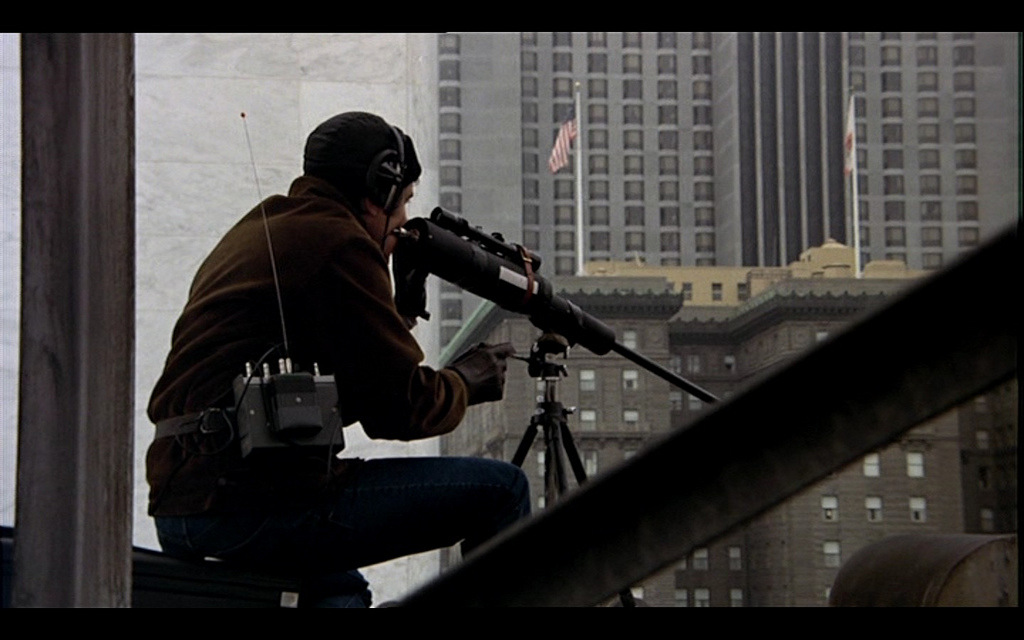
The Microphone as Weapon: Long-range surveillance in The Conversation (Screen capture by pablosanz )
Akin to John Cage’s forays into the anechoic chamber—which opened up new realms of previously ignored and unheard sounds to the artist—evidence produced by various recorders confirmed that there were audible shadow worlds operating underneath power’s prettier public face. In addition to such unnerving domestic politics, the use of the tape recorder in The Conversation also mirrored shifting Cold War policies. No longer a blunt tool of coercion as it was in Blackboard Jungle or a technology of intimacy like in Touch of Evil, the tape recorder is instead an anonymous precision instrument of consent, performing its work in the hidden underbelly of windowless vans, grimy warehouses, and bland, spartan apartments, all key settings in The Conversation.

Harry Caul (Gene Hackman) in The Conversation (screen capture by pablosanz)
At the film’s center is “the best bugger on the West Coast” Harry Caul (Gene Hackman), a surveillance expert who feels that he is more machine than man, an analog Bartleby the Scrivener. “I don’t care what they’re talking about,” he growls about his human subjects, “I just want a nice, fat recording.” While hard at work splicing and cleaning up some surveillance tapes, Caul overhears a simple phrase that will eventually be his undoing: “he’d kill us if he got the chance.” Chasing him through fitful dreams and into confessional booths, the haunting phrase causes Caul to doubt his mission. He begins asking uncomfortable questions—who is paying him? To what end?—and goes on the hunt, obsessively rewinding the tape again and again trying to make some sense out of the voices he has captured as if their recorded traces were technological tea leaves. However, the faith he places in the tape recorder and in its ability to isolate, clean up, and amplify the truth is his ultimate undoing, causing him to ignore the human flaws of his own listening ear.
.
.
And in a supporting role. . .
Admittedly, this film has nothing to do with Walter Murch (that I know of), but I wanted to end with some lighter fare and a *perfect* preview for Part Three of “Play it Again (and Again), Sam” coming on August 15th, which focuses on 1980s films.
 Ferris Bueller’s Day Off (Paramount, 1986, Director John Hughes): There have been some great recent analyses of the silver anniversary of this John Hughes flick—I especially dug Alan Siegel’s “Get Over ‘Ferris Bueller’ Everyone” for The Atlantic—but all of these posts missed a critical attraction of the film: Ferris’s ease with new technology (part of the 1980’s “invisible knapsack”of race and class privilege). Let’s give credit where credit is due: the tool that enabled Ferris Bueller (Matthew Broderick) to have his fabled day off was, in fact, the tape recorder. First, Ferris’s crew rigs up microcassette messages between Sloane Peterson (Mia Sara) and Cameron Frye’s (Alan Ruck) answering machines to throw the sniveling Principal Rooney (Jeffrey Jones) off their trail: one weepily attests to the death of Sloane’s grandmother, while the other purports to be the funeral home. And who can forget the mannequin rigged up to a tape loop of snorts and snores designed to fool Ferris’s mom (Cindy Pickett) into thinking that he is deep in sickness-induced slumber. Personal recording technology was part and parcel of Ferris Bueller’s über-privileged white suburban teen resistance to the conveyor belt of contemporary American life. Before the kids at school took up a collection to “Save Ferris,” Bueller was already using the recorder to save himself.


Share this:


Current Top Posts





April 2021

January 2020

November 2019

October 2019

August 2019

April 2014

November 2017

March 2015

December 2017

October 2015
 Sounding Out!
Recent Comments