
The Noise You Make Should Be Your Own
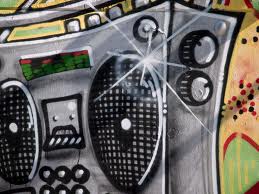 Before I suggested the name VIBE, even before the magazine was being called Volume, it was known as NOISE. I never liked that name. I mean, I knew what they were going for: “Noise” was meant to imply the loud raucousness of youth that defined the increasingly popular urban culture that would fill its pages. But the dominant strand of that youth culture was going to be represented by hip-hop, and I was quite sensitive to mainstream society’s tendency to think of hip-hop—what I liked to think of as the breakbeat concertos of inner city maestros—as not-music, as nothing but noise, something not necessarily from the street but of it, like a garbage truck or a knife fight.
I started to reminisce about the Noise name a coupla weeks ago when I walked into my university-owned apartment building and saw a note with the word “NOISE” poised at the top of it in a huge bold and italicized font, assured of getting everyone’s attention as they entered the elevator vestibule. According to the note taped to the wall, there was a noise problem in the building, and it was getting worse. Would tenants please be considerate of the other members of the apartment community and refrain from playing music loudly after certain proprietary hours?
I thought about it. I never heard music being played loudly. But maybe that was because I live on of the upper floors, away from the blaring speakers of others. The noise I was privy to was the natural noise of the many babies who lived in the building, the children of grad students, probably bored to tears (and tantrums) living in this austere monolith we all call home.
But then I thought about it some more. And I considered the musical noise I heard in this building, compared to the musical noise I’d heard in my building in Manhattan before I re-located to pristine, polite Cambridge, Massachusetts. In New York, I remember the guy on the second floor, the raging theater queen, who blasted cast albums and show tunes at top volume, usually during the day, when the only people in our small West Village building were him (a theater designer), me and the “model” who lived on the third floor—in other words, those of us who lived lives outside the traditional mainstream. The “model” cranked up the volume on her club-kid techno beats, while I was probably playing The Smiths or The Cure or R.E.M. at loud volumes, re-living my college rock days while missing a freelance deadline or two.
I remember, when I lived in New York, thinking that people had no shame when it came to making noise: people had loud  conversations about personal business on the subways; vendors shouted to (at?) delivery guys on street corners; sirens blared their way through the streets; boomboxes competed with car speakers for the ears and stares of passersby. But no one complained. If anything it was a competition of soundtracks in, on and around the streets of New York. Do the lipstick lesbians outside the bar across from my apartment mind, relish in the fact perhaps, that the iconic sound of Stevie Nicks growling out of the jukebox codifies them as queer women on the scene? That kid in the business suit and expensive Wall Street shoes on the train, bobbing his head to the rhythms of Jay-Z rapping loudly through his earbuds: does he really want those of us around him to know he was a hip-hopper? The 6’4” theatrical designer from the second floor who struts down 12th Street like a linebacker: does he simply want the world to know that Barbra’s star-making turn as Miss Marmelstein soothed his soul and that the Pippin version of “Corner of the Sky” is what gets him through the day?
And what was my noise telling the world? I was the queer black writer dude upstairs. But if someone had walked by the apartment, not knowing who was inside, and stopped to tap a toe or shed a tear at the mopey, fop-rock of Morrissey that so often cleared my door jamb, would I be what they expected? Perhaps; perhaps not.
But then I think about the times that I just had to hear Martika. And I had to hear her loud. Or I had to hear some 80s-style deep house, especially the tracks defined by the soul-shouting diva-fied orgasmic melismas that not only date me age-wise, but most definitely queer the space that was blasting the Rolling Stones’ Let It Bleed just a half hour before. I used to be self-conscious of those sonic shifts in my noise soundtrack, as if they highlighted a larger, deeper confusion about my own position, culturally-, racially-, and sexually-speaking.
But then I joined the team to start VIBE, a magazine once called NOISE. And my sensitivity over its possible name settled my own personal dilemma: We may want the world to hear our noise, because of its shorthand to who we are. But what we really want them to do is feel our noise, vibe it if you will, and hopefully feel our joy, pain, shame, love and contradictions in the process.
–SPB (Scott Poulson-Bryant)


Share this:

The Streets Are Alive with the Sound of Music
Hello, cyberworld. I have returned.
The past few weeks I took a hiatus from blogging because I a) gave birth to a pretty awesome baby girl b) moved halfway across the country c) started searching for a job. Yes, plenty of craziness. But the dust is starting to settle down, and I am back in action. And just because I have been invisible online doesn’t mean I have stopped thinking about sound. In fact, far from it.
Anyone who has moved can tell you it can be exciting but it can also be jarring. For one, everything that was familiar to you has disappeared all of a sudden. The street you took to go to work every day has been replaced by a bunch of new streets around your neighborhood that go…somewhere. And if you listen to your local radio stations, like I do, you lose your favorite radio station/stations when you go somewhere new. (Yes, I still listen to the radio. I refuse to pay to listen to radio stations, and I only listen to my iPhone in the car if I’m in the mood for a particular song/artist or I’m going on a long car ride). That’s another thing that falls out of place when you move: your programmed radio stations. Very much like when you drive into a new city far from home and you press the scan button, looking for something to listen to, but fumble around for a good ten minutes or so.
This time around I was spared that exercise when my boyfriend–who drove my car halfway across the US to our new home town, Kansas City–programmed my radio stations for me. When I got into my car the day after we arrived, I clicked on FM radio and found that the stations that were programmed were not the ones I had set up in Binghamton, and Radio Station #1 was playing a slew of my favorites. I was thrilled! I drove down our street and headed to the supermarket, singing along in my head. This station made me feel immediately at home, this station with its mix of nineties hits and Top 40 singles. In fact, my bf told me, when I mentioned how this station rocked my world, that he set it at number one because he knew I’d like it.
What puzzles me now, however, is this: the selections this stations plays don’t remind me exactly of Binghamton or of Puerto Rico or of New York. These are not songs that I relate to a particular place, but nonetheless they made me feel “at home” in Kansas City. I couldn’t pinpoint what about this station’s music choices made me feel like that. It could be that music plays such an important part in my life, and this station’s hits are songs I recognize as my own. When I think of my teenage years I think of Beck’s Mellow Gold and how my best friend recorded it on tape for me. (I still have that tape, by the way!) When I think of commencement, I think of Chamillionaire’s “Riding’ Dirty”; a friend of mine kept on singing it while we walked into the Events Center because I had revealed to her earlier that I had been pulled over about five times in my life, all of them in the town of Vestal NY in a two-year span. When I think of my daughter, I can’t help but think of The Beatles’ “In My Life.” Finding a music station that plays a lot of the music I like is a pretty sweet deal.
That feeling of being “at home” is complicated by the fact that these songs are not only mine. If you think about it, these songs are special to me, but aren’t really special in general. This is popular music, hits you’d hear anywhere. And if I listened to this radio station in, say, Phoenix Arizona, there wouldn’t be much of a difference. I could listen to this station’s music with my eyes closed and be anywhere. So with this station comes a sense of displacement at the same time that it roots me in Kansas City. Listening to this radio station made me feel like I hadn’t just arrived here. It seemed like I had already been here for years, listened to these songs and sung along to them on the way to work. I didn’t feel lost all of a sudden. But at the same time these songs are not exclusive of Kansas City, or of Binghamton or of Sabana Grande, Puerto Rico. Is it the memories I attach to these songs? Maybe, but not all of them. (Believe me, Montell Jordan’s “This Is How We Do It” is just a song with a catchy beat to me.) I believe it has to do with how Top 40 radio (or popular music stations in general) has the ability to send an artist and his/her music into each of our homes nationwide. Is it all in the ear of the listener then? Is the difference between listening in Kansas City and listening in Phoenix located in me?
Regarding the video: My bf reminded me of this song, and Miley’s experience of listening to songs that make her feel at ease. I figured it was the perfect accompaniment to this post. Good luck getting this earworm out of your head.
LMS


Share this:


Current Top Posts





April 2021

January 2020

November 2019

October 2019

August 2019

April 2014

November 2017

March 2015

December 2017

October 2015
 Sounding Out!
Recent Comments