
Living with Noise

Image by Flickr User Bill Selak
[O]ne of the chief values of living with music lies in its power to give us an orientation to time.– Ralph Ellison, “Living with Music” (1955)
Early this past fall, my wife and I moved back to Brooklyn after three years in central New York State. We spent two of those years on a back street in a mostly rural area of Cortland, NY, where are there are more dogs than people and more cows than dogs. Those dogs were probably the most intrusive neighborhood sound—a barker would get going and that’d set off a chain reaction from yard to yard, like a real life version of the “Twlight Barking” from 101 Dalmations. Still, I could get used to it, ignore it, zone out. The only other sounds that penetrated our home were the nearby freight trains, but their sounds are almost soothing—the rhythm of the clacking rails like Paul Simon singing “Everybody loves the sound of a train in the distance. . .” or a relaxation tape.
Now back in New York City, I am very aware of the different degree, frequency and quality of sounds I am subjected to while in my living space. Reconsidering living with noise put me in the mind of Ralph Ellison’s 1955 essay “Living With Music” from High Fidelity magazine. Like the living situation Ellison describes, our new place is a rear-facing apartment and we get the sound of echoing voices, car horns or yowling cats (fighting and/or making more cats) bouncing off the back wall of a garage on the next street. However, as most city-dwellers know, it is our neighbors that provide the most persistent and profound sonic disturbances. Ellison himself was disturbed at an upstairs neighbor’s overzealous singing, vocalizing “[f]rom morning until night.” In our case, another four-family apartment house abuts ours and through the two brick walls sandwiched by two layers of plaster, we can frequently hear the shrill cries of teenage anguish. The violent screaming between teenaged siblings or between one or more of them and their parents can shake the walls. It is difficult to ignore.
 The noise of children in New York City apartments was a topic of a New York Times feature a couple of years ago, but in that article the age of the children makes it easy to sympathize with the parents and to cast the complainers as insensitive villains. Little children cannot be expected to regulate their own crying or the seemingly ceaseless energy that is so easily transformed into cries of glee or the galloping of those baby shoes. In the case of my neighbors, it harder to sympathize when the sound is from near-adult children screaming about how life isn’t fair, or getting forced into frequent violent disagreements with a similarly aged sibling with which they must share a tiny part of an already tiny space—a New York City apartment.
It is easy to get angry when they get going. A teenager is not a chorus of barking dogs, a small crying child, or even some jerk honking his horn a block away who doesn’t realize how far the sound can travel, but ostensibly someone developing into a functional adult. The things they are screaming about can often seem beyond ridiculous to older people, and thus their need to scream about them is particularly offensive when I am simply trying to enjoy a evening of catching up on Mad Men or (more importantly) an afternoon writing my dissertation. As my wife often asks, “Why don’t their parents regulate?” But I try to remind her, it is the attempt to regulate their behavior that often starts the screaming matches. Like a 2-year old testing the range of her voice, these teens are exploring their own boundaries. Furthermore, unlike the class entitlement permeating the NYT Real Estate section feature, the economic reality of living in row houses in Bensonhurst changes expectations regarding the living experience.
The sonic disturbances often come when I am trying to get some writing done, so it is not hard to think about Ellison’s essay, since writing was also what he endeavored to do when bedeviled by his neighbor’s practice of “bel canto style.” The way noise can carry in these apartments creates a form of anonymous intimacy. Think of Duke Ellington’s “Harlem Airshaft,” a musical representation of just that urban intimacy.
As he said of the apartment airshaft that inspired that piece,
You hear fights, you smell dinner, you hear people making love. You hear intimate gossip floating down. You hear the radio. An air shaft is one great loudspeaker, you hear people praying, fighting and snoring.
While I don’t know my neighbors better than a polite nod of hello when I pass them sitting on the stoop, I am ear-witness to their dramas, and more than that I am sometimes drawn into them, finding myself banging the wall with a forearm and calling through the wall “enough already!” Or spending time discussing the family’s private affairs with my wife, speculating about the arguments. Similarly, Ellison’s trepidations about trying to silence his neighbor come from how her practice makes him intimately aware of her aspirations, even as that same intimacy drives him to build a stereo to blast at her in an attempt to conquer their shared sonic space.
Urban sonic intimacy is tightly tied to Ellison’s assertion regarding music and our orientation to time. However, Ellison’s observations can be expanded beyond music, because remember one person’s music is another person’s noise, as Scott Poulson-Bryant discussed in his Sounding Out! post on music and New York City apartment life in “The Noise You Make Should Be Your Own” (August 2010). A noise can likewise orient me in time: the sound of freight trains will bring me back to my time in Cortland, and more profoundly, that teenaged screaming brings me back to my own volatile adolescence, asking me to reconcile that version of me with the one I am now.
 In Ellison’s essay, he arrives at two conclusions regarding music. The first is the above-mentioned orientation to time and the second is deep sympathy that arises from that realization, as he associates his upstairs neighbor’s intrusive singing practice with his own childhood attempts to master the trumpet. The orientation to time he discusses is not only a matter of looking back and making associations with a younger self’s relationship to music, but also comes from an adult understanding that there were those “who were willing to pay in present pain for future pride. For who knows what skinny kid. . .might become the next [Louie] Armstrong?” The anonymous intimacy of city-living has made me reflective regarding these screaming matches and I have begun to develop a sympathy that lets me tolerate the disturbance, to understand it in a context of living and growing. For how do I know that those volatile teenaged emotions might not develop into the sensitive and thoughtful adult attitude I try to have in my own life? There is no need to imagine that these kids will grow into anyone special (though the world could certainly use a couple more Louis Armstrongs or Ralph Ellisons), but their noise is a signal for the need for empathy, to remember our own ability to make noise not only through simply living but in trying to grow, to become. . .
Ellison may have thought that “the enjoyment of music is always suffused with past experience,” but I think enjoyment is just the tip of an iceberg of sonic experience, because it also holds out the possibility for an affective relationship with sound that can shift from annoyance to understanding without actually having to enjoy. It is not just music, but noise that “gives significance to all those indefinable aspects of experience, which. . .help to make us what we are.” Noise transforms in the cramped urban setting from a residue of life into a connective tissue that signals a challenge to boundaries, requiring greater empathy and patience. The very noise that endangers our peace is also a reminder of how close and alike we really are. It is only time that separates me from the screaming of a teenager and it is only time that stands between me and a screaming teen of my own.
—
Osvaldo Oyola is a regular contributor to Sounding Out! and ABD in English at Binghamton University.
—
 REWIND! . . .If you liked this post, you may also dig:
Summer Soundscapes, East Coast Style–Jennifer Stoever-Ackerman
The Noise You Make Should Be Your Own–Scott Poulson-Bryant
Sound-politics in São Paulo, Brazil–Leonardo Cardoso
Share this:

The Sounds of Writing and Learning
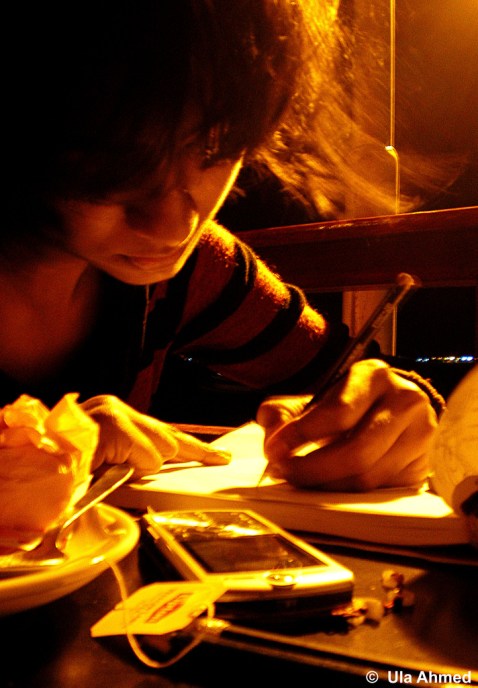
“I Rise,” image by Flickr User Lua Ahmed
 Welcome back to Sounding Out!‘s fall forum on “Sound and Pedagogy.” Developed to explore the relationship between sound and learning, this forum blends the thinking of our editors (Liana Silva), recruited guests (D. Travers Scott), and one of the winners of our recent Call For Posts (Jentery Sayers) to explore how listening impacts the writing process, the teachable moment, and the syllabus (and vice versa). Sharpen your pencils and/or give your typing fingers a good stretch, because today’s offering from Liana Silva asks you to exercise unexpected writing muscles—your tongue, mouth, and vocal chords! If you need a make-up assignment for last week’s post by D. Travers Scott, “Listening to #Occupy in the Classroom,” click here. And don’t forget–same class time next week!–JSA, Editor in Chief
—
When I started this draft, I sat in an office that is not mine, next to an old, whirring Westclox Dialite electric clock. When I write, I usually pop my headphones on and blast my “Writing” playlist on my iPhone. But that day, I was soothed by the sounds of a whirring clock and the air blasting through a wall vent. On another day I worked on my draft while I listened to sports talk radio, a big part of my morning routine; toward the end of the drafting process I shared this blog post with a writing consultant at the writing center where I work.
For me, writing is always connected to sound. Sound inhabits the spaces where I write, either in the shape of music, typing, or voices. These sounds are never far from my writing process. In fact, something so small as the typing of the keys as I write this can be construed as the soundtrack to my writing. Sounding Out! guest blogger and author Bridget Hoida made a case for how sound is part of the texts she reads and how she weaves sound into her own writing; in my case, I can’t think of writing without sound. It is my soundtrack/sound track, in the sense that sound is the track on which I lay my writing process, like the lines of a ruled notebook.

“Writing” by Flickr user Sara Bjork through Creative Commons License 2.0
However, many writers and educators tend to think of writing as a solitary, lonely, quiet endeavor. Last month, at an orientation where I was speaking, I heard someone refer to the “quiet activity of writing and learning.” As I looked around me, stunned, I seemed to be the only one surprised at this assertion. Although it is a common perception, as a writer, ex-writing instructor, and writing center staff member, this did not make sense to me. Both writing and learning, for me, are connected to sound, whether it was listening to music while editing or talking through my ideas during class discussion. If, to paraphrase Brandon Labelle in Acoustic Territories, places configure what sounds are deemed acceptable and unacceptable, do schools configure what are the appropriate sounds of learning?
I approach this question about the sounds of learning from the angle of my work at the writing center. For years I taught first-year composition, and later on in my academic career I started working at a writing center (where I currently work). At the Writing Center we are surrounded by the sounds of writing and learning. A student will walk up to one of our locations and meet with a writing consultant. They will discuss the writer’s text, in the case that the writer brings a draft. After this discussion, the consultant will read the writer’s text aloud, a practice that all of our writing consultants must adhere to. The text comes alive in the voice of the consultant; the good, the bad, and the ugly are made audible, concrete in the voice of the consultant. This enables both parties to hear the paper, but also to listen to the paper and, ideally, understand it better. The consultant and the writer then talk about what works, what doesn’t, what could be improved and how. Learning takes place through a conversation. It is at the writing center where writing and learning processes are no longer silent, but actually audible. The value for a writer of hearing their text aloud is not new; in 1967, Anthony Tovatt and Ebert L. Miller did a three-year study on how listening to their writing helped high-school writers improve their writing skills (see their article “The Sound of Writing”). My concern is how learning is coded as silent, despite evidence to the contrary.
I wonder about the implications of describing learning and writing as “silent” processes. Silence already has a domesticating quality: it is portrayed as the gift of the restrainted, of the eloquent, of the elite, and these ideas about silence and noise emerge from 19th Century ideas about respectability and middle-class values. As an example, American Studies scholar Daniel Cavicchi states in Listening and Longing: Music Lovers in the Age of Barnum,
“In fact, both in the North and the South, genteel people came to value the quietude of silent reading and listening as a form of ‘productive leisure’ that was explicitly opposed to the louder, more boisterous pastimes of slaves, immigrants, and workers. As in the days when European colonists and Native Americans struggled to understand each other’s sound worlds, aural difference now became a wedge that allowed those in power to place certain groups figuratively and literally outside the bounds of civilization” (52).
Ideas of learning as silent are coded in broader discourse about silence (or, to use Cavicchi’s more accurate terminology, quietude) and noise, about what is respectable and what is not. How do these common connotations of quietude as dignified and sound/noise as unpleasant carry over to descriptions of of learning? It is possible that society has normalized these types of learning (the “silent” types) as of a higher caliber, and schools have a major part in that: reading to one’s self in silence, filling out exam questions and not talking to anyone, typing in a quiet library at a computer station fit for only one. Even a lecture dignifies silence, in a way: students sit down and listen to what the teacher/professor has to say while they digest, quietly, what is being taught. In opposition, the sounds of learning can be associated to the sounds of collaboration, as it were: tutorials, consultations, advising sessions, discussion sections, movie viewings. Although talking is not the only way to collaborate in order to learn, I posit that these learning activities that are usually non-silent fall prey to hierarchies of sound and silence.

“Student Writing 2002,” Image by Flickr user Cybrarian
These hierarchies of sound and silence tell listeners that the learning activities that are portrayed as silent are more legitimate than those that are portrayed as boisterous, loud, animated—in other words, activities producing sound. In fact, it doesn’t have to be either/or. The fact that they are set in opposition to themselves is in itself problematic. Isolating sound from the learning process acts as a way of emphasizing writing as the main component of learning. Jody Shipka in “Sound Engineering: Toward a Theory of Multimodal Soundness” describes how writing is thought of as “the communication of scholarly, rigorous arguments or ideas, something more often associated with the production of linear, print-based texts” (356, emphasis in original). This dichotomy of rigor versus play can be portrayed also as visuality (as embodied in the written text) versus aurality. The writing center can be the place where these ideas are tested, in the sense that it is a location of collaborative learning where some learn by writing and others benefit from talk while others benefit from listening. By privileging quietude and solitude as the ideal modes for learning, we miss out on other important vehicles for learning, such as sound.
***
If I started this post with the whirring of the Westclox clock, how did I end this post? I ended it on a busy Sunday evening, while my daughter slept and my boyfriend talked on the phone. I finished it with the chatter of the air conditioner, the clack of baseballs against bats coming from the living room, and the click click click of the keyboard keeping me company.
—
Liana M. Silva is co-founder and Managing Editor of Sounding Out!
Share this:


Current Top Posts





April 2021

January 2020

November 2019

October 2019

August 2019

April 2014

November 2017

March 2015

December 2017

October 2015
 Sounding Out!
Recent Comments