
SO! Reads: Daniela Cascella’s F.M.R.L. (Finding Materials for Remembering and Listening)


***
Before I read F.M.R.L., I didn’t know Daniela Cascella or her work. I hadn’t read her first book or her blog or her Tweets; I hadn’t seen any exhibits she had curated or attended a reading. Instead, the words in her book introduced us.
Here’s how she was introduced, here in this exploration of how sound and writing intertwine:
- A wanderer, traveling the globe to meet friends, attend conferences, read books (and more books, and more books)
- An archivist, saving physical and digital boxes of sounds and words and quotes, all blended with her own notes and ideas
- A listener, noticing the sounds of words as much as their meanings
- A cave-explorer, digging ever deeper through layers of earth to find echoes of what has been buried—which is another way to say a wanderer, an archivist, a listener
How odd to meet someone through words alone, not knowing what she sounds like, what she would say if we met.
***

“you know you’re a Mac user when…” by Flickr user Nick Normal, CC BY-NC-ND 2.0
I’ve never told anyone this: I sometimes imagine descendants and friends sifting through my digital archives after I die, meeting me through my words and my collections.
“Collections” is too organized of a word, really. I save files, sometimes in clearly named folders, but just as often not: pdfs, docs, txts, sometimes containing my own words and sometimes others’. On 3.5” floppies, CDs, DVDs, in the cloud. Poems, essays, quotations, scans—I don’t even know what these people from the future might find, how these archives would introduce me to them.
Once, my first year in college, a girl I liked called me to complain about her boyfriend, and her words were so layered with meaning that I opened up a window of Word and started typing her words, verbatim. She was going fast, though, so when I got behind, I just hit enter and kept going. She must have heard the keyboard clicking, but she never said anything.
I haven’t read that file for years, but it must be somewhere in the cave of my collections.
***
 A colleague sees Cascella’s F.M.R.L. on my desk. His face scrunches as he tries to make sense of the letters on the cover.
“It’s a book I’m reviewing,” I offer.
“No, it’s just. . . .” He reads the subtitle. “I thought it was a play on the phrase FML or something.”
I know how he feels. Every time I see the book sitting there, new words and letters come to mind. I eventually heard it as ephemeral, but always after others:
Formerly. Fame, really. Female roll. F my real life. FM Radio, Live!
Here’s what it actually says on the cover: Footnotes, Mirages, Refrains and Leftovers of Writing Sound. When my colleague sees that subtitle, he experiences the tiny pleasure of “getting it,” of seeing what the letters “really” stand for, of feeling like these words now make sense in the way they were supposed to.
But inside the book, you quickly learn that in 1926, Louis Aragon also re-voiced ephemeral as F.M.R.L., but the letters stood for something different to him: frenzy, madness, reverie, love.
Cascella takes it further: the next page lists the other things that F.M.R.L. could stand for: footnotes, false starts, frenzy, and so on, each list of words ending in delightful ellipses, which seem to say, “And what does this F mean to you?”

“The Letter F for Flickr and Friends” by Flickr user Denise Womack-Avila, CC BY-NC 2.0
***
From Cascella’s blog: “The title is ‘F.M.R.L.’: not ‘Ephemeral’. I chose this title because of its ambiguity and because it calls to be sounded. I chose it to draw the attention toward language as material; to stay away from any literal understanding of sound as ephemeral, as if unworthy of attention; and to prompt other departures from and into words and letters.”
***
A note I wrote in the margin: “So much of this book is an explanation of this book.”
Consider:
“I have a habit with listening. It makes me write even when I don’t now [sic?] what to say. . .” (9). Do you hear? she seems to say. I’m writing, and you’re listening in, but I’m not sure what it will mean to you, or to me. That’s how sound works.
“Each cluster of words is not created anew but cast from words that were before, recalled from archival layers. I don’t want to explain them, but rearrange them and hand them over to you before they expire” (118). Do you hear? she continues. Will you listen? Can’t you make meanings without my explanations?
“SOUND: You should not have called me Sound, but told me of the sounds in s-s, addressed me with incoherent stories and undecipherable acoustic traces, signifiers whose sense is uncertain and that yet mean” (2).
That last is from the dialogue that opens the book: SOUND and WRITER are “walking in a circle, anticlockwise and diametrically opposite” as they try to figure each other out. Or, really, as Writer tries to figure out Sound, trying to grasp and understand and explain. Sound seems ok living in the moment, singing.
As I read the rest of the book, I kept remembering that tension between writing and sound. It’s infused in the pages of the book like strong tea.
And I kept thinking of myself, as a writer and teacher of writing who is also a listener and a maker of sounds. I’m dedicated to writing and sounds, both. Maybe Cascella’s solution is the best: to love words, to read and memorize and archive them, but to never stop at what they signify, to always attend to the sounds they suggest as well, the puns of meaning hidden throughout all languages.
***
By writing about this book, I feel I’m writing against some of its core ideas.
Writing about is so descriptive, explaining, clarifying, cleaning up, setting the table for dinner because something important is going to happen soon, so wash your hands. When I write about, I take notes in the margins, but not the kind of notes where I exclaim in wonder or shock, or record my emotional reactions. Instead, when I’m in writing about mode, I jot marginal notes that summarize, explain, organize, keep track of everything.
An example: here’s a list of the page numbers where I noticed Cascella using the word ephemeral:
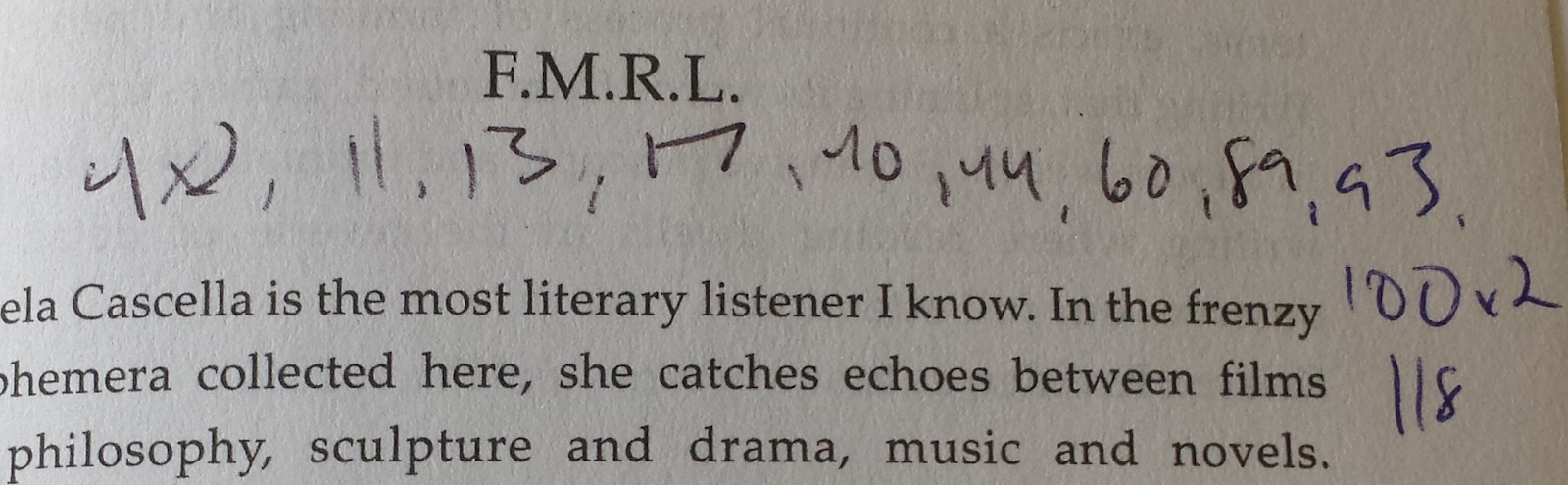
Ah, now I have some ownership over this book. Ah, now I am on my way to understanding it.
This is how I feel when reading/annotating poetry: a little embarrassed when I annotate only to explain and clarify, but pleasantly engaged when I annotate my gut reactions, often written in exclamation points or question marks or stars, doubled or tripled when I really mean it.
***
This is a book that asks to be read all in one sitting, even though that’s impossible.
At least it’s impossible for me. Cascella’s soundings (which seems like a better word than writings) are thick with images and quotations and sudden jumps, which seems to suggest a slow attitude, like reading a poem or two a day instead of powering through an entire book as if it were a long sandwich.
But the echoes (and this is very much a book about echoes, and caverns, and geological layers) threaten to disappear from memory if you wait too long to read the next chapter. My longer reading sessions were always rewarded with subtle connections: a circle, an incantation that I’m sure she mentioned just a few pages back, hold on while I find it.
So maybe the best solution is to read it once quickly, attending to the echoes, and then again slowly, attending to the layers. It’s like watching Twin Peaks, like exploring a museum.

“The Lion Man” by Flickr user storebukkebruse, CC BY 2.0
An example: in the final section of the book, she describes The Lion Man, a 40,000-year old sculpture. “I cannot even figure the meaning of 40,000 years ago,” she writes (113). I pause, look up, and bite the end of my pen. I’ve heard these lines before, I realize. Did I read ahead, when I first got the book in the mail? Or did I read about The Lion Man online somewhere, maybe when Thomas Rickert is discussing the Lascaux paintings in his book Ambient Rhetoric? Was I thinking about it when singing R.E.M.’s “Texarkana” the other day in the shower, how the numbers in that song grow from 20,000 to 30,000 to 40,000?
But then, later, I skim through my marginalia and realize I was wrong: Cascella herself told this story, back on page 14, using the same words.
I’m tempted to explain to you the effect of this verbal echo, from sculpture to exhibit to Cascella’s archival notes to Cascella’s book, written in two different places. But right now, I have page 15 open, held down under my arms as I type, and there’s a sentence there that I double-starred, and to me, double-stars are rare and important. I starred: “Perhaps their [ancient art objects’] final appeal is for us to cease to aim at being clear and distinct” (15).
So I’ll hold off my explaining, my desire to clarify. But I’ll add another echo from Cascella: toward the end of the book, she writes the same sentence—”Perhaps their final appeal is for us to cease to aim at being clear and distinct” (120)—but this time, the pronoun their is describing sounds, bottled up and kept in the room of an enchanted child. On this page, I once again double-starred the line, even though I had forgotten that I had read those words before in this book. They affected me the way sounds affect me, with the slam and the flood of standing in the ocean, which then pulls back before repeating the same slam and the same flood.
***

“Lascaux II – Hall of the Bulls” by Flickr user Adibu456, CC BY-NC 2.0
“[W]e can compare the designed use of Lascaux as afforded by its spatial, acoustic, and material properties to musicians’ attempts to get a certain sound by recording in a specific environment.” —Thomas Rickert, Ambient Rhetoric: The Attunements of Rhetorical Being
***
I recently taught Lauren Slater’s memoir Lying in a creative nonfiction class. I reread it on a plane ride to Florida and decided to write about my experience on the plane ride home. But when I opened my laptop, I found myself writing like Slater in little ways: invented scenes mixed into my nonfiction, insistent addresses to the reader (like “you have to believe me on this point”), sentences that drifted on, connected only by comma splices, there’s one there, they’re lovely sometimes, they were everywhere in my sentences.
What’s more, this echoing didn’t feel like a choice. Slater’s writing had become part of my internal archive, bubbling up unbidden.
***
Scholar of writing Peter Elbow emphasizes the importance of teaching students to trust their mouth and ears when making punctuation decisions. He admits that comma splices often feel right when you’re trusting the sound of your words, that there’s a connectedness you want with a comma that you don’t get with a pesky semicolon or period or even a lively dash.
“But,” he reminds us—and I hear some sad music in the background as I write this—”many teachers and readers who know the rules are unforgiving about run-ons.”
Do you see how Cascella is in my brain, connecting my mental archives with synthesizer cables? I can’t stop thinking about the rules of writing and the rules of sound, and how they might sound together if I just try plugging this here. . . .
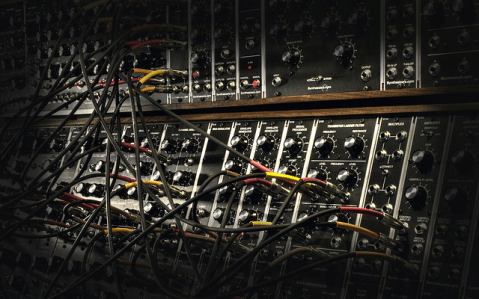
“Modular Synthesizer Desktop HDR” by Flickr user Peter Georges, CC-BY-NC-ND 2.0
***
In one of Cascella’s most fascinating chapters, she describes an experiment she performed on herself: “I learned by heart every week a paragraph from a new text that mentioned sounds, re-wrote it from memory the following week, and interpolated the missing parts with other words heard beside myself—an experiment in layered memory, as it corrodes and actualises my physical and emotional archives while I search for more voices: an echo cast into shape, to fold my enchantment with words round, and back dissolving, and again” (69).
She shares three examples, three “casts,” of these rewritings from memory. And I’ll be honest: when I first read this part of the book, I was excited at the idea of looking up the originals, of trying to catch exactly how much she did and didn’t remember—of reinscribing the authority of an ur-text, instead of allowing the echoes of the her-text envelope me.
So I looked one up. (I mean, Google Books.) And I compared. And I saw similarities and differences. Yep, there they were.
And out of nowhere, I felt ashamed. I felt like I was trying to break her experiment, her art, her practice. So I’ll leave it up to you: read her rewritings from memory—it’s chapter 11, I’ll wait while you find it—and decide for yourself if you want to know how much she changed or didn’t change from the “originals.” Decide for yourself how right/write or wrong it is to play with someone else’s texts. Decide for yourself if this is really how we do everything everyday anyway.
***
Slater’s Lying, the book I read on the plane, mixes truth and lies, a fact that aggravates some readers and enchants others. The thing is, she tells you exactly what she’s doing—I mean, the book is called Lying, and her first chapter, in its totality, is “I exaggerate.” Plenty of other obvious clues remind us that fact and fiction have been put in the blender of this book.
Cascella tells us what she’s doing, too. Eventually, you start to realize that explaining this book is one of the themes of the book—but no, explaining is the wrong word. More like inviting you to enjoy it the way she wants you to enjoy it.
Sometimes that invitation is rather direct: “I seek to reclaim the intermittent incoherence in listening as it urges to move through its residual presence into a marginated writing that is not a site of clarity but edge, horizon, fugue” (24). Bam. Pretty clear.
But often, she’s more invitational, writing in the second person, just to you: “Try and listen to them, one after the other, forget about genealogies and canons, listen to those vocal intertwinements and rhythmic mosaics” (30).
Then it’s back to her again, how she “want[s] words to follow the untidy movements in listening, to be mud and magma” (48), how she’s “drawn to listening to [sounds], to reinvent, recall and divine them in words” (68).
Her, you, her, you. Me. A swing, a dance, a recursive circle between telling and inviting.
“Blah” by Flickr user Flood G., CC BY-NC-ND 2.0
***
“The moment I begin to write, sound is no longer sound” (39).
***
One reason Cascella writes this way: she’s frustratred with work on sound that ignores the affordances of sound. At sound art conferences, in discussions about sound art—they all seem to be so filled with words and explanations that she couldn’t help but explode words onto these pages in a different mode, like she does in this book.
“[C]oming back from yet another conference on sound,” she writes, “I would feel like I no longer knew how to speak, listen or write” (23). She’s tired of artists who make complex work but then use “trite and worn-out expressions that say no more” when describing it (55), “where sound becomes an apology” (108).
So this book uses sounds, and there’s no accompanying apology. Sorry.
***
I’m sitting outside at an academic conference for scholars in rhetoric and composition. I’ve seen some boundary-breaking stuff today, but I want more.
“I mean, sometimes I don’t want to have to tell the audience everything,” I say. I’m at a table with friends. We’re in Florida, so we’re drinking obscenely bright cocktails. “I want to throw ideas and sounds at them and let them connect the dots. These are smart people, right?”
Paul nods and pauses before speaking. We just met, so I think he’s trying to give good advice in as gentle a way as he can. “Yes. They’re smart. But there’s obviously a line, too, right? If you’re creating scholarship, you have to make moves that signal that you’re part of that community, that conversation. Otherwise, you’re making. . . .”
“You’re making art. Right?”
“Right. And art is important, and I agree that we need more artistic sensibilities in our field. But it’s not scholarship.” He pauses. “You have to play the game, too.”
I nod. I think he’s right. Sometimes, in some places, I need to play the game.
But not always. And in different fields, different modes of expression beyond the scholarly, the game is different, you can see it if you peek around the corner into other rooms. And if you break down walls, it’s all one big room. Which is exciting and terrifying and I want it all, all the ideas and methods and all the sounds.
“Sound six points” by Flickr user Sarah Barker, CC BY-NC-ND 2.0
***
How can I tell you anything at all, when all I know are sounds?
But still, you want the point. You want to know what this book will do for you, for your art, for your scholarship.
How can I tell you anything at all, when all I know are sounds?
But ok. You’re not here to be moved. (Are you? I hope you are.) But if you’re not: what will propel your ideas, what will inspire your work after reading Cascella, what the take-aways are:
- “Writing away from sound” as a different way to “write about sound” (44). That is, instead of explaining, to let the nature of sound itself inspire the kinds of work you do.
- “Writing Sound” as an “encounter,” as “transcience” (54).
- Acknowledging our archives and inviting them to the forefront of our writing, even when those encounters are messy or confusing.
- Considering what we’re really doing in our art/theory/writing/sounding. Cascella says she’s not “a writer, a theorist, a critic” but “a handler of words, a listener, a reader” (90). Who are you? Who am I?
But how can I tell you anything at all, when all I know are sounds?
***
“I’m cut through by voices I don’t want to explain” (72).
—
Kyle D. Stedman is assistant professor of English at Rockford University, where he teaches first-year composition, digital rhetoric, and creative nonfiction. His work explores rhetorics of sound and music, intellectual property, and fandom. He tweets at @kstedman and hosts the podcast Plugs, Play, Pedagogy.
—
Featured image: “The Meaning of It All” by Flickr user Nick Webb, CC BY 2.0
—
 REWIND! . . .If you liked this post, you may also dig:
Living with Noise — Osvaldo Oyola
“Sound Studies: A Discipline?”: Sound Signatures Winter School, Amsterdam, January 2014 — Melle Kromhout
Sounding Out Podcast #36: Anne Zeitz and David Boureau’s “Retention” — Aaron Trammell
Share this:

Karaoke and Ventriloquism: Echoes and Divergences
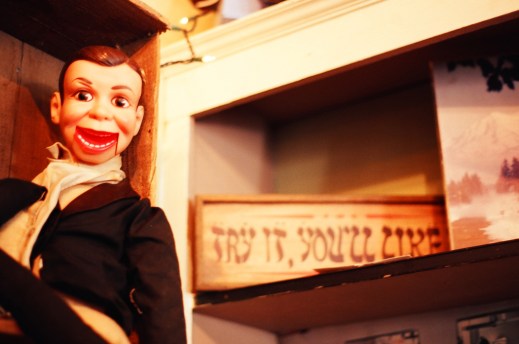
This piece is co-authored by Sarah Kessler and Karen Tongson.
Scholarship rarely happens in isolation, despite quantitative demands in the humanities for “single-authored” works. Instead, intimacies of different shapes and configurations, transpiring in spaces as variegated as “the institution,” cocktail bars, cars, and even boudoirs, have profound effects on how we think, and on what we eventually write. However, academics have very few forms beyond the citation, the footnote, or even the acknowledgment, through which to admit our debts, recognize our inspirations, and lay bare the narcissisms of our small differences.
Our current areas of research—karaoke for Karen, ventriloquism for Sarah—traverse what may appear to be a narrow terrain of sound studies currently focused on “voice” or “the voice.” And yet the strains of sound studies that draw us to these topics do not exclusively concern themselves with the tropes or techniques of voice and vocalization that karaoke and ventriloquism conjure. Though voice presents itself as the most basic and fundamental connection between these two concepts and practices, we are each more invested in exploring karaoke and ventriloquism as actual sound technologies, as well as technologies of power. As you will read below, ventriloquism, for all its associations with archaism and mysticism in certain historical contexts, is also depicted as a technology and technique of deception, statecraft, and power. Meanwhile, karaoke, for all its associations with the expressive and participatory potential of amateur vocalization is also, crucially, a technological apparatus, whose media archaeology bears the traces of intercolonial conflicts, negotiations, and aftermaths. Finally, we are also both interested in the ways in which these sound technologies and techniques have been transformed into critical, intellectual, and affective methodologies, especially since they’ve both been harnessed as broader cultural metaphors for judgments at once moral and aesthetic.
 .
.
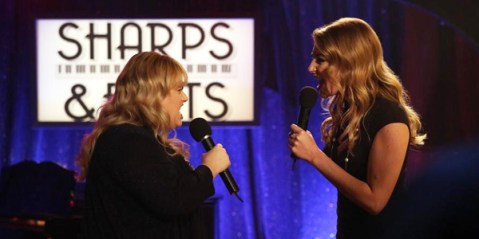
Over an obscenely caloric breakfast, we devised several questions touching upon some keywords and concepts we believe are applicable to both karaoke and ventriloquism, two topics that undermine notions of authorship, source, and origin. In our respective writing about these two subjects, we’ve both occasionally (or more than occasionally) been besieged by the anxiety that our work is melding together into some indeterminate blob. To put it another way: like any other lesbionic duo resisting the “urge to merge” (as so many other queers have warned against), we’ve arrived at that moment in our intimate and intellectual relationship where we’ve decided to sort out whose socks are whose. Somewhat ironically, then, we wrote this post together to establish some of the crucial differences between karaoke and ventriloquism.
The following “ventrilokeal” dialogue shows, from a conceptual standpoint, where some of the boundaries between karaoke and ventriloquism harden, while others remain porous.
We each provide separate answers, engaging the other person’s answer when appropriate. Feel free to supplement some of our questions in the comments section, addressing either or both of us. And thanks for indulging.
***
1) How do both karaoke and ventriloquism—as terms, metaphors, and practices—conjure and/or reframe our understandings of originality and derivation?
 KT: Karaoke, at least in my mind, has become the prevailing metaphor for derivation in the contemporary moment. Whenever the term is tossed about casually as a cultural metaphor, with little regard to the geographical contexts, modes of performance or the technologies that underlie its current practice, “karaoke” functions as a kind of shorthand for “the unoriginal,” the debased copy, the amateur reenactment. Novelist Dubravka Ugresic’s long essay on “Karaoke Culture” (2011) provides a perfect example of these applications of “karaoke.” And yet, karaoke in the U.S. in the last 15 years or so has also been construed as something that unlocks the creative and expressive potential of beleaguered, repressed or emotionally stunted individuals, usually men (see Lost in Translation, the forgotten Huey Lewis and Gwyneth Paltrow vehicle, Duets, and a recent pair of books I actually quite like, Brian Raftery’s Don’t Stop Believin’: How Karaoke Conquered the World and Changed My Life and Rob Sheffield’s Turn Around Bright Eyes: The Rituals of Love and Karaoke). Of course, it will take all of Empty Orchestra (my working book title), to answer this question properly, but one of the principles guiding my own account of karaoke as a metaphor for copies and reenactments (in addition to my exploration of its material practices and technological history), is that derivation and mimicry have always been a key concern of—and a point of intersection between—queer theory, aesthetics, critical race studies, and (post)-colonial studies.
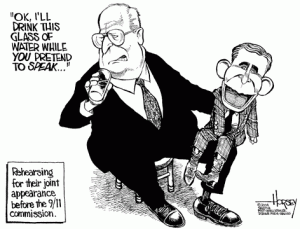 SK: When ventriloquism is employed as a metaphor in popular cultural contexts, it’s also often used to connote a lack of originality. The term tends to describe (and to fantasize) a situation in which one individual acts as the communications medium—usually the speaking or singing vessel—for words, songs, and other ideological formulations that originate or originated with someone else. So, in contrast to the mass copying and amateurism invoked by “karaoke,” “ventriloquism” suggests an unoriginality that can, and that must, be traced back to a discrete body and distinct point of origin. Think, for example, of George “Dubya” Bush and Dick Cheney, who were often represented as a ventriloquial duo. Political cartoons depicted Dubya as Cheney’s open-mouthed dummy, perched on the knee of his puppet master, the “actual” leader of the free world. Here, ventriloquism was used to image a scenario wherein the man who seemed to be in power was both secretly and openly manipulated by another man, who was the true source of power. In this case, unoriginality on Bush’s part connoted originality on Cheney’s, whereas in the case of the Beyoncé lip-synch scandal (more on this below), unoriginality signified very differently. Generally speaking, however, “ventriloquism” implies that a deceptive act has occurred, one that masks the origin of its own workings. It signals the veiling and subsequent exposure of a powerful apparatus. This apparatus is usually vocal in nature, the voice’s historical connections to power being well documented. In his Western cultural history of ventriloquism, Dumbstruck (2001), for example, Steven Connor traces the form back to Greco-Roman oracular myths in which divine prophecy is primarily accessible as a voice, transmitted through the mediating body of a priestess.
 Contemporary ventriloquists like the British performer Nina Conti often claim to be surprised by what their dummies say, which suggests that, far from being an omnipotent machinator, the ventriloquist is a bifurcated entity—one whose practice places her beside herself, in conversation with herself (or, as others have noted, with her unconscious). My recent work argues for bifurcation as a workable antidote to the tired, either/or question of originality vs. derivation to which popular cultural forms are repetitively subjected.
2) The terms “karaoke” and “ventriloquism” are both frequently employed in adjudicatory ways. As Karen has pointed out elsewhere, “karaoke” is often used in reality TV contexts (American Idol, The Voice) as a negative judgment of performance quality, i.e. “that performance was shit—mere karaoke.” “Ventriloquism,” for its part, is often used to connote a deviousness or deception that disqualifies a performance (think folks condemning Beyoncé post-lip-synched inauguration performance). What are the differences between “karaoke” and “ventriloquism” as judgments?
 KT: I actually think that one of the primary differences between these two terms as judgments, and perhaps more simply as just terms, is that “karaoke” condemns the person performing it, or performing something in “the style of” karaoke (i.e. derivatively, as a copycat, as a mere echo of the “original”), as a lightweight. Pulling off a feat of ventriloquism seems like a heavier, more sinister, and more complex operation of power, at least as I’ve heard you explain it, and as you describe it viz. Bush/Cheney above. Karaoke as a performance practice also lacks ventriloquism’s gravitas and requisite skill, insofar as ventriloquism is an archaic-seeming art form. Karaoke is the opposite of serious or sinister: it’s laughable, buffoonish, and absurd. It’s all surface and no depth. Ventriloquism, at least as I’ve heard you describe it to me on many occasions, in different situations, seems more layered. This is not to say, however, that I actually believe that karaoke is lightweight, or only about surfaces, but as a term of adjudication, it can’t really break free from those associations to mean anything more.
SK: Yes, as you say above, “karaoke” as judgment indicates amateurism and insubstantiality, whereas “ventriloquism” suggests a more menacing, or at least a more complicated, operation. And when one actually does karaoke, one can’t even conceal one’s appropriation—it’s part and parcel of the practice. A ventriloquist, on the other hand, hides herself in plain sight: the greater the attention focused on her dummy, the less it matters that—as the audience well knows—she’s the one talking. This is called “misdirection”: if the eyes are on the dummy, the ears will follow, and the dummy will appear to speak even if he doesn’t have his own microphone.
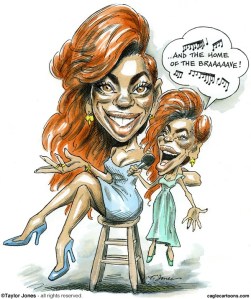 The interesting thing about the liberal accusation that Bush was Cheney’s ventriloquist dummy was that, though the image of Cheney as evil puppetmaster was sinister, it still served a reassuring function, in that it allowed for the continuation of the idea that there was a source, or origin, of power, period. As opposed, let’s say, to a more Foucauldian understanding of power as dispersed, not traceable to an isolated sovereign body. In contrast, when Beyoncé allegedly lip-synced, but in fact sang over, her own recording of the National Anthem at the 2013 presidential inauguration, her performance—which, as many have pointed out, was not unusual by pop industry standards—was framed as ventriloquism in order to cast doubt on her legitimacy as a live performer, i.e. as a performer whose voice could “stand up” in non-studio conditions (which are still, and ironically, just as much mediated as studio conditions). These ventriloquial scenarios are, it should go without saying, gendered and racialized: Bush-Cheney as ventriloquism emasculated Bush while restoring power to Cheney’s white, male, visibly disabled body; Beyoncé-Beyoncé as ventriloquism rather unsuccessfully attempted to pit Bey against herself (mediated, recorded Beyoncé vs. live Beyoncé) in order to devalue her corporeal body and frame her as unworthy of (national) subjectivity.
3) Both karaoke and ventriloquism are mass, but not mainstream, cultural practices. Karaoke is a mass cultural activity, but one that still carries with it the frisson of doing something slightly risqué (hence its frequent overlap with inebriation). Ventriloquism, while not being a cultural activity practiced by the masses, is a mass-mediated and mass-consumed cultural form, despite the aura of Vaudevillian anachronism (and/or pathology) it persistently conveys. How might we account for the “mass but not mainstream” quality of both practices?
 KT: I actually have to credit Zhou Xun and Francesca Tarocco, co-authors of an ambitious book, Karaoke: The Global Phenomenon (2007) with the “mass vs. mainstream” formulation. At this point, karaoke is globally ubiquitous, thanks to the many delivery systems that have evolved from the first karaoke and sing-along machines from Japan and the Philippines. There’s actually a popular app called Sing!, which enables you to perform karaoke and compete against anyone in the world. Meanwhile, YouTube is replete with karaoke videos to perform and practice with (some KJs, or “karaoke jockeys,” use YouTube as their primary interface), as well as with videos of people from all walks of life performing karaoke in various bars or at family functions in the home or elsewhere. These days, practically every sitcom on primetime TV stages a requisite “karaoke outing,” that usually leads to disastrous, if hilarious consequences for its characters.
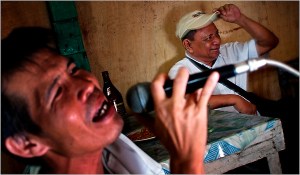 And yet karaoke as a mass practice can’t quite broach the mainstream, because of its various “abject” associations with immigrant communities, aspirational everymen longing to be idols, isolate geeks who only interact with the outside world through their computers, drunkards, gaggles of girls group-singing to Madonna, queens bereft of the piano bar’s liveness, slumming with an electronic delivery system for their show tunes, and other such “sad” spectacles. Once someone excels at karaoke—at singing someone else’s song so well that they transform it in some way—we are apt to think they actually exceed karaoke, and leave behind the form, much in the same way that, as you suggest in your opening comments, a good dummy eclipses its ventriloquist. When (in the words of many an Idol judge), someone makes someone else’s song “their own,” we enter into the territory of the cover, the reboot, the repurposed. The failure of the form to transcend its own limitations, even if it serves as the vehicle for many to otherwise achieve transcendence in myriad ways, is what keeps karaoke abject and not quite ready for mainstream acceptance.
SK: In the U.S., there’s a genre of white, masculine ventriloquism that’s currently extremely popular. This genre is typified by U.S. ventriloquism’s two biggest guns, Terry Fator and Jeff Dunham, who, following in the footsteps of Edgar Bergen, brought their ventriloquism to television to increase the art’s spread. Fator won America’s Got Talent in 2007 and now gives nightly performances at The Mirage in Vegas, where he has a theater named after him. He’s made hundreds of millions this way. Dunham has a strong presence on Comedy Central and is also one of the top-grossing U.S. standup acts. Both vents are especially popular with “Heartland” audiences, and both have casts of gendered and racialized puppets to whom they, as white male ventriloquists, play the straight man. Dunham, in particular, takes an unapologetic stance towards his own redneck identity, which permits him to criticize and recuperate this identity in one fell swoop. For instance, Dunham’s “white-trash trailer-park” dummy Bubba J drinks a surfeit of beer and is of low, if any, intelligence, but he remains benign in comparison to the rest of Dunham’s cast of characters, which includes Achmed the Dead Terrorist (a bin Laden caricature) and José Jalapeño on a Stick (use your imagination). Fator and Dunham’s ventriloquism evokes the practice’s historical connections and overlaps with minstrelsy, consolidating a fragile white masculinity in the process.
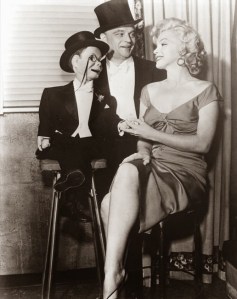 This culturally bounded reading of contemporary ventriloquism’s mass popularity directly resonates with your reading of karaoke as a practice with “abject” associations that is accordingly repurposed to “unlock the creative and expressive potential of beleaguered, repressed or emotionally stunted individuals, usually men.” While ventriloquism is difficult to perform well, vent instruction manuals always stress that, with practice, anyone can ventriloquize. One of the reasons that the practice isn’t mainstream is that it’s associated with a perverse desire, even a need, to speak through someone else in lieu of being able to speak “for oneself.” Edgar Bergen was always said to be shy with women, and to woo them through his brash, confident alterego Charlie McCarthy. And in his autobiography, Who’s the Dummy Now? (2008), Terry Fator (or his ghostwriter) writes about how his father found his ventriloquism perverse, and how he literally closeted his dummy as a result. Ventriloquism is too blatant a form of triangulation to be normal, and is thus coded as deviant, a perversion of heterosexuality’s direct, unmediated operation. Hence Fator’s book title, which aggressively restores authority to the formerly emasculated ventriloquist.

4) As the previous question suggests, and as prominent scholars of ventriloquism have also suggested, ventriloquism is ever anachronistic. Karaoke, too, is suffused by a sense of belatedness, reflected in nostalgic, hits-driven karaoke song choices and/or by the practice’s enduring connection to seemingly obsolete technological forms like laser discs. In what ways is each form out of time, or behind the times, and, alternatively, why do these forms appear as such even as they continue to exist in time?
 KT: As I mentioned above, karaoke’s purported abjection in the U.S. is, in many ways, a consequence of its association with the immigrant communities from Asia who imported the practice, as well as karaoke technologies, to the west coast as early as the mid-1970s. In that sense, karaoke functioned as a vehicle of nostalgia for those in the diaspora who longed to connect with memories of “home” through certain musical repertoires, even if some of those repertoires were actually already comprised of American pop hits folks grew to love when they were still “back home” (e.g. songs by the Carpenters, or any of the Johns—Elton, Olivia Newton, Denver). I haven’t quite worked it all out yet, but there is a certain circular temporality to karaoke. I have a hunch that the form is Romantic insofar as it is, at once, about the moment and its “spontaneous overflow of powerful feelings,” yet prone to saturating those powerful feelings with the “passionate recollection of youth.” There’s also something anticipatory and performative about karaoke, insofar as it has the capacity to do what it purports to articulate. I wrote something about this from a personal perspective in a piece about my favorite L.A. karaoke bar, the Smog Cutter. As the question above remarks, karaoke also feels belated, or emblematic of a particular era, because of the visual peripherals that accompany some song catalogues, especially those released on laser disc in the late 1980s and early-to-mid-1990s (i.e. the videos comprised of b-roll, and oblique narrative re-imaginings of certain songs). I can’t get into all of it here, but my plan is to devote a chapter to the karaoke video—from its production history (of which Brian Raftery offers an excellent preliminary account), to its repurposing in contemporary queer performance art.
 SK: I’m still working on understanding ventriloquism’s anachronism—why it continues to appear, or to feel, outmoded despite its present popularity—besides the obvious fact that its contemporary iterations evoke Vaudevillian performance. Nina Conti, who has, like Fator and Dunham, distributed her ventriloquism across multiple media platforms, makes many jokes about this. Her puppet Monk, who sounds like a muffled Sean Connery trapped in a fuzzy, simian body, will often deride her for practicing such a “dead art,” and Conti’s documentary, Her Master’s Voice (2012), theorizes the ventriloquist dummy as a “bereaved object” that loses its voice repeatedly, and finally for good. Conti’s film, however, argues with its own assertion by reanimating the dummies of a dead ventriloquist with new voices, a process that could theoretically continue ad infinitum. Steven Connor argues that present-day “revivals” of ventriloquism like Conti’s are always “necromantic,” conjuring the form’s prehistory while at the same time referencing “newer” media like film (which, according to Rick Altman (c. 1980) and Michel Chion (c. 1982) is itself a form of ventriloquism). Writes Connor, “Whether because it is scandalously or mysteriously archaic, or uncannily premonitory, ventriloquism is always anachronistic, never quite on time.” And Mladen Dolar tells us that the voice itself is ventriloquial, leading to the extrapolation that ventriloquism literalizes or visualizes what the voice has always already done.
I tend to think of ventriloquism as temporally bifurcated. A ventriloquist has to exist in both the future and the past to make her practice work. She has to anticipate what’s going to be said next while remembering what’s just been said, and she has to keep her lips still while moving her tongue—acts that circumvent linearity and synchronization. In saying this I’m not arguing for ventriloquism as a “resistant cultural practice”; rather, I’m simply pointing out the temporal perversion to which the art lends itself.
***

Reflecting upon this conversation on karaoke and ventriloquism—a conversation that is, of course, ongoing—it has become even more apparent to us that both forms are sound technologies struggling against obsolescence, even as they are so frequently imagined as possible gateways to some human “truth” or “essence” precisely because of their associations with the voice. Though vocalization and vocality are reflexively associated with both forms, we hope we’ve been able to underscore some of the ways in which their powerful associations with “voice” naturalize, and to a certain extent also neutralize, the technical elements of each practice. We appreciate the opportunity to make some key distinctions, and to sound some of these issues out, here on the SO! Blog. Many thanks to Jennifer Stoever and Liana M. Silva for their generous editorial input. Like Conti’s bereaved puppets, who lose their voices only to be invested with new ones, we now relinquish ours—for the time being.
SK & KT
—
Featured Image by Flickr User Sam Grover
—
Sarah Kessler is a Ph.D. candidate in Comparative Literature at the University of California, Irvine, where she is writing a dissertation on ventriloquism in contemporary British and U.S. popular culture. She received an M.A. in Modern Studies from the University of Wisconsin-Milwaukee in 2008. Kessler’s writing on art, film, and media has appeared in artforum.com, the Brooklyn Rail, In These Times, and Public Books, among other publications, and she has held editorial positions at Triple Canopy and Afterall: A Journal of Art, Context and Enquiry. She is currently completing an article on the documentary work of ventriloquist Nina Conti.
Karen Tongson is Associate Professor of English and Gender Studies at the University of Southern California, and the author of Relocations: Queer Suburban Imaginaries (NYU Press, 2011). Her work has appeared in numerous venues in print and online, including Social Text, GLQ, Nineteenth-Century Literature, and Novel: A Forum on Fiction. She is currently the series editor for Postmillennial Pop at NYU Press, and just completed a multi-year term as co-editor-in-chief of the Journal of Popular Music Studies. Her current book project, Empty Orchestra: Karaoke. Critical. Apparatus. critiques prevailing paradigms of imitation in contemporary aesthetics and critical theory, while offering a genealogy of karaoke technologies, techniques, and desires.
—
 REWIND!…If you liked this post, you may also dig:
“Hearing Queerly: NBC’s ‘The Voice’”-Karen Tongson
“Head Games?: The Strategic View of Liveness and Performance”-Andreas Duus Pape
“New Wave Saved My Life*”-Wanda Alarcon
Share this:


Current Top Posts





April 2021

January 2020

November 2019

October 2019

August 2019

April 2014

November 2017

March 2015

December 2017

October 2015
 Sounding Out!
Recent Comments