
Listen to the Sound of My Voice

Betrayal
I first realized there was a problem with my voice on the first day of tenth grade English class. The teacher, Mrs. C, had a formidable reputation of strictness and high standards. She had us sit in alphabetical order row after row, and then insisted on calling roll aloud while she sat at her desk. Each name emerged as both a command and a threat in her firm voice.
“Kelly Barfield?”
“Here,” I mumbled quietly. I was a Honor Roll student with consistent good grades, all A’s and one B on each report card, yet I was shy and softspoken in classes. This was an excellent way to make teachers amiable but largely go unnoticed. The softness of my voice made me less visible and less recognizable.
Mrs. C repeated my name. Caught off guard, I repeated “here” a little more loudly. She rose to her feet to get a better look at me. I knew what she saw: a petite girl with long ash blonde hair, big brown eyes, and overalls embroidered with white daisies on the bib. When her gaze finally met mine, Mrs. C frowned at me and cleared her throat loudly. I curled into my desk, hoping to disappear.

“Lincoln High School 9-16-2007 008” by Flickr user Paul Horst, CC BY-NC 2.0
“Miss Barfield, did you hear me call your name twice? In this class, when I call roll, you respond.” I gave a quick nod, but Mrs. C wasn’t finished: “We use our strong voices in here, not our girly, breathy ones.” My cheeks flushed red while Mrs. C droned on about confidence and classroom expectations.
“Do you understand me?”
I stammered a “yes.” Mrs. C turned her attention back to the roll call. Her harsh words rang in my ears. I sank low in my chair, humiliated and angry. I couldn’t help that I sounded girly: I was, in fact, a girl. This was the way my voice sounded. It was not an attempt to sound like the dumb blonde she appeared to think I was.
That day I decided that I would never speak up in her class. Forget the Honor Roll. If the sound of my voice was such a problem, then my mouth would remain firmly shut in this class and all of my others. I would never speak up again.

“Listen” by Flickr user lambda_x, CC BY-ND 2.0
My vow to stop speaking lived a short life. I enjoyed Mrs. C’s serious fixation on diagramming sentences and her attempts to show sophomores that literature offered ideas and worlds we didn’t quite know. At first, I spoke up with hesitation and fear of the inevitable dismissal, but I continued to speak. Becoming louder became my method to seem confident, even when I felt anything but.
Throughout high school, my voice emerged again and again as a problem. Despite the increased volume, my voice still sounded tremulous, squeaky, hesitant, and shrill to my own ears. Other girls had these steady, warm voices that encouraged others to listen to them. Some had higher voices that were melodic and lovely. I craved a lower, more resonant voice, but I was stuck with what I had. In drama club, our director scolded me with increasing frustration about my tendency to end my lines in the form of a question. My nerves materialized as upspeak. The more he yelled at me, the more pronounced the habit became. He eventually gave up, disgusted by my inability to control my vocal patterns.

By Dvortygirl, Mysid [GFDL (http://www.gnu.org/copyleft/fdl.html) or CC-BY-SA-3.0 (http://creativecommons.org/licenses/by-sa/3.0/)%5D, via Wikimedia Commons
Meanwhile, at a big state university in my native Florida, I learned quickly that a Southern accent marks you as a dumb redneck from some rural town that no one had heard of. Students in my classes asked me to say particular words and then giggled at my pronunciations. “You sound like a Southern belle,” one student noted. This was not really a compliment. According to my peers, Southern belles didn’t have a place in the classroom. Southern belles didn’t easily match up with “college student. As a working-class girl from a trailer park, I learned that I surely didn’t sound like a college student should. I worked desperately to rid myself of any hint of twang. I dropped y’all and reckon.
I listened carefully to how other students talked. I mimicked their speech patterns by being more abrupt and deadpan, slowly killing my drawl. When I finally removed all traces of my hometown from my voice, my friends both from home and from college explained that now I sounded like an extra from Clueless. My voice was all Valley girl. I was smarter, they noted with humor, than I sounded and looked. My voice now alternated between high-pitched and fried. Occasionally, it would squeak or crack. I thought I sounded too feminine and too much like an airhead, even when I avidly tried not to. I began to hate the sound of my voice.
My voice betrayed me because it refused to sound like I thought I needed it to. It refused to sound like anyone but me.
When I started teaching and receiving student evaluations, my voice became the target for students to express their displeasure with the course and me. According to students, my voice was too high and grating. Screechy, even: one student said my voice was at a frequency that only bats could hear. In every set of evaluations, a handful of students declared that I sounded annoying. This experience, however, was not something I alone faced. Women professors and lecturers routinely face gender bias in teaching evaluations. According to the interactive chart, Gender Language in Teaching Evaluations, female professors are more likely to be called “annoying” than their male counterparts in all 25 disciplines evaluated. The sound of my voice was only part of the problem, but I couldn’t help but wonder if how I sounded was an obstacle to what I was teaching them.
Once again, I tried to fix my problematic voice. I lowered it. I listened to NPR hosts in my search for a smooth, accentless, and educated sound, and I attempted to create a sound more like them. I practiced pronouncing words like they did. I modulated my volume. I paid careful attention to the length of my vowels. I avoided my natural drawl. None of my attempts seemed to last. Some days, I dreaded lecturing in my courses. I had to speak, but I didn’t want to. I wondered if my students listened, but I wondered more about what they heard.
Sound
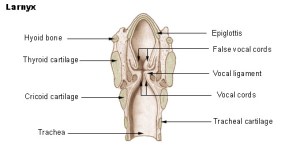
Public Domain, https://commons.wikimedia.org/w/index.php?curid=1393933
The sound of your voice is a distinct trait of each human being, created by your lungs, the length of your vocal cords, and your larnyx. Your lungs provide the air pressure to vibrate your vocal cords. The muscles of your larnyx adjust both the length and the tension of the cords to provide pitch and tone. Your voice is how you sound beyond the resonances that you hear when you speak. It is dependent on both the length and thickness of the vocal cords. Biology determines your pitch and tone. Your pitch is a result of the rate at which your vocal cords vibrate. The faster the rate, the higher your voice. Women tend to have shorter cords than men, which makes our voices higher.
Emotion also alters pitch. Fright, excitement, and nervousness all make your voice sound higher. Nerves would make a teenage girl have an even higher voice than she normally would. Her anxious adult self would too. Her voice would seem tinny because her larnyx clenched her vocal cords tight. Perhaps this is the only sound she can make. Perhaps she is trying to communicate with bats because they at least would attempt to listen.
Biology, the body, gives us the voices we have. Biology doesn’t care if we like the ways in which we sound. Biology might not care, but culture is the real asshole. Culture marks a voice as weak, grating, shrill, or hard to listen to.

“Speak” by Flickr user Megara Tegal, CC BY-NC-ND 2.0
My attempts to change my voice were always destined to fail. I fought against my body and lost. I couldn’t have won even if I tried harder. My vocal cords are determined that my voice would be high, so it is. The culture around me, however, taught me to hate myself for it. Voice and body seem to cast aspersions on intelligence or credentials. It’s the routineness of it all that wears on me. I expect the reactions now.
I wonder if I’m drawn to the quietness of writing because I don’t have to hear myself speak. I crave the silence while simultaneously bristling at it. Why is my voice a problem that I must resolve to placate others? How can I get others to hear me and not the stereotypes that have chased me for years?
Fury
My silence has become fruitful. The words I don’t say appear on the page of an essay, a post, or an article. I type them up. I read aloud what I first refused to say. I wince as I hear my voice reciting my words. I listen carefully to the cadence and tone. This separation of words and voice is why writing appeals to me. I can say what I want to say without the sound of my voice causing things to go awry.
People can read what I write, yet they can’t dismiss my voice by its sound. Instead, they read what I have to say. They imagine my voice; my actual sound can’t bother them. But, they aren’t really hearing me. They just have my words on the page. They don’t know how I wrap the sound around them. They don’t hear me.
Rebecca Solnit, in “Men Explain Things to Me,” writes “Credibility is a basic survival tool.” Solnit continues that to be credible is to be audible. We must be heard to for our credibility to be realized. This right to speak is crucial to Solnit. Too many women have been silenced. Too many men refuse to listen. To speak is essential “to survival, to dignity, and to liberty.”

“Listen” by Flickr user Emily Flores, CC BY-ND 2.0
I agree with her. I underline her words. I say them aloud. The more I engage with her argument, the more I worry. What about our right to be heard? When women speak, do people listen? Women can speak and speak and speak and never be heard. Our words dismissed because of gender and sound. Being able to speak is not enough, we need to be heard.
We get caught up in the power of speaking, but we forget that there’s power in listening too. Listening is political. It is act of compassion and empathy. When we listen, we make space for other people, their stories, their voices. We grant them room to be. We let them inhabit our world, and for a moment, we inhabit theirs. Yes, we need to be able to speak, but the world also needs to be ready to listen us.
We need to be listened to. Will you hear me? Will you hear us? Will you grant us room to be?
When I think of times I’ve been silenced and of the times I haven’t been heard, I feel the sharp pain of exclusion, of realizing that my personhood didn’t matter because of how I sounded. I remember the burning anger because no one would listen. I think of the way that silence and the policing of how I sound made me feel small, unimportant, or disposable. As a teenager, a college student, and a grown woman, I wanted to be heard, but couldn’t figure out exactly how to make that happen. I blamed my voice for a problem that wasn’t its fault. My voice wasn’t the problem at all; the problem was the failure of others to listen.
“listen” by Flickr user Jay Morrison, CC BY-NC-ND 2.0
Loss
While writing this essay on my voice, I almost lost mine, not once but twice. I caught a cold and then the flu. My throat ached, and I found it difficult to swallow. A stuffy nose gave my voice a muted quality, but then, it sounded lower and huskier. I could hear the congestion disrupting the timber of my words. My voice blipped in and out as I were radio finding and losing signal. It hurt to speak, so I was quiet.
“You sound awful,” my husband said in passing. He was right. My voice sounded unfamiliar and monstrous. I tested out this version of my voice. It was rougher and almost masculine. I can’t decide if this is the stronger, more authoritative voice I wanted all along or some crude mockery of what I can never really have. I couldn’t sing along with my favorite songs because my voice breaks at the higher register. I wheezed out words. I croaked my way through conversations. “Are you sick?” my daughter asked, “You don’t sound like you.”
Her passing comment stuck with me. You don’t sound like you. Suddenly, I missed the sound of my voice. I disliked this alien version of it. I craved that problematic voice that I’ve tried to change over the years. I wanted my voice to return.
After twenty years, I decided to acknowledge the sound of me, even if others don’t. I want to be heard, and I’m done trying to make anyone listen.
—
Featured image: “Speak” by Flickr user Ash Zing, CC BY-NC-ND 2.0
—
Kelly Baker is a freelance writer with a religious studies PhD who covers religion, higher education, gender, labor, motherhood, and popular culture. She’s also an essayist, historian, and reporter. You can find her writing at the Chronicle for Higher Education‘s Vitae project, Women in Higher Education, Killing the Buddha, and Sacred Matters. She’s also written for The Atlantic, Bearings, The Rumpus, The Manifest-Station, Religion Dispatches, Christian Century’s Then & Now, Washington Post, and Brain, Child. She’s on Twitter at @kelly_j_baker and at her website.
—
 REWIND!…If you liked this post, you may also dig:
Vocal Gender and the Gendered Soundscape: At the Intersection of Gender Studies and Sound Studies — Christine Ehrick
On Sound and Pleasure: Meditations on the Human Voice– Yvon Bonefant
As Loud As I Want To Be: Gender, Loudness, and Respectability Politics — Liana Silva
Share this:

‘A Clateryng of Knokkes’: Multimodality and Performativity in “The Blacksmith’s Lament”

 Each of the essays in this month’s “Medieval Sound” forum focuses on sound as it, according to Steve Goodman’s essay “The Ontology of Vibrational Force,” in The Sound Studies Reader, “comes to the rescue of thought rather than the inverse, forcing it to vibrate, loosening up its organized or petrified body (70). These investigations into medieval sound lend themselves to a variety of presentation methods loosening up the “petrified body” of academic presentation. Each essay challenges concepts of how to hear the Middle Ages and how the sounds of the Middle Ages continue to echo in our own soundscapes.
The posts in this series begins an ongoing conversation about medieval sound in Sounding Out!. Our opening gambit in April 2016, “Multimodality and Lyric Sound,” reframes how we consider the lyric from England to Spain, from the twelfth through the sixteenth centuries, pushing ideas of openness, flexibility, and productive creativity. We will post several follow-ups throughout the rest of 2016 focusing on “Remediating Medieval Sound.” And, HEAR YE!, in April 2017, look for a second series on Aural Ecologies of noise! –Guest Editors Dorothy Kim and Christopher Roman
–
The “Blacksmith’s Lament” is late medieval alliterative poem that rails against the disruptive, urban sounds of blacksmiths working late into the night. Catalogued by Rossell Hope Robbins in his 1955 Secular Lyrics of the XIV and XV Centuries, and now broadly anthologized, the poem is a 15th century addendum to a largely 13th century Norwich cathedral priory manuscript, now BL Arundel 292. The manuscript is comprised of Latin, French, Anglo-Norman and Middle English texts, and contains bestiaries, prayers, sermons, romances, prophecies, riddles and alliterative poems. As such, Arundel 292 might be categorized as a miscellany, what Ralph Hanna argues in “Miscellenaity and Vernacularity: Conditions of Literary Production in Late Medieval England,” is a kind of bespoke production that “represent[s] defiantly individual impulses—appropriations of works for the use of particular persons in particular situations” (37). Because each text included in a miscellany reflects one person’s desire to inscribe and compile, there are no “customary generic markers;” instead one finds a rich admixture of hands, images, texts, styles, forms, languages, and histories (Hanna 37). I argue that the inclusion of “Blacksmiths” in this miscellany is congruent with the poem’s own odd relationship to sound. In its multimodal blending of the onomatopoetic and the lyric as well as its consideration of manual labor, the “Blacksmith’s Lament” can be understood as an instantiation of specifically masculine medieval identity.
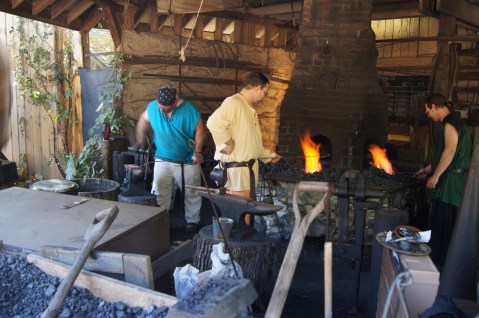
Modern medieval masculinity. Image by David Williss @Flickr CC BY.
Multimodality, Presentism and the Medieval Miscellany
The theoretical concept of multimodality is rooted in late 20th-century critique of semiotic systems. As the New London Group argued in “A Pedagogy of Multiliteracies: Designing Social Futures,” “effective citizenship and productive work” in the late 20th and early 21st centuries “now require that we interact effectively using multiple languages, multiple Englishes, and communication patterns that more frequently cross cultural, community and national boundaries” and that we the best way to do so is via methods that accommodate more than mere text (62-64). This engagement with the multiple modes of text, image, and video, among others, makes multimodality an ideal critical tool with which to analyze complex, hybrid compositions.
However, many theories of multimodality privilege a historical lens primarily afforded by 20th and 21st century literacy, dependent as it is on reading and looking (at screens or pages) as opposed to listening (to human voices). Indeed, Jeff Bezemer and Gunther Kress have observed in “Writing Multimodal Texts: A Social Semiotic Account of Designs for Learning” that because images predominate in 21st-century culture, textual “writing is now no longer the central mode of representation in learning materials” (166). In short, writing and images work in tandem to educate. Yet even though they note the different modes of text and image, Bezemer and Kress do not interrogate the fact that both depend on a single sensory ability: sight. Whether or not images have supplanted printed text in pedagogical documents, this assumption of the centrality of visuality as the singular mode of representation—in learning materials and elsewhere—is itself an historical phenomenon—as Walter Ong discusses in Orality and Literacy: The Technologizing of the Word—one dependent on the technology and dominance of print itself.
People do not depend only on seeing and reading text. They might also participate actively in “listening communities,” wherein one visually literate person reads aloud a text to a group who listens, ruminates over, and perhaps memorizes that text. Medieval “reading” is in fact an aural practice of recitation, memorization and listening as well as textual examination, a hybrid practice dating to the beginning of the medieval. Evidence of this hybrid practice can be found in the opening folio of Corpus Christi MS 61, which features Chaucer reciting Troilus and Criseyde to a royal audience. Studded with images and illuminations, musical notation and marginalia, medieval manuscripts often offer a complex multimodal relationship between graphics and written text, color and music, the visual and the aural.

An example of an illuminated manuscript. Image by Richard White @Flickr CC BY-NC-ND.
Long before print or digital media, “reading” manuscripts required a sophisticated multimodal form of interpretation. Arundel 292 is minimally illuminated, but it too must be understood as a flexible, multimodal form composed for a mouth reading aloud the words on the folio page as well as a group of listeners receiving those words. It offers a heterogeneity that mixes languages, genres, images, hands and modes. Indeed, there is little about this miscellaneous manuscript that might be categorized as using exclusively what Kress defines as “formalized, monolingual, monocultural, and rule-governed forms of language,” given its multilingual, multicultural, multi-genre variety of language forms, none of which take precedence over any other.
Onomatopoeia and the Medieval Lyric
The dependence of poetry upon aural and oral performance complicates the relationship between writing, sound, the body, and the intentionality of “design,” or the deliberate visual arrangement of words, images, and ideas. Like other time-bound, performative aesthetic genres such as music, dance, or theater, poetry exists in the moment of its performance as much as it does on the fixed, static page and only peripherally occupies the written mode. Ancient poetry has been preserved by manuscript and print technology, but the roots of the genre include both oral recitation and memorization. Because it depends simultaneously upon the modes of reading, writing and recitation, both historically and into the present day, poetry might be considered quintessentially multimodal. This is particularly true for medieval poetry, given its use of sound-dependent effects such as alliteration, assonance, consonance, onomatopoeia, meter and rhyme.

Figure 2 is BS MS Arundel 292, reproduced with permission from the British Library
Edmund Reiss has argued that “Blacksmiths” is the “earliest sustained onomatopoetic effort extant in English” in The Art of the Middle English Lyric: Essays in Criticism (167). But for an onomatopoetic poem that so carefully represents in language the sounds of men engaged in physical labor—from their “clateryng of knockes,” to the ringing exertion of iron on iron heard in “tik.tak.hic.hac.tiket.taket.tyk.tak/ lus.bus.lus.das” and the “stark strokes thei stryken on a stelyd stokke”—”Blacksmiths” is surprisingly unconcerned with its own visual appearance on the page. One turns the page in Arundel 292 and suddenly there is a neat chunk of prose with no other visual indication other than faint hashmark that one is looking at poetry. This is not unusual, for as Ardis Butterfield has recently observed in “Why Medieval Lyric?”, in many manuscripts containing lyric poetry or its traces, “there is no visual fanfare; nothing marks [the poetry] out” (322). Medieval scribes instead often use scripture continua—continuous script—to record the lyric, and “Blacksmiths” is no exception (Fig. 1). In short, “Blacksmiths” looks like prose, but sounds like poetry. Its insistent use of alliterative onomatopoeia, furthermore, suggests the poem might gain performative shape if addressed to both the mouth and the ear.
An aurally derived verbal pleasure, onomatopoeia exemplifies poetry’s general obsession with sound and performativity as it depends on the representational delight of hearing sounds that are the very things that they sound like. Onomatopoeia forces us into a strange ontological space in which a word is at once both signifier and sign. The bee buzzes, in other words; it has no other voice than the sound it creates, and we have no other way to describe that sound but to do so literally. This can produce the sounds of children’s babble as well as the more figurative pleasures found in “Blacksmiths.” The mimetic allure of using words that create the very sound of their own meaning is in many ways embedded in language itself. “Blacksmiths” calls our attention to sound, noise and listening, forcing further reflection upon the relationship between what is textually recorded and what is performed.
Blacksmithing and Masculine Poetic Labor
Salter argues persuasively in “A Complaint Against Blacksmiths” that the poem’s appearance in a priory cathedral manuscript suggests that the speaker’s resistance to blacksmithing may be the result of “older religious attitudes” about night labor and rioting (200). But given the fact that “Blacksmiths” is a poem concerned with labor likely written by a man about other men, I wonder if there is room as well for an additional consideration for the discourses of gender and labor that so consumed the late medieval period and how the poem interrogates these notions. While Salter resists categorizing the poem into any clear genre, noting that the poem is so realistic that it is frequently used as historical evidence [note], “Blacksmiths” draws attention to the lyric experiences and emotional expression of a presumably masculine first person speaker and in so doing might be categorized, as Robbins does, as a lyric.

Beyond a single, reflexive pronoun, “me,” we know nothing about the poet except the evidence of his poetic making—the poem itself. In the poem, there are two literary skills at work. There is narrative exposition and description and there is onomatopoetic mimicry. Both are dependent on verbal artistry and are held together by the tensile patternings of alliteration. Narratively speaking, the poem identifies the blacksmiths by what they look like and what they wield. They are “swarte, smekyd” and “smateryd with smoke,” swarthy dirty men who “spitten and spraulyn and spellyn many spelles,” and “gnauen and gnacchen thei gronys togedyr.” They are addressed pejoratively as “knauene,” and “cammede,” pug nosed knaves, who “blowen here bellewys that al here brayn brestes.” These alliterative lines represent the work of the forge as rhythmic, repetitive, harshly sibilant. Brains might get hyperbolically blown out in blowing the fires needed to produce metal goods, and dissonance is created by the groans and cries and tooth-gnashing of the workmen. The edge of the human blurs into the flame of the forge. Men use “hard” and “heavy hamerys” and “her schankes ben schakeled for the fere flunderys;” they work so long standing near the forge it seems that their ankles are shackled to the sparks. As those fiery images suggests, there is a nightmarish element to the poem. The speaker laments: “sweche dolful a dreme the deuyl it to dryue.” And he uses that infinitive “to dryue” when he begins the poem; the workmen might “dryue me to death with den of here dyntes.” The heavy repetition of the “d” in these lines mirrors the thudding of hammers on hot metal.

Image borrowed from Hasib Wahab @Flickr CC BY-NC-ND.
It is only in the second line of the text that the speaker identifies himself. He is “me,” an “I” making a poem and speaking to an implied addressee. And in his use of the first person, he might be understood as having engaged in what A.C. Spearing has called “self-pointing,” those moments in late medieval poetry where the poet identifies himself as a poet, in a meta-commentary on vernacular poetry and its performance. Obviously, the poet does not state his profession in this line. But the fact that he speaks in the first person is significant. His is the voice, and the descriptive rage, that drives the poem. Further, the alliterative matrix of the poem’s lines unmistakably reminds us that this is a poem, a work of art, a made thing. The repetition of alliteration is a bending of ordinary language into something clearly and pointedly artificial, a rhythmic joinery that is obviously not prose, and it requires a certain sonic attention. The speaker expresses his frustration in a pattern of sibilants, voiceless palatal consonants and voiced palatal g’s, as well as hard stops at dental and palatal phonemes. Indeed, the poem mimics the sounds of the smith’s labors, placing their calls and cries and bellows within the poem. The smiths “kongons cryen after col col,” and “huf puf seyth that on haf paf that other.” The poem is ostensibly about the speaker being awoken by the night labor of “Blacksmiths.” “Such noys on nyghtes ne herd men neuer,” he says, hyperbolically. In describing this never-before-experienced problem, the speaker creates a smithing cacophony so loud that it overwhelms his own voice.


Image borrowed from Hans Splinter @Flickr CC BY.
The smiths are so loud, so noxious, and I would argue, so much more manly, that they threaten to hijack the poem itself. It is through this sleight of hand, wherein the labors of blacksmithing obscure the poet-cleric’s own small voice, that the speaker makes his implicit argument about masculinity, poetry, and labor. As Kellie Robertson has argued, late medieval writing is concerned with the common profit. Some forms of labor contribute to the common profit while others do not. For the most part, profitable labor is material; it produces actual goods that can be used and sold. And profitable medieval English labor is gendered as almost exclusively masculine, as only men can be masters and authorities. Only men are blacksmiths, and only men are priory scribes. Yet the practice of blacksmithing cannot be separated from materiality. The blacksmiths, however badly skilled the speaker may declaim they are, produce goods to be used for vital purposes. The newly-shod horse will pull the cultour through the fields; the sharp scythe will bring in the harvest; the knife will butcher animals. Moreover, the labor of the blacksmiths is productive even if it is done at night. It can be done as the work demands, all night long if necessary to finish the job. But the clerical poet cannot do scribal work at night without serious consequence. His labor—copying, scraping, blotting, correcting, reading, blotting— depends on daylight, silence, and decent sleep.
The clerical poet, like the speaker of “Blacksmiths,” is engaged in “immaterial labor,” to use Italian Marxist Maurizio Lazzarato’s term, which, as he explains in Radical Thought in Italy: A Potential Politics is “labor that produces the informational and cultural content of the commodity” (133). Clerical poetic labor is abstract, one of inscription, composition and performance. Within the material economy of the later middle ages, poetic labor produces nothing of concrete value. Making, inscribing and reciting poetry, in the words of Harry Bailly, “doost noght elles but despendest tyme” (VII.931). “Blacksmiths” thus asks: what does it mean to make poems—immaterial, multimodal, performative things that are not things at all—from within society where material production is consonant with masculine virility?
The sequestered clerical maker and scribe, scratching away in the silent priory, might have been furious over being disrupted by the athletic, kinesthetic activities of the blacksmiths. The poem might be read as a kind of homosocial lament about what men’s work is and what it means. To write is to not engage in more busily productive, material labor, and the anxiety around what writing is and what it does can also be seen throughout late medieval poetry. The workers make noise and heat deep into the night, producing metal goods. But the maker of the “Blacksmiths” offers a poem that represents the “Blacksmiths”’ loud labor and that also serves as evidence of his own “travaillous stillness,” in the words of Hoccleve (RoP l.1013). In doing so, he calls attention to his own skill as a maker of verse. His labor, however immaterial, can verbally represent noise and sweat and physicality. His prosopoeia is a contribution to the common profit, in that he can make you see and hear the blacksmiths long after their hammers have been laid away. And his hastily composed poem has outlasted even the best-made medieval horseshoe.

Image borrowed from Peter Grima @Flickr CC BY-SA.
To conclude, I’d like to point out that it is no wonder that “Blacksmiths” is set in the dark, and that the speaker himself cannot see his tormentors but only hear them. Because it is out of this darkness that the speaker can name, and in doing so—as Daniel Tiffany observes in Infidel Poetics: Riddles, Nightlife and Substance (97)—call attention to his own aesthetic power. As Martin Heidegger has argued in Poetry, Language, Thought (73), naming is “the lighting of what is,” and I wonder if verbal naming is in itself a wonderful kind of literary power. To name is to point out to another, to claim, to damn. To point out, however obliquely, who you might be and how your work might be remembered.
—
Featured image “Succor” by Walter A. Aue @Flickr CC BY-NC-ND.
—
Katharine Jager is a poet and medieval scholar. She is associate professor of English at the University of Houston-Downtown, where she teaches medieval studies, creative writing, literature, and composition. Recent publications include essays on aesthetics in Chaucer’s Sir Thopas (Medieval Perspectives) and masculine speech acts in Sir Gawain and the Green Knight (Medieval Feminist Forum, forthcoming); and poetry in such journals as Found Magazine, Friends Journal, The Gettysburg Review, Commonweal and the anthology on the religious lyric Before the Door of God (Yale University Press). She was for many years co-author with Jessica Barr of the Chaucer chapter for the Year’s Work in English Studies (Oxford), and is currently editing the interdisciplinary volume Vernacular Aesthetics in the Later Middle Ages: Politics, Performativity, and Reception from Literature to Music, to which she is also contributing an essay on lyric aesthetics, manuscript placement and the texts of 1381 (Palgrave’s New Middle Ages series, forthcoming).
—
REWIND! . . .If you liked this post, you may also dig:
SO! Podcast #45: Immersion and Synesthesia in Role-Playing Games–Nick Mizer
“HOW YOU SOUND??”: The Poet’s Voice, Aura, and the Challenge of Listening to Poetry–John Hyland
Pretty, Fast, and Loud: The Audible Ali–Tara Betts
Share this:


Current Top Posts





April 2021

January 2020

November 2019

October 2019

August 2019

April 2014

November 2017

March 2015

December 2017

October 2015
 Sounding Out!
Recent Comments