
In Search of Politics Itself, or What We Mean When We Say Music (and Music Writing) is “Too Political”

Music has become too political—this is what some observers said about the recent Grammy Awards. Following the broadcast last week, some argued that musicians and celebrities used the event as a platform for their own purposes, detracting from the occasion: celebration of music itself. Nikki Haley, the U.S. Ambassador to the United Nations, tweeted:
I have always loved the Grammys but to have artists read the Fire and Fury book killed it. Don’t ruin great music with trash. Some of us love music without the politics thrown in it.— Nikki Haley (@nikkihaley) January 29, 2018
I don’t know for sure, but I imagine that the daily grind of a U.N. ambassador is filled with routine realities we refer to as “politics”: bureaucracy, budget planning, hectic meetings, and all kinds of disagreements. It makes some sense to me, then, that Haley would demand a realm of life that is untouched by politics—but why music in particular?
The fantasy of a space free from politics resembles other patterns of utopian thought, which often take the form of nostalgia. “There was a time when only a handful of people seemed to write politically about music,” said Chuck Klosterman, a novelist and critic of pop culture, in an interview in June 2017. He continued:
Now everybody does, so it’s never interesting. Now, to see someone only write about the music itself is refreshing. It’s not that I don’t think music writing should have a political aspect to it, but when it just becomes a way that everyone does something, you see a lot of people forcing ideas upon art that actually detracts [sic] from the appreciation of that art. It’s never been worse than it is now.
He closed his interview by saying: “I do wonder if in 15 years people are going to look back at the art from this specific period and almost discover it in a completely new way because they’ll actually be consuming the content as opposed to figuring out how it could be made into a political idea.” Klosterman almost said it: make criticism great again.
Reminiscing about a time when music writing was free from politics, Klosterman suggests that critics can distinguish between pure content and mere politics—which is to say, whatever is incidental to the music, rather than central to it. He offers an example, saying, “My appreciation of [Merle Haggard’s] ‘Workin’ Man Blues’ is not really any kind of extension of my life, or my experience, or even my values. […] I can’t describe why I like this song, I just like it.” If Klosterman, an accomplished critic, tried to describe the experiences that lead him to like this particular song, he probably could—but the point is that he doesn’t make explicit the relationship between personal identity and musical taste.

Screen Capture of Merle Haggard singing “Workin’ Man Blues,” Live from Austin, Texas, 1978
The heart of Klosterman’s concern is that critics project too many of their own problems and interests onto musicians. Musician and music writer Greg Tate recently made a similar suggestion: when reviewing Jay-Z’s album 4:44, Tate focuses on how celebrities become attached to public affects. In his July 2017 review, “The Politicization of Jay-Z,” he writes:
In the rudderless free fall of this post-Obama void […] all eyes being on Bey-Z, Kendrick, and Solange makes perfect agitpop sense. All four have become our default stand-ins until the next grassroots groundswell […] Bey-Z in particular have become the ready-made meme targets of everything our online punditry considers positive or abhorrent about Blackfolk in the 21st century.
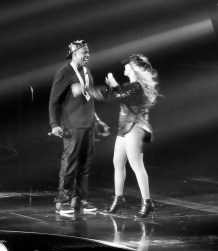
Jay and Bey perform live in 2013, by Flickr user sashimomura,(CC BY 2.0)
He suggests that critics politicize musicians, turning them into repositories of various projections about the culture-at-large. Although writing from a very different place than Klosterman, Tate shares the sense that most music criticism is not really about music at all. But whereas Klosterman implies that criticism resembles ideological propaganda too much, Tate implies that criticism is a mere “stand-in” for actual politics, written at the expense of actual political organizing. In other words, music criticism is not political enough.
In 1926, W.E.B. Du Bois wrote about this problem, the status of art as politics. In his essay “Criteria of Negro Art,” he dissects what he perceives to be the hypocrisy of any demand for pure art, abstracted from politics; he defends art that many others would dismiss as propagandistic—a dismissal revealed to be highly racialized. He writes:
Thus all Art is propaganda and ever must be, despite the wailing of the purists. I stand in utter shamelessness and say that whatever art I have for writing has been used always for propaganda for gaining the right of black folk to love and enjoy. I do not care a damn for any art that is not used for propaganda. But I do care when propaganda is confined to one side while the other is stripped and silent.
Du Bois’s ideas would be engaged extensively by later authors, including Amiri Baraka. In his 1963 essay “Jazz and the White Critic,” he addresses politics in terms of “attitude.” Then-contemporary white critics misunderstood black styles, he argued, because they failed to fully apprehend the attitudes that produced them. They were busy trying, and failing, to appreciate the sound of bebop “itself,” but without considering why bebop was made in the first place.
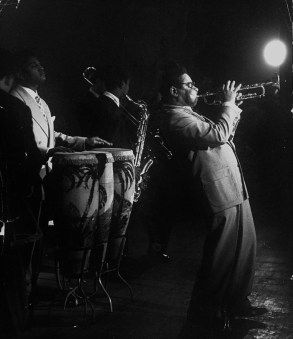
Dizzy Gillespie, one of BeBop’s key players, in Paris, 1952, Image courtesy of Flickr User Kristen, (CC BY 2.0)
As Baraka presents it, white critics were only able to ignore black musicians’ politics and focus on the music because the white critics’ own attitudes had already been assumed to be superior, and therefore rendered irrelevant. Only because their middle-brow identities had been so thoroughly elevated in history could these middle-brow critics get away with defining the object of their appreciation as “pure” music. Interestingly, as Baraka concludes, it was their ignorance of context that ultimately served to “obfuscate what has been happening with the music itself.” It’s not that the music itself doesn’t matter; it’s that music’s context makes it matter.
In response to morerecent concerns about the politicization of popular music, Robin James has analyzed the case of Beyoncé’s Lemonade. She performs a close reading of two reviews, by Carl Wilson and by Kevin Fallon, both of whom expressly seek the album’s “music itself,” writing against the many critical approaches that politicize it. James suggests that these critics can appeal to “music itself” only because their own identities have been falsely universalized and made invisible. They try to divorce music from politics precisely because this approach, in her words, “lets white men pop critics have authority over black feminist music,” a quest for authority that James considers a form of epistemic violence.
That said, James goes on to conclude that the question these critics ask—“what about the music?”—can also be a helpful starting point, from which we can start to make explicit some types of knowledge that have previously remained latent. The mere presence of the desire for a space free from politics and identity, however problematic, tells us something important.
 Our contemporary curiosity about identity—identity being our metonym for “politics” more broadly—extends back at least to the 1990s, when music’s political status was widely debated in terms of it. For example, in a 1991 issue of the queercore zine Outpunk, editor Matt Wobensmith describes what he perceived to be limitations of thinking about music within his scene. He laments what he calls “musical purism,” a simplistic mindset by which “you are what you listen to.” Here, he capitalizes his points of tension:
Suddenly, your taste in music equates you with working class politics and a movement of the disenfranchised. Your IDENTITY is based on how music SOUNDS. How odd that people equate musical chops with how tough or revolutionary you may be! Music is a powerful language of its own. But the music-as-identity idea is a complete fiction. It makes no sense and it defies logic. Will someone please debunk this myth?
Wobensmith suggests that a person’s “musical chops,” their technical skills, have little to do with their personal identity. Working from the intersection of Klosterman and Tate, Wobensmith imagines a scenario in which the abstract language of music transcends the identities of the people who make it. Like them, Wobensmith seems worried that musical judgments too often unfold as critiques of a musician’s personality or character, rather than their work. Critics project themselves onto music, and listeners also get defined by the music they like, which he finds unsettling.
 That same year, in an interview published in the 1991 issue of the zine Bikini Kill, musicians Kathleen Hanna and Jean Smith addressed a similar binary as Wobensmith, that of content and technique. But they take a different view: in fact, they emphasize the fallacy of this dualism in the first place. “You just can’t separate it out,” said Hanna, questioning the possibility of distinguishing between content—the “music itself”—and technique on audio recordings.
Female-fronted bands of this era were sometimes criticized for their lack of technique, even as terrible male punk bands were widely admired for their cavalier disregard of musical rules. Further still, disparagement of women’s poor technique often overlooked the reasons why it suffered: many women had been systematically discouraged from musical participation in these scenes. Either way, as Tamra Lucid has argued, it is the enforcement of “specific canons of theory and technique,” inevitably along the lines of identity, that cause harm if left unexamined.
All of these thinkers show that various binaries in circulation—sound and identity, personality and technique, music and politics—are gendered in insidious ways, an observation arrived at by the same logic that led Du Bois to reveal the moniker of “propaganda” to be racialized. As Hanna puts it, too many people assumed that “male artists are gonna place more importance on technique and female artists’ll place more on content.” She insists that these two concepts can’t be separated in order to elevate aspects of experience that had been implicitly degraded as feminine: the expression of righteous anger, or recollection of awkward intimacy.

Bikini Kill at Gilman Street, Berkeley, CA, 1990s, Image by Flickr User John Eikleberry, CC BY-NC 2.0
Punk had never pretended not to be political, making it a powerful site for internal critique. Since the 1970s, punk had been a form in which grievances about systemic problems and social inequality could be openly, overtly aired. The riot grrrls, by politicizing confessional, femme, and deeply private forms of expression within punk, demonstrated that even the purest musical politics resemble art more than is sometimes thought: “politics itself” is necessarily performative, personal, and highly expressive, involving artifice.
Even the act of playing music can be considered a form of political action, regardless of how critics interpret it. In another punk zine from c. 1990, for example, an anonymous author asks:
What impact can music have? You could say that it’s always political, because a really good pop song, even when it hasn’t got political words, is always about how much human beings can do with the little bag of resources, the limited set of playing pieces and moves and words, available […] Greil Marcus calls it ‘the vanity of believing that cheap music is potent enough to take on nothingness,’ and it may be cool in some places to mock him but here he’s dead-on right.
But music is never only political—that is, not in the elections-and-petitions sense of the word. And music is always an action, always something done to listeners, by musicians (singers, songwriters, producers, hissy stereo systems)—but it’s never only that, when it’s any good: no more than you, reader, are the social roles you play.
The author persuades us that music is political, even as they insist that it’s something more. Music as “pure sound,” as a “universal language” seems to have the most potential to be political, but also to transcend politics’ limitations—the trash, the propaganda. Given this potential, some listeners find themselves frustrated with music’s consistent failure to rise to their occasion, to give them what they desire: to be apolitical.

Kelly Clarkson performed at The Chelsea on July 27, 2012, image by Flickr User The Cosmopolitan of Las Vegas, CC BY-NC 2.0
In an interview during the recent Grammys broadcast, pop singer Kelly Clarkson said, “I’m political when I feel like I need to be.” It’s refreshing to imagine politics this way, like a light we turn on and off–and it’s a sign of political privilege to be able to do so. But politics are, unfortunately, inextricable from our lives and therefore inescapable: the places we go, the exchanges we pursue, the relationships we develop, the ways we can be in the world. Thinking with Robin James, it seems that our collective desire for a world free from all this reveals a deeper knowledge, which music helps make explicit: we wish things were different.
I wonder if those who lament the “contamination” of the Grammys with politics might be concerned that their own politics are unfounded or irrelevant, requiring revision, just as many white people who are allergic to identity politics are, in fact, aware that our own identity has been, and continues to be, unduly elevated. When Chuck Klosterman refuses to describe the reason why he likes “Workin’ Man Blues,” claiming that he “just does,” does he fear, as I sometimes do, not that there is no reason, but that this reason isn’t good enough?
Fortunately, there are many critics today who do the difficult work of examining music’s politics. Take Liz Pelly, for example, whose research about the backend of streaming playlists reminds us of music’s material basis. Or what about the astute criticism of Tim Barker, Judy Berman, Shuja Haider, Max Nelson, and others for whom musical thought and action are so thoroughly intertwined? Finally, I think of many music writers at Tiny Mix Tapes, such as Frank Falisi, Hydroyoga, C Monster, or Cookcook, for whom creation is a way of life—and whose creative practices themselves are potent enough to “take on nothingness.”
“Music is never only political,” as the anonymous ‘zine article author argues above, but it is always political, at least a little bit. As musicians and critics, our endeavor should not be to transcend this fact, but to affirm it with increasing nuance and care. During a recent lecture, Alexander Weheliye challenged us in a lecture given in January 2018 at New York University, when listening, “To really think: what does this art reflect?” Call it music or call it politics: the best of both will change somebody’s mind for real, and for the better.
—
Featured Image: Screen Capture from Kendrick Lamar’s video for “HUMBLE,” winner of the 2018 Grammy for “Best Music Video.”
—
Elizabeth Newton is a doctoral candidate in musicology. She has written for The New Inquiry, Tiny Mix Tapes, Real Life Magazine, the Quietus, and Leonardo Music Journal. Her research interests include musico-poetics, fidelity and reproduction, and affective histories of musical media. Her dissertation, in progress, is about “affective fidelity” in audio and print culture of the 1990s.
—
 REWIND!…If you liked this post, you may also dig:
SO! Reads: Jace Clayton’s Uproot–Elizabeth Newton
Re: Chuck Klosterman – “Tomorrow Rarely Knows”–Aaron Trammell
This is What It Sounds Like . . . . . . . . On Prince (1958-2016) and Interpretive Freedom–Ben Tausig
Share this:

Vocal Deformance and Performative Speech, or In Different Voices!

**This post was co-authored by Marit J. MacArthur and Lee M. Miller
Like it or not, we are now accustomed to contemporary pop vocalists manipulating their voices using Autotune and other tools or effects for pitch correction. We may exult in it, and congratulate ourselves on our sophisticated appreciation of the options available to the contemporary vocalist. In another mood, we may scream for low-fi and acoustic music, feel cynical about the possibility that we might ever hear an unmediated voice, live or recorded (if we ever did), and/or laugh off the notion of authenticity in performance entirely. Of course, rather than tricking the audience or trying to sound somehow “better” than they are, many performers manipulate their voices to pose questions about the nature of performance—Reggie Watts and Anna Deavere Smith come readily to mind—and to test essentialist assumptions about and perceptions of voice and sound.
Watts, in an exemplary 2012 TED Talk, plays with the different sorts of authority and affect conveyed by, among other voices: upper-class-British-absurd-explanatory, affectively-meaningful-nonsense-foreign-language, and caz-hip-hop-introducing-a-song-chat. Inhabiting and playing with different voices, he amuses listeners into recognizing how much intonation—the rise and fall of pitch—and other acoustic features affect our perception of a speaker’s voice, and how much we expect people to speak in ways that match our assumptions about their identities.
 We cannot all be so talented at vocal imitation, however. And in sound, voice and performance studies concerned with speech, machine-assisted manipulation of vocal recordings—which we term “vocal deformance”—is much less common than in the creative industries. A playful approach to vocal deformance, as a critical and creative practice, has much to teach us about our perceptions of speech in general, and performative speech in particular. Too often, when we use archival poetry recordings in our teaching, they may reify an idea that students are often loathe to relinquish: a poem is a finished art object, weighted with authorial intention and biographical significance, with one possible interpretation (the instructor’s). When we play a single canonical recording of T.S. Eliot reading The Waste Land in 1946, for instance, his particular intonation, together with assumptions that he was a stuffy, overeducated, repressed snob, can foreclose the possibility of a fresh encounter with the many voices of the poem and a multitude of interpretations.
Using vocal deformance in the classroom and in our own research and scholarship, we can unsettle overdetermined readings of poems, essentialist assumptions about the poets who speak them and questions of poetic authority, and recover the crucial oral components of poetry. Below we offer some examples of vocal deformance of poetry readings, and consider the potential and limits of this technique for teaching and research with recordings of performative speech. As John Hyland wrote in Sounding Out! in 2014, “The act of listening to recorded poetry … poses particular analytic challenges, which become more complex when the politics of identity are brought to bear on … questions of voice and poetry.” Among these challenges are essentialist assumptions, both about identity and recording medium, which are difficult to avoid when we listen. Hyland concludes that, when we listen to recordings, “the poet’s voice falsely takes on an authoritative ‘aura,’ as Walter Benjamin used that word”; one way to counter to this is to listen to the same poem read by the poet at different points in their career, in different contexts, as Hyland does with three recordings of Amiri Baraka’s “Black Dada Nihilismus.” Another approach is to play with recordings.
***
“Glitch” by Ray Weitzenberg, Attribution 2.0 Generic (CC BY 2.0)
***
The concept of deformance dates to a 1999 essay by Jerome McGann and Lisa Samuels. They take inspiration from Emily Dickinson, who sometimes liked to read poems backward, for the potential insights of reading against the form, scrambling the original sequence, and so on. According to McGann and Samuels, Dickinson’s
critical model is performative, not intellectual [. . . ]. it is anti-theoretical: not because it is opposed to theory (i.e., speculative thought), but because it places theory in a subordinated relation to practice. Deformative moves reinvestigate the terms … [of] critical commentary [, with] dramatic exposure of subjectivity as a live and highly informative option of interpretive commentary, if not indeed one of its essential features. [our italics]
Too often in the literature class room, the subjectivity of interpretation is something of a problem. While we might initially encourage a somewhat fluffy reader-response discussion of a poem, eventually we might also worry that students are simply wandering too far from it, following their own random associations with a phrase or metaphor, without learning to parse the rich intricacy of the whole poem. One effect of vocal deformance is that it makes space for the playful response, and also keeps bringing students back to the telling phrase, to the words of the poem, imagining what difference it makes if they are said in different ways, trying on different interpretations, as it were.
While vocal deformance can be applied to any performative speech, it particularly lends itself to poetry recordings. Poetry is, of course, an oral form with a fraught relationship between text and performance, and poetry reading styles are often perceived to be highly conventional, so that we feel we are listening to a Poem rather than a particular poem. From a literary and performance studies perspective, what could be more tiredly familiar than a canonical recording of a canonical poem by a canonical poet in a conventional style of poetry reading that deadens the audience to the charms and nuances of that poem? And how can we do something productive and interesting with the (sometimes extremely) idiosyncratic subjectivity of student responses to canonical texts?
As an interpretive practice, vocal deformance opens up new possibilities for testing assumptions about performance, poetic authority and gender, and, potentially, about race, class, education, region, and canonicity. Is The Waste Land (1922) the deadly serious poem that many readers often take it to be, partly because it is presented to them as an immensely influential Modernist monolith? How does T.S. Eliot’s seemingly grim reading of it, and our perception of his style, contribute to such an interpretation of the poem? After all, the working title of the poem was “He Do the Police in Different Voices,” from Charles Dickens’s Our Mutual Friend (1864-65), and it includes many different voices or speakers, from the clairvoyant Madame Sosistris to Tiresias. What better way to defamiliarize and exploit the authority of the poem than to deform Eliot’s authoritative reading voice?
How do we respond to the now-canonical voice of Eliot reading the opening lines of The Waste Land, “April is the cruellest month, breeding / lilacs out of the dead land”?
.
Okay. Now what if we raise his pitch? Is he suddenly his own great-aunt? What does the same lament mean, spoken by a voice that sounds like an elderly woman?
.
And if we leave his pitch alone, but speed up his speaking rate, does he suddenly sound like an old-school radio announcer, the poem a deranged weather forecast?
.

Glitch Decoration GIF, Licensed under CC-BY-SA 3.
In terms of digital humanities research, a refreshing aspect of vocal deformance is that it avoids some of the easy and misleading reassurances of the empirical move. It’s not that it only clarifies what we thought we were hearing (as visualizing intonation through pitch contours can), but that it encourages multiplicity in listening.
Vocal deformance is essentially a playful strategy for defamiliarization that reminds us, in many ways, of the subjective, creative, even arbitrary nature of interpretation. In this, it has clear affinities with the OULIPO movement (which Dickinson’s practice of reading backwards presages). It may help us imagine, create and respond to alternative sequences and versions of recorded canonical texts—and to any apparently stable, singular performance of a text. The art of the glitch is one deformative practice, with the goal countering screen essentialism, the unreflective assumption that a digital artefact is immutable, stable and coherent. For an example of glitching photographs, see Trevor Owens’s “Glitching Files for Understanding: Avoiding Screen Essentialism in Three Easy Steps,” and Michael Kramer’s blog post about using audio deformance in a digital folk music history seminar at Northwestern University, “Distorting History to Make It More Accurate,” which demonstrates some potential insights gained by glitching newspaper images, photographs and music (Bob Dylan’s “Tangled Up in Blue”). John Melillo and Johanna Skibsrud’s “Two Sides for Wallace Stevens,” on Harvard’s Woodberry Poetry Room site, also offers a beguiling example of audio deformance.
Most deformative practices work with text and image, however, and the few that manipulate recordings introduce noise, skipped phrases, repetition, etc., usually without changing the acoustic features of the voice. It is well worth applying deformance more often to speech, not only in linguistics and the neurobiology of speech perception, but in humanistic study of performative speech because our perception of speech is nothing if not subjective, not to say mysterious, for two reasons.
First, our expectations of what we will hear influence what we do hear, from simple sounds to complex language comprehension. Often these expectations, which can be visual, auditory, cultural, etc., have been naturalized by the listener over time as unconscious reactions. Though many have anecdotal experience of this phenomenon (see an example about a black student, a white teacher, and a black student-teacher disagreeing on what the student said in a 2012 Sounding Out! piece by Christina Sharpe), it is has been demonstrated in many experiments as well. For instance, our perception of foreign-accented speech changes rapidly as we hear a few sentences and calibrate our internal expectations, as shown by Clarke and Garret’s 2004 study “Rapid Adaptation to Foreign-accented English.” And, according to Richard Warren’s “Perceptural Restoration of Missing Speech Sounds” (1970), “when natural speech is interrupted by noisy gaps like a cough or a slammed door, we unknowingly “fill in” the noise, vividly hearing speech sounds that do not exist acoustically. This phenomenon arises both from linguistic expectations as well as our deep familiarity with basic speech acoustics, as shown in Shahin, Bishop, and Miller’s “Neural mechanisms for illusory filling-in of degraded speech.” Similarly, in an illusion called the McGurk effect—noted by Harry McGurk and John MacDonald in 1976—just seeing a talker’s lip movements changes the perception of speech sounds categorically, say from “buck” to “duck.”
Though much of this reshaping of our acoustic perception happens unconsciously, we can also profoundly alter what we hear through selective attention. Particularly in everyday acoustic environments, we hear speech better when we expect it, and when it matches our specific expectations: from a given location, from a certain talker or type of talker, at a certain pitch, and so on (See “Speech Recognition in Adverse Conditions: A Review” by Mattys, Davis, et al. 2012). Perceptual filters fundamentally constrain our experience: if we attend to a talker in one ear, we may not even realize when a second talker in the other ear switches from English to German, as Cherry concluded in “Some Experiments on the Recognition of Speech” in 1953. Social and cultural knowledge also changes what we hear. Listening to someone whom a listener visually perceives as a “non-native speaker” can make speech sound not only more “accented” (see Donald Rubin’s “Nonlanguage Factors Affecting S Judgments of Nonnative English-Speaking Teaching Assistants” from 1992)—what we might call a subjective quality—but, as Molly Babel and Jamie Russell found in 2015’s “Expectations and Speech Intelligibility,” it can also trigger speech processing reactions that make the speech less intelligible to the listener making visual judgments regarding accented speech.

Waveform from a sine wave composition, “Wave Hello to Outsiders.” Rendered in Adobe Audition by Matthew Potter. Attribution 2.0 Generic (CC BY 2.0)
Given what we know about the brain, the fact that expectations affect perception—of recorded voices reading poems, in this case—should not come as a surprise. A growing consensus holds that the brain’s job is not merely to represent the world; rather it strives to predict the world, make inferences about it, and correct those expectations whenever a mismatch is detected (see Knill and Pouget’s “The Bayesian brain: the role of uncertainty in neural coding and computation” [2004] and Karl Friston’s 2010 “The free-energy principle: a unified brain theory?”) In somewhat familiar environments and situations (pretty much everything after infancy), predictive inference is far more efficient than continually rendering the perceptual world de novo. This means that vocal deformance—particularly when it manipulates a known voice, as with canonical poets, or a familiar way of speaking, as with conventional poetry reading styles—waves a red flag at the brain. Change wakes up the quiescent, habitual brain to something new and potentially informative, because the voice does not fit our expectations for what the person would or should sound like. Listen to Reggie Watts!
This effect can also operate inversely; that is, if we do not expect someone to have a particular voice, we may adjust the stories we tell ourselves about our perceptions, to better match our expectations. In musicology, we might think of Nina Eidsheim’s article on the racialized reception of opera singer Marian Anderson, the first African American to sing at New York’s Metropolitan Opera:
the timbre of her voice has routinely (if often admiringly) been characterized as ‘black,’ … [despite] classical music’s minimal indulgence of individual style … this distinction [has] to be based on an assumption that the black body is intrinsically different from the white body and that even when emitting a timbre recognized as classical, the resonance of a singer’s black body is evident (3, 4).
Certainly, as Jennifer Stoever writes, “listening [is] an interpretive site where racial difference is coded, produced, and policed” (62). The same is true of gender difference and many other identity markers and cultural factors related to authority and authenticity. As Shai Burstyn notes in the article “In Quest of the Period Ear,” about attempts to imagine how contemporary audiences experienced medieval music, “culture plays a highly significant—though not exclusive—role in shaping the cognitive skills of its members” (695). If it is remarkably difficult to escape our stereotypical expectations and perceptions of what a person’s voice “should” sound like, that is partly because our brain uses such expectations to make predictions about our sonic experience. We cannot overcome our expectations through good will alone, and engaging with these issues in the classroom, which can be challenging, also provides an opportunity to help students think critically about essentialism and voice, for those moments when a student in the back of the room mutters in surprise that Langston Hughes “doesn’t sound black,” or exclaims that Walt Whitman “doesn’t sound gay.” Though it is not designed to assess stereotyping in speech perception, the Harvard implicit bias test is a good way to engage students in questions of cultural bias and perception [also, see “So You Flunked a Racism Test. Now What?”].
Furthermore, our affective responses to acoustic, non-verbal qualities of speech matter tremendously to our interpretation of verbal semantics, of the meaning of the words spoken. According to voice perception research in Foundations of Voice Studies: An Interdisciplinary Approach to Voice Production and Perception by Jody Kreiman and Diana Sidtis, when we listen to speech, “[s]ome authors … have claimed that normal adults usually believe the tone of voice rather than the words…. For example, the contrast in ‘I feel just fine’ spoken in a tense, tentative tone might be politely ignored, while, ‘I’m not angry’ spoken in hot anger would not” (304). The teacher’s boring tone of voice on the Peanuts cartoon makes the point.
In other words, we pick up on the affective meaning of a speaker’s tone of voice, and weigh it against the semantic meaning of the words spoken. While Kreiman and Sidtis argue that tone cannot be reduced to intonation patterns, “the fundamental frequency of the human voice [pitch] … heads the list of important cues for emotional meanings” (311). Pitch manipulation, then, changes the affective meaning of speech. Tone of voice is also influenced by other acoustic features, including speaking rate or tempo, and rhythm. In poetry recordings, the poet’s tone of voice influences the listener’s interpretation of a poem.
Two fundamental intonation patterns are rising or falling pitch. In American English, relatively high or relatively low pitch at the end of an utterance, compared to the beginning and middle, seems to carry distinct meanings, as demonstrated by Janet Pierrehumbert and Julia Hirschberg. They developed the ToBI (Tones and Break Indices) system for marking the prosody or intonation of speech. Rising intonation can make any utterance sound like a question, whether it is one or not. A relatively high pitch at the end of an utterance—called a high boundary tone—can make the speaker sound less confident or assertive, and more open to other’s opinions. Rising intonation implies that more is to come, that the utterance is not conclusive or concluded, that it should be understood in connection to the next utterance, and sometimes, that the speaker seeks the listener’s agreement before proceeding.
Uptalk, notably practiced among Generation Xers and now millennials, sounds conciliatory, agreeable and open, on the one hand, and lacking in confidence and authority, on the other—depending on the listener and the context. Marybeth Seitz-Brown argues that criticizing uptalk “implies that if women just spoke like men, our ideas would be valuable … [and] sexist listeners would magically understand us, and we would be taken seriously. But the problem is not with feminized qualities, of speech or otherwise, the problem is that our culture pathologizes feminine traits as something to be ashamed of or apologize for.”
Conversely, women can be criticized when they sound too much like men; see “Why Do So Many People Hate the Sound of Hillary Clinton’s Voice?” Falling intonation—and ending an utterance on a relatively low pitch, or a low boundary tone, implies conclusion, closure and confidence. The utterance, such intonation implies, finishes the argument (if there is one), does not seek the listener’s agreement or opinion, and suggests that this utterance can be understood on its own, without connection to subsequent utterances. Donald Trump, for example, is fond of falling intonation and low boundary tones (for a parody of masculine confident declarative intonation, have a listen at Troy McClure from The Simpsons.)
Of course, not all women use uptalk, and not all men use falling intonation with low boundary tones. In American culture, for better or worse, low boundary tones do seem to carry a tone of authority. And in poetry reading as well. Eliot’s original, and now canonical, reading of the opening line of The Waste Land, “April is the cruellest month,” uses falling intonation, so that it sounds like a confident assertion, with a low boundary tone on “month.”

Click on the image to enlarge the pitch contour graph showing Eliot’s low boundary tone.
.
“[B]reeding / lilacs out of the dead land” sounds like a steady, inevitable process, ending on a slightly higher relative pitch, implying that there is more to come, and that the phrase should be understood in connection to the next line, “mixing / Memory and desire, stirring / Dull roots with spring rain.”
What is so compelling and seemingly authoritative about Eliot’s reading style? In some basic sense, the falling intonation of the first phrase does it. Why does it strike many contemporary listeners as pompous? How might we undercut the seeming authority of the Eliotic voice? Make him do uptalk. Here we have simply inverted his intonation.
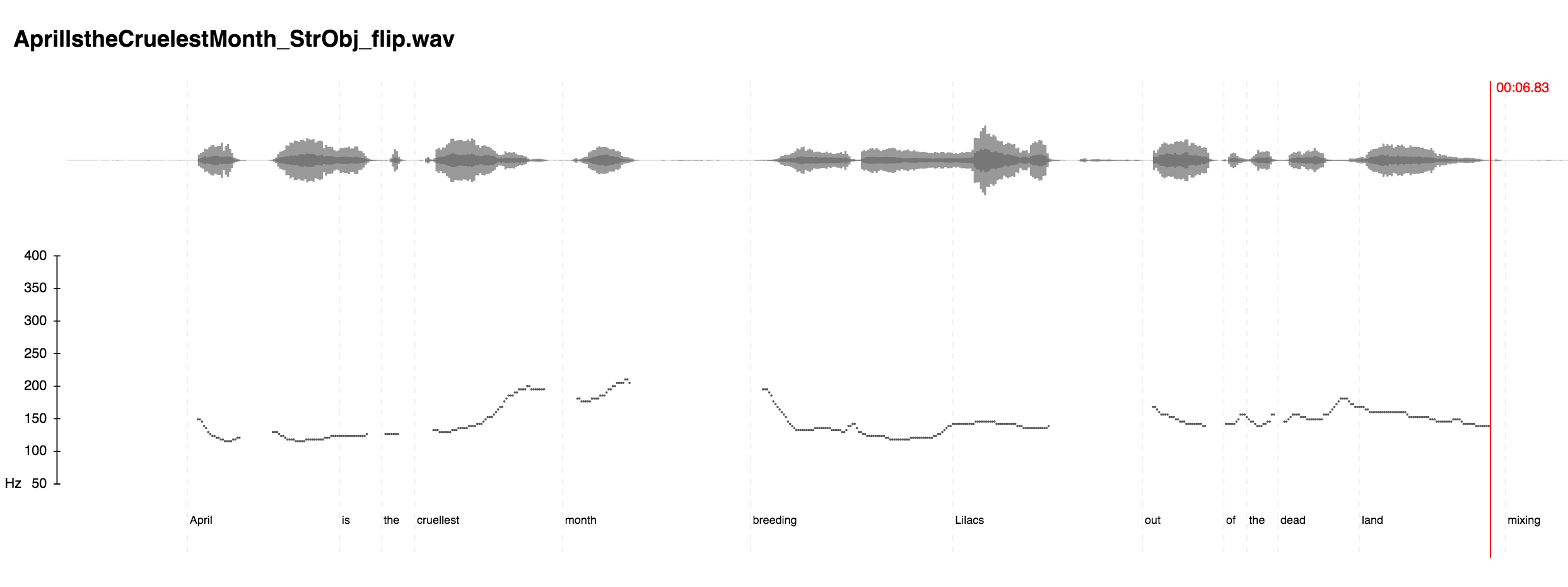
Click on the image to enlarge the pitch contour graph of Eliot’s voice “flipped.”
.
Suddenly he sounds doubtful. The opening line becomes a question—“April is the cruellest month[?]”—instead of a confident statement. Suddenly, Eliot himself expresses the skepticism or confusion many an undergraduate has felt—before we encountered this poem, did we not assume that spring, the return of life and fertility, is a cheerful escape from winter? And his deformed recital of “breeding / Lilacs out the dead land” suddenly sounds more like an agonized complaint, expressing the painful, reluctant awakening of desire in one who had found the dull sleep of winter comforting. Inverting the typical poetic authority of falling intonation into uptalk may embolden readers to entertain very different readings of the poem’s opening.
The editors of Poetry Archive had hopes of stimulating listeners of The Waste Land when they made available a 1935 recording of the poem, claiming: “Whilst the sound quality is understandably not so good, the recording is fascinating for Eliot’s faster, more energetic rendition. Listening to this urgent interpretation blows the dust of this iconic poem and helps us encounter it afresh.” However, if the fundamental falling intonation pattern of Eliot’s reading style doesn’t change—and overall, it doesn’t, between the 1935 and 1946 recordings—his voice may remain, for listeners, an aloof poetic authority.
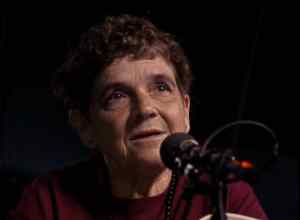
Adrienne Rich reading her poetry
Falling intonation with low boundary tones, then, is a fundental tone of poetic authority. Listen to Adrienne Rich reading from her poem, “What Kind of Times Are These” (1995), which leads the reader to a place “between two stands of trees … near … [where] the persecuted / … disappeared into the shadows.” She insists, “this isn’t a Russian poem, this is not somewhere else but here,” and concludes, “to have you listen at all it’s necessary / to talk about trees.”

Click here to enlarge the pitch contour graph of Rich’s “original” reading
.
She sounds like she means it. Rich has to write poems about nature, her tone implies, to wake people up to the political horrors of the American past and present. Poetry as a form, in pastoral guise, allows her to sneak in political content, potentially grabbing the attention of people who might only listen to poetry if they think it is safely, simply about nature. (Click here to hear the entire poem, starting at 4:01.)
When we invert her intonation, turning it into uptalk, she sounds as if she is questioning the wisdom of this approach, and/or chiding her listeners for making her take it. In this case, uptalk exerts a different kind of authority, the challenging question.

Click image to enlarge the pitch contour graph of Rich’s voice “flipped.”
.
Is it ethical to manipulate the intonation and other vocal qualities on poetry recordings, for the purposes of teaching and research? Obviously it would not be, if we were to present the manipulated recordings as the authentic voice of a poet. And all peoples have the right to protect culturally sensitive recordings, such as sacred songs, music, dances and prayers; see “Native American Intellectual Property Issues.” Otherwise, potential conflicts are similar to those with sampling in the music industry (See Kembrew McLeod and Peter DiCola’s Creative License: The Law and Culture of Digital Sampling [2011]). Vocal deformance, however, can help remind us that no single reading of a poem, by the poet or someone else, is the ultimately authoritative one.
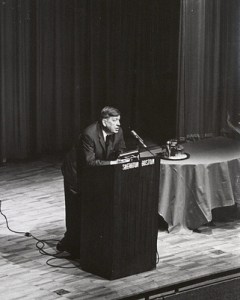
Photograph of Auden speaking at the Boston Sheraton Hotel, February 23, 1966, Box 60, Folder 9, Francis W. Sweeney, SJ, Humanities Series Director’s Records, MS2002-37, John J. Burns Library, Boston College. Attribution-NonCommercial-NoDerivs 2.0 Generic (CC BY-NC-ND 2.0)
In teaching writing, we (the authors) sometimes ask our students to explore alternative methods of presenting the same material. This can be as simple as writing the same sentence, the thesis for instance, in three different ways, or it can involve a different format. Write a poem, record oneself reading it, then try to represent it with a collage of images. Turn a 2,000-word essay into a 250-word presentation with verbal and sonic components. An instructive trick with the opening line of W.H. Auden’s “Musée des Beaux Arts” (1940): “About suffering they were never wrong, the Old Masters.” They were never wrong, the Old Masters, about suffering. The Old Masters were never wrong about suffering. Each version of the opening creates a subtly different emphasis, on suffering versus the wisdom of the Old Masters.
Too often, we lock ourselves into one approach, and cannot imagine an alternative. Locked into one approach, too often we cannot imagine an alternative. Alternatives we cannot imagine, if we lock into one approach too quickly. Writing three different opening paragraphs to the same essay, or rearranging the lines of the poem, stimulates our imagination and our critical faculties because it dramatizes different possibilities, possibilities that offer a different emphasis. And when we play with the pitch, intonation and speaking rate of a poem, this can change the tone as dramatically, from a challenge to confession, or an assertion into doubt.
In the classroom, poet Harryette Mullen is often popular with students, both for her poems on the page and for her expressive reading style, while students can sometimes resist recordings by Adrienne Rich (saying that she sounds lecture-y) and Louise Glück (saying that she sounds bored by her own poems), even as they are engaged by the poems on the page.
When Mullen reads “Present Tense” (2002)—a beguiling comical poem, loosely about the grammatical present and the speaker’s and the world’s present circumstances —what is it about her contrastive intonation that sounds expressive? She ends her opening phrases, “Now that my ears are connected to a random answer machine” with rising intonation and high boundary tones. This draws the reader on: keep listening, the statement’s not finished.

Click image to enlarge the pitch contour graph of Mullen’s reading
.
When we flip the intonation pattern, so that each utterance ends on a relatively low pitch, she sounds more conventional, a poetic authority declaring observations, confident and closed off.

Click image to enlarge the pitch contour graph of Mullen’s reading “flipped”
.
Another tone of poetic authority approaches pure monotony. It was practiced by Alfred Lord Tennyson, Irish modernist poet W.B. Yeats and, perhaps through Yeats’s influence, by American poets such as Yvor Winters. Note how similar they sound here. Winters reads the opening of his poem “The Journey” (1931), moving into a Yeatsian monotone after the title and location of Snake River Country, “I now remembered slowly how I came[.]”

Click here to enlarge the pitch contour graph of Winters reading “The Journey.”
.
Here is Yeats reading the opening of “The Lake Isle of Innisfree”: “I will arise and go now, and go to Innisfree[.]”

Click image to enlarge the pitch contour graph of Yeats reading “The Isle of Innisfree”
.
All we have to do to turn Winters into Yeats is raise his pitch a bit:

Click image to enlarge the pitch contour graph of “Winters as Yeats.”
.
Monotone performance is—at least acoustically—quite uninformative for the brain. Early parts of the auditory brain rapidly adapt or habituate to a wide array of regularities such as pitch and temporal pattern, and they only signal when the pattern changes, as noted in “Early selective-attention effect on evoked potential reinterpreted” (Näätänen, Gaillard et al., 1978). But expectations can work differently across speech’s descriptive dimensions. When speech is usually vivid, as in a direct quotation (“He said ‘I’m leaving now”), higher-level voice-processing areas in the right temporal lobe actually work harder to process (unexpectedly) monotone quotes, according to Yao, Belin, et al.’s “Brain ‘talks over’ boring quotes: top-down activation of voice-selective areas while listening to monotonous direct speech quotations” (2012). In other words, sameness of pitch often means the brain must work harder to grasp meaning.
Interestingly, David Hadbawnik relates in Sounding Out! his disappointment with the productions of three audio recordings of three poetic specimens from Middle English created with SPARSAR, because “they produced monotone outputs that fail to account for prosody.” Vocal deformance might allow him to try to approximate Middle English prosody with the specimens.
MacArthur has written elsewhere about “poet voice,” which she also calls “monotonous incantation.” But how close are contemporary canonical poets to actual monotone, compared to Tennyson and Yeats? Here is Glück, whose reading style is often mentioned as an example of Poet Voice, reading the third stanza of “The Wild Iris” (1992): “It is terrible to survive / as consciousness / buried in the dark earth”:

Click image to enlarge the pitch contour graph of Glück reading “The Wild Iris.”
.
Not much manipulation is required to make it purely monotone, which may account for some students saying she sounds bored by her own poems—though they do not say that about Yeats. They say Yeats’s voice makes them feel like they are in church.
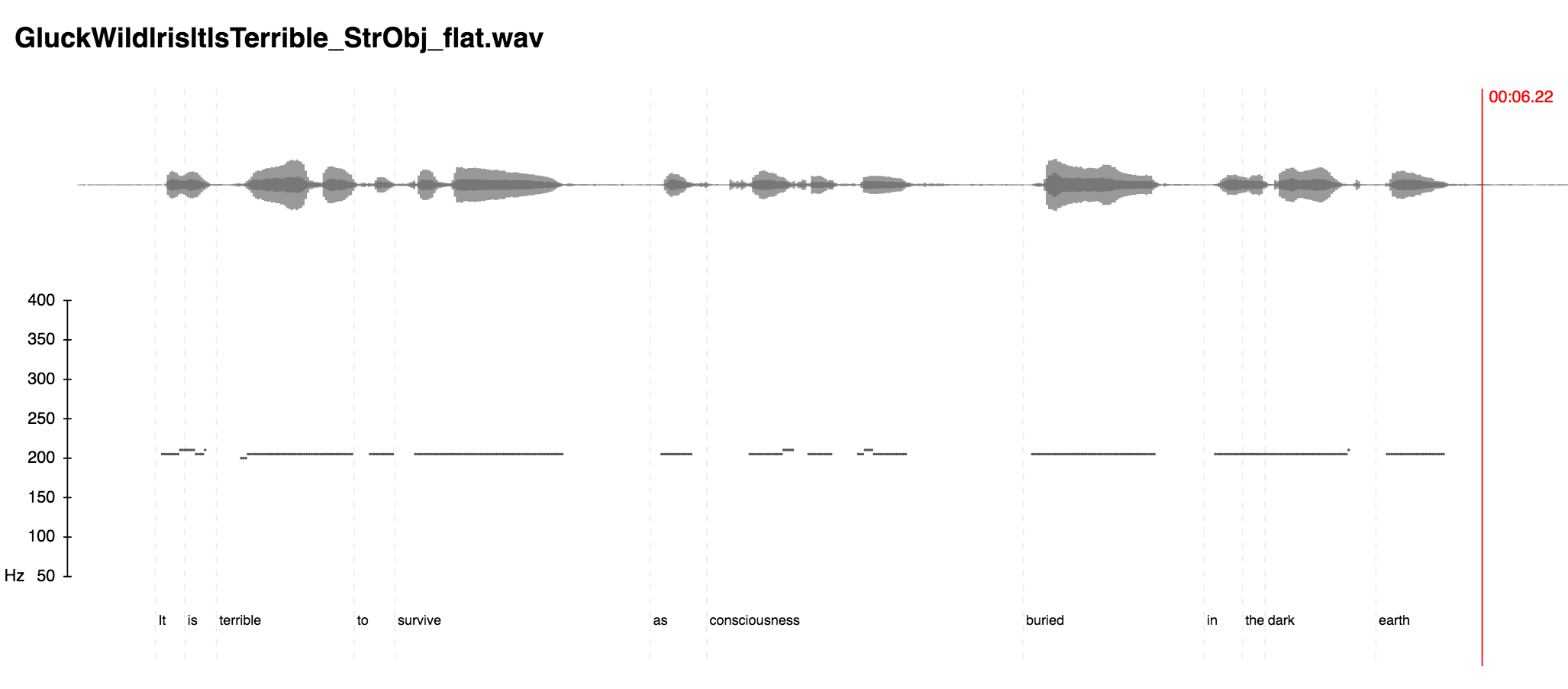
Click image to enlarge the pitch contour graph of Glück “flattened.”
.
Ideally, Glück’s manner of reading her poem should not prevent students from appreciating it. While in other contexts we may defend women’s use of uptalk, it also seems fair to raise the point that academic poetry reading can seem to discourage the expression of affect. (See Donald Hall’s well-known polemic, “The Poetry Reading: Public Performance / Private Art” (1985) and David Groff’s “The Peril of the Poetry Reading: Page Versus Performance” [2005].) Vocal deformance, among other strategies, might help students perceive as much drama in Glück’s poems as they do in Mullen’s—and find as much as poetic authority in both poets’ voices as they do in Yeats’s churchy one. Here, we’ve manipulated Glück’s voice to sound more like Mullen’s style of reading, with a wider pitch range and rising intonation and high boundary tones.

Click image to enlarge the pitch contour graph of Glück reading “expressively.”
.
If we want to explore alternatives to conventional modes of reading poetry, as many do, directly deforming the acoustic qualities of canonical recordings is an excellent way to defamiliarize performance conventions. Ideally, it can help us listen to alternate versions of the history of poetic performance and to different, unimagined possibilities in the present. Given the extraordinary vitality of spoken word and slam poetry outside the academy, it would be a missed opportunity to suppress varied reading styles in the classroom. At the same time, it would be a great shame to leave behind canonical American poetry when the poets’ reading styles fail to appeal to students.
Finally, if we want to liberate students from the anti-performative tendencies of academic culture, resist essentialist readings of poems according to our assumptions about the identities of the poets who wrote them, and dramatize the idea that there are many ways to read a poem, vocal deformance can help, alongside other strategies. As Yvon Bonenfant wrote in a 2014 Sounding Out! piece, “we are mostly neurotic, or otherwise hung up on, what kinds of sounds we make, where and when.”
Instead, let’s play in different voices.
—
NOTE: To illustrate vocal deformance, we used Straight, a state-of-the-art open-source voice synthesis program developed by Hideki Kawahara at Wakayama University in Japan, with the Advanced Telecommunications Research Institute and the Auditory Brain Project. We also used Drift, an open-source pitch-tracking tool that uses an algorithm developed by Byung Suk Lee and Dan Ellis, implemented by Robert Ochshorn and Max Hawkins with support from MacArthur’s ACLS Digital Innovations Fellowship in 2015-16, to visualize intonation with pitch contours.
—
Marit J. MacArthur is associate professor of English at California State University, Bakersfield, and a research associate in Cinema and Digital Media at the University of California, Davis.
Lee M. Miller is associate professor of Neurobiology, Physiology, & Behavior at the University of California, Davis, and technical director of the Center for Mind and Brain.
—
Featured Image: Cropped and Enlarged version of Bill Smith’s “Voice Glitch,” Attribution 2.0 Generic (CC BY 2.0)
—
REWIND! . . .If you liked this post, you may also dig:
A Listening Mind: Sound Learning in a Literature Classroom–Nicole Furlonge
Audio Culture Studies: Scaffolding a Sequence of Assignments–Jentery Sayers
“HOW YOU SOUND??”: The Poet’s Voice, Aura, and the Challenge of Listening to Poetry–John Hyland
Hearing the Tenor of the Vendler/Dove Conversation: Race, Listening, and the “Noise” of Texts–Christina Sharpe
Share this:


Current Top Posts





April 2021

January 2020

November 2019

October 2019

August 2019

April 2014

November 2017

March 2015

December 2017

October 2015
 Sounding Out!
Recent Comments