
Blog-O-Versary #Flawless 5.0!

Click here to download our free Blog-O-Versary 5.0 Mix!
.
HAPPY 5th BLOG-O-VERSARY! Parabéns!
As I write this, I am sitting on the return flight from Portugal, where I spent an utterly transformational four days at the Invisible Places, Sounding Cities conference (deftly organized and elegantly curated by Raquel Castro), a sensory torrent that still has me buzzing. While there, I was thrilled, provoked, taken, shaken, intrigued, pleased, taught, energized, exhausted, re-energized, puzzled, lifted up. . .all of the things I hope a truly great meeting will do (and then some). What I wasn’t prepared for—and when going to a conference featuring sound artists and performers, I imagine myself ready for anything—was the flood of gratefulness and gratitude that I felt every time I had a conversation about Sounding Out!, every time all of our stickers disappeared off the registration table, every time I introduced myself and there were nods of recognition from people I had never met—people located thousands of miles from my home IP address—and every time my scouting attempts were met with enthusiasm that matched (and often rivaled) my own.
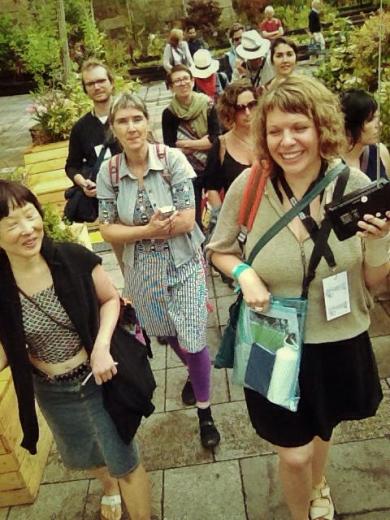
Multimedia artist, SO! Regular Writer, and Portugal resident Maile Colbert leading Invisible Places attendees on the Radio Terramoto soundwalk co-created with her partner Rui Costa (of Binaural/Nodar).
And, while I cannot deny that I my work on Sounding Out! has generated personal pride—speaking honestly, sometimes I go to soundstudiesblog.com just to LOOK at it—but the feeling I enjoyed in Viseu was different from “accomplishment.” I felt grateful for the support of our editors, writers, and podcasters—sharing the best of themselves, tirelessly and without compensation other than mad props and ‘nuff respect—for our readers, ever stretching across the globe, sharing, liking, and ReTweeting, until this endeavor became a networked community, and for our fans—Yes! We have received fan mail!—whose enthusiasm always seems to arrive at the right time, the Hail Mary eleventh hour when the editors are fighting sleep and/or needing another reason to allow Dora the Explorer to play a little longer to steal time to finish a piece. I also felt gratitude for the diverse and full-bodied sound studies community, particularly its rigorous but generous, inviting embrace, which extended to the fledgling Sounding Out! experiment five lightning-quick years ago.
In that time, I hope we have expressed our gratitude in return, by deepening and extending our mutual community, binding us in new and unexpected ways, showcasing our best and giving air to our challenges, and, most importantly, enabling us to greet each other as familiar colleagues—in Viseu, Berlin, Toronto, San Juan, Los Angeles, Copenhagen, New York, Sao Paolo. . .—even if we had never before met “In Real Life.” Know that as we continue to grow and renew the site that the function of community will always remain a prime directive of SO!. I welcome the responsibility we have collectively invested in Sounding Out!; it makes my decisions both more contemplative and surefooted. Thank you, everyone, for the last five years—lets raise a glass of Grão Vasco Dão Tinto toward many more together!
As we sip, let’s also partake in the annual SO! tradition of taking stock of the last action-packed year, with soundtrack supplied by another artist having a #flawless year, Ms. Beyoncé Knowles herself. . .
 “Irreplaceable” (Goodbye, Liana): I write this first update completely under protest. I know I am not supposed to admit to affective reactions, especially in cyberspace and especially as a woman with her feet in several male dominated fields, but when Liana Silva-Ford, our stalwart and smoothly bad-ass Managing Editor and Co-Founder, told me she was considering leaving SO!, my eyes welled up instantaneously. Okay, so she very straightforwardly told me she was leaving—even now I still have to sneak in the modifier “considering.” Liana was recently named Editor-in-Chief of the longstanding publication Women in Higher Education (now on Wiley-Blackwell)—read her first “Editor’s End Notes” here—and she is embarking on a book project on her not-so-secret passion, postcards. Liana has, rightly and deservedly, decided to bestow more of her time on these two *amazing ventures. Even though none of us has yet to successfully visualize SO! without her, we know this is right and we wish her all and only the best. Thank you, Liana for your steady hand but light touch, your sharp yet generous editorial eye, and the intelligence, professionalism, and enthusiasm you brought to every meeting, every challenge, and every writer. Working (and SO!-hiveminding) with you has been an exquisite pleasure. And thank you for letting me twist your arm into a permanent “Editor-at-Large” position (whew!).
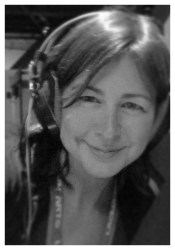 “Green Light” (Welcome Cara, Neil, Will): On the other hand, I am pleased to announce that the O.G. SO! triumvirate has happily expanded to a sextet. Media scholar Neil Verma (Visiting Assistant Professor in the Department of Radio/Television/Film at Northwestern University) our new ASA/SCMS Special Editor, came on board in late 2013, curating our new Thursday stream that launched in January 2014. Neil has already proved himself to be a skilled editor, an intuitive curator, and a natural at the brand of humor and enthusiastic tomfoolery we thrive on behind the scenes. We initiated our “L.A. Office” in December with the addition of William Stabile, our new Assistant Visual Editor, who is responsible for many of the mighty fine layouts that that you have seen this year. He is flexible, patient, and extremely gifted in the visual arts, with a wit dryer than Riverside, California this time of year. We value his work and presence immensely. And, drum roll please (especially with our crowd), we are pleased to announce right here today, that Cara Lynne Cardinale is our new Managing Editor, coming to us live from the East Bay in Northern California with a soaring collection of great ideas and her feet firmly planted on the ground of spreadsheets, calendars, and deadlines. Cara graduated in 2010 with her Ph.D. in English from the University of California, Riverside, with a brilliant dissertation that I am constantly telling my graduate students to seek out: “‘Through the Eyes’: Reading Deafened Gestures of Look-Listening in Twentieth Century Narratives.” A unanimous selection for her intensity, sharpness, and style-for-miles, Cara will undoubtedly turn this mother out!.
 “Upgrade U” (Thursday Stream!): You may have noticed that there has been twice the SO! to love in 2014, thanks to Neil Verma’s work on the Thursday stream, with his cadre of guest editors and an array of media-related subjects that has greatly expanded and deepened the site’s threshold. The year is only a little more than half-over and already we have been treated to forums on Cuban radio history (Tom McEnaney’s “Radio de Acción”), Lou Reed’s voice and sonic influence (NV’s “Start a Band”), and Justin Burton’s rumbling “The Wobble Continuum” of dubstep sounds and scholarship. Jump on the most current series of the stream, “Sculpting the Film Soundtrack” (guest edited by Katherine Spring), a collection of posts that re-frames the cinematic soundtrack to to be heard anew. The media stream + our monthly podcast series + SO!’s monthly pass-the-mic “Sound Off! // Comment Klatsch” = vibrant sounding Thursdays. We like this new math.
 “Check on It” (“SO! Amplifies”) b/w “Schoolin’ Life” (Book Reviews): Sounding Out!, by design, is not a clearing house for any-and-all sound-related events [however, you CAN get all that information by following us on Twitter, liking us on Facebook, and Tumbling with us too]. BUT, we realized this year that relationships are built and connections are made through support of one another’s work, and, more often than not, it takes more than 140 characters to properly accomplish this important task. So, in 2014, we launched two new ongoing series, “Sounding Out! Reads,” reviewing the latest monographs of interest to Sound Studies peeps, and a curatorial series called “SO! Amplifies” that enables selected makers, artists, authors, researchers, designers, and other creative/creating folks to introduce their work and tell SO! readers how/why it is important to them (and should be to us). In addition to amplifying the signal sent out by our featured works, we also hope to enable the production of new research, art, and other types of projects and connections through the introduction of these new tools, models, information, and archives. At the very least, we will be hipping your ears and eyes to some seriously cool new ish.
 “Satellites” b/w “Rocket” (War of the Worlds collabo extravaganza): Neil Verma came to the SO! team last summer in search of a site to host observations on the occasion of the 75th Anniversary of Orson Welles’ 1938 broadcast of War of the Worlds. Knowing the brilliance and exceptional quality of Neil’s work—please buy and devour his 2012 Theater of the Mind (University of Chicago Press, SCMS First Book Award Winner) ASAP—I automatically said an enthusiastic “YES.” BOOM. Just like that, an international multimedia fandango was born. On the ground, or since we are talking radio, terrestrially, #WOTW75 sounded like a three-hour radio broadcast on Binghamton University’s WHRW 90.5 with 2 hours of original content produced by Team SO! (one of them live!) bookending a re-broadcast of Welles’ original at the precise date and time of its debut, 8:00 PM EST, October 30th [1.5 hours are available via our podcast series: EPISODE XXII: Remixing War of the Worlds presents an original creative sound composition by Monteith McCollum and his Performative Processes class at Binghamton University that re-imagined act three of WOTW and EPISODE XXIII: War of the Worlds Revisited, the new 60-minute audio documentary featuring interviews with top media scholars engineered by our very own Multimedia editor Aaron Trammell]. BUT, out in the aether and Twittersphere, #WOTW75 looked like so much more: simultaneous listening parties dotting the globe—a special shout out to Jake Smith’s event at Northwestern U in Chicago—a months-long supergroup collabo between the
  Sounding Out! crüe and the University of Wisconsin-Madison’s Antenna—mad props to Andrew Bottomley—a real-time Twitter conversation using the hashtag #WOTW75 that sparked myriad reactions from excitement to snark—NV has curated the best of these for the upcoming sound special issue of Velvet Light Trap—academic panels, radio interviews, podcasts—thank you Aca-Media!—TV interviews, live dramatic radio performances—you rock, Charles Berman and the WHRW drama dept—a live collaging project put on by Toronto’s Collage Collective at the Textile Museum of Canada, martian-themed cupcakes, commemorative T- shirts by artisanal screen printers Muckles Ink, a theme-song (!!) written and performed by Binghamton’s finest ambient surf-noise band The Short Waves, and, we dearly hope, renewed excitement for the experience of “liveness” in the twenty-first century, an experience greatly changed since 1938, but no less vital in importance and thrilling in affect.
- “Run the World” (Citations, Reposts, and Writer Updates): It has been a great year for our writers, who have found their work cited and re-blogged in many venues including The Society Pages, The Feminist Wire, Twentieth Century Music, The New Inquiry’s Sunday Reading, Radio Survivor, Repeating Islands, Past and Present, About Place Journal’s 1963-2013 Civil Rights Retrospective, and American History Now [for the full bibliographic details see our SO! Media page].
We also congratulate our writers on their recent news and updates!
- Kaj Ahlsved is working hard on his PhD dissertation “Music and sport: soundscape, identity, context and function.” He published his first article in the 2013 Yearbook for the Finnish society for Ethnomusicology. His second article, “Let’s Play Hockey,” is currently under peer review. He is also part of a research project called Kiekkokansa that will publish a book on Finnish ice hockey culture in April 2015. For this project he and a few other researchers had the opportunity to do ethnography in Minsk during the 2014 World Ice Hockey Championships.
- Regina Bradley released her video dialogue series called Outkasted Conversations. She has a chapter titled “Kanye West’s Sonic [Hip Hop] Cosmopolitanism” in the collection The Cultural Impact of Kanye West. She also has an article forthcoming on Edward P. Jones’ The Known World and the Hip Hop Imagination in Southern Literary Journal.
- Dolores Inés Casillas was promoted to Associate Professor with tenure at the University of California at Santa Barbara.
- Kariann Goldschmitt will be a Visiting Lecturer in the Faculty of Music at the University of Cambridge this upcoming October. Her essay on mobile tactics in the Brazilian independent music industry has been published in The Oxford Handbook of Mobile Music Studies, Volume 1.
- Carter Mathes saw the release of his new book this year, titled Imagine the Sound: Experimental African American Literature after Civil Rights.
- Jonathan Sterne is co-organizing, with Nick Mirzoeff and Tamar Tembeck, the first-ever sound studies-meets-visual culture studies conference. Called Sound, Vision, Action, it puts scholars and artists in dialogue across sonic and visual traditions. They are especially interested in how each field addresses questions of power. The lineup is still being confirmed, but it will be hosted by Media@McGill in Montreal, 14-15 November 2014. Sterne is teaching a graduate seminar in conjunction with the conference in the Fall. More details will be available at http://media.mcgill.ca.
- Jennifer Stoever was promoted to Associate Professor with tenure at the State University of New York, Binghamton where she was also awarded a 2014 Chancellor’s Award in Teaching.
 And now. . .because this is how we do year after year, roll up your rug or roll down your partition, please, it is time to celebrate our #flawless 5.0 blog-o-versary, ‘Yonce-style. –JS, Editor-in-Chief
—
Jennifer Stoever is co-founder and Editor-in-Chief of Sounding Out! She is also Associate Professor of English at Binghamton University.
—
Click here for Sounding Out!‘s Blog-O-Versary #Flawless 5.0 mix with track listing
(Just in case you missed last year’s 4.0 celebration and mix click here; 3.0 click here; for year two, click here; and for our first Blog-O-Versary party mix click here)
—
Share this:

The Musical Flow of Shane Carruth’s Upstream Color
Welcome back to Sculpting the Film Soundtrack, SO!‘s new series on changing notions about how sound works in recent film and in recent film theory, edited by Katherine Spring.
Two weeks ago, Benjamin Wright started things off with a fascinating study of Hans Zimmer, a highly influential composer whose film scoring borders on engineering — or whose engineering borders on music — in many major Hollywood releases. This week we turn to the opposite end of the spectrum to a seemingly smaller film, Shane Carruth’s Upstream Color (2013), which has made quite a few waves among sound studies scholars and fans of sound design, even earning a Special Jury Prize for sound at Sundance.
To unpack the many mysteries of the film and explore its place in the field of contemporary filmmaking, we are happy to welcome musicologist and film scholar Danijela Kulezic-Wilson of University College Cork. Listen to Upstream Color through her ears (it’s currently available to stream on Netflix) and perhaps you’ll get a sense of why you’ll have to listen to it two or three more times. At least.
–nv
—
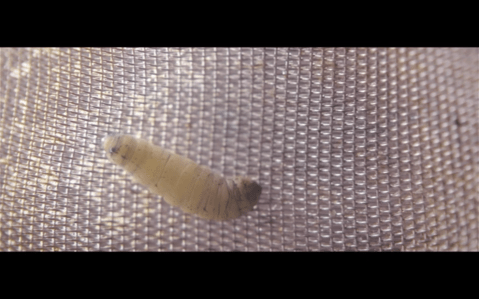
When Shane Carruth’s film Upstream Color was released in 2013, critics described it in various ways—as a body horror film, a sci-fi thriller, a love story, and an art-house head-scratcher—but they all agreed that it was a film “not quite like any other”. And while the film’s cryptic imagery and non-linear editing account for most of the “what the hell?” reactions (see here for example), I argue that the reason for its distinctively hypnotic effect is Carruth’s musical approach to the film’s form: he organizes the images and sounds according to principles of music, including the use of repetition, rhythmic structuring, and antiphony.
The resulting musicality of Upstream Color may not be surprising given that Carruth composed most of the score, and also, as Jonathan Romney has noted in Sight & Sound, Carruth has said on many occasions that he was hoping “people would watch this film repeatedly, as they might listen to a favourite album” (52). In this sense, Carruth (whose DIY toolkit also includes writing, directing, acting, producing, cinematography, and editing) joins the ranks of filmmakers such as Darren Aronofsky and Joe Wright who recognize that, despite our culture’s obsession with the cinematic and narrative aspects of “visual” media, music governs film’s deepest foundations.
Upstream Color is a story about a woman, Kris, who is kidnapped by a drug manufacturer (referred to in the credits as Thief) and contaminated with a worm that keeps her in a trance-like state during which the Thief strips her of all her savings. Kris is subsequently dewormed by a character known as the Sampler, who transfers the parasite into a pig that maintains a physical and/or metaphorical connection to Kris. Kris later meets and falls in love with Jeff who, we eventually discover, has been a victim of the same ordeal. Although the bizarreness of the plot has encouraged numerous interpretations, the film’s unconventional audio-visual language suggests that its story of two people who share supressed memories of the same traumatic experience shouldn’t be taken at face value, but rather serves as a metaphor for existential anxiety resulting from being influenced by unknown forces.
Such an interpretation owes as much to the film’s disregard for the rules of classical storytelling as it does to a formally innovative soundtrack, one that uses musicality as an overarching organizing principle. The fact that Carruth wrote the score and script simultaneously (discussed in the video below) indicates the extent to which music was from the beginning considered an integral part of the film’s expressive language. More importantly, as the scenes discussed in this post suggest, the musical logic of the film is even more pervasive than the style, role, and placement of the actual score.
Whereas feature films traditionally assign a central role to speech, allowing music and sound effects supporting roles only, Upstream Color breaks down the conventional soundtrack hierarchy, often reversing the roles of each constitutive element. For example, hardly any information in the film that could be considered vital to understanding the story is communicated through speech. Instead, images, sound, music, and editing–for which Carruth shares the credit with fellow indie director David Lowery–are the principal elements that create the atmosphere, convey the sense of the protagonists’ brokenness, and reveal the connection between the characters. At the same time, characters’ conversations are either muted or their speech is blended with music in such a way that we’re encouraged to focus on body language or mise-en-scène rather than trying to discern every spoken word. For example, Jeff and Kris’s flirting with one another during their initial meetings (at roughly 0.44.20-0.47.00 of the film) is conveyed primarily through gestures, glances, and fragmentary editing rather than speech, which would be more typical for this sort of narrative situation.
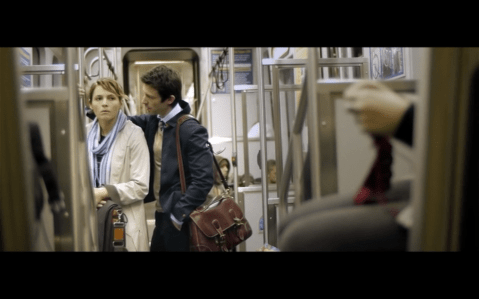
Further undercutting the significance of speech across the film is how the film has been edited to resemble the flow of music. For example, non-linear jumps in the narrative are often arranged in such a way as to create syncopated audio-visual rhymes. This technique is particularly obvious in the montage sequence in which Kris and Jeff argue over the ownership of their memories, whose similarities suggest that they were implanted during the characters’ kidnappings. In this sequence, both the passing of time and the recurrence of the characters’ argument is conveyed through the repetition of images that become visual refrains: Kris and Jeff lying on a bed, watching birds flying above trees, touching each other. Some of these can be seen in the film’s official trailer:
The scene’s images and sounds are fragmented into a non-linear assembly of pieces of the same conversation the characters had at different times and places, like the verses and the choruses of a song. Importantly, the assemblage is also patterned, with phrases like “we should go on a trip” and “where should we go?” heard in refrain. The first time we hear Jeff say “we should go on a trip” and suggesting that they go “somewhere bright”, his words are played in sync with the image of him and Kris lying on the bed. The following few shots, accompanied only by music, symbolize the “honeymoon” phase of their relationship: the couple kiss, hold hands, and walk with their hands around each other’s waists. A shift in mood is marked by the repetition of the dialogue, with Jeff again saying “we should go on a trip” – only this time, the phrase plays asynchronously over a shot of Jeff and Kris pushing a table into the house that they have moved into together. Finally, the frustration that starts infiltrating the characters’ increasingly heated arguments is alleviated by the repetition of the sentence “They could be starlings.” As it is spoken three times by both characters in an antiphonic exchange, the phrase emphasizes the underlying strength of their connection and gives the scene a rhythmic balance. Across this sequence, the musical organization of audio-visual refrains prompts us to recognize the psychic connection between Kris and Jeff, and even to begin to guess the sinister reason for it.
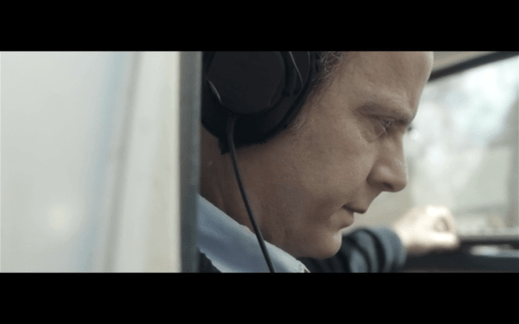
While speech in Upstream Color is often stripped of its traditional role as a principal source of information, sound and music are given important narrative functions, illuminating hidden connections between the characters. In one of the most memorable scenes, the Sampler is revealed to be not only a pig farmer but also a field recordist and sound artist who symbolizes the hidden source of everything that affects Kris and Jeff from afar. As we hear the sounds of the Sampler’s outdoor recordings merge with and emulate the sounds made and heard by Kris and Jeff at home and at work, the soundtrack eloquently establishes the connection between all three characters while also giving us a look “behind the scenes” of Kris’s and Jeff’s lives and suggesting how they are influenced from a distance.
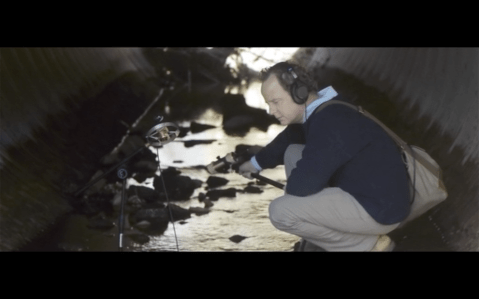
In one sense, by calling attention to the very act of recording sound, the scene exposes how films are constructed, offering a reflexive glimpse into usually hidden processes of production. The implied idea here–that the visible and audible are products of not-so-obvious processes of formation–refers not only to the medium of film but also to the complexity of the inner workings of someone’s mind. Thus the Sampler’s role, his actions, and his relationship to Kris, Jeff, and other infected victims can be interpreted as a metaphor for the subconscious programming – all the familial, social and cultural influences – that all of us are exposed to from an early age. The Sampler is portrayed symbolically as the Creator, a force whose actions affect the protagonists’ lives without them knowing it. The fact that he is simultaneously represented as a sound artist establishes sound-making and musicality as the film’s primary creative principles.
Considering Carruth’s very deliberate departure from the conventions of even what David Bordwell calls “intensified” storytelling, it is fair to say that Upstream Color is a film that weakens the strong narrative role traditionally given to oral language. What is intensified here are the musical and sensuous qualities of the audio-visual material and a mode of perception that encourages absorption of the subtext (in other words, the metaphorical meaning of the film) as well as the text.
The musical organization of film form and soundtrack is no longer limited to independent projects such as Carruth’s Upstream Color. As I have shown elsewhere, musicality has become an extremely influential principle in contemporary cinema, acting as an inspiration and model for editing, camera movement, movement within a scene and sound design. Some of the most interesting results of a musical approach to film include Aronofsky’s “hip hop montage” in Pi (1998) and Requiem for a Dream (2000), Jim Jarmusch’s rhythmically structured film poems (The Limits of Control, 2009; Only Lovers Left Alive, 2013), the interchangeable use of musique concrète and environmental sound in Gus Van Sant’s Death Trilogy and films by Peter Strickland (Katalin Varga, 2009; Berberian Sound Studio, 2012); the choreographed mise-en-scène in Joe Wright’s Anna Karenina (2012); the musicalization of language in Harmony Korine’s Spring Breakers (2012); and the foregrounding of musical material over intelligible speech in Drake Doremus’s Breathe In (2013). Given the breadth of these examples, it’s no exaggeration to say that filmmakers’ growing affinity for a musical approach to film is changing the landscape of contemporary cinema.
—
Danijela Kulezic-Wilson teaches film music, film sound, and comparative arts at University College Cork. Her research interests include approaches to film that emphasize its inherent musical properties, the use of musique concrète and silence in film, the musicality of sound design, and musical aspects of the plays of Samuel Beckett. Danijela’s publications include essays on film rhythm, musical and film time, the musical use of silence in film, Darren Aronofsky’s Pi, P.T. Anderson’s Magnolia, Peter Strickland’s Katalin Varga, Gus Van Sant’s Death Trilogy, Prokofiev’s music for Eisenstein’s films, and Jim Jarmusch’s Dead Man. She has also worked as a music editor on documentaries, short films, and television.
—
All images taken from the film.
—
 REWIND! . . .If you liked this post, you may also dig:
Sound Designing Motherhood: Irene Lusztig & Maile Colbert Open The Motherhood Archives— Maile Colbert
Play it Again (and Again), Sam: The Tape Recorder in Film (Part One on Noir)— Jennifer Stoever
Animal Renderings: The Library of Natural Sounds— Jonathan Skinner
Share this:


Current Top Posts





April 2021

January 2020

November 2019

October 2019

August 2019

April 2014

November 2017

March 2015

December 2017

October 2015
 Sounding Out!
Recent Comments