
Sculptural Dissonance: Hans Zimmer and the Composer as Engineer
DOI: https://doi.org/10.59350/kx3v2-f6114
Welcome to our new series Sculpting the Film Soundtrack, which brings you new perspectives on sound and filmmaking. As Guest Editor, we’re honored and delighted to have Katherine Spring, Associate Professor of Film Studies at Wilfrid Laurier University. Spring is the author of an exciting and important new book Saying it With Songs: Popular Music and the Coming of Sound to Hollywood Cinema. Read it! You’ll find an impeccably researched work that’s the definition of how the history of film sound and media convergence ought to be written.
But before rushing back to the early days, stick around here on SO! for the first of our three installments in Sculpting the Film Soundtrack.
– NV
—
It’s been 35 years since film editor and sound designer Walter Murch used the sounds of whirring helicopter blades in place of an orchestral string section in Apocalypse Now, in essence blurring the boundary between two core components of the movie soundtrack: music and sound effects. This blog series explores other ways in which filmmakers have treated the soundtrack as a holistic entity, one in which the traditional divisions between music, effects, and speech have been disrupted in the name of sculpting innovative sonic textures.
In three entries, Benjamin Wright, Danijela Kulezic-Wilson, and Randolph Jordan will examine the integrated soundtrack from a variety of perspectives, including technology, labor, aesthetic practice, theoretical frameworks, and suggest that the dissolution of the boundaries between soundtrack categories can prompt us to apprehend film sound in new ways. If, as Murch himself once said, “Listening to interestingly arranged sounds makes you hear differently,” then the time is ripe for considering how and what we might hear across the softening edges of the film soundtrack.
– Guest Editor Katherine Spring
—
Composing a sound world for Man of Steel (2013), Zack Snyder’s recent Superman reboot, had Hans Zimmer thinking about telephone wires stretching across the plains of Clark Kent’s boyhood home in Smallville. “What would that sound like,” he said in an interview last year. “That wind making those telephone wires buzz – how could I write a piece of music out of that?” The answer, as it turned out, was not blowing in the wind, but sliding up and down the scale of a pedal steel guitar, the twangy lap instruments of country music. In recording sessions, Zimmer instructed a group of pedal steel players to experiment with sustains, reverb, and pitches that, when mixed into the final track, accompany Superman leaping over tall buildings at a single bound.
His work on Man of Steel, just one of his most recent films in a long and celebrated career, exemplifies his unique take on composing for cinema. “I would have been just as happy being a recording engineer as a composer,” remarked Zimmer last year in an interview to commemorate the release of a percussion library he created in collaboration with Spitfire Audio, a British sample library developer. “Sometimes it’s very difficult to stop me from mangling sounds, engineering, and doing any of those things, and actually getting me to sit down and write the notes.” Dubbed the “HZ01 London Ensembles,” the library consists of a collection of percussion recordings featuring many of the same musicians who have performed for Zimmer’s film scores, playing everything from tamtams to taikos, buckets to bombos, timpani to anvils. According to Spitfire’s founders, the library recreates Zimmer’s approach to percussion recording by offering a “distillation of a decade’s worth of musical experimentation and innovation.”
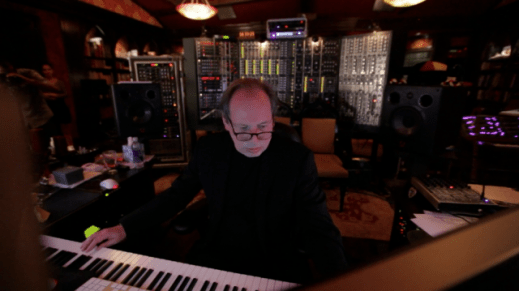
In many ways, the collection is a reminder not just of the influence of Zimmer’s work on contemporary film, television, and video game composers but also of his distinctive approach to film scoring, one that emphasizes sonic experimentation and innovation. Having spent the early part of his career as a synth programmer and keyboardist for new wave bands such as The Buggles and Ultravox, then as a protégé of English film composer Stanley Myers, Zimmer has cultivated a hybrid electronic-orchestral aesthetic that uses a range of analog and digital oscillators, filters, and amplifiers to twist and augment solo instrument samples into a synthesized whole.
http://www.youtube.com/watch?v=Iwuy4hHO3YQ
Zimmer played backup keyboards on “Video Killed the Radio Star.”
In a very short time, Zimmer has become a dominant voice in contemporary film music with a sound that blends melody with dissonance and electronic minimalism with rock and roll percussion. His early Hollywood successes, Driving Miss Daisy (1989) and Days of Thunder (1990), combined catchy themes and electronic passages with propulsive rhythms, while his score for Black Rain (1989), which featured taiko drums, electronic percussion, and driving ostinatos, laid the groundwork for an altogether new kind of action film score, one that Zimmer refined over the next two decades on projects such as The Rock (1996), Gladiator (2000), and The Pirates of the Caribbean series.
What is especially intriguing about Zimmer’s sound is the way in which he combines the traditional role of the composer, who fashions scores around distinct melodies (or “leitmotifs”), with that of the recording engineer, who focuses on sculpting sounds. Zimmer may not be the first person in the film business to experiment with synthesized tones and electronic arrangements – you’d have to credit Bebe and Louis Barron (Forbidden Planet, 1956), Vangelis (Chariots of Fire, 1981), Jerry Goldsmith (Logan’s Run, 1976), and Giorgio Moroder (Midnight Express, 1981) for pushing that envelope – but he has turned modern film composing into an engineering art, something that few other film composers can claim.
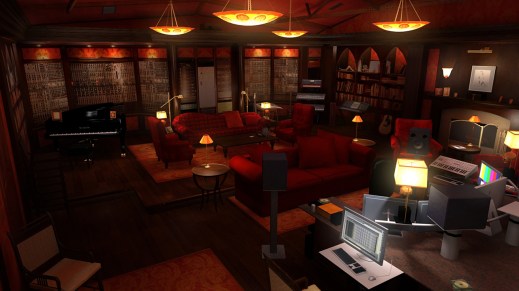
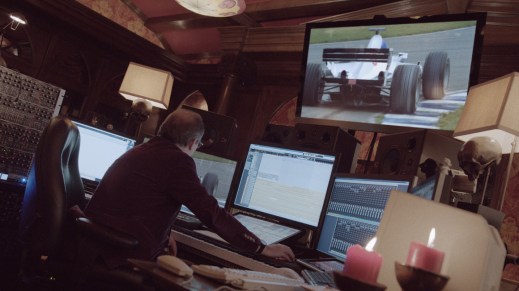
One thing that separates Zimmer’s working method from that of other composers is that he does not confine himself to pen and paper, or even keyboard and computer monitor. Instead, he invites musicians to his studio or a sound stage for an impromptu jam session to find and hone the musical syntax of a project. Afterwards, he returns to his studio and uses the raw samples from the sessions to compose the rest of the score, in much the same way that a recording engineer creates the architecture of a sound mix.
“There is something about that collaborative process that happens in music all the time,” Zimmer told an interviewer in 2010. “That thing that can only happen with eye contact and when people are in the same room and they start making music and they are fiercely dependent on each other. They cannot sound good without the other person’s part.”
Zimmer facilitates the social and aesthetic contours of these off-the-cuff performances and later sculpts the samples into the larger fabric of a score. In most cases, these partnerships have provided the equivalent of a pop hook to much of Zimmer’s output: Lebo M’s opening vocal in The Lion King (1994), Johnny Marr’s reverb-heavy guitar licks in Inception, Lisa Gerrard’s ethereal vocals in Gladiator and Black Hawk Down (2002), and the recent contributions of the so-called “Magnificent Six” musicians to The Amazing Spider Man 2 (2014).
The melodic hooks are simple but infectious – even Zimmer admits he writes “stupidly simple music” that can often be played with one finger on the piano. But what matters most are the colors that frame those notes and the performances that imbue those simple melodies with a personality. Zimmer’s work on Christopher Nolan’s Dark Knight trilogy revolves around a deceptively simple rising two-note motif that often signifies the presence of the caped crusader, but the pounding taiko hits and bleeding brass figures that surround it do as much to conjure up images of Gotham City as cinematographer Wally Pfister’s neo-noir photography. The heroic aspects of the Batman character are muted in Zimmer’s score except for the presence of the expansive brass figures and taiko hits, which reach an operatic crescendo in the finale, where the image of Batman escaping into the blinding light of the city is accompanied by a grand statement of the two-note figure backed by a driving string ostinato. Throughout the series, a string ostinato and taikos set the pace for action sequences and hint at the presence of Batman who lies somewhere in the shadows of Gotham.
Zimmer’s expressive treatment of musical colors also characterizes his engineering practices, which are more commonly used in the recording industry. Music scholar Paul Théberge has noted that the recording engineer’s interest in an aesthetic of recorded musical “sound” led to an increased demand for control over the recording process, especially in the early days of multitrack rock recording where overdubbing created a separate, hierarchical space for solo instruments. Likewise for Zimmer, it’s not just about capturing individual sounds from an orchestra but also layering them into a synthesized product. Zimmer is also interested in experimenting with acoustic performances, pushing musicians to play their instruments in unconventional ways or playing his notes “the wrong way,” as he demonstrates here in the making of the Joker’s theme from The Dark Knight:
The significance of the cooperative aspects of these musical performances and their treatment as musical “colors” to be modulated, tweaked, and polished rests on a paradoxical treatment of sound. While he often finds his sound world among the wrong notes, mistakes, and impromptu performances of world musicians, Zimmer is also often criticized for removing traces of an original performance by obscuring it with synth drones and distortion. In some cases, like in The Peacemaker (1997), the orchestration is mushy and sounds overly processed. But in other cases, the trace of a solo performance can constitute a thematic motif in the same way that a melody serves to identify place, space, or character in classical film music. Compare, for instance, Danny Elfman’s opening title theme for Tim Burton’s Batman (1989) and Zimmer’s opening title music for The Dark Knight. While Elfman creates a suite of themes around a central Batman motif, Zimmer builds a sparse sound world that introduces a sustained note on the electric cello that will eventually be identified with the Joker. It’s the timbre of the cello, not its melody, that carries its identifying features.
To texture the sounds in Man of Steel, Zimmer also commissioned Chas Smith, a Los Angeles-based composer, performer, and exotic instrument designer to construct instruments from “junk” objects Smith found around the city that could be played with a bow or by hand while also functioning as metal art works. The highly abstract designs carry names that give some hint to their origins – “Bertoia 718” named after modern sculptor and furniture designer Harry Bertoia; “Copper Box” named for the copper rods that comprise its design; and “Tin Sheet” that, when prodded, sounds like futuristic thunderclaps.
Smith’s performances of his exotic instruments are woven into the fabric of the score, providing it with a sort of musical sound design. Consider General Zod’s suite of themes and motifs, titled “Arcade” on the 2-disc version of the soundtrack. The motif is built around a call-and-answer ostinato for strings and brass that is interrupted by Smith’s sculptural dissonance. It’s the sound of an otherworldly menace, organic but processed, sculpted into a conventional motif-driven sound world.
Zimmer remains a fixture in contemporary film music partly because, as music critic Jon Burlingame has pointed out, he has a relentless desire to search for fresh approaches to a film’s musical landscape. This pursuit begins with his extracting of sounds and colors from live performances and electronically engineering them during the scoring process. Such heightened attention to sound texture and color motivated the creation of the Spitfire percussion library, but can only hint at the experimentation and improvisational nature that goes into Zimmer’s work. In each of his film scores, the music tells a story that is tailored to the demands of the narrative, but the sounds reveal Zimmer’s urge to manipulate sound samples until they are, in his own words, “polished like a diamond.”
—
Ben Wright holds a Provost Postdoctoral Fellowship from the University of Southern California in the School of Cinematic Arts. In 2011, he received his Ph.D. in Cultural Studies from the Institute for Comparative Studies in Literature, Art and Culture at Carleton University. His research focuses on the study of production cultures, especially exploring the industrial, social, and technological effects of labor structures within the American film industry. His work on production culture, film sound and music, and screen comedy has appeared in numerous journals and anthologies. He is currently completing a manuscript on the history of contemporary sound production, titled Hearing Hollywood: Art, Industry, and Labor in Hollywood Film Sound.
—
All images creative commons.
—

REWIND! . . .If you liked this post, you may also dig:
Fade to Black, Old Sport: How Hip Hop Amplifies Baz Luhrmann’s The Great Gatsby— Regina Bradley
Quiet on the Set?: The Artist and the Sound of a Silent Resurgence— April Miller
Play It Again (and Again), Sam: The Tape Recorder in Film (Part Two on Walter Murch)— Jennifer Stoever
—
Share this:

Reproducing Traces of War: Listening to Gas Shell Bombardment, 1918

DOI: https://doi.org/10.59350/bjmd1-g2d64
Welcome to World Listening Month 2014, our annual forum on listening in observation of World Listening Day on July 18th, 2014. World Listening Day is a time to think about the impacts we have on our auditory environments and, in turn, its affects on us [for the full deets, peep our recent SO! Amplifies post by Eric Leonardson, Executive Director of the World Listening Project]. We kick off our month of thinking critically about listening with a post by media historian Brian Hanrahan, who listens deeply to sonic traces of the past to prompt us to question our desires for contemporary media representations of “reality.” It also marks the global 100 year anniversary of World War I this August 2014: a moment of silence. —J. Stoever, Editor-in-Chief
—
For some reason that I don’t fully understand, I am very emotionally moved by the space around a sound. I almost think that sometimes I am recording space with a sound in it, rather than sound in a space. –Walter Murch
If you want to listen to the past, there’s never been a time like the present. Every year, it seems, new old recordings are identified, new techniques developed to recover sounds thought irrecoverable. Here is Bismarck’s voice, preserved on a cylinder in 1889. Here, older still, is Edison’s. There is the astonishing recuperation of phonautograms – reverberation traced onto soot-blackened paper in the mid-nineteenth century, digitally processed and played back in our own. But as that processing underlines, no sound recording straightforwardly reproduces the real. An acoustic artifact is a compound of materiality, form and meaning, but also a place where technology meets desire. Old recordings meet the listener’s longing halfway; they invoke a reality always out of reach. And not simply a longing to hear, but also to touch, and be moved by, the fact of an absent existence.
Take, for instance, HMV 09308. In October 1918, just before the end of the Great War, William Gaisberg, a sound recordist of the pre-electric era, took recording equipment to the Western Front in order to capture the sound of British artillery shelling German lines with poison gas. Gaisberg died not long after, probably from Spanish flu, although some say he was weakened by gas exposure during the recording. Nonetheless the “Gas Shell Bombardment” record – a 12-inch HMV shellac disc, just over 2 minutes at 78 rpm – was released a few weeks later, just as the war came to an end. Initially intended to promote War Bonds, ultimately the record was used to raise money for disabled veterans.
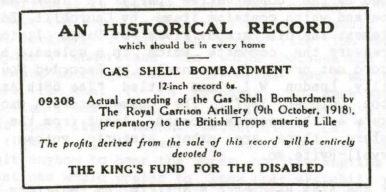
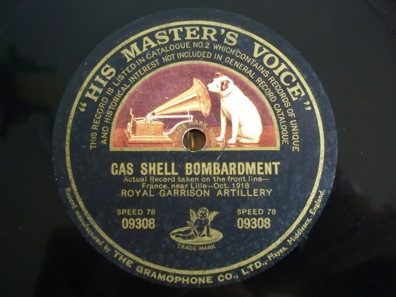
For decades, the HMV recording had a reputation as one of the very earliest “actuality” recordings – one documenting a real location and event beyond the performative space of the studio, imprinted with the audible material trace of an actual moment in space and time. Documents like this – no matter what the technology – usually come with additional symbolic authentication. Here, the record’s label does some of that work. This “historic recording,” says the subtitle, is an “actual record taken on the front line.” Publicity pieces drove home the message. In the popular HMV magazine The Voice, Gaisberg – or probably his posthumous ghost-writer – described the expedition in detail, claiming the track to be a “true representation of the bombardment.”
.
In the same issue, a Major C.J.C. Street compared the recording to his own experience on the Front. “Its realism,” he wrote, ”took my breath away… I played the record many times… finding at each attempt some well-remembered detail.” He didn’t say so in his article, but Street – an artillery officer, a novelist and a propaganda man for the intelligence agency MI7 – was in fact the impresario of the record. This was not the first time he had found astute uses for sound media. The previous year he had put together a record that set artillery drill commands to popular tunes – the recording was both a propaganda release and an army training tool for new recruits. With the Gas Shell record, Street knew he wasn’t just selling recorded sound, but also an auratic sense of closeness to an overwhelming reality, the palpable proximity of war and death. Authenticating detail helped to underpin this sense of an absent real made present. Street cued the listener for those “well-remembered details.” In particular, he singled out one indistinct rattly flap-whizz noise, hearing in it, he claimed, the sound of a round with a “loose driving-band.”
The record stayed in the HMV catalog until 1945, but only in the early 1990s were its production history and authenticity claims seriously examined. In specialist journals, archivists, collectors and amateur historians undertook a collective forensic and critical analysis. A promising auditory witness was located: 95-year-old Lt.-Col. Montagu Cleeve another former artillery officer, in his time a developer of “Boche Buster” railway gun, later a music professor – was invited to critically assess the recording. Cleeve vouched unreservedly for its authenticity. He heard in it, he said, an unmistakable succession of sounds – the clang of the breech, the gigantic report of the firing explosion, the distinctive whiny whistle of a gas shell on its way across no-man’s-land. Others looked to data rather than the memories of old soldiers. One expert on pre-electric recording noted the angles commanded in firing instructions, correlated them with known muzzle velocities for 4.5 and 6-inch howitzers, then used this and other information to “definitively” explain the counter-intuitive anti-Doppler sound of the shells’ whistling. He also identified the audible echo effect – the curious “double report” of the guns heard here – as the sound of a brass recording horn violently resonating at a distance of exactly 26.5 meters from the guns.
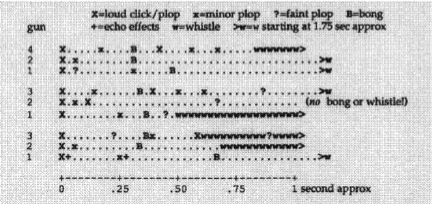
Eventually, skepticism won out. Close listening at slow speeds – just careful attention and notation, nothing more elaborate – revealed inconsistencies and oddities in the firing noises. The bongs, plops and whistles seemed internally inconsistent. Some of the artillery sounds – ostensibly a battery of four, firing in quick succession – varied implausibly with each successive firing. Physical evidence from the record’s groove, as well as extraneous noises – surface crackle and fizz, and, audible within the recording, the swish of a turntable – seemed to indicate at least two rudimentary overdubs, in which the output of one acoustic horn was relayed into a second, possibly using an auxetophone, an early compressed-air amplifier. All this resulted in a double- or triple-layered sonic artifact. Finally – the crucial evidence, although oddly it was hardly noticed at the time – an alternative take was located. In this take, according to its discoverer, the entire theatrics of gunnery command is simply absent, and there is no sound at all of whistling shells in motion. What was left was a skeleton sequence of clicks, thuds and cracks, supplemented with only a single closing insert, the portentous injunction “Feed the Guns with War Bonds!”
In short, it seems highly likely that any original field recording was, at the very least, post-dramatized with performed voices and percussive and whistling sound effects. So, it is tempting to say, that clears that up. The recording’s inauthenticity is proven. File under Fake. But in fact, if we don’t stop there, if we set aside narrow and absolutist ideas of authenticity, and instead explore the recording’s ambiguity and hybridity, then Gas Shell Bombardment becomes all the more interesting as an historical artifact.
Let’s assume, for the sake of argument, that some form of basic recording was done in France, very possibly a staged barrage specifically performed for Gaisberg’s visit, and that this recording then had effects added back at HMV in London. The record might then be seen less as a straightforward documentary, and instead as an unusual version of the “descriptive speciality,” a genre of miniature phonographic vignette dating back to the 1890s, far predating longer-form radio drama. Very little is known about these early media artworks, but it is a fair generalization to say that in America the genre was more slanted towards vaudeville comedy, whereas in Europe, imperial and military scenes predominated. As early as 1890, for example, there had been German phonographic representations of battles from the Franco-Prussian war. The Great War saw a flourishing of the genre. Scholars are just beginning to take an interest these old phonographs; here’s one recent essay on the “Angel of Mons,” for example, a British acoustic vignette of a famous incident on the Western Front.
Listen to a 1915 German descriptive speciality, depicting the attack on the fortress of Liège the previous year:
.
As a descriptive speciality, Gas Shell Bombardment is unusual because it incorporates an actual indexical trace. But such traces – as emphasized by Charles Sanders Pierce and many later media-theoreticians– do not resemble their referent, they are caused by it. The bullet hole does not look much like a bullet; thunder is lightning’s trace, not its likeness. But for Street and Gaisberg, the trace’s lack of resemblance caused problems: the original recording’s lack of detail, cues and clues, but above all its lack of internal dimensionality, created a perceptual shortfall and a lack of credibility. Maybe they hoped that the guns, by sheer force of amplitude, would overcome the spatially impoverished, reverbless reproduction of pre-electric recording. If so, it didn’t work. Without added effects, the guns’ trace was as flat and “body-less” as a sequence of Morse. It was a sound without a scene. The producers’ interventions aimed to thicken the primary artifact with referential-sounding detail, but also to heighten the sense of materiality and spatiality, and to strengthen the sense of diegetic presence, of worlded thereness. The soldiers’ voices – louder and quieter, close-up and farther-out – and the fake-Doppler of the “shell whistling” lent the recording narrative direction (literally, some trajectory) and “authenticating” points of detail. But above all they gave a sense of internal space to the recording, a space into which the listener could direct her attention.
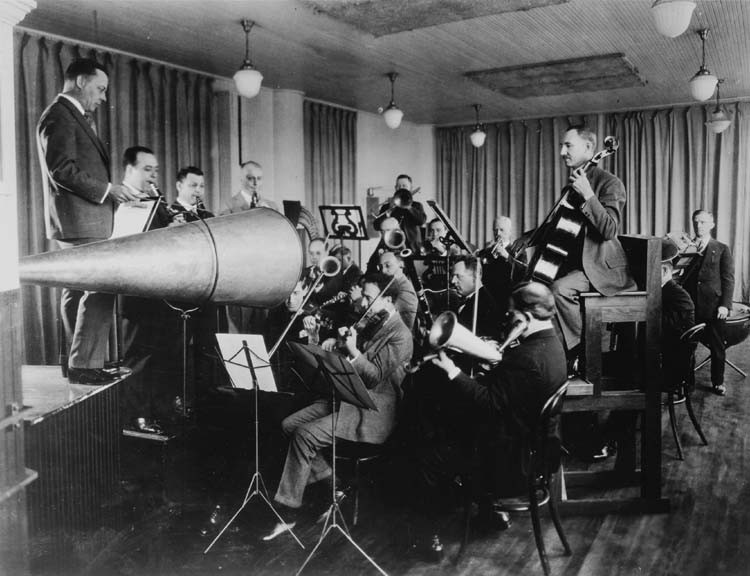
In this context, we can only admire the creativity and performative élan of the unknown production crew. We know little about effects production in early phonography. It is a safe bet that some techniques were adopted from theatre, and that there was overlap with silent film accompaniment. But whatever the method used, it would have called for the awkward orchestration of a limited number of iconic sounds to create an impression of a spatially coherent and materially detailed sonic environment. The recordist and his team would first have had to imagine how relative loudness – of voices, of material objects struck and sounded – might create a sense of spatial depth when transduced through the horn’s crude interface. Then they would have had to perform this as a live overdub, keeping time with the base track of the gun recording played through another horn. And all this done with participants and equipment crowded tightly around the mouth of the huge horn, crammed into the tiny pick-up arc, a scene looking something like this image of Leopold Stokowski’s pre-electric recording sessions or this photograph of the recording of a cello concerto.
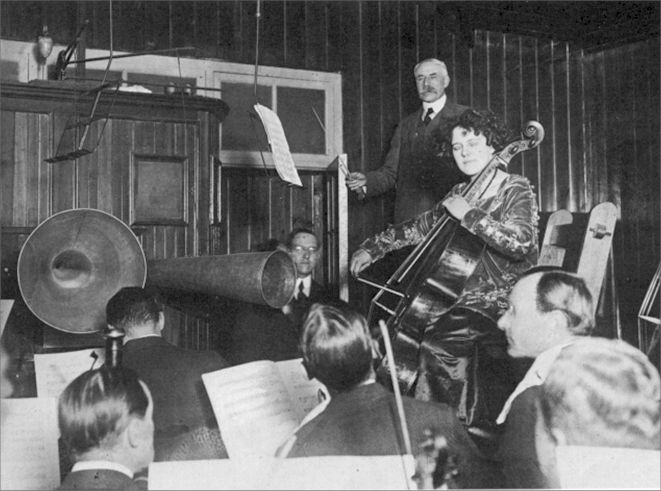
As well as this hybrid of trace and live performance, there is another performance here – Gaisberg’s journey itself. With twenty years of recording experience, Gaisberg was probably very well aware that the expedition would not yield a “realistic” recording of the guns. But the expedition had to be made, so that it could be said to have taken place. Expectations had to be primed and colored, so that, to use André Bazin’s famous phrase about photographs, the recording could partake in an “irrational power to… bear the belief” of the listener. The journey, and the accounts of Gaisberg and Street are not a supplement to the “true representation” of the gas bombardment. They are part of that representation. Moreover, in subsequent writing it is noticeable that the manner of Gaisberg’s death becomes a rhetorical amplification for the authenticity of the recording’s trace, as if his fatal inhalation (of gas molecules or flu bacilli) were itself a deadly indexation, paralleling the recording’s claim to capture the breath of the War, and even of History itself.
In media-historical terms, the Gas Shell Bombardment recording can be understood as a late, transitional artifact from phonography’s pre-microphonic era. The desire for the sonic trace, for an ever more immersive proximity to events was there, but electro-acoustic technology was not yet in place. Two years later, in 1920, Horace Merriman and Lionel Guest made the first experimental electrical recording, arguably also the first true field recording. The event, appropriately enough, was an official war memorial service in London, where Merriman and Guest – working for Columbia Records – put microphones in Westminster Abbey, running cables to a remote recording van parked in the street outside, where they sat amidst heating ovens and cutting lathes. By the end of the 1920s, remote recording and broadcasting, while never straightforward, were well on the way to ubiquity.
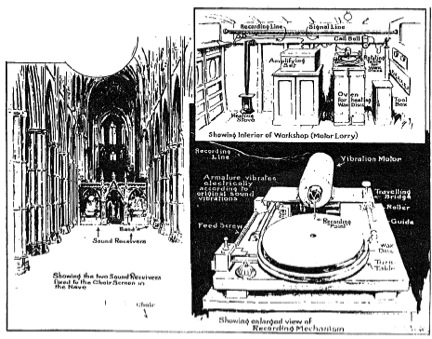
Claims made on behalf of technologies of reproduction may seem simplistic, but there’s a grain of truth to their simplicity. If there were nothing special – even magical – in the referentiality of the camera that captures the moment, the recording that’s like being there, the liveness of the live broadcast, these things would not play the role they do in everyday life and in the ideological fabric of society. But there is falsehood too, in over-simplifying the nature and affective charge of old photographs, old footage, old recordings. These are made things, composed of different materials, media, signs and conventions; they are inseparable from the desires and expectations they induce and direct. They function in part by mimesis and verisimilitude, but also through the gaps, blank spots and false illusions of their trace. They can – rightly – intensify our feeling towards the past, but should also prompt us to think about our own desires and investments.
—
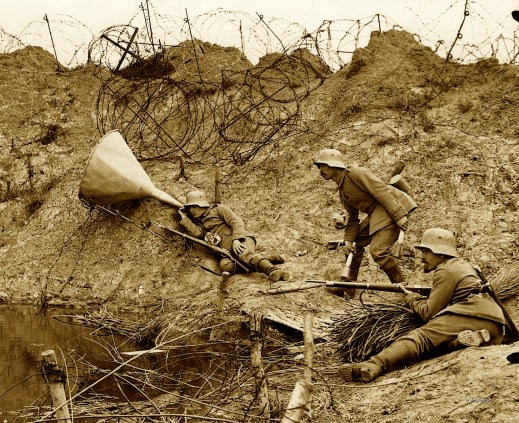
Image by Flickr User DrakeGoodman, “Horchposten im Spengtrichter vor Neuve-Chapelle 6km nördlich von La Bassée Nordfrankreich 1916,” A trio of lightly equipped soldiers from an unidentified formation oblige the photographer by looking serious and pretending they’re just metres from the enemy, listening for activity in his lines. The improvised “listening device” is actually a large funnel, probably liberated from a nearby farm.
—
Brían Hanrahan is a film, media and cultural historian, whose work focuses on the history of acoustic media, German and European cinema and the culture of the Weimar Republic.
—
Edited post-publication at 8:00 pm EST on July 7, 2014
–
REWIND!…If you liked this post, you may also dig:
SO! Reads: Susan Schmidt Horning’s Chasing Sound: Technology, Culture and the Art of Studio Recording from Edison to the LP–Enongo Lumumba-Kasongo
A Brief History of Auto-Tune–Owen Marshall
DIY Histories: Podcasting the Past–Andrew Salvati
—
Share this:




Current Top Posts





April 2021

January 2020

November 2019

October 2019

August 2019

April 2014

November 2017

March 2015

December 2017

October 2015


Recent Comments