
Listening to Robots Sing: GarageBand on the iPad
 I recently had the opportunity to fool around with the iPad2’s new GarageBand suite. Enticed by the intuitive touch interface I soon found myself lost within the device’s labyrinthine architecture. Every poke, prod and press brought me to a new screen with a bevy of exciting options. A touch to create a drum loop, a tickle to evoke some reverb, and a brush to strum a guitar. I was one with the machine; it was a truly cybernetic, kinesthetic moment. This may sound naïve, but I had never realized how many tools were available to electronic musicians, or how intuitive using these tools could be. As digital tools to create music become more accessible and more intuitive, what is the role of the human in understanding their use? Further, what strategies can we adopt when listening to these creations?
This question may seem a bit outdated to those who have been researching post-humanist phenomena since the digital boom in the mid-nineties. Often conflicting perspectives regarding the negotiation of the human and the digital have been considered in the last decade or so. Some like Donna Haraway, Pierre Lévy, and even Ray Kurzweil offer particularly optimistic readings of the post-human (although for radically different reasons). While scholars like Nancy Baym and Jaron Lanier have offered decisively more sober readings of the problematic. They argue that splits between the human and post-human, or analog and digital are false dichotomies. Truth be told, none of the theorists above adequately address my feelings on this topic. Producing music with a digital audio suite makes me defensive of my humanism and it is by its very nature a project of preservation.
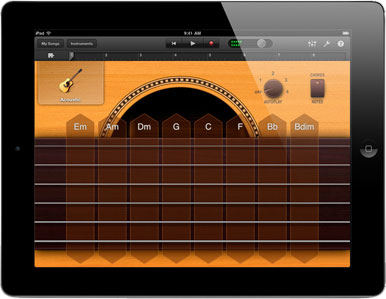 The algorithmic tools packaged within digital audio suites encourage a sense of aesthetic preservation. Tools like GarageBand’s Smart Guitar, Smart Drums, Smart Bass, various arpeggiators and Appleloops encourage the user to program music on a high level where the nuance of serendipity and improvisation play second fiddle to the overall sonic contours of a piece. Although the user is provided the tools to intervene and program music in a very specific way, it is by default a distinctly different experience than that of playing a guitar or piano. The ghost of the algorithm haunts such performances; reminding the user that these acts of spontaneous creation are no longer the default but deliberate…. This sense of deliberate improvisation forces me into a reflexive space where I am acutely aware of the mediations occurring within my performance. Succinctly, I must defend a sense of self within my creation. If I yield to the algorithms that seek to help me compose, I destroy all sense of the human within my work. Simply turning on robots and watching them sing.
For this reason, I propose an aesthetic of preservation as a way to understand the ways in which we listen to works created by digital audio suites. As algorithmic aids become more advanced and commonplace in music, the human becomes a less essential aspect of the form. Understanding what has been deliberately included in spite the seductive algorithmic environment is ultimately a project that seeks to recover the human in the machine; perhaps even, a project doomed from the start, as we grow ever closer to the means of our artistic production.
AT
Magnasanti – Check out the results of my collaboration with Colin Germain on GarageBand!


Share this:

#TigerBlood: Charlie Sheen and Affective Listening
 What is going on with Charlie Sheen? Banking almost 1.5 million dollars per episode of Two and a Half Men, there seems to be very little reason for Sheen to say things like: “I am on a drug. It’s called Charlie Sheen. It’s not available. If you try it once, you will die. Your face will melt off and your children will weep over your exploded body,” to 20/20. If extreme quotations like that were not enough, you can connect to the Charlie Sheen Twitter feed for round the clock updates on his inanities. Considering this statement, the key question is not who is listening but instead, who does Charlie think his listeners are? Are these tweets a candid rehearsal of Sheen’s innermost thoughts, or considering Andreas Duus Pape’s recent post, is there a strategic construction of audience within Sheen’s Twitter-mediated performances?
To this question, I shall argue that there definitely is a strategy. Sheen knows that he is being watched, and he knows exactly which of his quotes have the potential to go viral. As Radar Online has noted, Sheen has hired a TweetMaster to manage his Twitter account. The TweetMaster adds hashtags (# symbols which link tweets through keywords) to Sheen’s most potent memes. #TigerBlood, #Winning, #earnyourself and #teamsheen, all brand a series of tweets to Sheen in this cross-platform #twitterwar. If Sheen was as slaphappy as some of his quotes evince, he would not have hired a TweetMaster to manage his tweets nor would it be important to aggregate these points via hashtag in Tweetspace. Charlie Sheen’s recent actions exploit a strategy of spectacle in this notable propaganda campaign.
Building on my previous post regarding the politics of the interior, Sheen’s media blitz works to amplify his voice within the interior space of Twitter. In keeping with the politics of interiority and even a so-called ideology of immanence, Sheen’s quotes can be read as exemplifying the production of positive affect. When Sheen tweets: “fastball. the trolls are foaming from their toothless holes. rumor mill abundant with evil gossip. mainstream heretics smirking,” (3/7/11) he draws on the extreme and fantastic to paint what is ultimately a comical picture. Contrasting the fantastic troll to a space-less rumor mill and also making reference to a nebulous mainstream, Sheen leaves attentive followers confused and bemused. Some might chuckle, connecting the troll/hole reference to a musical skit from an episode of It’s Always Sunny in Philadelphia. Because Sheen relies on such extreme and fantastic images while striking a somewhat fanatical tone, he makes people laugh. Sheen’s humor here can be understood as the production of positive affect in a diffuse and decentralized audience. Sheen’s craft has become so slick that it even made headlines in the news this week.

Sheen’s ability to produce positive affect through talk-radio and Twitter quotes yields a positive strategic position. Because Sheen commands the production of a widespread and diffuse affect, he improves on his own “brand.” Further, as a successful producer of affect Sheen transforms himself into a commodity bar-none. Though he may no longer benefit from his meaty Two and a Half Men revenue stream, he becomes available for countless high paying, low-stress cameos seeking to cash in on Sheen the commodity. Sheen exploits what is common in all audiences, the production of sadness and joy, in doing so he transforms and rebrands himself as celebrity commodity. Ultimately, Sheen’s recent statements are highly strategic, because of them he stands to gain work. Cleverly, he imagines an audience of the common, one that will perceive him as either comic or tragic, joyful or sad. Either way, he wins.
This victory comes at a cost, as audiences laugh at and about Sheen, stereotypes of drug abuse and mental illness stand to replicate along with Sheen’s haphazard quotations. Within this sea of affect, monstrous cultural trends will surely endure. Such is the nature of tigerblood, it is contagious.
AT


Share this:


Current Top Posts





April 2021

January 2020

November 2019

October 2019

August 2019

April 2014

November 2017

March 2015

December 2017

October 2015
 Sounding Out!
Recent Comments