
Becoming a Bad Listener: Labyrinthitis, Vertigo, and “Passing”
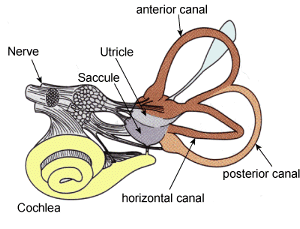 For the past three weeks I have been sick with labyrinthitis. It started with a bout of vertigo while picking up some essentials at a local pharmacy and has since recurred in various other locations. In the morning, when I stroll for coffee, it feels like I am walking a tightrope. Shelves after shelves of boxes at a local store have made the world spin. A determined trip to Manhattan (for a friend’s film release) quickly transformed into an incomprehensible blur of light and sound. Because of this lapse in cognition I have found myself listening to the world, and my body, in fascinating (although frustrating) new ways. The most frightening moments of vertigo I experienced have followed moments of both visual and audio overload. When I can no longer understand what I hear, panic is sure to follow. Worst of all, even though negotiating my day-to-day responsibilities has become a trial in patience, to most observers, I seem perfectly fine. I have decided to share these experiences because of how well they inform the ways that sound, specifically the practice of listening, informs the process of “passing” as normal in everyday life.
Labyrinthitis is often related to an inner ear infection. When the series of canals within the ear are damaged, a sense of balance is lost. This lack of balance completely skews all visual cues: things look blurry, there is an unsteadiness to things (as if on a boat), bright and flashing lights are extremely distracting . . .imagine being drunk, but with none of the perks. Another symptom of labyrinthitis is an occasional ringing in the ear. For me, this ringing is at its worst when I am trying to focus on a conversation in an environment with lots of ambient noise. For instance, if I try to hold a conversation while walking down the street and several cars pass by, the ringing will begin to overwhelm both the cars and the conversation. It’s like my brain is dialing back the volume of all the sounds around me. As mentioned earlier this is the most terrifying of all the symptoms that I experience – it feels, uncannily, like I am waking from a dream.
One labyrinthitis support site suggested that prolonged coping with the above symptoms in everyday life is, perhaps, the most difficult part of recovery. In an interesting twist they drew on sociologist Erving Goffman’s 1963 work Stigma to support this claim, “An individual carries a stigma if s/he is unable for any reason to fulfil society’s sterotypic criteria for normality – if this deviation is obvious (eg: physical deformity) the person is at once ‘discredited’. Failings that are less obvious or may be concealed (eg: vestibular problems) render the individual ‘discreditable’ in the sense that his/her identity is vulnerable. Whereas a discredited person must adopt a stigmatised identity – a discreditable individual may prefer the effort and risks attached to trying to ‘pass’ as normal to the frank stigma of admitting the attribute.” Has labyrinthitis rendered me discreditable? Although it is tempting to critique the armchair diagnosis above, I believe that it is a valuable basis for theoretical inquiry. What are the risks of acquiring the stigma of vestibular problems? In other words: do I choose to reveal my illness tactically?
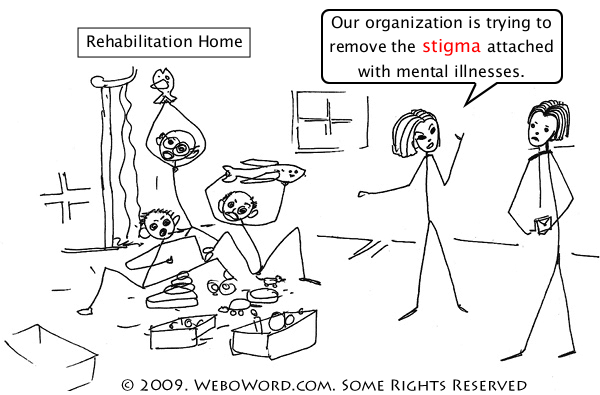
Surely, as this blog post attests, I am not too frightened by the stigma of revealing my illness. It is likely to pass in the next few months and I assume that most of our readers are not particularly judgmental. I am scared, however; when I lose track of conversations. Sometimes even to the point that I choose, as Goffman suggests, to “pass” and keep my lapse of understanding secret. As the ringing in my ear grows: I will often keep quiet, smile, and nod my head. There have been several times in recent memory that I have even forced a chuckle, or a short, daft, answer. Often these replies are deliberately vague, peppered with just enough key words to convince my companion that I was listening. At these times, in my head, I am lost – reeling with confusion. I’m trying to figure out where I am (what street is this, how can I get home quickly?), what has triggered this confusion (is it the noises behind me, or the lights ahead?), and if there is cause to be concerned (is this business as usual, or am I about to faint?). I want, at these moments, to “pass” as normal because I am scared of becoming too much of a burden to those around me. My Achilles’ heel in these situations is contingent on my ability to listen, passing, at least, as a good listener.
 The sense of stigma I imagine, as a bad listener, is infinitely worse than the sense of stigma I could accrue as a sick individual. Goffman, in 1963, had been writing in a late Fordist economy. As such, the stigma of illness related more to physical labor than one’s ability to socialize and fit in. In these context of illness could suggest an inability to produce; the diseased body set apart from all others. As immaterial and affective labor become valorized in new ways, stigma comes to relate to the inter-social processes of control that form the new societal knot. Chief among these stigmas, for myself at least, is the inability to listen. Listening cues others in to how well one is able to socialize, participate, and contribute to a tight web of everyday activities. When I cannot listen, yes, I am vulnerable. I am vulnerable, mostly, because I am suddenly and inexplicably alone.
The worst part of becoming a bad listener is recognizing how very little is required in a conversational exchange. As noted earlier, vagaries and key words are, for the most part, sufficient. Is there a final irony here, while my ability to listen to and understand others is diminished has my ability to listen to and understand myself increased? Many have argued that mimesis, or imitation, is, in fact, central to the way people communicate. “The whole of human culture,” according to Anna Gibbs, “then, is, perhaps, predicated on imitation, in which difference and innovation are as central as reproduction and similarity” (p.202). This notion sends eerie chills up my spine. Bad listening, is, from this perspective, simply an alternative mode of identity. Words come in through the ear, rattle around for a bit in the brain, and then come out of the mouth with sparse changes and a different order. Where difference and innovation can be considered the bi-products of good listening, reproduction and similarity stem from bad listening.
Perhaps bad listening is not all that bad. Gibbs also suggests that mimetic communication, “is the cement of parent-child, peer, friendship, and love relations” (p. 202). When “passing” for normal, I shift gears. I use my listening instincts to further a set of affective and emotional bonds which are equally important to my everyday life. Listening is central to “passing,” but there is a fine distinction between modes of listening. Listening analytically is the practice of listening in order to decipher, decrypt, suggest and parse new ideas from a statement or song. Listening affectively is, then, the binary. Not a mode which drives conversations, and/or innovates, but one which actively seeks to create bonds of comfort, compassion, and support. Listening for timbre, tone, and vibe instead of composition, consistency and argument.
AT


Share this:

#TigerBlood: Charlie Sheen and Affective Listening
 What is going on with Charlie Sheen? Banking almost 1.5 million dollars per episode of Two and a Half Men, there seems to be very little reason for Sheen to say things like: “I am on a drug. It’s called Charlie Sheen. It’s not available. If you try it once, you will die. Your face will melt off and your children will weep over your exploded body,” to 20/20. If extreme quotations like that were not enough, you can connect to the Charlie Sheen Twitter feed for round the clock updates on his inanities. Considering this statement, the key question is not who is listening but instead, who does Charlie think his listeners are? Are these tweets a candid rehearsal of Sheen’s innermost thoughts, or considering Andreas Duus Pape’s recent post, is there a strategic construction of audience within Sheen’s Twitter-mediated performances?
To this question, I shall argue that there definitely is a strategy. Sheen knows that he is being watched, and he knows exactly which of his quotes have the potential to go viral. As Radar Online has noted, Sheen has hired a TweetMaster to manage his Twitter account. The TweetMaster adds hashtags (# symbols which link tweets through keywords) to Sheen’s most potent memes. #TigerBlood, #Winning, #earnyourself and #teamsheen, all brand a series of tweets to Sheen in this cross-platform #twitterwar. If Sheen was as slaphappy as some of his quotes evince, he would not have hired a TweetMaster to manage his tweets nor would it be important to aggregate these points via hashtag in Tweetspace. Charlie Sheen’s recent actions exploit a strategy of spectacle in this notable propaganda campaign.
Building on my previous post regarding the politics of the interior, Sheen’s media blitz works to amplify his voice within the interior space of Twitter. In keeping with the politics of interiority and even a so-called ideology of immanence, Sheen’s quotes can be read as exemplifying the production of positive affect. When Sheen tweets: “fastball. the trolls are foaming from their toothless holes. rumor mill abundant with evil gossip. mainstream heretics smirking,” (3/7/11) he draws on the extreme and fantastic to paint what is ultimately a comical picture. Contrasting the fantastic troll to a space-less rumor mill and also making reference to a nebulous mainstream, Sheen leaves attentive followers confused and bemused. Some might chuckle, connecting the troll/hole reference to a musical skit from an episode of It’s Always Sunny in Philadelphia. Because Sheen relies on such extreme and fantastic images while striking a somewhat fanatical tone, he makes people laugh. Sheen’s humor here can be understood as the production of positive affect in a diffuse and decentralized audience. Sheen’s craft has become so slick that it even made headlines in the news this week.

Sheen’s ability to produce positive affect through talk-radio and Twitter quotes yields a positive strategic position. Because Sheen commands the production of a widespread and diffuse affect, he improves on his own “brand.” Further, as a successful producer of affect Sheen transforms himself into a commodity bar-none. Though he may no longer benefit from his meaty Two and a Half Men revenue stream, he becomes available for countless high paying, low-stress cameos seeking to cash in on Sheen the commodity. Sheen exploits what is common in all audiences, the production of sadness and joy, in doing so he transforms and rebrands himself as celebrity commodity. Ultimately, Sheen’s recent statements are highly strategic, because of them he stands to gain work. Cleverly, he imagines an audience of the common, one that will perceive him as either comic or tragic, joyful or sad. Either way, he wins.
This victory comes at a cost, as audiences laugh at and about Sheen, stereotypes of drug abuse and mental illness stand to replicate along with Sheen’s haphazard quotations. Within this sea of affect, monstrous cultural trends will surely endure. Such is the nature of tigerblood, it is contagious.
AT


Share this:


Current Top Posts





April 2021

January 2020

November 2019

October 2019

August 2019

April 2014

November 2017

March 2015

December 2017

October 2015
 Sounding Out!
Recent Comments