
How not to listen to Lemonade: music criticism and epistemic violence

With the premier last month of Lemonade, her second visual album, Beyoncé didn’t make the world stop so much as she make it revolve: around her, around her work, around black women. For all of the limitations of pop music as a medium (it’s inherently capitalist, for one) and Lemonade’s various feminist strategies (“Formation,” with its “Black Bill Gates” language, can be heard as a black parallel public to white corporate feminism), the album nevertheless re-centered mainstream media attention on black women’s cultural and creative work.
As the conversation about Lemonade revolved around black women and black feminism, two white men pop critics writing for major publications responded with “So What About The Music?” articles. The description to Carl Wilson’s Slate piece asks “But how is it as strictly music?,” and Kevin Fallon’s Daily Beast piece asks both “But is the music any good?” in the title and “But is the music worth listening to?” in the dec. Each time, the “but” sounds like the antecedent to its implied mansplainy consequent “actually…” And just as “but actually” recenters men as authorities and experts, these three questions decenter features prioritized in black women’s pop performance traditions, and in Lemonade itself. As posed in these two articles, the “so what about the music?” question frames “music” so narrowly that it both obscures or at best trivializes what the album does musically. Wilson and Fallon’s essays are good examples of how not to listen to Lemonade.

Borrowed from “Let’s Talk About Sex(ism)” from Twin Geeks
I want to read Wilson and Fallon carefully so we can think about when this question makes for both technically correct and ethically/politically responsible theory and criticism, and when it makes for technically incorrect and ethically/politically irresponsible theory and criticism. My aim here isn’t to argue that Wilson and Fallon are bad people. My focus is the definition or concept of “music” that’s at the heart of the method they use in these two articles (and methods are bigger than individual writers). In more academic terms, I’m asking about research ethics. If, as Wilson’s and Fallon’s articles prove, the “so what about the music?” question can be a power move that establishes the critic’s or theorist’s authority, how can we–especially the mainstream we–ask about the music parts of pop music without making that power move?
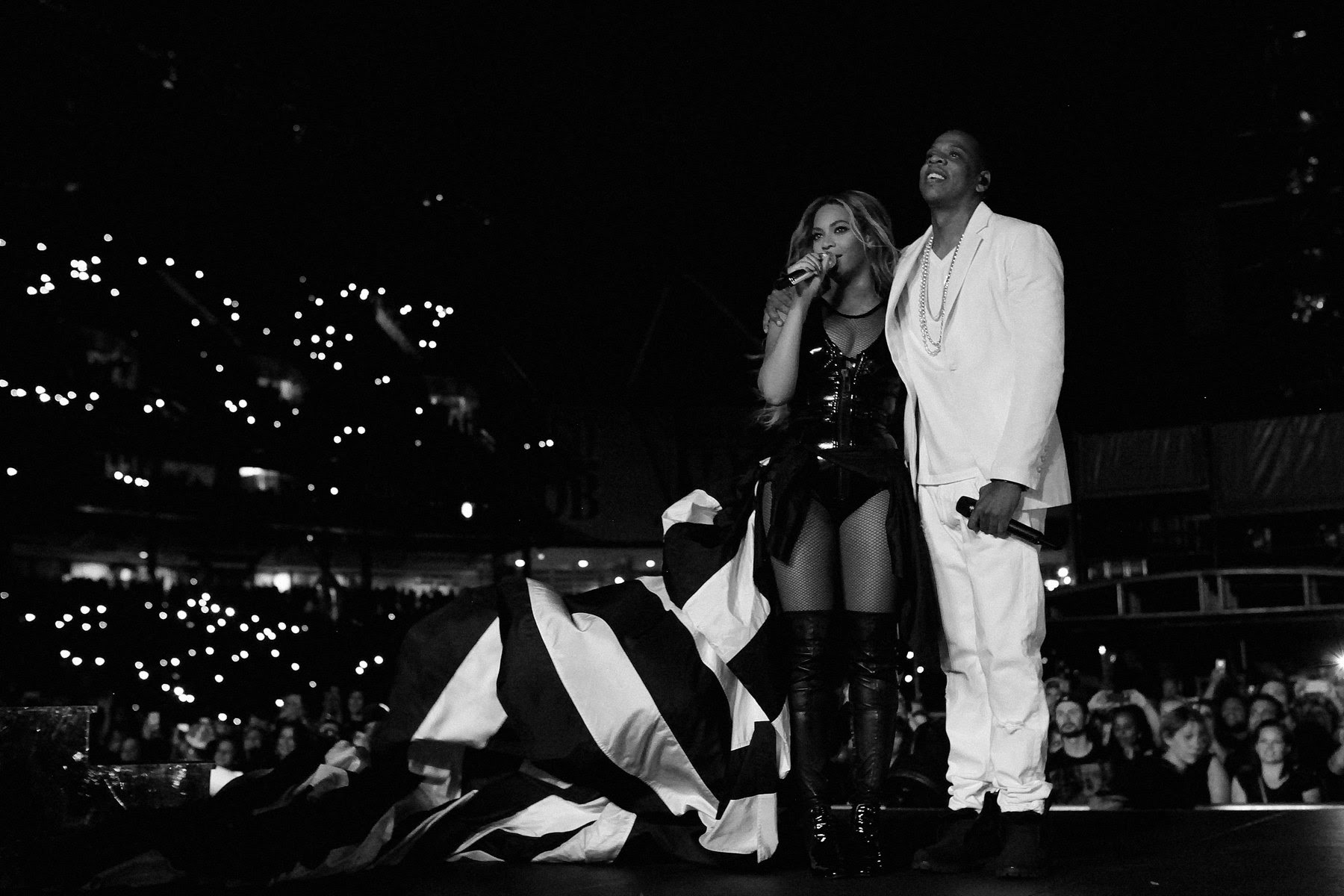 Firstly, both articles apply fairly conventional European fine art aesthetics to the album. Wilson invokes pre-Enlightenment European aesthetics to argue that the “reality show aspect” of the album is somehow aesthetically inconsistent with great pop music. Prior to the 17th century, it was commonly thought that the status of a work’s form or medium ought to correspond to the status of its representational content: painting, the most highly regarded art form, should have subject matter of equal stature–gods and royalty. Wilson’s claim that “the other distraction is the way that the album’s central suite of music interacts with tabloid-style gossip (and a certain elevator video clip) about Beyoncé and her husband Jay Z” echoes that centuries-old sentiment, a sentiment which is about as alien to Lemonade’s aesthetic as, well, Boethius is.
Fallon begins his article with a genuflection to Prince (as does Wilson), scrunches its nose at the gossipy lyrical and narrative content, and then twice scoffs at the very idea of a visual album, “whatever that is,” as though we in the West don’t have precedents for this sort of Gesamtkunstwerky (the total artwork combining music, visuals, and lyrics) thing going back to Wagner and the Florentine Camerata (the collective attributed with inventing opera in the 17th century). He does talk more extensively about the sounds and music than Wilson does, but given the rapid turnaround he also faced, there’s not a lot of close listening to specific musical figures, performances, or compositional techniques, mostly just a survey of the different genres on the album.
Wilson says that the cheating story detracts from the album’s musical quality because it’s an unoriginal narrative:
a drama of jealousy, betrayal, and reconciliation, one of the most ancient and common of human experiences, and of songwriting fodder…that issue of thematic freshness may render some of the songs here less distinctive and invigorating than Beyoncé was.
I find this an odd criticism to level at a pop album, or even an artwork. Nobody would say that West Side Story or Romeo & Juliet were aesthetically diminished because they recycled that tired old theme of jealousy, betrayal, and (failed) reconciliation. Moreover, as Angela Davis argued in Blues Legacies and Black Feminism, these themes of jealousy, betrayal, and reconciliation are the foundation of black feminist pop music aesthetics in a personal-is-political kind of way. Both articles force a contextually incorrect definition of “politics” onto the album, one which sees the most intimate details of relationships, sex, and kinship as merely personal and apolitical. Fallon, for example, says “there’s no doubt that the music on the album is far more personal than it is political.” Both critics fail to consider it in terms established in black women’s pop performance traditions.
Even in Wilson’s attempt to focus strictly on the music, he spends most of the time talking about visuals and lyrics. He hears a wide range of sonic references in Lemonade, from Dolly Parton to Donna Summer to the Lomax recordings to calypso. But he thinks this makes it sound derivative: “as an aural album, Lemonade is a little less fascinatingly singular and eccentric than Beyoncé” (Wilson). Fallon makes an almost identical remark in his article: “Lemonade doesn’t hurl itself toward any genre in a statement of artistry. Instead it masters… um, all of them, but in turn doesn’t make the same powerful statement of Beyoncé’s artistic mission, like her last album did.” Contrast this with the way Jonathan Shecter talks about Diplo’s post-genre eclecticism as “fresh and cutting-edge,” part of an “ongoing artistic evolution.” As philosopher Christine Battersby has argued, the habit of thinking that flexibility is a sign of innovation when attributed to white men, but a sign of regression when attributed to anyone else, is a habit that goes back to the 19th century. It’s not surprising that Beyoncé gets dinged for the same thing that garners Diplo praise: in her case, what Fallon calls “the most daringly genre-hopping music she’s ever produced” is evidence of unoriginality, whereas in Diplo’s case post-genre eclecticism is evidence of his ability to distinctively transcend provincialism. Even when Wilson’s article does manage to talk about sounds and music, it trivializes Beyoncé’s other artistic achievements on the album.
Both articles rely on some gendered and racialized interpretive habits to address the song’s aesthetic value, lyrical content, and Beyoncé’s artistry. But what about their discussion of the music?

“listen” by Flickr user Robyn Jay, CC BY-SA 2.0
These same racialized, gendered habits tune Wilson and Fallon’s listening and mask the sonic dimensions of Lemonade that don’t fit their narrow concept of music. Both critics make a conceptual move that separates musical practice from black feminist practice. Fallon uses some parentheses and a “but…?” question to put rhetorical and grammatical space between Lemonade’s black femininity and its musical and sonic features: “(By the way, it’s powerful, and feminist, and unapologetically black, and transfixing, and gorgeous, and assured, and weird, and confusing, and dumb, and groundbreaking.) But hey: Is the music any good?” This framing defines “the music” as something distinct and independent of the album’s black femininity, as though black women’s and black feminist musical traditions didn’t infuse the album’s music…or, to the extent they do, they don’t count as “music.”

“Listening” by Jens Schott Knudsen, CC BY-NC 2.0
Wilson makes an identical move. Following the white liberal feminist aesthetics that influence lots of contemporary post-feminist pop, Wilson’s piece locates treats the black feminist message primarily in the video. “In video form…it’s more evident that [Lemonade] is equally the cyclical story of generations of black women dealing with men and balancing their struggle for R-E-S-P-E-C-T (as well as S-E-X) against the violations and injustices of race and gender.” He sees the politics in the visuals, but doesn’t consider the sounds as having anything to say or do about that story and that struggle.
This approach isn’t limited to well-meaning but ignorant white men pop critics: even bell hooks’ now (in)famous essay on Lemonade looks at but doesn’t listen for its politics. She argues that it is a “visual extravaganza” whose “radical repositioning of black female images does not truly overshadow or change conventional sexist constructions of black female identity.” Locating the politics entirely in Lemonade’s visuals, hooks’s essay treats black feminism as something contested solely in terms of images. (And divorcing the images from the sounds fails to consider the fact that the sounds impact how viewers interpret what they see.)

Screenshot from Lemonade
This is the wrong method to use for thinking about Lemonade and Beyoncé’s work as a whole (and pop music in general). Sounds on this album don’t operate independently of black femininity, black women’s performance traditions, or individual artists’ black feminist politics. On the one hand, thinking with Daphne Brooks and Regina Bradley, it’s more accurate to say that Beyoncé’s sound game has generally led the way and been more politically cutting-edge than her visual game. On the other hand, sound can also be what does the heavy lifting for patriarchy and other systems of domination, as I argue here. Separating the music itself out from the political content misrepresents what music is and how it works. And it is a particularly gendered misrepresentation: critics are not so eager to separate Kendrick’s sounds from his politics. In both white and black philosophical traditions, dominant concepts of politics and the political are normatively masculine (just think about the gendered public/private distinction, for example), so from these perspectives feminine and feminized sounds don’t feel or seem “political.”
But in these two cases the divorce between music and politics is also what lets white men pop critics have authority over black feminist music. If they can distill Lemonade down to its “solely musical” aspects, then they can plausibly present themselves as experts over generic, depoliticized sound, sounds disconnected from knowledges and values tied to particular lived experiences and performance traditions. Problem is, in the same way that there is no generic ‘person’ without a race or a gender, there is no generic, depoliticized sound. As Jennifer Stoever has argued, even though Western modernity’s occularcentric epistemology obscures the sonic dimensions of white supremacist patriarchy and the subaltern knowledges developed under it, sounds nevertheless work politically. Digging deep into the music on Lemonade or any other pop song does not involve abstracting the music away from every other aspect of the work and its conditions of production. Digging deep into the music part of pop music means digging deeper into these factors, too.
When Regina Bradley, Dream Hampton, Laur M. Jackson, Zandria Robinson, and Joan Morgan talk about how Lemonade makes them feel, what affects and knowledges and emotions it communicates, they are talking about the music–they just work in a tradition that understands music as something other than ‘the music itself’ (that is, they don’t think music is abstracted away from visual and cultural elements, from structures of feeling common to black women with shared histories and phenomenological life-worlds). As I have tried to show in my own work, the sounds and musical performance are central to Beyoncé and Rihanna’s work because they engage traditions of black women’s and black feminist knowledges. Aesthetic practices develop and emerge as types of implicit (i.e., non-propositional or non-verbal) knowledge, knowledge created in response to lived experiences in a particular social location. Aesthetic practices can communicate and perform knowledges that reinforce systems of domination, and they can also communicate and perform subordinate knowledges that map out strategies for survival amid domination. Dominant institutions (like the music industry) and people from dominant groups (like Iggy Azalea or Eric Clapton) separate the aesthetic practice from the implicit knowledges that make it meaningful, and thus neutralize those knowledges and make the aesthetic practice fungible and co-optable. Talking about “the music itself” or “solely music” does the same thing: it is a form of what philosophers call epistemic violence.

Screenshot from Lemonade
So, asking “but what about the music?” is a way to dig into those implicit knowledges to show where much of this epistemic work is happening. And that’s good analysis that isn’t (necessarily) epistemically violent. It demonstrates what Stoever calls “an ethical responsibility to hear African American cultural production with…assumptions about value, agency and meaning” (31) that are appropriate to them. But you can also ask “but what about the music?” in a way that abstracts away from these implicit knowledges. That’s what Wilson’s and Fallon’s pieces do, and that’s why they’re both epistemically violent and objectively poor methods of musical interpretation. But we can and do better when we write about and theorize the music part of pop music. And, to riff on Mariana Ortega’s argument in her article on the type of epistemic violence she calls “loving, knowing ignorance,” doing better means listening to and with black women, black women’s music, and black feminist aesthetics. You can’t divorce music or listening from politics; listening better can and will follow from practicing more just politics.
—
Robin James is Associate Professor of Philosophy at UNC Charlotte. She is author of two books: Resilience & Melancholy: pop music, feminism, and neoliberalism, published by Zer0 books last year, and The Conjectural Body: gender, race and the philosophy of music was published by Lexington Books in 2010. Her work on feminism, race, contemporary continental philosophy, pop music, and sound studies has appeared in The New Inquiry, Hypatia, differences, Contemporary Aesthetics, and the Journal of Popular Music Studies. She is also a digital sound artist and musician. She blogs at its-her-factory.com and is a regular contributor to Cyborgology.
—
 REWIND!…If you liked this post, you may also dig:
I Been On: BaddieBey and Beyoncé’s Sonic Masculinity-Regina Bradley
Listening to Sounds in Post-Feminist Pop Music-Robin James
Of Resilience and Men: How Bieber, Skrillex, and Diplo Play with Gender in “Where Are Ü Now”-Justin Burton
Share this:

Listening to Sounds in Post-Feminist Pop Music
Some of the most popular early 21st century feminist approaches to pop culture are rooted in a collapse of visual and aural representations. For example, though Disney princesses have become visibly more diverse and realistic, linguists Carmen Fought and Karen Eisenhauer have compiled data showing that women characters in Disney princess films speak less in films released between 1989-1999 than they did in films released in the 1930s-1950s. Writing in Noisey in 2015, Emma Garland wonders whether we “have created an environment in which female artists are being judged only on their feminism.” Both in her own analysis and in the thinkpieces she references, that judgment addresses the verbal content of song lyrics or artists’ public statements and the visual content of music videos. Noting that “a lengthy Google search will drag up hundreds of editorial pieces about the [Rihanna’s] ‘BBHMM’ video” (The Guardian alone hosts six), but barely any reviews of the actual song, Garland illustrates just how much feminist analysis of pop music skews to the visual and away from sound and music. Popular post-feminist analysis focuses on the visual and verbal because of the influence of law and legal theory on 20th century American feminism. However, in post-feminist pop, the sound lets in the very same problems the lyrics and visuals claim to have solved.
“filming of the HTML music video” by Flickr user MadLab Manchester Digital Laboratory, CC BY-SA 2.0
In her article “Liberal Feminism From Law To Art,” L. Ryan Musgrave argues, “many early feminist accounts of how art is political depend largely on a distinctly liberal version of politics” (214). This is a classical contractarian liberalism where “equality meant equality before the law…[and] democratic representation in a state” (214). Legally, these principles inform foundational liberal values like freedom of speech (e.g., the First Amendment to the US Constitution) and equality of opportunity (e.g., the Fourteenth Amendment to the US Constitution). 20th century feminist artists and art scholars translated these legal principles into ideas about how art should be made and interpreted. According to Musgrave, the political principle of free speech is translated into an aesthetic principle of “free expression…we should celebrate in order to be inclusive, straightforward expressions of either one’s individual experience or one’s identity as a member of an historically disenfranchised group” (223). This type of feminist aesthetics sought to counter the tendency to silence, ignore, trivialize, and censor women’s art.
In pop music, liberal feminism informs discussions of the marginalization of women artists in a particular genre, or celebrations of women’s self-expression, like ‘90s “girl power” and “revolution girl style now” aesthetics. As an aesthetic principle, equality of opportunity manifests as a two-pronged commitment to non-exploitative modes of production and to representational accuracy: women should not be objectified by or excluded from artistic practice, and they should be truthfully, realistically depicted in art (Musgrave 220). Pop and hip hop feminisms often appeal to this type of feminism, generally in discussions of women’s bodies: were women objectified in the video-making process? Do they appear on screen only as objects? Do the images of women accurately depict “real” women, or are they unrealistic images of too-thin, too-blonde ideals?
With its commitments to free speech and equality of opportunity, mainstream Anglo-American feminist aesthetics translates liberalism’s concept of political representation into a concept of aesthetic representation. The outcome of this translation is a “realism focused on the content of artworks” (Musgrave 223; emphasis mine) and “the conviction that it is the job of art or creative work to get it right, to show how it ‘really’ is, to come clean of previously incorrect and ideologically weighted images” (226). A feminist aesthetics focused primarily on the representational content of artworks and the subjectivity (or objectification) of artists translates classical liberalism’s ideas of what politics, injustice, and equality are into artistic terms.
Meghan Trainor’s infamous “All About That Bass” and “Dear Future Husband,” Lilly Allen’s “Hard Out Here,” and even Usher’s “I Don’t Mind” are recent examples of songs that trade in equality of opportunity-style liberal feminism. For example, “All About That Bass” and “Hard Out Here” address a disjoint between how women are portrayed in the media and how they “really” look. “Dear Future Husband” and “I Don’t Mind” are about (partnered, heterosexual) women’s entitlement to work, even sex work. Both of these approaches share the underlying assumption, drawn from liberalism, that art re-presents reality in the same way a vote re-presents a citizen’s will or an elected representative re-presents the will of their constituents: accurately and truthfully, in the sense of truth as correspondence between statement and fact, signifier and signified.

“In Her World” by Flickr user Nana B Agyei, CC BY 2.0
Within a liberal feminist framework, sound can only be political if it has a representational content that depicts or expresses a subject’s voice or identity. This is why post-feminist approaches to pop music overlook sound and music: requiring attention to things like formal relationships, pattern repetition and development, the interaction among voices and timbres, and, well, structure, they don’t fit into liberalism’s understanding of what politics is and how it works. But because the music part of Anglo-American pop music always does more than this, it has political effects that this liberal feminist framework can’t perceive as political, or as having to do with gender (or race).
This can be both a good thing and a bad thing. On the one hand, this emphasis on the visual to the exclusion of sound opens a space for radical and subcultural politics within the mainstream. For example, as Regina Bradley has argued here at Sounding Out!, Beyoncé uses sound to move outside the politics of respectability that her visual image often reinforces. On the other hand, it creates a back door through which white supremacist patriarchy can sneak in. This is the same back door that all liberalisms have, the back door that lets substantive inequality pass as equality before the law and/or the market (Falguni Sheth, Charles Mills, and Carole Pateman talk extensively about this).
Popular post-feminist pop refers back to liberal aesthetics in order to establish its “post-”ness, that is, to show that the problems liberal feminism identified are things in its and our past. For example, inaccurate representation and objectification or silencing are precisely the things that the contemporary pop examples I cited claim to have fixed: Trainor and Allen accurately represent “real” women, and Usher’s song talks about a stripper as an empowered (near) equal rather than an object. However, the sounds in these songs tell different stories; they make white supremacist patriarchy entirely present.
Usher’s “I Don’t Mind” uses sound to straighten out some of the ratchetness in hip hop sexuaility. L.H. Stallings’s “Hip Hop & the Black Ratchet Imagination” argues that
the strip club genre and the hip hop strip club also develop as a result of the unacknowledged presence of black women with various gender performances and sexual identities within the club, on stage and off, whose bodies and actions elicit new performances of black masculinity. Moreover, when woman is undone in this way, we note the potential for such undoing to temporarily queer men.” (138)
Though it’s conventional to see women strippers and their male rapper audience in terms of heterosexual desire and normativity, the dancers’ use of black dance performance traditions and aesthetics displace scripts of femininity and put their bodily gender performance in transition. And because “this is what rappers get caught up in–the fantasy of woman whose origin is in the female dancers’ undoing of woman,” (138), this fantasy also undoes them as “men.” The dancers’ performances are a type of “corporeal orature” (138) that puts outwardly heteropatriarchal gender and sexuality in transition, bending it away from respectability (the reproduction and transmission of wealth, property, and non-deviance qua whiteness) and toward ratchet.
The booty clap synth patch is one way this corporeal orature gets translated into sounds. It’s a particular variation on the hand-clap drum machine sound, and it translates the “booty clap” dance move and the rhythm of twerking into music. Following the dancers’ rhythm, the patch is usually used in a four-on-the-floor pattern, as for example in Juicy J’s “Bandz A Make Her Dance.” Featuring Juicy J as the misogynist foil to Usher’s progressive nice guy, “I Don’t Mind” is easy to hear as a direct response to “Bandz.” Like “Bandz,” “I Don’t Mind” is a song about men’s desire for strippers. However, “I Don’t Mind” straightens that desire out and classes it up by rewriting–indeed, erasing–the corporeal orature translated into the 4/4 booty-clap synth rhythm. Throughout “I Don’t Mind” that same synth patch is used on beats 2 and 4; it takes a “ratchet” sound and translates it into very respectable, traditional R&B rhythmic terms. Sound is the back door that lets very traditional gender and sexual politics sneak in to undermine some nominally progressive, feminist lyrics.
Sound plays a similar role in much of Meghan Trainor’s work. In “Dear Future Husband,” she sings apparently feminist lyrics about economic and sexual empowerment over do-wop, a backing track that sounds straight out of an episode of Happy Days (a 1970s TV program about 1950s nostalgia). Similarly, “All About That Bass” puts lyrics about positive body image over a very retro bassline that has more in common with the bassline in the theme song to David Simon’s New Orleans series Treme than it does with the bass in either Iggy Azalea’s “Black Widow” or Jessie J’s “Bang Bang”—two of the other singles consistently in the top five slots during “All About That Bass’s” weeks-long dominance of the Billboard Hot 100 in fall 2014.
Especially after the success of 2014’s “Uptown Funk” by Mark Ronson and Bruno Mars, this retromania isn’t unusual. But few pop songs look back as far as these post-feminist songs do, to the 1950s and even earlier. Appealing to pre-Civil Rights era sounds, these songs double down on the racialized sexual normalcy of white women’s performances of post-feminist empowerment. “Dear Future Husband,” “All About That Bass,” and “Marvin Gaye” (Trainor’s collaboration with Charlie Puth) all take rhythms, timbres, and genre conventions appropriated from black pop music, but which have, over half a century, been assimilated to bourgeois respectability. They recall Grease more so than Little Richard.

“Vintage Sindy Record Player” by Flickr user
Tai O’Leary, CC BY 2.0
For example, James Shotwell describes “Marvin Gaye” as taking “an innocent approach to talking about sex, with accompaniment that is straight out of your grandma’s favorite sock hop memories…Just like how Mark Ronson and Bruno Mars have made a mint in recent years with a revitalization of funk ethos, Meghan Trainor and Charlie Puth are now doing the same for pop, only with less risk.” “Marvin Gaye” sounds less sexually risky because it recalls what, for whites, was a more racially “innocent” time, a pre-Civil Rights era when white ears could more easily avoid the sounds of black radical politics in either James Brown’s funk or Gaye’s soul. In “Marvin Gaye,” old-school sounds evoke a time when society was organized by the same sort of comparatively simple racial politics that organize the song itself. For example, its bridge follows the trap convention of using a male-chorus “Hey!” on the 2 and 4 of every measure. Its verses, however, put that same “Hey!” patch only on 4. Sounds evoke racial non-whiteness to generate tension, but then resolve that tension sonically. Definitive sonic resolution shuts down the transitional effect ratchet sounds, like those heard in the bridge, can have on sexuality and gender.
In “Marvin Gaye” and the other retromanical post-feminist pop songs, sounds do the white supremacist patriarchal work the lyrics and videos claim to have progressed past. Even though these women’s speech and appearance are outside the bounds of traditional femininity, the sounds reassure us that this newfangled gender performance isn’t racially and sexually deviant, that it isn’t “ratchet” in Stallings’ sense. Using liberalism to define the paramaters of political (in)justice, contemporary post-feminist aesthetics focus our attention and effort on verbal content and visual mimesis; this creates an opening for sound and music to either destabilize or double down on normative gender, sexual, and racial performance. As the “Marvin Gaye” example shows, this opening is an essential component of neoliberal post-feminism: sound recodes white women’s transgressions of traditional femininity as racially and sexually normal.
—
Featured image: “mannequin head on concrete with headphones” from Flickr user J E Theriot, (CC BY 2.0)
—
Robin James is Associate Professor of Philosophy at UNC Charlotte. She is author of two books: Resilience & Melancholy: pop music, feminism, and neoliberalism, published by Zer0 books last year, and The Conjectural Body: gender, race and the philosophy of music was published by Lexington Books in 2010. Her work on feminism, race, contemporary continental philosophy, pop music, and sound studies has appeared in The New Inquiry, Hypatia, differences, Contemporary Aesthetics, and the Journal of Popular Music Studies. She is also a digital sound artist and musician. She blogs at its-her-factory.com and is a regular contributor to Cyborgology.
—
 REWIND! . . .If you liked this post, you may also dig:
Love and Hip Hop: (Re)Gendering The Debate Over Hip Hop Studies–Travis Gosa
SO! Amplifies: Mega Ran and Sammus, The Rappers With Arm Cannons Tour–
Share this:


Current Top Posts





April 2021

January 2020

November 2019

October 2019

August 2019

April 2014

November 2017

March 2015

December 2017

October 2015
 Sounding Out!
Recent Comments